August 13, 2026
When Grade Becomes the Story: The Geology Behind New Zealand's Most Anticipated Gold Revival
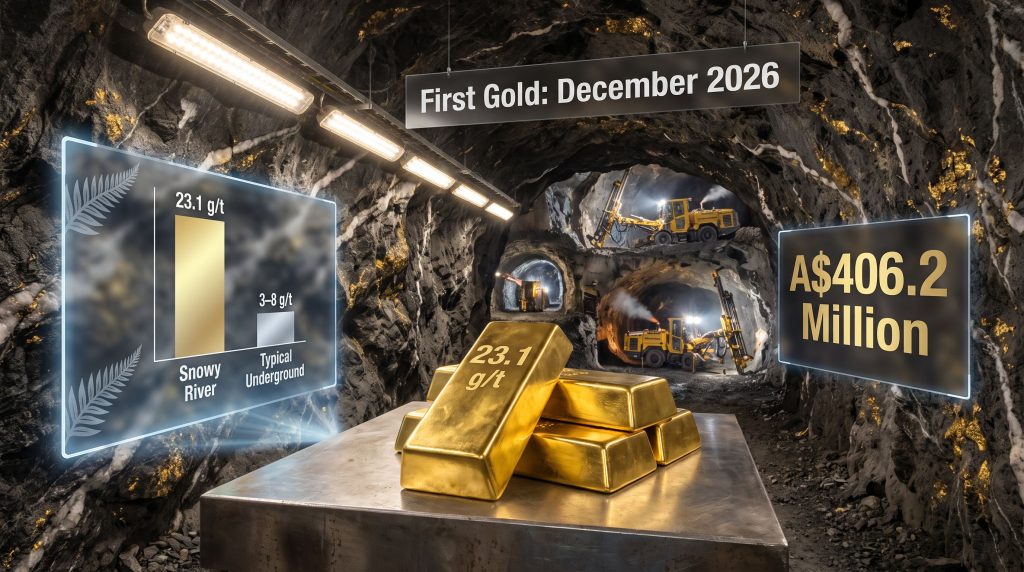
In underground gold mining, grade is everything. A deposit grading 3 grams per tonne can sustain a viable operation. One grading 6 grams per tonne attracts serious institutional attention. But when a resource grades at 23.1 grams per tonne, it enters a category so rare that it redefines how investors, operators, and geologists think about an entire jurisdiction.
That is precisely the situation unfolding near Reefton on New Zealand's South Island, where Endura Mining has formalised a A$406.2 million, five-year underground mining contract with ASX-listed Macmahon Holdings. The deal, which marks the operational activation of the Snowy River gold project, is built on a geological foundation that most mining projects simply cannot replicate. The decision by Endura awards Macmahon Snowy River gold mine contract status as one of the most significant underground commitments in the region's recent history.
Understanding why this contract matters requires starting underground, not in a boardroom.
When big ASX news breaks, our subscribers know first
The Birthday Reef: A Geological Anomaly With a Century-Long Track Record
Not all gold reefs are created equal. Most quartz-vein systems exhibit grade variability across their strike length, meaning the ore quality fluctuates significantly as miners advance along the reef. This unpredictability inflates costs, complicates mine planning, and introduces production risk.
The Birthday Reef, which forms the backbone of the Snowy River project, is an exception to this pattern. Mined continuously across an estimated 1 kilometre strike horizon during the early twentieth century, this quartz-vein system developed a reputation within geological and mining circles for a level of grade consistency that is rarely observed globally. According to Endura Mining, the Birthday Reef remains regarded as one of the richest and most consistently graded gold reefs identified anywhere in the world.
The underlying rock at Snowy River sits atop the former Blackwater mine, a historic operation that extracted approximately 733,000 ounces of gold between 1906 and 1951. Blackwater's two shafts were sunk to depths of 800 metres, a considerable engineering achievement for the era, which speaks to how economically compelling the orebody was considered even with the technology and gold prices of that period.
What the Numbers Tell Us About Ore Quality
To appreciate how exceptional the Snowy River resource profile is, consider where it sits relative to global benchmarks:
| Metric | Snowy River | Global Underground Average |
|---|---|---|
| Resource Grade | 23.1 g/t | 3 to 8 g/t |
| Reserve Grade | 6.03 g/t | 2 to 5 g/t |
| Contained Gold Reserves | 244,000 oz | Varies widely |
| Resource Tonnage | ~800,000 tonnes | Varies widely |
| Underground Tunnels Established | 3+ km | Project-dependent |
| Drill Metres Completed | 30+ km | Project-dependent |
The divergence between the resource grade of 23.1 g/t and the reserve grade of 6.03 g/t is a technical nuance worth understanding. Reserve grades apply conservative economic cut-offs and dilution factors that reflect actual mining conditions, while resource grades reflect the broader geological endowment before those practical adjustments are applied. Both figures at Snowy River remain well above industry norms.
Furthermore, the cut-off grade parameters applied to a system of this calibre are markedly more favourable than those applied at lower-grade operations, directly improving the proportion of material that qualifies as ore.
One of the less commonly understood aspects of this project is that the bulk of the 30+ kilometres of drilling programs was conducted from within the existing underground tunnel network rather than from surface. Underground drill positions allow for tighter, more precise intersection of a narrow-vein system like the Birthday Reef, reducing positional error and improving confidence in grade continuity estimates.
This approach is technically superior for narrow high-grade veins and provides a more reliable basis for resource estimation than equivalent surface drilling. In addition, the definitive feasibility study outcomes were underpinned by this high-confidence underground data, lending greater credibility to the project's published reserve and production estimates.
The A$406 Million Contract: What Endura Awards Macmahon Snowy River Entails
The decision by Endura to award Macmahon the Snowy River gold mine contract reflects a deliberate choice to partner with an operator possessing specific underground credentials rather than simply selecting the lowest-cost tender. For context on how favourable conditions are for this kind of investment, the current gold price outlook has made high-grade underground assets particularly attractive to institutional capital globally.
Full Contract Breakdown
| Parameter | Detail |
|---|---|
| Contract Value | A$406.2 million |
| Contract Term | Five years |
| Operator | Macmahon Holdings (ASX-listed) |
| Client | Endura Mining (formerly Federation Mining) |
| Scope | Mine development, production drilling, backfill operations |
| Operations Commencement | October 2026 |
| First Gold Target | December 2026 |
| Annual Production Target | 50,000 to 60,000 ounces |
| AISC Target | A$2,400 per ounce |
| Projected Mine Life | 10+ years |
| Workforce at Full Capacity | 250+ employees |
The backfill component of the contract scope is particularly relevant from a geotechnical perspective. In high-grade narrow-vein underground mines, paste or hydraulic backfill is used to fill mined-out stopes, providing structural support and allowing adjacent ore panels to be safely extracted. Without competent backfill operations, mines of this type face increased ground control risk and reduced ore recovery. Its inclusion in the contract scope signals a technically rigorous approach to mine design.
Why Macmahon's Re-entry Into New Zealand Is Significant
Macmahon's previous New Zealand underground experience came from its work at Newmont Mining's Waihi gold mine, an operation it departed in 2015. That background means the company understands New Zealand's specific regulatory environment, workforce culture, and underground operating conditions. A contractor re-entering a jurisdiction after more than a decade is making a deliberate strategic bet, and the A$406 million commitment confirms the depth of Macmahon's confidence in the project's economics.
Macmahon's CEO Michael Finnegan described Snowy River as a high-grade underground gold project being developed to become one of New Zealand's most significant gold operations, and framed Endura's leadership team and growth strategy as key factors behind the company's decision to engage.
The Capital Stack: How Endura Funded a Mine Without Relying on Debt Alone
A critical but underappreciated dimension of the Snowy River story is its financing structure. In November 2025, Endura secured A$150 million in equity funding to advance project development, including the construction of a gold processing plant capable of supporting the targeted production profile.
Equity-funded mine builds are increasingly preferred by institutional investors over project-level debt arrangements, particularly in gold markets where commodity price volatility can compress margins on leveraged development assets. The A$150 million raise, followed by the formalisation of a A$406 million contractor commitment, creates a capital structure where execution risk is distributed between the company and its contracted operator rather than concentrated in a debt repayment obligation.
This financing approach also has implications for how future cash flows are allocated. With a targeted AISC of A$2,400 per ounce and gold prices trading materially above that level in 2025 and 2026, the project's operating margins create room for debt service if project-level financing is layered in at a later stage, while preserving equity upside for shareholders in the near term.
Leadership Calibre as a Proxy for Institutional Confidence
Jake Klein's appointment as Executive Chair of Endura Mining carries weight that extends beyond a biographical footnote. As the former CEO of Evolution Mining, Klein oversaw the transformation of that company from a small-cap gold producer into one of Australia's largest gold companies by market capitalisation. His track record demonstrates an ability to allocate capital efficiently across multi-asset gold portfolios, manage operating costs, and navigate the regulatory complexities of Pacific region mining.
Klein characterised Macmahon's appointment as a pivotal milestone on Snowy River's path toward gold production, emphasising the contractor's safety culture and its proven capability in delivering technically complex underground projects.
For institutional investors, leadership pedigree functions as a risk mitigant. When a management team has built and operated large-scale gold mines before, the probability of execution failure on a project of Snowy River's scale decreases materially. This is a factor that sophisticated capital allocators assess before committing to equity raises of the size Endura achieved.
What Snowy River Signals for New Zealand's Investment Attractiveness
New Zealand mining exploration has historically attracted less capital than comparably endowed jurisdictions in Australia, Canada, or parts of Africa, despite the country's significant geological endowment, mature regulatory frameworks, and stable political environment.
Snowy River's emergence as a fully funded, contractor-backed project with institutional-grade leadership challenges that historical underinvestment narrative. However, several dynamics are worth noting:
-
The combination of a A$150 million equity raise and a A$406 million contractor commitment totals over A$550 million in committed capital directed at a single New Zealand gold asset, an unusual concentration of private capital in this jurisdiction.
-
The West Coast region of the South Island has a mining heritage stretching back to the 1860s gold rush era, meaning community familiarity with resource development is embedded in the region's social fabric, a factor that can reduce community opposition risk compared to greenfield projects in historically non-mining areas.
-
With more than 250 direct jobs expected at full capacity, Snowy River represents a meaningful economic stimulus for a region that has faced structural employment challenges over several decades.
High-grade underground gold assets in politically stable, common-law jurisdictions are among the most sought-after investment targets in the current gold market cycle. Snowy River's project economics, combined with the calibre of its sponsors and operator, position it as a benchmark for how New Zealand's resource sector can compete for global capital.
The next major ASX story will hit our subscribers first
Project Timeline: Key Milestones From Decline to First Pour
| Milestone | Timing |
|---|---|
| Twin decline development commenced | 2021 (as Federation Mining) |
| 3km+ underground tunnel network established | Pre-2025 |
| 30km+ drill programme completed underground | Pre-2025 |
| A$150 million equity funding secured | November 2025 |
| Macmahon contract awarded | August 2026 |
| Underground development and production operations commence | October 2026 |
| First gold production targeted | December 2026 |
| Full operational capacity projected | 2027 |
The timeline is notably compressed. From contract award to first gold, Macmahon has roughly two months of development operations before production is expected to begin. This is only feasible because the groundwork, including the 3km+ of established tunnels and the 30km+ of underground drilling, was completed during the Federation Mining phase between 2021 and 2025. The contract is not starting from a blank canvas.
FAQ: Endura Mining, Macmahon Holdings, and the Snowy River Gold Project
What is the Snowy River gold mine?
Snowy River is a high-grade underground gold project near Reefton on New Zealand's South Island, developed by Endura Mining over the geological footprint of the historic Blackwater mine, which produced approximately 733,000 ounces of gold between 1906 and 1951.
How much is the Macmahon contract worth?
The contract is valued at approximately A$406.2 million over five years, covering underground mine development, production drilling, and backfill operations.
When will Snowy River produce its first gold?
First gold production is targeted for December 2026, with Macmahon commencing operations in October 2026.
What is the annual production target?
Endura is targeting approximately 50,000 to 60,000 ounces per year at an AISC of around A$2,400 per ounce over a mine life exceeding 10 years.
Who leads Endura Mining?
Endura Mining is led by Executive Chair Jake Klein, the former CEO of Evolution Mining, one of Australia's largest gold producers.
Is Macmahon new to New Zealand?
No. Macmahon previously operated at Newmont Mining's Waihi gold mine in New Zealand, concluding that contract in 2015. Snowy River marks its return to underground mining in New Zealand after more than a decade. Consequently, the company arrives with established local knowledge that meaningfully reduces operational ramp-up risk.
How many jobs will Snowy River create?
At full operational capacity, the mine is expected to employ more than 250 people, providing significant economic benefit to the West Coast region of New Zealand's South Island. The full contract announcement outlines additional detail on workforce deployment and fleet requirements for those seeking deeper technical insight.
A Convergence of Geology, Capital, and Operational Expertise
The significance of Endura awards Macmahon Snowy River gold mine contract status cannot be overstated. It represents the operational activation of one of the Southern Hemisphere's most geologically compelling gold assets, backed by an experienced leadership team, a fully funded development pathway, and a contractor with proven underground credentials.
The Birthday Reef's extraordinary grade consistency, validated by over a century of historical production and more than 30 kilometres of modern underground drilling, provides the geological foundation. The A$150 million equity raise provides the financial architecture. And Macmahon's appointment provides the execution capability.
With first gold targeted before the end of 2026, Snowy River is positioned to become a material contributor to New Zealand's gold production profile within months, and a compelling case study for how high-conviction assets in stable jurisdictions attract premium capital when the fundamentals genuinely justify it.
Disclaimer: This article is intended for informational purposes only and does not constitute financial advice. Forecasts, production targets, and financial projections referenced in this article are based on company announcements and are subject to change. Investors should conduct their own due diligence before making investment decisions.
Want to Be First to Identify the Next High-Grade Discovery Like Snowy River?
Discovery Alert's proprietary Discovery IQ model scans ASX announcements in real time, instantly identifying significant mineral discoveries and translating complex geological data into actionable investment insights — explore historic discoveries and their extraordinary returns, then begin your 14-day free trial at Discovery Alert to position yourself ahead of the broader market.