August 13, 2026
The Stranded Asset Opportunity Rewriting Australian Gold Economics
Commodity markets operate in cycles, and few phenomena are as instructive as the revival of mines that were once declared economically dead. Across Australia's resource landscape, a structural shift in gold pricing has fundamentally altered the calculus for dozens of deposits that sat idle for decades — not because the gold was gone, but because the price never justified extraction. Understanding why dormant operations become compelling again requires unpacking the concept of the all-in sustaining cost (AISC) threshold, a figure that determines the minimum gold price at which a project generates positive returns after accounting for mining, processing, administration, and sustaining capital expenditure.
When that threshold sits well below the prevailing market price, formerly stranded assets transform almost overnight into strategic opportunities. The Mount Bundy gold mine revival, located approximately 100 kilometres south of Darwin in Australia's Northern Territory, is one of the clearest expressions of this phenomenon currently unfolding in the Australian mining sector.
When big ASX news breaks, our subscribers know first
Understanding the Price Transformation That Changed Everything
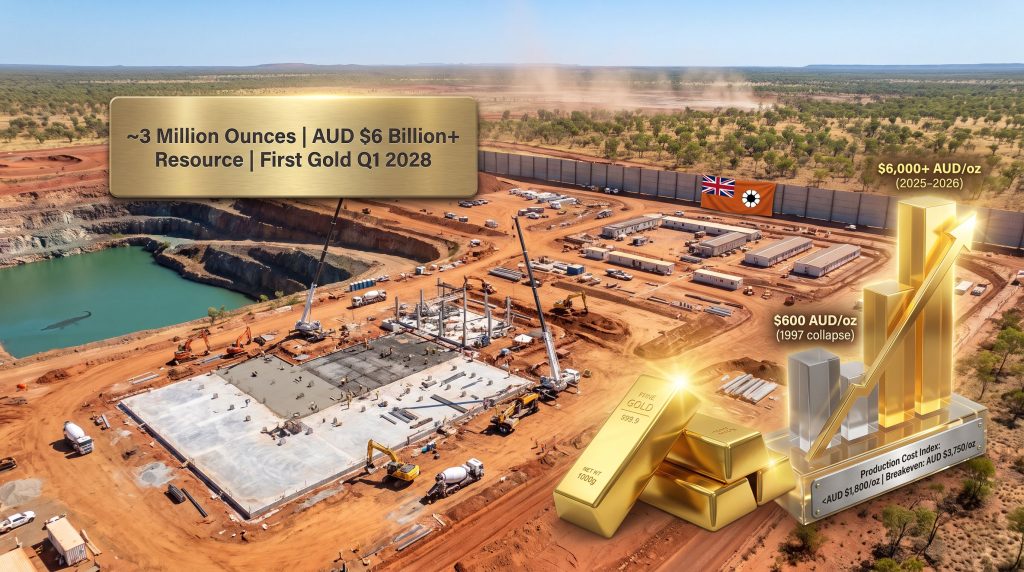
The original Mount Bundy operation ran intermittently across roughly a decade before its financial collapse in 1997. At the time, the AUD gold price hovered around $600 per ounce, a figure that made the deposit's ore grades and cost structure fundamentally unworkable. For nearly three decades, the pits filled with water, the infrastructure rusted, and the resource sat untouched.
What followed was one of the most dramatic commodity price re-ratings in modern Australian mining history. The gold price surge across successive periods tells the story clearly:
| Period | Approximate AUD Gold Price (per oz) | Mount Bundy Status |
|---|---|---|
| Late 1980s to 1997 | ~$500 to $650 | Active, then financially collapsed |
| 1997 to 2020 | $600 to $2,500 | Dormant and mothballed |
| 2020 to 2024 | $2,500 to $4,500 | Feasibility studies and approvals progressed |
| 2025 to 2026 | $6,000+ | Processing plant construction commenced |
This tenfold increase in the AUD gold price did not just make Mount Bundy marginally more attractive. It completely rewrote the project's financial logic. Hanking Gold, the Chinese-financed company that has been developing the project across a 12-year development cycle, reports that its feasibility analysis identifies profitability beginning at a gold price of AUD $3,750 per ounce. With record gold prices trading above $6,000 AUD per ounce in 2025 and 2026, the project sits with a price buffer of more than $2,250 per ounce above its breakeven — an unusually wide margin that provides substantial downside protection rarely seen in junior and mid-tier gold development.
Key Margin Insight: With projected production costs indexed at under AUD $1,800 per ounce for the first decade of operations, and gold trading above AUD $6,000 per ounce, the implied gross margin per ounce exceeds AUD $4,200, placing Mount Bundy among the most cost-competitive gold operations currently entering the Australian production pipeline.
The project's chief development officer has stated publicly that the movement in gold prices across recent years has dramatically increased margins and made it significantly easier to attract investment and financing at the scale required to build an operation of this complexity. This observation reflects a broader industry truth: gold price momentum does not just improve project economics in isolation — it reduces financing risk, compresses the cost of capital, and accelerates timelines.
What the Mount Bundy Gold Project Actually Involves
A Multi-Deposit Operation With Decades of Geological History
Mount Bundy is not a single pit operation. The project encompasses three distinct former mining areas: Rustlers Roost, the Quest 29 open-cut, and the Tom's Gully underground workings. Each brings a different ore type and extraction methodology to the overall production profile, which is an important consideration for understanding why the project's cost structure is relatively efficient.
The combination of surface and underground extraction is central to the economics. Open-cut mining at Rustlers Roost and Quest 29 targets lower-grade but accessible ore bodies that can be processed at scale and with lower per-tonne mining costs. Tom's Gully, by contrast, involves high-grade underground ore that delivers stronger gold content per tonne, compensating for the higher extraction costs typical of underground operations.
This dual-mode approach allows the processing plant to blend feed grades and maintain consistent throughput — a technique that optimises plant utilisation and reduces the per-ounce processing cost over time. Furthermore, the approach mirrors strategies employed at other large-scale Australian operations, such as the Tanami gold mine expansion, where multi-faceted extraction methodologies underpin long-term cost efficiency.
Resource Scale and Development Timeline
Hanking Gold's 12-year involvement has not simply been a holding exercise. Through sustained exploration and resource definition drilling, the company has grown the estimated gold resource from approximately 1 million ounces to approximately 3 million ounces. At prevailing gold prices, the company values the total resource at more than AUD $6 billion, a figure that places the project firmly in the tier of significant long-life Australian gold assets.
The key project metrics at a glance:
| Metric | Estimated Figure |
|---|---|
| Total gold resource | ~3 million ounces |
| Resource value at current prices | >AUD $6 billion |
| Projected mine life | 17 to 20+ years |
| Average annual production (estimated) | 135,000+ ounces |
| Full-time operational jobs | ~300 |
| Project capital value | ~AUD $412 million |
| Production cost index (first 10 years) | <AUD $1,800 per ounce |
| Feasibility breakeven price | AUD $3,750 per ounce |
| First gold target | Q1 2028 |
Management has expressed confidence that further resource drilling will extend the operational life beyond the current 17-year mine plan to more than 20 years — a projection that hinges on converting inferred resources at depth around the existing deposit footprints.
The Regulatory Journey: A Decade of Approvals
One of the least-discussed but most strategically significant dimensions of the Mount Bundy gold mine revival is the length and complexity of its regulatory pathway. Projects of this scale in environmentally sensitive NT locations do not receive approvals quickly, and the multi-year timeline reflects the genuine complexity of operating near sensitive ecosystems.
The key milestones in sequence:
- 2020: Tom's Gully underground mine component receives environmental approval from relevant authorities.
- 2022: The Northern Territory Government grants Mount Bundy major project status, a classification that provides a structured coordination framework for the project's dealings with government agencies, though this does not constitute financial or direct operational support.
- 2023: Environmental approval granted for the Rustlers Roost and Quest 29 open-cut redevelopment components.
- 2026: Construction of the new processing plant formally commences, with a sod-turning ceremony attended by Hanking Gold executives. A 400-bed worker accommodation camp is simultaneously under construction.
The processing plant construction contract, valued at AUD $30 million, has been awarded to Perth-based contractor CPC Engineering, whose chief executive has noted that Australia's current gold construction pipeline — including approximately ten gold plants in design or active construction in Western Australia alone — is generating a strong pipeline of work for Australian engineering firms.
Environmental Complexity: Cyanide Management and an Unusual Ecological Challenge
Tailings Management and Water Treatment Standards
Gold processing operations that use cyanide leaching to extract gold from crushed ore are subject to strict environmental licence conditions in Australia. At Mount Bundy, those conditions include maintaining cyanide concentrations in the tailings facility at an average of no more than 20 parts per million (ppm) — a threshold considered environmentally safe under Australian standards.
The management system installed to meet these requirements includes several layers:
- A dedicated detoxification circuit within the tailings management system that treats material before any discharge occurs.
- A closed-loop water reclamation system that captures all water running off the tailings dam and reprocesses it back through the plant, preventing any cyanide-bearing water from reaching the surrounding environment.
- A purpose-built AUD $3 million water treatment plant already constructed on-site, operational ahead of mining activities commencing.
These investments signal a recognition that environmental compliance is not merely a box-ticking exercise in the current regulatory climate. The cost of non-compliance, both financially and reputationally, would far exceed the capital invested in prevention.
The Crocodile Problem: An Ecological Complication With No Industry Parallel
Perhaps the most distinctive operational challenge facing the Mount Bundy gold mine revival has nothing to do with metallurgy or geotechnical engineering. During the nearly three decades the pits sat idle, they filled with water and, given the site's proximity of approximately 10 kilometres to the Mary River system — one of Australia's most densely crocodile-populated waterways — the flooded legacy pits became crocodile habitat.
Before open-cut mining can recommence, Hanking Gold must drain those pits and safely remove the crocodiles that have established themselves there. This is not a trivial logistical exercise. It represents a legally required component of the project's environmental licence conditions and has no direct parallel in any other currently active Australian gold mining operation.
Operational Note: The requirement to manage crocodile relocation from flooded pit infrastructure reflects the mine's sensitive ecological position and serves as a reminder that dormant mine reactivation carries legacy environmental obligations that no amount of financial modelling can fully anticipate in advance.
Three Scenarios for Mount Bundy's Production Future
Investors and industry observers examining this project should understand that its long-term success is not guaranteed regardless of how compelling the current gold price environment appears. A structured scenario analysis reveals where the genuine risks and opportunities lie.
Scenario 1: Base Case at Sustained Gold Prices Above AUD $5,000
If AUD gold prices remain above $5,000 per ounce through the late 2020s, the project produces on schedule from early 2028, achieves first-year profitability as projected, and ramps to full annual production of 135,000 ounces or more. Resource extension drilling converts inferred resources, extending the mine life beyond 20 years. This scenario represents the continuation of the structural gold bull market driven by global monetary policy dynamics and sustained demand from both investment and industrial sectors.
Scenario 2: Margin Compression if Gold Corrects to AUD $4,000 to $4,500
The project remains technically viable above its AUD $3,750 breakeven, but margins narrow considerably. Capital return timelines extend, exploration spending is rationalised, and the probability of mine life extension through additional resource drilling diminishes. However, operational continuity is maintained, though the risk-reward profile becomes less compelling for new investors entering the project at this stage.
Scenario 3: Structural Downside Below AUD $3,750
A sustained gold price decline below the feasibility breakeven threshold would revisit the economic conditions that originally closed the mine in 1997. Nevertheless, there are meaningful structural differences compared to the 1997 closure: the modern resource base is three times larger, the regulatory approvals are secured, and the sunk capital investment in processing infrastructure creates a significantly higher barrier to abandonment than existed for the original operation.
The critical takeaway from this scenario framework is not which outcome is most likely, but rather that the current price buffer of more than AUD $2,250 per ounce above breakeven provides a degree of downside protection that few comparable development-stage projects can demonstrate.
The next major ASX story will hit our subscribers first
Northern Territory's Gold Economy and Mount Bundy's Role in It
The Mount Bundy gold mine revival does not exist in isolation. It is part of a structural transformation in Australia's gold industry, where elevated prices have triggered the reactivation of more than 20 formerly dormant operations across the country. According to data from the Australian Department of Industry, Science and Resources, gold surpassed natural gas in the most recent financial year to tie with coal as Australia's second most valuable export commodity, behind only iron ore.
Within the NT specifically, the gold production landscape is taking shape around a small number of anchor operations:
| NT Gold Operation | Operator | Status (2026) | Notes |
|---|---|---|---|
| Granites Mine (Tanami) | Newmont | Active since 1986 | NT's largest gold producer |
| Mount Bundy Gold Project | Hanking Gold | Construction phase | Projected NT's second largest; largest processing plant |
| Nobles Nob (Tennant Creek) | Pan African Resources | Reopened 2025 | Historic operation restarted |
| Mount Todd | Separate operator | Restart planned ~2030 | One of NT's largest gold reserves |
Mount Bundy is projected to become the NT's second largest gold operation and is expected to house the territory's largest gold processing plant — a distinction that reflects both the scale of the resource and the ambition of the infrastructure investment being made. In addition, the broader gold price outlook for Australian producers remains constructive, further strengthening the investment case for operations of this scale.
For the NT economy, the downstream effects extend well beyond production royalties. The AUD $30 million processing plant contract illustrates the economic multiplier that large mining projects create for engineering firms, logistics operators, and service businesses in a jurisdiction where non-resources economic activity has been relatively subdued. The 300 projected operational jobs represent a material employment contribution in a small labour market.
What Patient Capital in Australian Mining Actually Looks Like
The Hanking Gold story at Mount Bundy offers a case study in long-duration resource investment that is worth examining independently of the gold price narrative. The company maintained its commitment to feasibility work, resource definition drilling, and regulatory approvals across a 12-year period that included years when the gold price did not obviously justify the expenditure.
A thorough definitive feasibility study underpins the project's financial model, and this patient capital approach — common among certain Asian mining investors who take a longer-duration view of commodity cycles than typical Western institutional investors — has resulted in Hanking Gold arriving at the production phase with all approvals in place. Furthermore, a fully defined resource and a cost structure calibrated over years of detailed engineering study mean the elevated gold price environment did not create this project's opportunity; it simply confirmed that the investment thesis, constructed over more than a decade, was sound.
According to mining industry analysts, the approval and construction commencement at Mount Bundy marks a significant milestone for the NT's gold sector, reinforcing confidence that the territory can attract and sustain large-scale international mining investment through complex, multi-decade project cycles.
Disclaimer: This article is intended for informational purposes only and does not constitute financial advice. All production forecasts, cost projections, resource estimates, and price scenarios referenced herein are forward-looking in nature and subject to material risks and uncertainties. Readers should conduct their own independent research and seek professional financial advice before making any investment decisions.
Frequently Asked Questions: Mount Bundy Gold Mine Revival
When will Mount Bundy begin producing gold?
Gold production is targeted for the first quarter of 2028, with Hanking Gold expressing confidence in achieving profitability within the first year of production under current gold price conditions.
How large is the Mount Bundy gold resource?
Through 12 years of sustained exploration, the resource estimate has grown from approximately 1 million ounces to approximately 3 million ounces, with a total estimated value exceeding AUD $6 billion at prevailing gold prices.
Why did the original mine fail in 1997?
The original operation became financially unviable when the AUD gold price, then approximately $600 per ounce, fell below the cost threshold required to sustain the operation profitably. The deposit was not exhausted; it was simply stranded by the price environment of the era.
What environmental protections govern the operation?
The project operates under licence conditions requiring cyanide concentrations in tailings to average no more than 20 parts per million, a detoxification circuit prior to any tailings discharge, a closed-loop water reclamation system, and a purpose-built AUD $3 million water treatment plant already operational on-site.
What is the significance of the mine's proximity to the Mary River?
The Mary River system is one of Australia's most ecologically sensitive crocodile habitats. The flooded legacy pits at Mount Bundy have attracted crocodile populations during the dormancy period, requiring a managed relocation programme before open-cut mining can recommence — a legally mandated and logistically complex obligation with no direct parallel in Australian gold mining.
How many jobs will the operation create?
Approximately 300 full-time operational positions are projected once the mine reaches full production, supported by additional indirect employment through construction contracts, accommodation services, and downstream supply chain activity.
Want to Identify the Next Stranded Asset Before It Transforms Into a Major Producer?
Discovery Alert's proprietary Discovery IQ model delivers real-time alerts the moment significant ASX mineral discoveries are announced, turning complex geological and financial data into clear, actionable insights for investors at every experience level — explore historic examples of exceptional discovery returns to understand the scale of opportunity these transformations can generate, then begin a 14-day free trial at Discovery Alert to position yourself ahead of the broader market.