
June 13, 2026
Understanding the Energy Challenge in Mining Operations
The mechanical complexity of extracting mineral resources from deep within the earth creates one of the most energy-intensive industrial processes on the planet. Modern mining operations demand enormous amounts of electrical power to drive crushing equipment, ventilation systems, and material transport networks that operate continuously across multiple shifts. This energy intensity has transformed mining companies into sophisticated energy managers who must balance operational requirements with volatile electricity costs and increasingly stringent environmental regulations.
Mining operations typically consume between 7-10% of global electricity according to the International Energy Agency, significantly higher than many other industrial sectors. The sector's energy costs represent a substantial portion of operational expenses, typically ranging from 20-40% of total costs depending on the commodity extracted and processing complexity required.
Primary Energy Consumption Areas:
- Comminution processes (crushing/grinding): 35-50% of total energy use
- Material handling and transportation: 20-25%
- Ventilation systems: 15-20%
- Pumping and dewatering: 10-15%
The grinding circuits that reduce ore to particle sizes suitable for mineral separation represent the single largest energy demand in most mining operations. These mechanical processes require precise control to optimise both energy consumption and mineral recovery rates, making them prime targets for efficiency improvements.
Energy intensity varies dramatically across different commodities. Copper mining typically requires 2-4 megawatt-hours per ton of refined metal, while gold extraction can demand 50-100 megawatt-hours per ton due to significantly lower ore grades and more complex processing requirements. These variations highlight why energy efficiency tools in mining must be tailored to specific operational contexts rather than applied uniformly across all mining sectors.
When big ASX news breaks, our subscribers know first
What Are the Core Categories of Mining Energy Efficiency Tools?
Digital Intelligence and Real-Time Optimisation Platforms
Advanced process control systems represent the technological backbone of modern mining energy management. These platforms deploy machine learning algorithms that continuously analyse vast amounts of operational data to identify optimisation opportunities that human operators might miss. The systems process sensor data from crushing circuits, flotation cells, and grinding mills to predict optimal operating parameters that minimise energy consumption while maintaining production targets.
Real-time optimisation capabilities extend beyond simple monitoring to active process control. When sensors detect changes in ore hardness or mineral composition, these systems automatically adjust mill speeds, flotation reagent dosages, and separator settings within minutes rather than hours. This rapid response capability prevents energy waste that occurs when equipment operates under sub-optimal conditions.
Advanced Control System Components:
- Predictive maintenance algorithms that identify equipment degradation before failures occur
- Load forecasting models that enable participation in demand-response electricity programs
- Closed-loop optimisation delivering 4-5% EBITDA improvements through automated parameter adjustments
- Real-time anomaly detection identifying equipment issues within hours of occurrence
The integration of Internet of Things (IoT) sensors throughout mining operations creates comprehensive data networks that monitor everything from bearing temperatures to power quality metrics. Furthermore, data-driven mining operations utilise edge computing systems to process this data locally before transmitting relevant insights to centralised control rooms, reducing communication latency and enabling faster response times to changing operational conditions.
Grid Integration and Power Management Solutions
Mining operations increasingly function as sophisticated electricity consumers that can actively manage their grid interactions through advanced power management systems. These tools enable mines to participate in electricity markets as both consumers and potential grid service providers, creating new revenue streams while reducing energy costs.
Battery Energy Storage Systems (BESS) represent a fundamental shift in how mining operations approach electricity procurement and consumption. Modern lithium-ion installations typically provide 10-100+ megawatt-hours of storage capacity with 2-20+ megawatt power output capabilities. These systems achieve 85-95% round-trip efficiency while enabling sophisticated load management strategies.
Power Management Capabilities:
- Peak-shaving algorithms reducing demand charges by 20-40% during high-tariff periods
- Load curtailment systems for non-critical operations during grid stress events
- Power quality monitoring preventing equipment damage from voltage fluctuations
- Microgrid controllers seamlessly switching between renewable and traditional power sources
In addition, renewable energy integration through sophisticated grid management enables mining operations to reduce their exposure to volatile electricity prices while meeting sustainability targets. Solar and wind power installations combined with battery storage create hybrid energy systems that can maintain operations even during grid outages or renewable generation intermittency periods.
The Australian mining sector has emerged as a leader in renewable integration, with operations deploying over 2 gigawatts of battery storage capacity as of 2024. Major implementations include partnerships between mining companies and battery manufacturers to create large-scale storage systems that support both operational requirements and grid stability services.
How Do Electrification Technologies Reduce Energy Intensity?
Battery-Electric Vehicle Systems for Mining Operations
The transition from diesel-powered to battery-electric mining equipment represents one of the most significant technological shifts in modern mining operations. However, electric vehicles transforming mining deliver substantially higher energy efficiency per unit of work performed, with battery-electric trucks consuming approximately 1.5-2.0 kilowatt-hours per ton-kilometre compared to diesel equivalents requiring 8.8-13.2 kilowatt-hours per ton-kilometre when accounting for fuel energy content.
Modern mining electric vehicles incorporate sophisticated energy recovery systems that capture kinetic energy during braking and downhill operations. Regenerative braking systems can recover 15-25% of the energy used during loaded uphill hauling cycles, significantly reducing overall energy consumption compared to conventional diesel trucks that dissipate this energy as waste heat.
Electric Vehicle Fleet Components:
- Trolley-assist systems for ultra-class haul trucks during high-energy uphill operations
- Battery-electric underground loaders with fast-charging capabilities for continuous operation
- Hybrid drive systems optimising between electric and diesel power based on operational requirements
- Energy recovery mechanisms capturing gravitational potential energy during downhill hauling
Global adoption of battery-electric vehicles in mining has accelerated rapidly, with approximately 500-800 electric haul trucks operating worldwide as of 2024-2025. Growth rates of 30-40% year-over-year in new electric vehicle procurement demonstrate the industry's commitment to electrification despite higher initial capital costs.
The energy efficiency advantages of electric vehicles become particularly pronounced in underground operations where ventilation requirements create additional energy demands. Diesel equipment requires substantial airflow to manage exhaust emissions, while electric vehicles eliminate this ventilation load entirely, creating compound energy savings throughout the mining system.
Underground Ventilation Optimisation
Ventilation-on-Demand (VoD) systems revolutionise underground mining energy consumption by directing airflow only where and when needed rather than maintaining constant mine-wide ventilation. These intelligent systems use sensor networks to monitor air quality, equipment location, and personnel presence to optimise ventilation energy consumption continuously.
Traditional ventilation systems operate at constant capacity regardless of actual ventilation requirements, leading to substantial energy waste. VoD systems reduce ventilation energy consumption by 20-40% through automated damper controls and variable frequency drives that modulate fan speeds based on real-time demand measurements.
Smart Ventilation Technologies:
- Automated damper controls adjusting airflow based on equipment and personnel occupancy
- Air quality sensors triggering ventilation only when atmospheric conditions require intervention
- Variable frequency drives modulating fan speeds according to calculated demand requirements
- Zone-based ventilation control isolating airflow to active mining areas only
The integration of autonomous mining systems with ventilation optimisation creates additional efficiency opportunities. Autonomous equipment provides precise location data that enables ventilation systems to predict airflow requirements and pre-position ventilation resources before personnel or equipment enter specific mining zones.
What Role Do Data Analytics Play in Energy Optimisation?
Comprehensive Energy Monitoring Platforms
Advanced analytics platforms transform raw operational data into actionable energy management insights through sophisticated data processing and machine learning capabilities. These systems aggregate information from thousands of sensors throughout mining operations to create comprehensive energy consumption profiles that identify optimisation opportunities invisible to traditional monitoring approaches.
Modern energy management systems process data at multiple temporal scales, from millisecond power quality measurements to multi-year consumption trend analysis. This multi-scale approach enables both immediate operational adjustments and long-term strategic energy planning that aligns with commodity price cycles and regulatory requirements.
Data Collection and Analysis Framework:
- IoT sensor networks monitoring equipment performance at 2-5 second intervals
- Power quality analysers tracking electrical system efficiency and harmonic distortion
- Predictive analytics identifying optimal maintenance schedules to prevent energy-intensive failures
- Energy intensity benchmarking measuring consumption per ton of material processed
The granular visibility provided by these platforms enables mining operations to identify equipment that consumes excessive energy relative to production output. Crushing circuits with declining efficiency, pumps operating outside optimal performance curves, and electrical systems with poor power factor correction become immediately apparent through continuous monitoring and analysis.
Fleet Management and Autonomous Systems
Autonomous mining systems deliver consistent energy efficiency through precise operational control that eliminates human variability in equipment operation. These systems optimise routes, speeds, and operational parameters using real-time data analysis that considers factors such as payload weight, road conditions, and traffic patterns throughout the mining operation.
The elimination of human operational variability creates measurable energy savings through consistent gear shifting patterns, optimal braking strategies, and coordinated fleet movements that minimise idle time. Autonomous haul trucks typically achieve 10-15% fuel efficiency improvements compared to human-operated equivalents through these optimisation mechanisms.
Autonomous System Benefits:
- Consistent operational patterns minimising energy waste from erratic driving behaviours
- Optimised route planning reducing unnecessary energy expenditure from inefficient traffic flows
- Coordinated fleet operations eliminating idle time through intelligent scheduling algorithms
- Predictive maintenance integration scheduling maintenance activities to minimise energy system disruptions
Fleet management systems provide comprehensive visibility into vehicle energy consumption patterns, enabling identification of specific routes, operators, or operational conditions that create energy inefficiencies. This data drives both immediate operational improvements and longer-term infrastructure investments that support energy optimisation objectives.
How Do Mining Companies Implement Energy Efficiency Strategies?
Systematic Energy Auditing Approaches
Comprehensive energy audits provide the foundational analysis necessary for mining companies to identify and prioritise energy efficiency investments. These audits focus on high-energy processes and equipment that offer the greatest potential return on efficiency improvement investments, typically targeting comminution circuits, compressed air systems, and electrical distribution networks.
Moreover, energy efficiency opportunities employ sophisticated measurement and analysis techniques that go beyond traditional energy billing analysis. Portable power analysers, thermal imaging systems, and ultrasonic flow meters enable detailed assessment of individual equipment energy consumption patterns and identification of specific inefficiencies that contribute to overall system energy waste.
Audit Focus Areas:
- Comminution circuit analysis identifying grinding optimisation opportunities through ore characterisation
- Compressed air system efficiency assessments targeting leak detection and pressure optimisation
- Electrical distribution system power factor improvements and harmonic distortion reduction
- Process heat recovery evaluation for waste heat utilisation opportunities
The systematic approach to energy auditing enables mining operations to develop phased implementation strategies that prioritise high-impact improvements while managing capital expenditure requirements. Return on investment analysis for different efficiency technologies guides decision-making and ensures that efficiency investments align with operational financial constraints and strategic objectives.
Technology Integration and Scalability
Successful implementation of energy efficiency tools in mining requires careful integration of multiple technologies and systems to create comprehensive energy management ecosystems. Mining operations must balance immediate efficiency gains with long-term scalability and operational flexibility to accommodate changing production requirements and technological advancement.
The integration challenge extends beyond technical compatibility to encompass operational training requirements, maintenance capabilities, and vendor support availability. Mining operations typically operate in remote locations with limited technical support infrastructure, making system reliability and maintenance requirements critical factors in technology selection and implementation strategies.
Integration Considerations:
- System compatibility between different vendor platforms and legacy equipment
- Scalability planning for future operational expansion and technology evolution
- Maintenance requirements and technical support availability in remote locations
- Training needs for operational and maintenance personnel across multiple technology platforms
The phased deployment of energy efficiency tools enables mining operations to validate technology performance and operational impact before committing to full-scale implementation. This approach reduces implementation risk while building internal expertise and operational confidence in new energy management technologies.
What Are the Financial and Environmental Benefits?
Economic Impact Analysis
Energy efficiency tools in mining deliver measurable financial returns through multiple mechanisms including direct energy cost reduction, improved equipment reliability, and optimised production efficiency. The combination of these benefits typically generates positive return on investment within 2-3 years for most efficiency technology implementations.
| Benefit Category | Typical Impact Range |
|---|---|
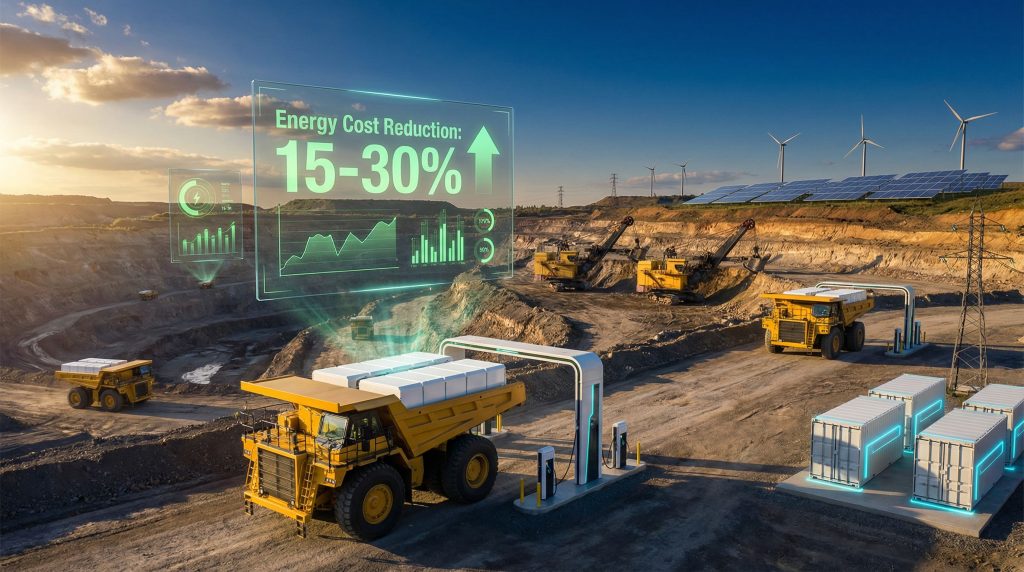
| Energy Cost Reduction | 15-30% |
| Maintenance Cost Savings | 10-20% |
| Production Efficiency Gains | 5-15% |
| Peak Demand Charge Avoidance | 20-40% |
The financial benefits extend beyond direct cost savings to include improved operational predictability and reduced exposure to volatile energy markets. Energy efficiency investments create hedge-like protection against future energy price increases while improving operational cash flow stability through reduced energy cost volatility.
Mining operations participating in demand-response programmes and grid services markets can generate additional revenue streams that further improve the economic returns from energy efficiency investments. These programmes typically compensate industrial consumers for reducing electricity consumption during peak demand periods or providing grid stability services through controllable loads.
Environmental Performance Improvements
Beyond economic benefits, energy efficiency tools in mining enable mining operations to significantly reduce their environmental footprint while meeting increasing regulatory requirements and stakeholder expectations for sustainable mining practices. Carbon emission reductions of 20-35% through electrification and energy optimisation demonstrate the substantial environmental impact potential of comprehensive efficiency programmes.
Furthermore, decarbonisation mining benefits extend beyond direct emissions reduction to include reduced diesel consumption in remote operations, lower overall energy intensity per unit of production, and improved compliance with evolving environmental regulations. These improvements support mining companies' environmental, social, and governance (ESG) objectives while potentially reducing regulatory compliance costs and environmental liabilities.
Environmental Impact Metrics:
- Carbon emission reductions of 20-35% through comprehensive electrification programmes
- Reduced diesel consumption in remote operations through renewable energy integration
- Lower energy intensity per unit of production through process optimisation
- Improved regulatory compliance with environmental standards and reporting requirements
The quantification of environmental benefits enables mining operations to participate in carbon credit markets and sustainability-linked financing arrangements that can provide additional economic returns from environmental performance improvements. These mechanisms create financial incentives that align environmental and economic objectives in energy efficiency investments.
The next major ASX story will hit our subscribers first
Future Trends in Mining Energy Efficiency
Emerging Technologies and Applications
The next generation of energy efficiency tools in mining incorporates artificial intelligence, advanced materials, and innovative power systems that promise even greater efficiency improvements than current technologies. Quantum computing applications for complex optimisation problems represent a potential breakthrough in real-time process optimisation capabilities, though practical implementation remains several years in the future.
Advanced battery technologies with higher energy density and faster charging capabilities will enable broader electrification of mining equipment while reducing infrastructure requirements for charging systems. Solid-state batteries and alternative chemistries promise energy densities 2-3 times higher than current lithium-ion technologies, potentially enabling electrification of the largest mining equipment that currently requires diesel power.
Technology Development Areas:
- Quantum computing applications for complex multi-variable optimisation problems
- Advanced battery technologies with higher energy density and faster charging rates
- Hydrogen fuel cell systems for heavy-duty mining equipment in remote operations
- Smart materials that adapt operational parameters automatically to changing conditions
Hydrogen fuel cell technology represents a potential solution for mining operations where battery-electric systems face limitations due to extreme operating conditions or extended duty cycles. The development of hydrogen infrastructure and fuel cell durability improvements could enable zero-emission operation of the largest mining equipment within the next decade.
Industry Transformation Outlook
The mining industry innovation continues to accelerate, driven by regulatory requirements, cost pressures, and technological advancement. Future mining operations will integrate multiple efficiency systems into comprehensive energy management ecosystems that optimise across all operational systems simultaneously rather than addressing individual efficiency opportunities in isolation.
Integration with renewable energy microgrids will become standard practice for new mining developments, with energy storage systems sized to provide both operational flexibility and grid services revenue generation. Mining operations will increasingly participate in electricity markets as prosumers rather than simple consumers, generating revenue through grid services while optimising their energy costs.
Strategic Evolution Factors:
- Renewable energy microgrid integration becoming standard for new mining developments
- Participation in grid services markets creating new revenue streams from controllable loads
- Circular economy approaches to energy use through waste heat recovery and byproduct utilisation
- Technology provider collaboration for customised solutions addressing site-specific challenges
The development of circular economy approaches to mining energy use will create additional efficiency opportunities through waste heat recovery, byproduct utilisation, and integration with other industrial processes. These approaches require sophisticated energy system integration but offer the potential for substantial efficiency improvements beyond what individual technologies can achieve independently.
Disclaimer: This analysis includes forward-looking statements about technology development and industry trends that are subject to uncertainty. Actual results may differ from the projections and trends discussed. Readers should conduct independent research and consult with qualified professionals before making investment or operational decisions based on this information.
Ready to Capitalise on the Next Major Mining Efficiency Discovery?
Discovery Alert's proprietary Discovery IQ model delivers instant notifications when ASX mining companies announce breakthrough efficiency technologies and energy innovations, turning complex technical developments into actionable investment insights. Explore historic mining discoveries that generated substantial returns for early investors, then begin your 14-day free trial to position yourself ahead of the market in this rapidly evolving energy efficiency sector.