
May 21, 2026
Energy Development Through Market Dynamics Rather Than Political Cycles
The offshore energy landscape operates through complex market forces that extend far beyond individual political administrations. Understanding how long-term resource development intersects with regulatory frameworks, technological capabilities, and capital allocation strategies provides crucial insights into America's energy independence trajectory. Rather than viewing recent Gulf of Mexico lease sale activities as isolated events, industry analysts must examine them within broader strategic positioning frameworks that span multiple decades.
Modern offshore energy development requires sophisticated understanding of geological formations, deepwater drilling technologies, and integrated supply chain management. Companies investing in offshore leases must navigate technical challenges including subsea production systems, directional drilling capabilities, and advanced seismic imaging technologies that justify substantial capital commitments over extended timeframes.
When big ASX news breaks, our subscribers know first
Strategic Framework Transformation in Offshore Energy Development
Recent Gulf of Mexico lease sale results demonstrate fundamental shifts in how energy companies approach offshore investment strategies. The December 2025 auction generated approximately $299 million in bids from 30 participating companies, representing selective geological targeting rather than speculative land acquisition approaches. Furthermore, this activity reflects broader tariffs impact investment considerations as companies navigate evolving trade policies.
Key Performance Metrics:
- Total bidding activity: $299 million
- Participating companies: 30 operators
- Competitive blocks: 30 locations received multiple bids
- Acreage utilisation: 1.02 million acres from 80 million available
- Bid submissions: 219 total proposals
The bidding patterns reveal sophisticated market positioning strategies. Companies concentrated investments on high-confidence geological prospects rather than pursuing broad acreage accumulation, indicating confidence in specific subsurface formations and long-term regulatory stability.
Regulatory Framework Evolution:
Current offshore development operates under modified economic parameters compared to previous policy frameworks. Royalty rate reductions to 12.5% represent the lowest federal revenue sharing since 2007, fundamentally altering project economics for deepwater developments. This 25% reduction from previous 16.67% rates creates enhanced economic incentives that improve project returns across the investment spectrum.
Market Leadership Through Strategic Capital Deployment
Investment patterns from the recent Gulf of Mexico lease sale reveal clear strategic positioning among major energy operators. Industry leadership emerges through sophisticated geological targeting combined with disciplined capital allocation approaches. However, these developments occur alongside broader concerns about US economy tariffs affecting overall market conditions.
Primary Investment Leaders:
| Company | Investment Amount | Market Position |
|---|---|---|
| BP | $61 million | 20.4% of total activity |
| Woodside Energy | $38 million | 12.7% market share |
| Chevron | $33 million | 11.0% participation |
| Murphy Exploration | $27.4 million | 9.2% investment |
BP's leading $61 million commitment signals renewed focus on Gulf deepwater operations, representing strategic re-engagement with the region after previous operational challenges. This investment level demonstrates confidence in both geological prospects and regulatory stability over extended development timelines.
Woodside Energy's $38 million participation marks significant international operator engagement in U.S. offshore development. Australian multinational involvement indicates competitive project economics relative to global deepwater opportunities in regions including Southeast Asia and the North West Shelf.
Investment Concentration Analysis:
The top four companies represent 52.3% of total bidding activity, demonstrating significant market consolidation among operators with advanced deepwater capabilities. This concentration reflects technical requirements for subsea production systems, directional drilling expertise, and integrated project management capabilities necessary for successful offshore development.
Policy Predictability as Investment Enabler
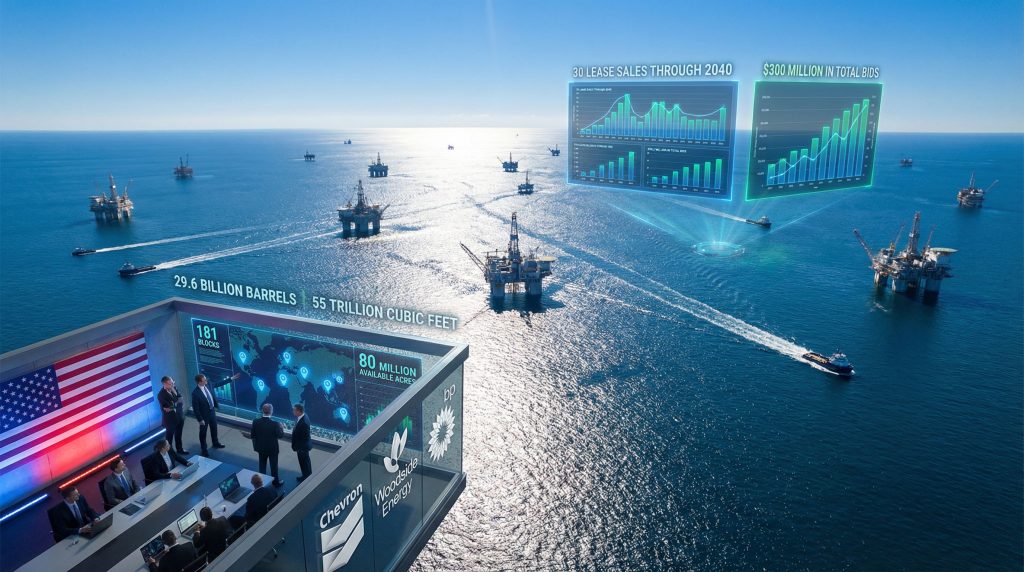
The commitment to 30 offshore lease sales through 2040 addresses fundamental industry concerns regarding policy continuity across political cycles. This framework provides unprecedented regulatory predictability for long-term capital planning and technology development investments. In addition, these developments contrast with Canada's energy transition challenges facing northern markets.
Scheduled Development Framework:
- Total planned auctions: 30 sales through 2040
- Development timeline: 15-year strategic horizon
- Resource potential: 29.6 billion barrels crude oil
- Natural gas reserves: 55 trillion cubic feet
- Next auction date: March 26, 2026
Laura Robbins from the Bureau of Ocean Energy Management characterised the industry response as strategically calibrated rather than urgency-driven. Her assessment emphasises how policy certainty enables companies to optimise bidding strategies across multiple future auctions rather than competing intensively in single events.
The extended lease schedule transforms competitive dynamics from scarcity-driven urgency to multi-period optimisation strategies. Companies can now sequence investments based on geological merit and capital return calculations rather than policy risk considerations.
Economic Impact Assessment Through Resource Development
Expanded offshore development creates sustained economic activity across multiple industrial sectors. The resource base underpinning the 30-sale programme represents substantial energy security and economic development potential. These developments also influence commodity markets, particularly affecting oil price movements globally.
Economic Impact Projections:
| Category | Estimated Value |
|---|---|
| Recoverable crude oil | 29.6 billion barrels |
| Natural gas resources | 55 trillion cubic feet |
| Average per sale (oil) | 0.987 billion barrels |
| Average per sale (gas) | 1.833 trillion cubic feet |
| Employment impact | All 50 states affected |
Erik Milito from the National Ocean Industries Association emphasised multiple economic dimensions of offshore development: investment attraction, employment generation across all states, and advancing American energy dominance objectives. This perspective frames offshore leasing as foundational infrastructure for energy security rather than transactional resource extraction.
The geographic distribution of economic benefits extends beyond coastal states to inland manufacturing, technology development, and supporting service industries. Offshore development requires sophisticated supply chains spanning equipment manufacturing, specialised services, and advanced materials production.
Environmental Considerations and Risk Management
Environmental organisations have raised significant concerns about expanded offshore drilling programmes. Joseph Gordon from Oceana characterised lease sales as initial steps toward potential spill catastrophes, emphasising existing industrial infrastructure density in Gulf waters.
Environmental Risk Factors:
- Existing infrastructure density: Thousands of rigs and pipelines
- Spill risk considerations: Historical accident patterns
- Cleanup responsibility concerns: Industry performance standards
- Ocean ecosystem protection: Marine habitat preservation
The Center for Biological Diversity highlighted Gulf waters' existing industrial footprint as a primary concern for expanded development. These perspectives create ongoing regulatory pressures that companies must incorporate into long-term planning frameworks.
Industry response strategies increasingly emphasise operational excellence and environmental risk management as operational licences become more scrutinised. Companies recognise that environmental performance standards directly impact regulatory approval processes and social licence considerations.
The next major ASX story will hit our subscribers first
Technology Integration and Operational Excellence
Modern offshore development relies on advanced technological capabilities that require sustained investment commitments. The predictable lease schedule enables companies to optimise technology deployment across multiple projects and development phases.
Advanced Technological Requirements:
- Seismic imaging systems: High-resolution subsurface mapping
- Directional drilling capabilities: Extended reach and precision targeting
- Subsea production systems: Remote operation and monitoring
- Digital integration: Predictive maintenance and optimisation
- Environmental monitoring: Real-time ecosystem assessment
Technology development timelines align with extended lease availability, justifying investments in advanced drilling systems, subsea infrastructure, and digital monitoring capabilities. Companies can now develop integrated technology strategies spanning multiple offshore assets rather than project-specific approaches.
The combination of regulatory predictability and technical advancement requirements creates competitive advantages for operators with sustained technology development capabilities. Digital integration opportunities include remote monitoring, predictive maintenance systems, and optimised production management across multiple offshore installations.
Global Energy Market Positioning
Expanded Gulf of Mexico development aligns with broader energy independence objectives while enhancing America's position in global energy markets. Increased domestic production potential reduces import dependency while strengthening export capabilities, particularly in liquefied natural gas markets. Furthermore, these developments coincide with natural gas trends showing market volatility patterns.
International Market Implications:
- Energy independence advancement: Reduced import requirements
- Export market positioning: Enhanced global supply capabilities
- Supply chain strengthening: Domestic production infrastructure
- Strategic resource management: National security considerations
The 55 trillion cubic feet of estimated natural gas resources positions American producers advantageously in expanding global LNG markets. Growing international demand for clean-burning natural gas creates substantial export opportunities that benefit from domestic supply reliability.
Offshore development contributes to broader energy security strategies by diversifying supply sources and enhancing production flexibility. Multiple offshore assets provide operational resilience against regional supply disruptions while supporting strategic reserve capabilities.
Investment Strategy Implications for Market Participants
The Gulf of Mexico lease sale demonstrates sophisticated market behaviour reflecting confidence in specific geological prospects while maintaining disciplined capital allocation approaches. Companies are bidding premium prices for high-confidence opportunities rather than pursuing speculative land banking strategies.
Market Behaviour Analysis:
- Selective geological targeting: Focus on proven formations
- Premium pricing acceptance: Confidence in project returns
- Disciplined capital allocation: Quality over quantity approaches
- Long-term strategic positioning: Multi-cycle investment planning
Average bid prices reached eight-year highs despite lower total auction revenues compared to 2023 levels. This pricing pattern indicates companies' willingness to pay premiums for quality prospects while avoiding marginal acreage investments.
The participation of 30 companies across 219 bid submissions demonstrates sustained industry interest balanced with strategic selectivity. Multiple bids on 30 blocks indicate competitive focus on premium geological prospects rather than broad market participation.
Future Development Pathways
The March 26, 2026 lease sale provides the next strategic checkpoint for assessing industry appetite and regulatory framework effectiveness. Companies can now develop comprehensive Gulf of Mexico strategies spanning multiple auctions with predictable timing and competitive frameworks. The Bureau of Ocean Energy Management continues to oversee these strategic development processes.
This systematic approach enables integrated development planning, coordinated infrastructure investments, and optimised resource extraction strategies. Companies benefit from predictable lease availability while regulators achieve consistent revenue generation and resource development objectives.
The extended timeline through 2040 allows for technology advancement integration, environmental performance improvements, and supply chain optimisation across the offshore development sector. Strategic planning capabilities extend beyond individual projects to comprehensive regional development approaches.
Disclaimer: This analysis is based on publicly available information and industry assessments current as of the publication date. Energy market conditions, regulatory frameworks, and political policies may change, affecting future offshore development activities. Readers should conduct independent research and consult qualified professionals before making investment decisions related to offshore energy development.
Ready to Discover the Next Major Mining Breakthrough?
Discovery Alert's proprietary Discovery IQ model delivers instant notifications on significant ASX mineral discoveries, empowering subscribers to identify actionable opportunities ahead of the broader market. Explore why major mineral discoveries can lead to exceptional returns and begin your 30-day free trial today to secure your market-leading advantage.