
August 26, 2026
Understanding the Strategic Context Behind Energy Diplomacy
The evolving landscape of international energy partnerships reveals how middle powers are recalibrating their approaches to resource security and market access. Traditional alliance structures face mounting pressure as economic nationalism intensifies across major economies, forcing nations like Canada to seek alternative pathways for energy commerce. This strategic repositioning reflects deeper structural shifts in global trade patterns, where bilateral partnerships increasingly serve as hedging mechanisms against volatile multilateral frameworks.
Contemporary energy diplomacy operates within a context of heightened supply chain awareness, driven by recent disruptions that exposed vulnerabilities in concentrated trade relationships. The imperative to diversify export destinations has become particularly acute for resource-rich nations seeking to reduce dependency on single-market exposure while maintaining energy security for importing partners.
Recent developments in Canada-India relations demonstrate this strategic recalibration in practice. Following diplomatic tensions that suspended energy cooperation mechanisms, both nations have moved to reestablish formal dialogue structures. The ministerial energy partnership relaunched in January 2026 at India Energy Week represents more than diplomatic reconciliation—it signals recognition of complementary economic opportunities that transcend short-term political disputes.
This renewed cooperation framework emerges as Canada pursues what officials characterise as pragmatic, economy-first diplomacy with major Asian partners. The timing coincides with escalating North American trade tensions, particularly following threats of substantial tariff increases on Canadian goods should Ottawa pursue expanded economic partnerships with other major economies. Furthermore, these developments align with Canada's energy transition challenges as the nation seeks to balance domestic transformation with international market opportunities.
When big ASX news breaks, our subscribers know first
What Economic Forces Drive This Energy Alliance?
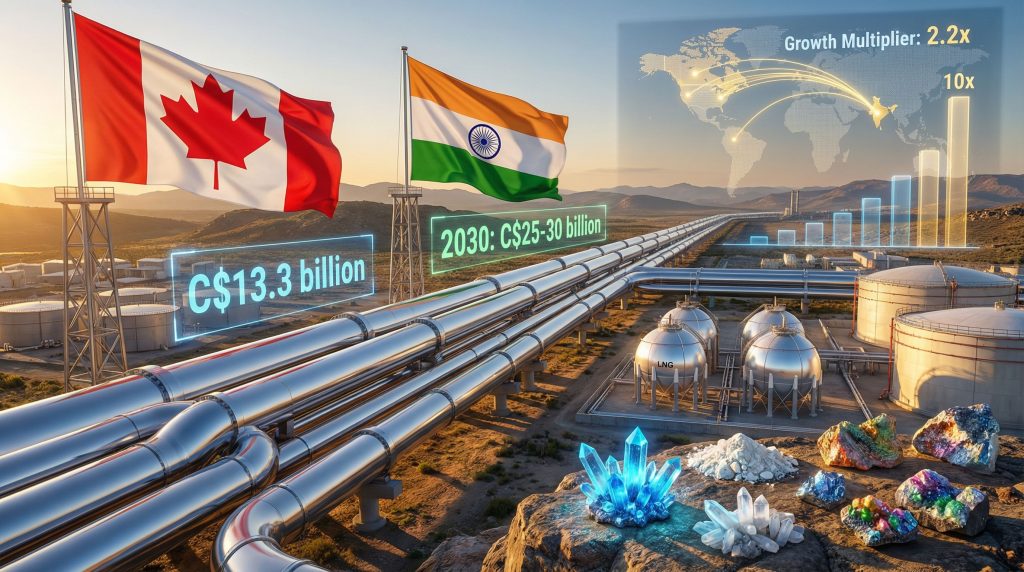
The fundamental economic logic underlying renewed Canada India energy trade agreement stems from complementary supply-demand dynamics that have reached critical mass. Bilateral goods trade reached C$13.3 billion (US$9.7 billion) in 2024, establishing a substantial foundation for expanded commerce. This baseline figure represents significant growth potential, particularly given that India accounts for only 1 percent of Canada's critical minerals exports—a proportion that underscores the scale of untapped opportunity.
Canada's recent entry into Asian LNG markets, which began in June 2025, provides the infrastructure foundation necessary to support expanded energy trade flows. The development of liquefied natural gas export capabilities specifically targeting Pacific Basin markets creates new opportunities for Canadian producers to access rapidly growing Asian demand centres.
Current Trade Structure Analysis
| Commodity Category | Current Status | Growth Potential |
|---|---|---|
| Bilateral Goods Trade | C$13.3 billion (2024) | Significant expansion targeted |
| Critical Minerals Share | 1% of Canadian exports | Substantial increase opportunity |
| LNG Export Capability | June 2025 launch | Asian market penetration |
| Refined Product Exchange | Limited current volumes | Bidirectional flow expansion |
The partnership establishes complementary commodity flows that optimise each nation's comparative advantages. Canada commits to increased shipments of crude oil, liquefied natural gas, and liquefied petroleum gas to Indian markets. Simultaneously, India will expand refined petroleum product exports to Canada, leveraging its advanced refining infrastructure and technical capabilities.
Geographic advantages further strengthen the economic foundation. Canada's LPG terminals maintain relatively short shipping routes to India, reducing transportation costs and delivery timeframes compared to alternative suppliers. This logistical efficiency creates competitive pricing advantages that support sustained trade volume growth.
The Trans Mountain pipeline expansion has opened direct pathways for crude oil shipments to Indian destinations, though most Canadian barrels currently move through US Gulf Coast facilities. Consequently, this infrastructure development provides routing flexibility that reduces dependency on any single transportation corridor while enabling direct supplier-to-market connections.
Which Energy Commodities Will Define This Partnership?
The renewed Canada India energy trade agreement encompasses a comprehensive range of hydrocarbon and refined product categories that reflect both nations' production capabilities and consumption requirements. The commodity scope extends beyond traditional oil and gas exchange to include emerging energy technologies and strategic materials essential for energy transition.
Primary Hydrocarbon Flows
Canadian energy exports to India will focus on upstream commodities where Canada maintains established production capacity:
- Crude Oil: Direct shipments utilising Trans Mountain pipeline capacity and Pacific Coast export terminals
- Liquefied Natural Gas: Leveraging recently commissioned Asian export facilities operational since June 2025
- Liquefied Petroleum Gas: Capitalising on shorter shipping distances that provide competitive delivery advantages
Indian energy exports to Canada emphasise downstream refined products that utilise India's sophisticated refining infrastructure:
- Refined Petroleum Products: High-value processed fuels and industrial feedstocks
- Value-Added Petrochemicals: Specialised chemical compounds for industrial applications
Advanced Energy Technology Collaboration
Beyond traditional hydrocarbon exchange, the partnership establishes frameworks for cooperation across emerging energy sectors. The ministerial commitment encompasses collaboration in hydrogen production, biofuels development, battery storage systems, critical minerals processing, electricity grid optimisation, and artificial intelligence applications in energy sector operations.
This technology-focused cooperation reflects both nations' recognition that future energy security depends not only on commodity access but on technological capabilities that enable efficient production, transportation, and consumption of diverse energy sources. Moreover, these developments connect with critical minerals for energy security initiatives worldwide.
Strategic Materials and Rare Earth Elements
The partnership creates pathways for Canada to expand critical minerals exports beyond the current 1 percent share of total exports to India. These materials include rare earth elements, lithium compounds, and other strategic metals essential for renewable energy infrastructure, battery manufacturing, and advanced electronics production.
The integration of critical minerals trade with traditional energy commodity flows creates comprehensive supply chain relationships that strengthen both nations' access to materials essential for economic competitiveness and energy security. In addition, these developments complement ongoing battery-grade lithium initiatives in the region.
How Does This Partnership Address Global Energy Security Challenges?
Contemporary energy security frameworks prioritise supply source diversification as a fundamental risk mitigation strategy. The Canada-India partnership directly addresses concentration risks that expose nations to supply disruptions, price volatility, and geopolitical leverage by singular supplier relationships.
Diversification Strategy Implementation
Canada's systematic effort to reduce export market concentration responds to recent trade tensions that highlighted vulnerabilities in over-reliance on single-destination exports. The partnership provides alternative market access that reduces exposure to unilateral trade policy changes whilst maintaining existing commercial relationships.
The strategic value extends beyond simple market diversification to encompass technological cooperation that enhances both nations' energy sector capabilities. Joint development of hydrogen technologies, artificial intelligence applications, and battery storage systems creates shared technological assets that strengthen long-term competitive positioning.
Supply Chain Resilience Architecture
According to the Economic Times, "Canada seeks India energy partnership to counter US economic coercion". The renewed energy dialogue demonstrates how middle powers can construct resilient supply networks that function independently of major power competition dynamics whilst delivering mutual economic benefits.
The partnership creates redundant supply pathways that strengthen both nations' energy security through multiple mechanisms:
- Geographic Distribution: Multiple transportation routes reduce single-point failure risks
- Commodity Diversification: Various energy product categories prevent concentration in any single resource type
- Technology Integration: Shared infrastructure development creates interdependent systems that enhance security through cooperation
Risk Assessment and Management Framework
The bilateral energy relationship incorporates risk management mechanisms designed to maintain stability during periods of global market volatility or geopolitical tension. These include:
- Flexible Delivery Scheduling: Adaptable shipping arrangements that accommodate market condition changes
- Price Stability Mechanisms: Long-term contract structures that provide predictable cost frameworks
- Technology Sharing: Joint research initiatives that reduce individual nation dependency on external technology suppliers
- Infrastructure Redundancy: Multiple facility options that prevent service interruptions from single-point failures
What Investment Opportunities Emerge From This Framework?
The renewed partnership creates substantial investment opportunities across multiple sectors, driven by infrastructure requirements necessary to realise expanded trade volumes and technology collaboration commitments. These opportunities span traditional energy infrastructure, advanced technology development, and integrated supply chain optimisation.
Priority Infrastructure Investment Areas
Port and Terminal Expansion
- LNG export terminal capacity increases at Canadian Pacific Coast facilities
- Refined product import terminals at major Canadian distribution centres
- Specialised handling equipment for liquefied petroleum gas transfers
- Digital integration systems for automated cargo management
Pipeline and Transportation Infrastructure
- Enhanced crude oil transportation networks connecting production regions to export facilities
- Strategic petroleum storage facilities to manage supply timing and market volatility
- Intermodal transportation systems linking pipeline networks with marine export terminals
Technology Development and Integration
- Artificial intelligence systems for supply chain optimisation and predictive maintenance
- Hydrogen production facilities utilising Canadian natural gas resources
- Battery storage systems for grid stability and renewable energy integration
- Critical minerals processing facilities to increase value-added export products
Investment Facilitation Mechanisms
The ministerial commitment to facilitate reciprocal investment in each nation's energy sectors creates formal frameworks for cross-border capital deployment. These mechanisms include streamlined regulatory approval processes, bilateral investment protection agreements, and technology transfer facilitation systems. However, investors should consider potential tariffs and investment impacts on bilateral trade relationships.
Joint Venture and Partnership Opportunities
Canadian energy companies gain access to Indian downstream markets through partnership structures that leverage India's refining expertise and distribution networks. Indian firms obtain access to Canadian upstream resources and advanced extraction technologies through similar cooperative arrangements.
Research and development collaboration creates opportunities for shared technology development costs whilst accelerating innovation timelines. Joint research initiatives in clean energy technologies, hydrogen production methods, and artificial intelligence applications distribute financial risks whilst maximising technical expertise integration.
How Will This Impact Regional Energy Markets?
The Canada India energy trade agreement will create ripple effects across Pacific Basin energy markets, potentially reshaping supplier relationships, pricing benchmarks, and trade flow patterns. These changes reflect Canada's strategic entry into Asian markets previously dominated by Middle Eastern and Australian suppliers.
Asia-Pacific Market Dynamics Transformation
Canadian LNG entry into Asian markets, which began in June 2025, introduces new competitive dynamics for established suppliers. The shorter shipping routes from Canadian LPG terminals to India provide cost advantages that may pressure existing supplier pricing structures whilst offering Indian importers enhanced supply security through source diversification.
Market Share Implications Analysis
| Supplier Region | Current Position | Potential Impact | Strategic Response |
|---|---|---|---|
| Middle Eastern Suppliers | Dominant market share | Potential volume displacement | Enhanced service offerings |
| Australian LNG Exporters | Established Pacific presence | Direct competition from Canadian facilities | Cost optimisation initiatives |
| Russian Energy Producers | Constrained by sanctions | Market share redistribution | Alternative market development |
The partnership may establish new pricing benchmarks for Pacific Basin energy trade, particularly for refined product exchanges that optimise processing capabilities across different market centres. Indian refiners' access to Canadian crude oil feedstock creates opportunities for specialised product development targeting specific market requirements.
North American Energy Export Pattern Modifications
Expanded Canadian energy exports to India will influence continental energy flow patterns by potentially reducing crude oil exports to US refineries whilst creating alternative markets for Western Canadian production. This diversification reduces Canadian producers' dependency on US refining capacity whilst providing pricing alternatives that may improve netback revenues. Furthermore, these developments occur alongside broader oil price rally insights affecting global markets.
The development of Pacific Coast export infrastructure specifically targeting Asian markets creates permanent capacity that extends beyond the India partnership to encompass broader Asian market access. This infrastructure foundation supports long-term strategic positioning in rapidly growing Pacific Basin energy markets.
The next major ASX story will hit our subscribers first
Long-Term Strategic Implications and Technology Integration
The Canada India energy trade agreement establishes frameworks that extend far beyond traditional commodity exchange relationships. The emphasis on technology collaboration, artificial intelligence integration, and clean energy development creates pathways for sustained cooperation that evolve with changing global energy requirements.
Innovation Ecosystem Development
Joint research initiatives in hydrogen production technologies leverage Canada's natural gas resources and India's advanced chemical processing capabilities. These collaborations create intellectual property assets that both nations can deploy across broader international markets whilst maintaining competitive advantages in emerging energy sectors.
Battery storage system development addresses grid stability requirements that become increasingly critical as renewable energy generation expands in both nations. Shared technology development reduces individual research costs whilst accelerating deployment timelines for advanced storage solutions.
Geopolitical Positioning and Strategic Autonomy
The partnership positions both nations as independent actors in global energy markets, capable of developing mutually beneficial relationships that operate independently of major power competition dynamics. This strategic autonomy becomes particularly valuable as traditional alliance structures face increasing strain from economic nationalism and trade policy volatility.
The success of this bilateral framework may serve as a template for similar partnerships between other middle powers, gradually reshaping global energy trade patterns away from hub-and-spoke models dominated by major powers toward more distributed, resilient networks based on complementary capabilities and mutual interests.
Market Psychology and Investment Sentiment
The partnership's emphasis on technology collaboration and long-term infrastructure development signals commitment to sustained cooperation that extends beyond short-term commodity price cycles. This stability attracts investment capital that requires predictable regulatory frameworks and sustained political commitment for major infrastructure projects.
The integration of clean energy technologies and artificial intelligence applications demonstrates alignment with global energy transition trends, positioning both nations to capture investment flows directed toward sustainable energy infrastructure and advanced technology development. According to Reuters, "Canada is looking to boost energy trade with India, energy minister says", highlighting the strategic importance of this partnership for both nations' energy security objectives.
Disclaimer: Future energy trade volumes, investment returns, and market share projections involve significant uncertainties including geopolitical developments, technological advancement rates, and global economic conditions. All forward-looking statements should be evaluated considering these inherent risks and uncertainties.
Looking to capitalise on Asia-Pacific energy partnerships?
Discovery Alert's proprietary Discovery IQ model delivers real-time alerts on significant ASX mineral discoveries across energy transition commodities, instantly empowering subscribers to identify actionable opportunities ahead of the broader market. Begin your 30-day free trial today and secure your market-leading advantage in the evolving energy sector landscape.