May 11, 2026
The Complex Energy Economics Driving Australia's Resource Competitiveness
Global commodity markets increasingly operate within frameworks where energy costs determine mining sector viability across decades-long project lifecycles. Nations possessing substantial fossil fuel reserves paradoxically encounter domestic energy pricing that contradicts their export capacity, creating investment allocation challenges that reshape resource development patterns. Furthermore, energy transition strategies demonstrate how Australia exemplifies this disconnect, where world-scale LNG export infrastructure coexists with domestic industrial energy costs exceeding those in North American and European competitor jurisdictions.
Contemporary mining operations require energy infrastructure capable of responding to variable demand cycles while maintaining grid stability during renewable energy integration phases. This technical requirement positions gas-fired generation as a bridging technology between coal-based systems and pure renewable configurations, particularly within resource-intensive sectors demanding flexible power supply characteristics.
When big ASX news breaks, our subscribers know first
Australia's Energy Infrastructure Paradox and Mining Sector Implications
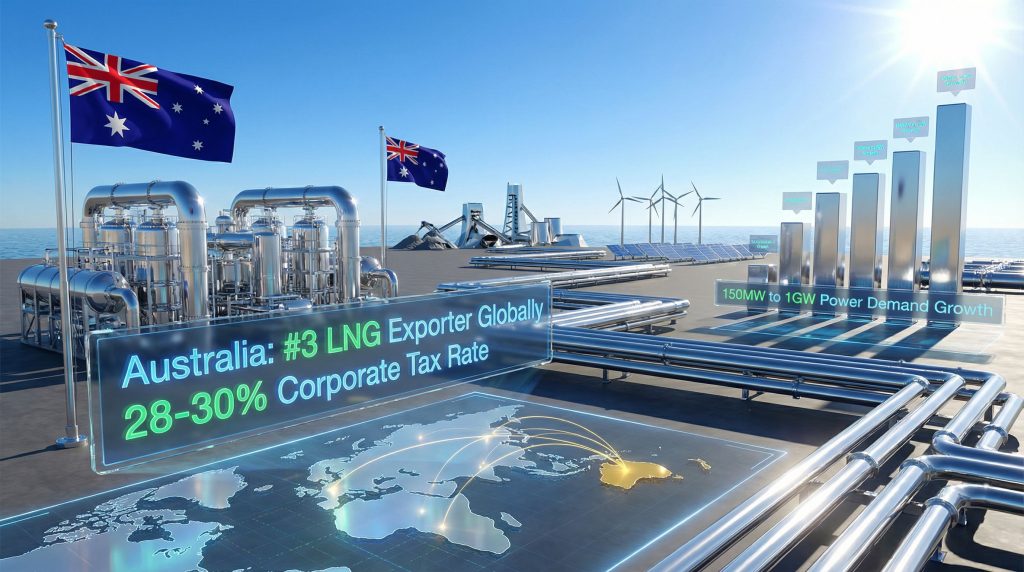
Australia's position as the world's third-largest liquefied natural gas exporter creates a fundamental economic contradiction for domestic mining operations. Despite massive offshore gas reserves and processing capacity, Australian industrial electricity prices rank among the highest in developed economies, with manufacturing sector costs approximately 30-40% higher than comparable North American facilities according to Australian Energy Market Operator data.
The structural disconnect between export volumes and domestic pricing reflects infrastructure compartmentalization where LNG facilities operate primarily through long-term Asian supply contracts. Natural gas pricing in Australia follows export parity mechanisms, tracking international LNG benchmarks rather than domestic production costs. As of March 2026, wholesale natural gas prices hover around $2.99-3.50 per million BTU, substantially exceeding US natural gas forecasts in North America.
Peak Demand Management and Mining Operations
Australia's mining and quarrying sector consumes approximately 28-30% of total industrial electricity, with large integrated operations often requiring 150 megawatts or higher during operational peaks. Major copper and iron ore producers can exceed 500 megawatts during processing phases, creating sustained demand periods lasting 4-6 hours during concentrate processing cycles.
Summer peak demand in mining operations exceeds baseload requirements by 40-60%, occurring predominantly during daylight hours when renewable capacity is abundant but cooling demands compete for available generation. This demand pattern creates technical requirements for responsive generation capacity that can modulate output within minutes rather than the multi-hour startup cycles required for coal plants.
Gas-fired generation provides unique operational advantages through combined cycle technology achieving thermal efficiencies of 50-60% compared to 35-40% for conventional coal plants. Gas turbines transition between zero and full output within 10-15 minutes, enabling rapid load response matching mining demand variations that occur over 4-6 hour periods throughout daily operational cycles.
Technical Infrastructure Requirements
Mining concentration plants processing ore require sustained power during froth flotation and solvent extraction phases, typically involving 20-30 hour operational cycles within each production week. This operational pattern creates demand profiles poorly matched to central grid renewable generation, driving economic justification for site-specific gas infrastructure supporting distributed generation requirements.
Distributed generation configurations using modular gas turbine systems ranging from 10-150 megawatts enable mine-site generation tailored to specific operational requirements. These systems reduce transmission losses while providing supply security independent of central grid vulnerabilities, particularly relevant for remote mining locations in Western Australia's Pilbara region and Northern Queensland copper operations.
Gas generators provide automatic frequency response through governor systems maintaining grid frequency within ±0.1 Hz control tolerances. This capability maintains system stability during rapid renewable output transitions or sudden load changes, a technical service that renewable systems cannot independently provide without substantial battery storage integration.
Corporate Tax Structure Analysis and International Competitiveness
Australia's 30% corporate tax rate positions the nation among the highest-tax jurisdictions within the 38-member OECD framework. This rate exceeds competitor nations including Canada (26.5%), the United Kingdom (19-25% progressive), the Netherlands (19%), and Ireland (12.5%), while ranking behind only Colombia (37%), Portugal (31.5%), and Germany (30%) according to OECD Fiscal Decentralisation Database analysis.
Investment Return Sensitivity Analysis
The tax rate differential creates measurable competitive disadvantages for long-term mining investment decisions spanning 20-40 year operational lifecycles. A hypothetical $1 billion greenfield mining project with 30-year operational life demonstrates substantial after-tax return variations comparing Australian versus Canadian jurisdiction development:
| Jurisdiction | Corporate Tax Rate | After-Tax Returns (10% Pre-Tax) | Return Differential |
|---|---|---|---|
| Canada | 26.5% | 7.35% | Baseline |
| Australia | 30% | 7% | -35 basis points |
| United Kingdom | 19-25% | 7.5-8.1% | +15-75 basis points |
| Ireland | 12.5% | 8.75% | +140 basis points |
Mining operations with $5 billion capital investment and $2 billion annual EBITDA demonstrate return-on-capital-employed sensitivity to tax rate variations. At Australia's 30% tax rate, annual after-tax cash flow approximates $1.4 billion, while equivalent Canadian operations retain $1.47 billion after-tax. Over 10-year periods, this $70 million annual differential compounds to $700+ million cumulative impact on project cash flow.
Tax Depreciation and Effective Rate Considerations
Australia's tax depreciation schedules for mining infrastructure typically involve straight-line depreciation over 20-30 year periods, contrasting with accelerated depreciation available in competitor jurisdictions. These provisions reduce tax shield benefits of capital investments, creating additional tax burden beyond statutory rate comparisons.
Effective tax rates diverge from statutory rates through Australia's Petroleum Resource Rent Tax (PRRT) and proposed Resource Rent Tax structures. These rent-based taxes create marginal rate incidence exceeding statutory rates for higher-profitability operations, potentially reaching 50%+ effective tax rates for premium resource projects.
Gas Infrastructure Investment Framework and Mining Integration
BHP gas investment Australia strategies reflect broader industry evolution trends where gas infrastructure represents critical enablement for mining sector evolution. Contemporary mining operations increasingly require electrification replacing diesel-powered systems, demanding stable voltage and frequency characteristics maintained through rapid frequency response capabilities measured in seconds rather than minutes.
Infrastructure Development Scenarios
Several strategic pathways could reshape Australia's domestic gas market dynamics and mining sector competitiveness. For instance, these developments align with emerging renewable energy integration strategies transforming mining operations:
Accelerated Domestic Gas Infrastructure Development:
- Pipeline expansion and domestic processing capacity investment focus
- 5-7 year development cycle timeline
- Projected 15-25% reduction in domestic energy costs
- Enhanced mining operational cost competitiveness outcomes
Integrated Renewable-Gas Hybrid Systems:
- Gas peaking plants supporting renewable baseload infrastructure
- 3-5 year implementation timeline
- Grid stability improvement with cost optimisation benefits
- Predictable energy pricing with reduced volatility for mining operations
Export-Domestic Balance Reoptimisation:
- Domestic reservation policies and infrastructure reallocation
- 2-4 year policy implementation framework
- Improved domestic supply security outcomes
- Long-term energy cost predictability for mining operations
Technical Integration Advantages
Mining engineer perspectives emphasise that electrified mining equipment requires power systems maintaining technical specifications that gas generators uniquely provide. Battery energy storage systems offer faster response (milliseconds to seconds) but current technology economics limit discharge cycles to 4-6 hours at competitive costs, creating complementary rather than substitutional relationships with gas infrastructure.
The Pilbara iron ore mining region demonstrates technical integration requirements where major operations including Rio Tinto and BHP's strategic initiatives consume 1.5-2.0 gigawatts during peak periods. These operations cycle through 8-12 hour concentration plant processing requiring sustained power availability during summer peak thermal demand, necessitating responsive backup capacity as coal facilities retire.
Regional Market Positioning and Supply Chain Security
Australia's strategic geographic positioning for Asian market access creates supply chain advantages despite domestic energy cost challenges. Mining operations export 90-95% of major mineral production to Asian destinations where trade route security remains stable despite Middle Eastern geopolitical tensions.
Asia-Pacific Trade Route Resilience
Regional market positioning analysis indicates several risk mitigation factors supporting Australia's mining export competitiveness. However, ongoing market assessments suggest continued infrastructure investment remains critical:
- Established long-term supply agreements with major Asian economies reducing price volatility exposure
- Diversified export infrastructure across multiple ports minimising single-point-of-failure risks
- Strategic geographic positioning providing shipping route alternatives independent of Middle Eastern disruptions
- Strong bilateral relationships with key Asian trading partners supporting supply chain stability
China represents the largest destination market for Australian mineral exports, with established shipping infrastructure supporting iron ore, copper concentrate, and metallurgical coal trade flows. These trade relationships operate through long-term contracts providing price stability and volume certainty that support mining investment planning across multi-decade project lifecycles.
Future Mining Energy Requirements and Infrastructure Planning
Mining sector energy demand projections indicate substantial growth driven by electrification, processing expansion, and automation technology integration. Current mining operations typically require 150MW during standard operations, with projections indicating growth to up to 1GW for major integrated operations by 2040.
Electrification and Processing Expansion Drivers
Mining electrification trends create energy demand patterns requiring infrastructure capable of supporting variable load profiles. Consequently, effective investment strategy components must consider these evolving requirements:
- Current mining sector demand: ~150MW typical operations
- Projected 2040 demand: Up to 1GW for major integrated operations
- Primary growth drivers: Electrification replacing diesel systems, processing capacity expansion, automation technology integration
Gas infrastructure provides modular capacity expansion capabilities enabling mining operators to scale power generation matching operational growth requirements. This scalability advantage contrasts with coal infrastructure requiring substantial upfront capital investment for minimum viable generation capacity that may exceed immediate operational needs.
Integration with Renewable Energy Systems
Future mining operations increasingly require power systems integrating renewable generation with responsive backup capacity. Gas infrastructure provides technical capabilities supporting this integration through:
- Grid stabilisation services maintaining frequency and voltage during renewable output variations
- Peak demand management supporting solar and wind intermittency patterns
- Reduced environmental footprint compared to coal alternatives while maintaining operational reliability
- Carbon capture integration potential for future emissions reduction requirements
The next major ASX story will hit our subscribers first
Investment Opportunities and Strategic Considerations
The intersection of gas infrastructure development, corporate tax policy optimisation, and mining sector modernisation creates multiple investment themes reflecting Australia's energy transition requirements. BHP gas investment Australia initiatives exemplify strategic positioning recognising gas infrastructure as transitional technology supporting renewable energy integration.
Primary Investment Vectors and Market Opportunities
Infrastructure Development Investment Focus:
- Gas processing and distribution network expansion supporting domestic utilisation
- Peaking power generation facilities providing grid stabilisation services
- Integrated renewable-gas hybrid systems optimising cost and reliability outcomes
Policy-Driven Investment Opportunities:
- Corporate tax reduction beneficiaries across resource sector operations
- Domestic gas utilisation incentive structures supporting infrastructure development
- Mining sector productivity enhancement programs improving international competitiveness
Technology Integration Investment Themes:
- Advanced gas turbine technologies achieving higher thermal efficiency ratings
- Grid stabilisation systems supporting renewable energy integration requirements
- Carbon capture and utilisation projects addressing future emissions regulations
The analysis framework indicates that successful navigation of Australia's energy transition requires coordinated policy intervention addressing both immediate cost competitiveness challenges and long-term infrastructure development requirements. Mining sector stakeholders increasingly recognise that gas infrastructure investment represents essential enablement for operational modernisation supporting electrification trends while maintaining cost competitiveness within global commodity markets.
Disclaimer: This analysis contains forward-looking statements and projections based on current industry data and policy frameworks. Investment decisions should consider additional factors including regulatory changes, commodity price volatility, and project-specific technical requirements. Past performance and current market conditions do not guarantee future investment outcomes.
Looking to Capitalise on Australia's Evolving Resource Infrastructure?
Discovery Alert's proprietary Discovery IQ model identifies significant ASX mineral discoveries in real-time, helping investors navigate complex energy transition opportunities and resource infrastructure developments across Australia's mining sector. Explore historic discovery returns that demonstrate how major mineral finds can generate substantial market gains, then begin your 14-day free trial today to stay ahead of emerging opportunities.