May 22, 2026
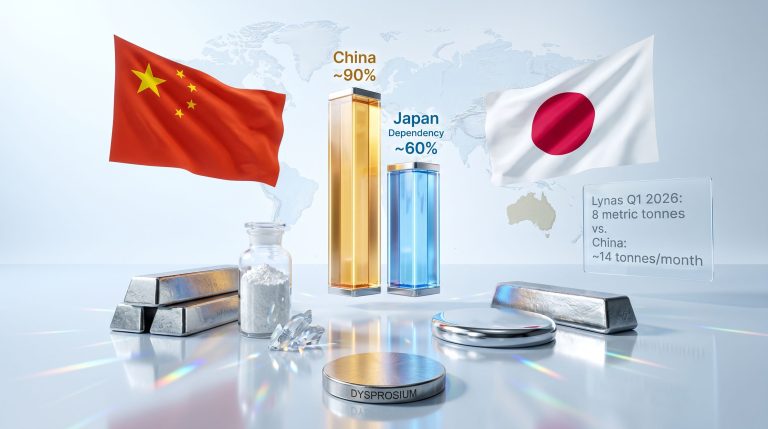
The Western world's strategic materials landscape is undergoing a fundamental transformation as Energy Fuels rare earth production emerges as America's answer to critical supply chain vulnerabilities. With China controlling over 90% of global rare earth processing capacity, this dependency extends far beyond economics into national security concerns. The company's revolutionary approach leverages existing uranium processing infrastructure to create the only operational rare earth separation facility in the Western hemisphere, addressing uranium market volatility through integrated production strategies.
Furthermore, recent policy developments including the critical minerals executive order and Australia's defence‐critical materials strategy highlight the strategic importance of domestic rare earth capabilities.
America's Singular Rare Earth Processing Infrastructure
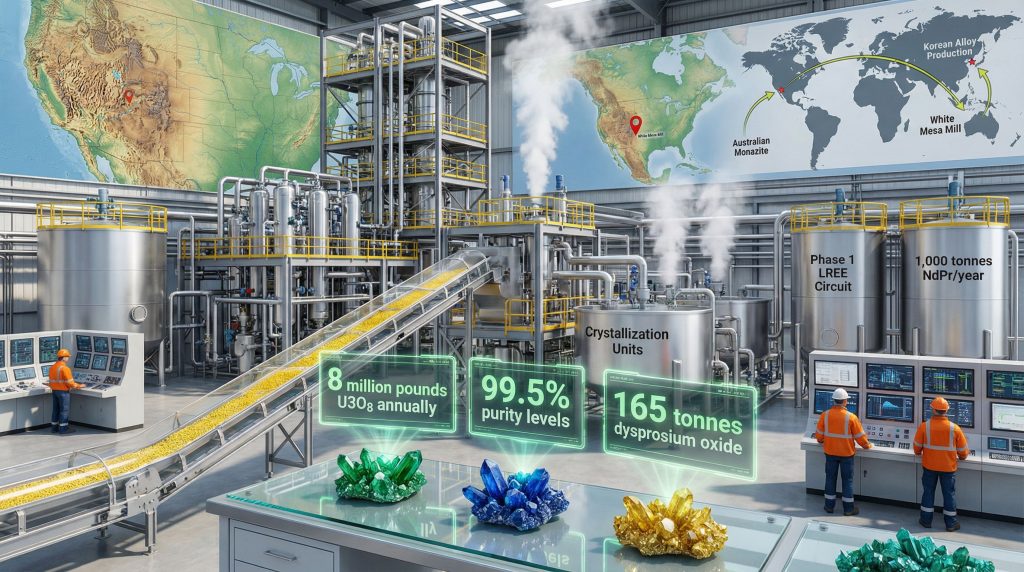
The White Mesa Mill in Utah operates as the Western world's only facility combining uranium milling with monazite-based rare earth separation. This 45-year operational history provides regulatory advantages that cannot be replicated through new construction. The facility processes monazite concentrates containing 50-60% total rare earth oxides, significantly higher than traditional bastnäsite or xenotime sources commonly used in Chinese operations.
Processing specifications demonstrate commercial viability:
| Processing Parameter | Current Capability | Industry Benchmark |
|---|---|---|
| Annual Licensed Capacity | 8+ million lbs U3O8 | Largest in North America |
| NdPr Oxide Purity | >99.5% | EV motor magnet grade |
| Heavy REE Separation | >99.9% Dy/Tb | Defence application grade |
| Monazite Throughput | 10,000 tonnes/year Phase 1 | Commercial scale |
The facility's hydrometallurgical approach offers distinct advantages over pyrometallurgical alternatives. Acid dissolution circuits, originally designed for uranium ore processing, handle monazite's complex mineralogy effectively. Thorium co-products, representing 5-10% of monazite content, integrate seamlessly with existing radioactive waste management protocols developed over decades of uranium production.
Technical Processing Advantages Creating Market Position
Monazite processing requires specialised handling due to its cerium phosphate structure (CePO₄) and radioactive thorium content. The White Mesa Mill's integrated approach leverages sequential solvent extraction stages:
- Primary dissolution: Sulfuric acid leaching extracts rare earth elements and thorium from monazite matrix
- Selective separation: Organophosphorus extractants separate individual elements based on ionic radius and extraction coefficients
- Purification circuits: Counter-current extraction achieves >99.5% purity for commercial applications
- Crystallisation systems: Thermal processing converts separated solutions to marketable oxides
This technical complexity explains why Energy Fuels rare earth production maintains pricing premiums over Chinese alternatives. Western rare earth premiums reflect supply chain security concerns, with dysprosium commanding 443% premiums and terbium reaching 401% premiums compared to domestic Chinese pricing as of February 2026.
When big ASX news breaks, our subscribers know first
The Regulatory Moat No Competitor Can Breach
New rare earth processing facilities face 10-20 year development timelines in Western jurisdictions, primarily due to environmental permitting complexity. The White Mesa Mill operates under legacy Nuclear Regulatory Commission licences predating modern environmental legislation, creating structural advantages for scaling operations.
Regulatory framework comparison reveals the advantage:
Existing White Mesa Mill Operations
- NRC Licence: Continuously renewed since 1980s uranium operations began
- RCRA Permits: Established hazardous waste handling protocols
- State Approvals: Water rights, air quality permits grandfathered under historical standards
- Tailings Management: Licensed radioactive waste disposal infrastructure operational
- Environmental Baseline: Four decades of monitoring data established
New Facility Requirements
- NEPA Review: 2-5 years for comprehensive Environmental Impact Assessment
- Multi-agency Coordination: Federal, state, and local permitting processes
- Public Opposition: Extended comment periods and potential litigation
- Financial Assurance: Bonding requirements for decommissioning and waste management
- Operational Validation: Years of testing before commercial production approval
Case study evidence supports these timelines. Energy Fuels subsidiary MP Materials' Mountain Pass facility required 22 years from closure to production restart, despite existing infrastructure and proven processing methods. Lynas Rare Earths' Western Australian facility needed 8-10 years from project announcement to first commercial production.
The sequential nature of regulatory approvals prevents parallel processing, creating the extended timelines that protect Energy Fuels rare earth production from competitive threats.
How Does Monazite Supply Chain Integration Enable Production Scaling?
Strategic feedstock security remains crucial for maintaining processing circuit utilisation. The company has developed a multi-continent supply strategy spanning Australia, Madagascar, Brazil, and existing U.S. heavy mineral sand operations.
Strategic feedstock pipeline development:
Donald Project (Australia)
- Annual Capacity: 13,000 tonnes monazite concentrate
- Development Timeline: Final investment decision expected Q1 2026, production late 2027
- Capital Requirement: A$520 million total funding for mine development
- Strategic Value: Provides primary feedstock for White Mesa Mill Phase 2 expansion
Vara Mada Project (Madagascar)
- Production Potential: 24,000+ tonnes monazite annually
- Economic Returns: $1.8 billion NPV with 24.9% internal rate of return
- Revenue Projections: $500 million expected EBITDA post-ramp
- Development Status: Government approvals pending, production targeted 2028-2029
Bahia Project (Brazil)
- Expected Output: 3,000-5,000 tonnes monazite annually
- Development Phase: Resource estimation completion expected 2026
- Geographic Advantage: South American supply diversification
- Timeline: Commercial production targeted 2027-2028
Monazite processing economics improve significantly with integrated operations. The company benefits from shared infrastructure across uranium and rare earth processing lines, reducing per-unit costs compared to standalone facilities requiring parallel development.
Processing yields from monazite concentrates typically achieve 45-50% recoverable rare earth oxides, with neodymium-praseodymium representing 20-25% of total content and recovery rates exceeding 90% through optimised solvent extraction circuits.
Commercial Production Metrics Defining Market Impact
Energy Fuels rare earth production operates across Phase 1 commercial operations with expansion pathways through Phase 2/3 development. Current production validates commercial viability whilst planned expansion targets transformational revenue generation.
Phase 1 Operational Performance (2025-2026):
- NdPr Oxide Production: 400-500 tonnes annually at >99.5% purity
- Commercial Validation: Automotive OEM and magnet manufacturer certification for EV motor applications
- Heavy REE Development: 29 kg dysprosium oxide produced at pilot scale
- Terbium Production: 1 kg expected March 2026 from dysprosium processing streams
Phase 2/3 Expansion Targets:
| Element | Additional Annual Capacity | Market Pricing (BMI Feb 2026) | Revenue Potential |
|---|---|---|---|
| NdPr Oxide | 5,513 tonnes | $135,000/tonne | $744 million |
| Dysprosium Oxide | 165 tonnes | $1,125,000/tonne | $186 million |
| Terbium Oxide | 48 tonnes | $4,500,000/tonne | $216 million |
| Combined Total | Multiple elements | Premium pricing | $1.2+ billion |
These production volumes would position the company as approximately 8-10% of global NdPr oxide supply outside China, significantly enhancing Western supply chain resilience for electric vehicle and renewable energy applications. Moreover, this aligns with Australia's critical minerals strategic reserve initiatives.
Australian Strategic Materials Acquisition Completes Value Chain Integration
The pending acquisition of Australian Strategic Materials creates the Western world's first fully integrated mine-to-magnet supply chain. This $700 million transaction adds downstream processing capabilities that capture additional value beyond separated oxide production.
Integration benefits include:
Korean Metals Plant Operations
- Current Production: 1,300 tonnes NdFeB alloy annually
- Operational Status: Producing commercial-grade permanent magnet alloys
- Customer Base: Established relationships with Asian electronics and automotive manufacturers
- Technology Platform: Proven alloy production processes for oxide feedstock
Planned U.S. Metals Facility
- Target Capacity: 2,000 tonnes NdFeB alloy production annually
- Strategic Location: Domestic production supporting North American supply chains
- National Security Value: Non-Chinese permanent magnet supply for defence applications
- Market Access: Direct supply to U.S. electric vehicle and wind turbine manufacturers
Dubbo Project Addition
- Mine Life: 42-year operation with established mineral reserves
- Production Targets: 1,000 tpa NdPr oxide, 11 tpa terbium, 49 tpa dysprosium
- Construction Status: Development-ready project requiring final investment decision
- Complementary Profile: Different rare earth distribution compared to monazite feedstocks
The acquisition financing through convertible notes was oversubscribed seven times, demonstrating institutional confidence in expansion strategy.
What Technical Risk Factors Could Impact Production Scaling?
Heavy rare earth separation requires precise operating parameters with narrow process windows. Critical risk factors include:
Process Control Complexity
- Solvent extraction sensitivity: Temperature, pH, and reagent concentration tolerances measured in decimal points
- Equipment scaling: Pilot-scale parameters may not translate directly to commercial operations
- Quality control systems: Maintaining >99.5% purity across variable feedstock compositions
- Thorium management: Radioactive waste handling complexity increases with production volumes
Infrastructure Development Requirements
- Capital intensity: Phase 2 expansion requires significant investment in additional separation circuits
- Operational continuity: Expansion construction whilst maintaining Phase 1 production
- Utility requirements: Increased power, water, and reagent supply needs
- Environmental compliance: Scaling environmental monitoring and waste management systems
Feedstock Variability Management
- Source diversity: Different monazite deposits exhibit varying rare earth element distributions
- Process optimisation: Circuit parameters require adjustment for each feedstock type
- Supply chain logistics: Managing concentrate transportation from multiple international sources
- Quality consistency: Maintaining product specifications across variable input materials
Operational mitigation strategies include extensive pilot testing, gradual capacity increases, and maintaining feedstock inventory buffers to manage supply variability. Furthermore, heavy rare earth production represents a crucial milestone in Western supply chain independence.
The next major ASX story will hit our subscribers first
Economic Comparison With Chinese Competition
The company benefits from unique cost structure advantages through integrated uranium operations and Western market premium capture. Byproduct credits from uranium sales reduce rare earth processing costs by an estimated 15-25% compared to standalone operations.
Competitive advantage analysis:
Cost Structure Benefits
- Shared infrastructure: Uranium mill circuits adapted for rare earth separation
- Utility efficiency: Combined power, water, and reagent purchasing across operations
- Labour optimisation: Experienced workforce managing both uranium and rare earth production
- Waste management: Integrated tailings disposal reducing per-unit waste costs
Premium Market Access
- Defence applications: U.S. contractors requiring non-Chinese rare earth sources
- Automotive validation: OEM certification for EV motor magnet applications
- Supply chain security: Western premium pricing for strategic material independence
- Long-term contracts: Utility-style contracting models for stable revenue streams
Processing efficiency metrics demonstrate competitive performance with >90% recovery rates for target elements and 24/7 operational capability designed for continuous production cycles.
Strategic Supply Chain Position For Western Security
The strategic importance extends beyond commercial considerations into national security requirements. At planned full capacity, the company would represent substantial production outside Chinese control, supporting both energy transition and security objectives.
Strategic importance indicators:
Defence Industry Applications
- Weapon systems: Permanent magnets required for guidance systems and electronic warfare equipment
- Radar technology: High-performance magnets essential for advanced detection systems
- Communications: Military-grade electronics requiring rare earth elements
- Aerospace: Advanced alloys for jet engines and satellite systems
Clean Energy Infrastructure
- Wind turbines: Direct-drive generators requiring high-strength permanent magnets
- Electric vehicles: Motor efficiency dependent on NdPr magnet performance
- Grid storage: Power electronics utilising rare earth magnetic materials
- Solar applications: Inverter systems requiring magnetic components
Supply chain resilience improves substantially with domestic processing capability, reducing dependency on Chinese exports that could face trade restrictions or supply disruptions during geopolitical tensions.
The technical complexity of rare earth processing, combined with regulatory barriers facing competitors, positions the company as a critical element in Western supply chain security across defence, automotive, and renewable energy sectors.
Investment considerations must weigh production scaling risks against the strategic value of rare earth processing independence and the structural challenges facing potential competitors attempting to replicate this integrated capability.
Disclaimer: This analysis contains forward-looking statements regarding production targets, market pricing, and development timelines that involve significant risks and uncertainties. Rare earth processing involves complex technical challenges, and production scaling may face unexpected delays or cost increases. Market pricing for rare earth elements remains volatile and subject to supply-demand dynamics beyond company control. Investors should conduct independent due diligence and consider their risk tolerance before making investment decisions.
Ready to Invest in the Next Critical Minerals Breakthrough?
Discovery Alert's proprietary Discovery IQ model delivers real-time alerts on significant ASX critical mineral discoveries, instantly empowering subscribers to identify actionable opportunities ahead of the broader market. Begin your 14-day free trial today at Discovery Alert and secure your market-leading advantage in this rapidly evolving strategic materials sector.