August 6, 2026
When Supply Chain Vulnerability Becomes an Investment Thesis
Critical minerals markets rarely reward the patient investor with clean narratives. Supply chains built over decades around single-country dominance tend to fracture slowly, then suddenly, and the transition period between those two states is where asymmetric investment opportunities tend to emerge. The rare earth element market is currently somewhere between slow fracture and sudden shift, and uranium is undergoing its own structural realignment, making the Energy Fuels rare earth and uranium update one of the most closely watched developments in critical minerals investment circles.
Energy Fuels Inc. (NYSE American: UUUU | TSX: EFR) operates at the precise intersection of both transitions. The Colorado-based company runs the only conventional uranium processing facility in the United States while simultaneously constructing what could become the most integrated domestic rare earth supply chains in the country. Understanding what the company has already built, what remains under construction, and what the mid-2026 catalyst window could clarify is the foundation of any credible assessment of its position.
When big ASX news breaks, our subscribers know first
What Makes the White Mesa Mill Strategically Irreplaceable?
A Dual-Licensed Processing Hub With No Domestic Equivalent
The White Mesa Mill in Blanding, Utah has operated continuously for more than four decades. That longevity matters not as a marketing point but as a regulatory fact. The facility holds two categories of licences that no other operating US company currently possesses: one authorising conventional uranium ore processing into nuclear fuel, and one permitting the separation of rare earth element oxides from monazite, a phosphate mineral that contains both rare earth elements and naturally occurring radioactivity.
That second licence is the rarer asset. Because monazite is radioactive, processing it commercially requires nuclear-grade regulatory authorisation through a pathway that takes years to complete regardless of the capital available to a prospective entrant. A well-funded competitor cannot shortcut the regulatory timeline. This creates a structural competitive position that is durable in a way that operational or financial advantages typically are not.
Three Revenue Streams, One Shared Infrastructure Cost Base
The Mill generates output across three distinct commodity categories:
- Uranium (U3O8): Processed from ore delivered by Energy Fuels' operating mines and sold to US nuclear utilities under long-term contracts
- Rare earth element oxides: Separated from monazite feedstock, currently at commercial NdPr scale with terbium separation demonstrated in March 2026
- Vanadium: A byproduct of the uranium processing workflow, used in steel strengthening and grid-scale battery storage applications
Because fixed operating costs are distributed across all three output streams, the per-commodity cost burden is lower than it would be for a single-commodity processor. This cost-sharing structure improves the economics of each individual product line and provides operational resilience across commodity price cycles.
The White Mesa Mill's dual-licence status functions as a regulatory moat that capital alone cannot replicate. The timeline to obtain equivalent authorisations, not the financial barrier, is what prevents competition from emerging quickly.
How Strong Is the Energy Fuels Rare Earth and Uranium Update Heading Into Mid-2026?
Uranium Production: Growing Output, Contracted Revenue
Uranium remains the company's primary revenue generator. Two mines are currently in production: the Pinyon Plain Mine in Arizona and the La Sal Complex in Utah. The Pinyon Plain operation delivered a record quarterly output of 638,700 pounds of U3O8 in Q2 2025, demonstrating operational capability at a scale that supports the upward production trajectory. Furthermore, the uranium market dynamics underpinning this growth remain structurally supportive.
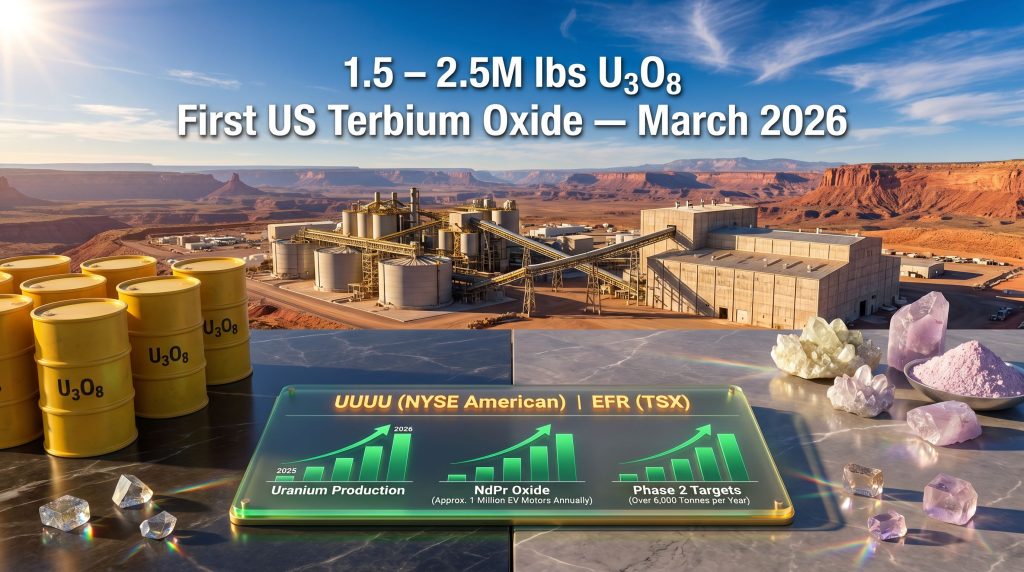
Full-year 2025 uranium production exceeded 1 million pounds of U3O8. For 2026, management has guided for output of 1.5 to 2.5 million pounds, representing growth of between 50% and 150% year-over-year at the guidance range boundaries. The wide range reflects the variability inherent in mine scheduling and ore grade, but the directional trajectory is clearly upward.
Long-term supply contracts with US nuclear utilities extend through 2032 and include price floor provisions, meaning the company receives a minimum guaranteed price per pound regardless of spot market movements. This structure insulates revenue from short-term uranium price volatility and provides multi-year cash flow visibility.
The Russian Import Ban and Its Structural Consequences
The Russian uranium import ban implemented in 2024 removed a historically significant supply source from the domestic utility market. Russia accounted for a substantial portion of US utility uranium procurement prior to the restriction, and the gap created by that policy shift must be filled by domestic producers and allied-nation suppliers.
This structural change benefits established US producers directly. Energy Fuels, as the operator of the only conventional uranium mill in the country, is positioned to capture an expanded share of utility procurement as contracts placed with Russian counterparties reach expiry and require replacement.
Uranium Pipeline: Projects That Could Add Substantial Capacity
Beyond current operations, Energy Fuels holds a development pipeline with meaningful potential to extend production beyond the 2026 guidance range:
| Project | Location | Potential Role |
|---|---|---|
| Roca Honda | New Mexico | Large-scale expansion asset |
| Bullfrog | Utah | Part of multi-project production pipeline |
| Sheep Mountain | Wyoming | Additional capacity contributor |
The combined pipeline is internally described as capable of supporting more than 5 million pounds of annual U3O8 output, though the timing of individual project development decisions depends on uranium pricing and capital allocation priorities. These projects represent optionality rather than committed production, and investors should assess them accordingly.
What Does First US Terbium Oxide Production in Decades Actually Mean?
March 2026: A Milestone That Reframes the Risk Profile
In March 2026, Energy Fuels announced the production of high-purity terbium oxide at the White Mesa Mill, processed from ore sourced in Florida and Georgia. This represented the first documented US primary production of terbium oxide at this scale in decades, and its significance extends well beyond a headline.
Terbium sits within the group of rare earth elements that China restricted from export beginning in early 2025. Its primary application is in neodymium-iron-boron permanent magnets used in electric vehicle drive motors, wind turbine generators, and defence-grade electronics. Prior to March 2026, any US manufacturer requiring terbium for these applications had no credible domestic supply option at commercial quantities.
The March milestone changes that calculus. Producing terbium oxide at high purity from domestically mined ore through a US-licensed facility demonstrates that the full supply chain from rock to certified oxide is technically viable without reliance on Chinese processing infrastructure. This is particularly relevant given the broader critical minerals demand surge reshaping procurement decisions across industries.
Phase 1 Expansion: From Demonstration to Commercial Scale
The terbium production milestone functions as technical validation ahead of the Phase 1 expansion, which targets commercial-scale output of multiple heavy rare earth elements by approximately 2027:
- Terbium oxide (Phase 1 target): Approximately 12 tonnes annually
- Dysprosium oxide (Phase 1 target): Approximately 35 tonnes annually
- NdPr oxide (current 2026 capacity): Sufficient to support approximately 1 million EV motors per year
- NdPr oxide (Phase 2 target by 2029): Over 6,000 tonnes per year, supporting approximately 6 million EV motors annually
Dysprosium is terbium's closest functional counterpart in high-performance magnets. Both elements improve the heat resistance of permanent magnets, a critical performance requirement for EV motors operating under thermal stress. Domestic supply of both is strategically significant for any automotive or defence manufacturer seeking to reduce exposure to Chinese export policy.
Demonstrating that terbium oxide can be produced at high purity before Phase 1 expansion capital is committed reduces the technical risk associated with the next investment tranche. It moves the expansion from a planned capability to a proven one.
How Does the Rare Earth Feedstock Position Compare to What Is Still Needed?
Current Supply Security vs. Development-Stage Dependency
The rare earth expansion requires a consistent and large-volume supply of monazite as feedstock. The current commercial supply position is considerably smaller than what Phase 1 expansion will require:
| Feedstock Source | Location | Current Status | Expected Contribution |
|---|---|---|---|
| Chemours Agreement | United States | Operational at limited volume | Partial near-term supply only |
| Donald Project (JV with Astron Corporation) | Victoria, Australia | Regulatory approvals received June 2025; construction decision pending | Potential delivery by late 2027 |
| Vara Mada Project | Madagascar | Government approvals still required | Longer-term; politically uncertain timeline |
| Brazilian Assets | Brazil | Development stage | Future supply pipeline contributor |
The Energy Fuels-Chemours partnership provides operational supply today but at volumes insufficient to support commercial-scale rare earth oxide production. Consequently, the gap between current secured supply and planned expansion requirements is the most material risk in the company's rare earth thesis.
The Donald Project as the Critical Near-Term Catalyst
The Donald Project in Victoria, Australia, structured as a joint venture with Astron Corporation under which Energy Fuels receives the entirety of the monazite output, is the most advanced of the development-stage feedstock options. Regulatory approvals were secured in June 2025. A construction decision and the timeline for first monazite delivery to the White Mesa Mill, potentially as early as late 2027, represent key data points that investors should track through 2026 reporting periods.
The Vara Mada Project in Madagascar presents a different risk profile. It carries the potential for larger monazite volumes but requires government-level approvals before construction can proceed. Sovereign timeline risk in Madagascar is meaningfully higher than in Australia, and this distinction should inform how investors weight each project's contribution to the feedstock supply plan.
What Does the Australian Strategic Materials Acquisition Add to the Value Chain?
Moving Beyond Oxide: The Alloy Stage Is Where Margin Resides
Announced in January 2026 and targeting a mid-2026 close, the proposed acquisition of Australian Strategic Materials (ASM) represents a deliberate strategic extension down the rare earth processing chain. The value of this move lies in where margin currently sits within the global supply structure.
At present, rare earth oxide producers sell into a processing segment largely controlled by Chinese refiners and alloy manufacturers. The oxide is a partially processed intermediate product. The metals and alloys derived from that oxide command significantly higher pricing and are the direct input required by magnet manufacturers. By acquiring ASM, Energy Fuels would move from selling oxide to supplying finished alloy directly to end-use customers.
The ASM acquisition brings three specific assets:
- A producing rare earth metals and alloys plant in South Korea, currently operational
- A planned US-based alloy manufacturing facility, which would be the first of its kind on American soil upon completion
- A fully permitted development mining project in New South Wales, Australia, with a projected multi-decade mine life per ASM's July 2025 scoping study
Why the Alloy Stage Matters for Margin Capture
The Chinese processing infrastructure that currently handles the transition from oxide to metal to alloy captures a margin layer that Western producers have historically surrendered. If the ASM acquisition closes as targeted, that margin layer moves onto Energy Fuels' income statement rather than being transferred to an overseas processor. For investors focused on long-term earnings potential, this is the most consequential aspect of the deal.
The next major ASX story will hit our subscribers first
How Is Energy Fuels Funded Through Its Development Phase?
Balance Sheet Structure and Institutional Confidence
Energy Fuels holds substantial working capital, the majority held in liquid investments convertible to cash. In late 2025, the company completed a bond offering at a low interest rate, structured to minimise shareholder dilution. The offering was oversubscribed by more than 7 times, meaning institutional demand to provide debt financing at the offered terms significantly exceeded the amount the company sought to raise. That level of oversubscription is an observable signal of institutional confidence in the development plan at debt rather than equity pricing.
Three Financial Metrics to Watch in the May 7 Q1 2026 Results
The first quarter 2026 financial results, scheduled for release before market open on May 7, 2026, represent the earliest opportunity to assess 2026 execution against stated guidance. The three most informative data points available from that release are:
- Working capital consumption rate relative to development milestones achieved during the quarter
- Uranium sales volume and realised price compared to the 1.5 to 2.5 million pound annual guidance trajectory
- Donald Project construction decision status and any update on the ASM acquisition closing timeline
The company is not yet profitable and is unlikely to reach net profitability until rare earth oxide production reaches meaningful commercial revenue scale. Investors should assess the spending rate relative to milestone delivery rather than treating pre-profitability as a standalone negative indicator.
What Does the Leadership Transition Mean for Strategic Continuity?
A Planned Handover With Structural Continuity Built In
Ross R. Bhappu was appointed Chief Executive Officer on April 15, 2026, following the planned retirement of the prior chief executive on the same date. The outgoing CEO has been retained as a paid consultant for two years, available to support Bhappu and the broader leadership team on ongoing and future growth initiatives.
Critically, Bhappu served as President during the period in which the three most consequential strategic decisions of recent years were executed: the Australian Strategic Materials acquisition announcement, the rare earth expansion plan, and the late 2025 bond offering. He was not an external appointment inheriting an unfamiliar strategy. He was an internal architect of it.
For investors evaluating leadership transition risk, the relevant factors are:
- The handover was publicly announced months in advance, not triggered by an unexpected departure
- Institutional knowledge is retained through the consulting arrangement
- The incoming CEO has direct execution history with the current strategic plan
- The May 7 earnings call represents his first public appearance as CEO, providing an immediate opportunity to assess communication style and strategic framing
Medical Isotopes: An Emerging Revenue Stream Beyond Current Guidance
Why Radium Matters and How the Mill Produces It
Targeted alpha therapy is an emerging cancer treatment modality that delivers radiation with high precision directly to malignant cells, minimising collateral tissue damage relative to conventional radiotherapy. Several radium isotopes are active subjects of clinical research for this application, and global supply of these specific materials is currently insufficient to meet clinical trial demand.
The White Mesa Mill produces radium as a natural byproduct of its existing uranium and rare earth processing operations. Because the Mill is already handling radioactive materials in its core workflows, radium recovery does not require a separate processing facility; it emerges from work the Mill is already performing.
The company is planning to produce small research quantities during 2026, with commercial-scale production targeted from 2028, subject to regulatory approvals and commercial agreements. This timeline should frame how investors incorporate this opportunity into their analysis:
- Near-term (2026): Research-quantity production only; no revenue contribution expected
- Medium-term (2027-2028): Pathway to commercial scale subject to regulatory and commercial clearance
- Long-term: A potential additional revenue stream with near-zero marginal input cost relative to existing operations
This is best assessed as optionality, not as a core investment driver. It does not affect the uranium or rare earth investment case in either direction, but if it develops as planned, it represents meaningful upside from materials that would otherwise be treated as process byproduct.
Key Risks Investors Must Weigh Against the Strategic Opportunity
No honest assessment of Energy Fuels' position omits the material risks alongside the strategic advantages. Four risks carry particular weight:
-
Monazite feedstock dependency: The rare earth expansion requires development-stage projects in Australia, Madagascar, and Brazil to progress to production. None are currently in construction. The Donald Project is the most advanced, but its construction decision remained pending as of early 2026.
-
ASM integration execution: Closing an acquisition is distinct from integrating it. The South Korean alloy plant, the planned US facility, and the New South Wales mining project each carry their own execution complexity. Post-close integration risk is real and not yet quantifiable.
-
Pre-profitability capital consumption: Working capital is finite. The rate at which it is consumed relative to milestone delivery will determine whether additional financing is required before the rare earth business generates sufficient revenue to fund itself.
-
Geopolitical and regulatory variables: The Vara Mada Project in Madagascar requires sovereign government approvals. Political timelines in any single jurisdiction are difficult to forecast with precision, and delays could extend the period during which the company depends on limited feedstock supply from Chemours alone.
Frequently Asked Questions: Energy Fuels Rare Earth and Uranium Update
What uranium production volumes is Energy Fuels targeting in 2026?
The company has guided for 1.5 to 2.5 million pounds of U3O8 in 2026, up from over 1 million pounds produced in 2025. The Pinyon Plain Mine in Arizona is the primary growth driver, having delivered a record 638,700 pounds in a single quarter during 2025.
What rare earth elements does Energy Fuels currently produce?
The White Mesa Mill currently separates neodymium-praseodymium (NdPr) oxide at commercial scale and achieved first US primary production of terbium oxide in March 2026. Commercial-scale production of dysprosium, terbium, samarium, europium, and gadolinium is targeted for 2027 under the Phase 1 expansion plan.
What is the White Mesa Mill and why does it matter?
The White Mesa Mill in Blanding, Utah is the only operating conventional uranium processing facility in the United States and the only US facility licensed to separate rare earth oxides from monazite. Its dual-licence status creates a regulatory barrier that competitors cannot overcome quickly regardless of capital available.
What does the Australian Strategic Materials acquisition bring to Energy Fuels?
The deal, announced January 2026 and targeting a mid-2026 close, adds a producing rare earth metals and alloys plant in South Korea, a planned US alloy facility, and a permitted development mining project in New South Wales, Australia. It moves Energy Fuels from oxide producer to alloy supplier, capturing margin currently held within Chinese processing infrastructure.
Is Energy Fuels currently profitable?
No. The company is in an active development and expansion phase. Uranium sales generate revenue and offset a portion of operating costs, but net profitability is not expected until the rare earth expansion reaches meaningful commercial revenue scale.
What is the medical isotope opportunity at Energy Fuels?
The White Mesa Mill produces radium as a natural byproduct of its existing processing operations. Radium is used in targeted alpha therapy, an emerging cancer treatment. Small research quantities are planned for 2026 with commercial-scale production targeted from 2028, subject to regulatory and commercial approvals. This should be treated as optionality rather than a core investment driver.
The Investment Thesis in Structural Terms
The most useful framework for assessing the Energy Fuels rare earth and uranium update is to separate what already exists from what is under construction. The White Mesa Mill is real, operating, and licensed. The uranium contracts are signed and extend to 2032. Terbium oxide has been produced at domestic scale for the first time in decades. The bond offering was oversubscribed sevenfold. These are not projections.
What remains under construction is the rare earth feedstock supply chain, the ASM integration, and the path to profitability. These are genuine risks with genuine timelines, and the gap between the demonstrated asset base and the development-stage ambitions is where most of the investment uncertainty lives. Investors seeking further context on the company's broader strategy can review Energy Fuels' investor releases for the latest operational updates.
Three catalysts converge in mid-2026: uranium production continues scaling toward guidance, the demonstrated rare earth capability advances toward Phase 1 commercial expansion, and the ASM acquisition approaches its targeted close. Each of these on its own would represent meaningful progress. Together, they define a period in which the distance between what Energy Fuels has built and what it is building could begin to close in ways visible in financial results, not just in strategic presentations.
The structural foundation — a single facility holding the only two licences of their kind in the US within markets where Chinese supply restrictions have become operational realities — is unchanged. However, whether that foundation supports the multi-year construction above it depends on execution discipline, feedstock development progress, and the integration capabilities of a leadership team now operating under new management for the first time in years. May 7, 2026 delivers the first data point. Investors who understand the distinction between the foundation and the structure being built upon it are better equipped to interpret what that result actually means.
This article is for informational purposes only and does not constitute financial advice. Readers should conduct their own due diligence before making investment decisions. Forward-looking statements regarding production targets, acquisition timelines, and financial projections involve risks and uncertainties and may not reflect actual outcomes. For ongoing coverage of Energy Fuels and related critical minerals producers, visit cruxinvestor.com.
Want To Be First When the Next Major Critical Minerals Discovery Hits the ASX?
Discovery Alert's proprietary Discovery IQ model delivers real-time notifications on significant ASX mineral discoveries across uranium, rare earths, and more than 30 other commodities, instantly translating complex geological data into actionable investment insights — explore historic discoveries and the extraordinary returns they have generated, then begin your 14-day free trial to position yourself ahead of the broader market.