June 24, 2026
The Strategic Logic Behind Vertical Integration in Rare Earth Supply Chains
For decades, the global rare earth magnet industry operated on a simple but fragile premise: Western manufacturers would design the end products, and China would supply the materials to build them. This arrangement worked well enough during periods of stable trade relations, but it quietly embedded a structural vulnerability into some of the most critical industrial systems on the planet, from fighter jet guidance systems to electric vehicle drivetrains to offshore wind turbines.
The decision by Energy Fuels to acquire Vacuumschmelze GmbH and Co. KG (VAC) for approximately $1.9 billion is not simply a corporate transaction. It represents a deliberate attempt to dismantle that dependency architecture and replace it with something far more resilient. Understanding why this deal matters requires looking beyond the headline figures and examining what it actually takes to produce a finished rare earth permanent magnet, and why no Western company has managed to control that full process until now.
When big ASX news breaks, our subscribers know first
What the Energy Fuels Acquires VAC Deal Actually Involves
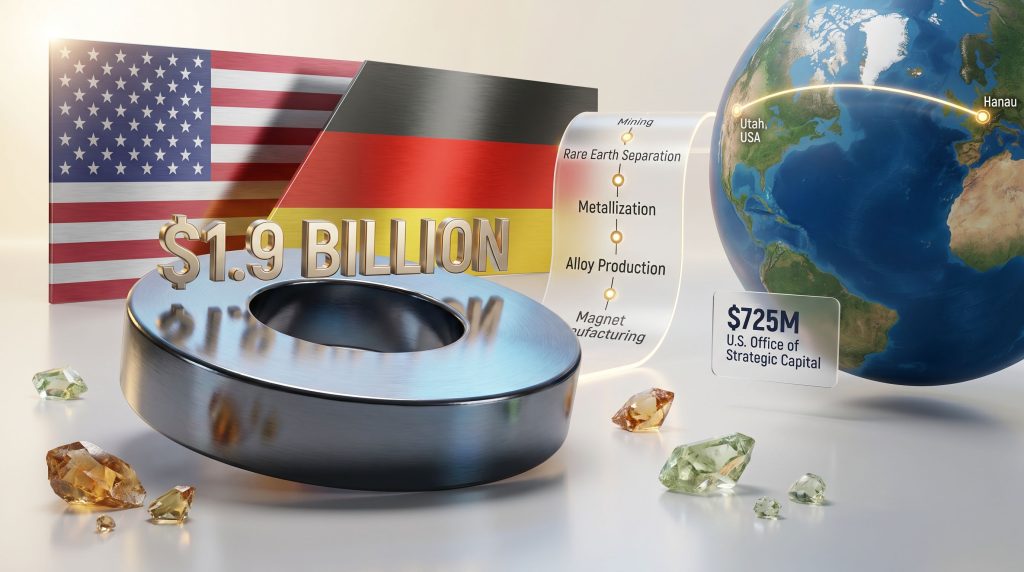
When Energy Fuels acquires VAC, the combined entity gains something genuinely unprecedented in Western industrial history: continuous control over every stage of the rare earth magnet value chain. From ore extraction and separation through to metallization, alloy production, and finished magnet manufacturing, the integrated platform covers a sequence that China has dominated for over three decades. The shifting landscape of rare earth supply chains makes this kind of consolidation increasingly significant.
VAC, headquartered in Hanau, Germany, has been at the forefront of advanced magnetic materials manufacturing for more than a century. The company produces two magnet types that sit at the centre of modern industrial and defence applications:
- Sintered neodymium-iron-boron (NdFeB) permanent magnets, which are the primary magnet type used in EV traction motors, wind turbine generators, and defence guidance systems
- Samarium-cobalt (SmCo) magnets, which are used in high-temperature aerospace applications where NdFeB magnets begin to lose their magnetic properties
The distinction between these two magnet types is worth understanding. NdFeB magnets offer superior energy density at ambient temperatures, making them the preferred choice for mass-market EV motors. SmCo magnets, by contrast, maintain performance at temperatures exceeding 300 degrees Celsius and are used where reliability under thermal stress is non-negotiable, such as in aircraft engines and military electronics.
Energy Fuels brings the upstream counterpart to this equation. Its White Mesa Mill in Utah is the only operating conventional uranium mill in the United States and is already licensed for rare earth processing. This infrastructure, combined with VAC's downstream manufacturing capabilities, creates the integrated stack that no other Western company currently possesses.
Breaking Down the $1.9 Billion Transaction Structure
The financial architecture of the deal reflects both the scale of the ambition and the complexity of cross-border industrial acquisitions. The total equity value of approximately $1.9 billion was calculated based on Energy Fuels' closing share price of $16.12 on June 22, 2026. Reuters has reported on the acquisition in detail, confirming the key terms of the transaction.
| Component | Detail |
|---|---|
| Cash Consideration | $718 million |
| Newly Issued Shares | 65.853 million common shares |
| Total Equity Value | ~$1.9 billion |
| VAC Net Debt Assumed | ~$140 million (as of March 31, 2026) |
| Contingency Preferred Shares | Up to $135 million if share price falls below $20.93 at closing |
| Seller Post-Close Ownership | Ara Partners to hold 19.9% of Energy Fuels |
| Board Rights | Ara Partners gains right to nominate one director |
The seller, private equity firm Ara Partners, will retain a 19.9% stake in the combined entity post-close, aligning its interests with the long-term success of the integration. A contingency mechanism is also embedded in the structure: if Energy Fuels' share price falls below $20.93 at the time of closing, preferred shares valued at up to $135 million are issued to protect Ara Partners against dilution risk. This kind of price protection clause is common in stock-heavy deals where the buyer's share price volatility could materially alter the seller's effective consideration.
On the debt side, Goldman Sachs has committed a $250 million term loan to refinance VAC's existing obligations. Separately, Energy Fuels secured a $725 million conditional loan from the U.S. Office of Strategic Capital on June 18, 2026, directed toward building a domestic rare earth separation and metallisation facility and expanding processing capacity at White Mesa Mill.
It is important to note that the U.S. Office of Strategic Capital loan is a conditional commitment tied to Energy Fuels' broader infrastructure development programme. Readers should not interpret this as project-specific government approval for the VAC acquisition itself, and all financing remains subject to applicable conditions and reviews.
Why VAC's U.S. Manufacturing Footprint Changes the Calculus
One of the less widely reported aspects of this deal is that VAC already has a functioning U.S. manufacturing presence. Its subsidiary, E-Vac Magnetics, operates a production facility in Sumter, South Carolina, and in December 2025 shipped its first batch of commercially produced NdFeB permanent magnets from that site.
This milestone matters for several reasons. It demonstrates that the technical transfer of NdFeB magnet manufacturing to a U.S. facility is not theoretical — it has already happened. The Sumter facility therefore represents a proven domestic manufacturing beachhead that can be scaled with additional capital investment following the acquisition close.
For the broader rare earth supply chain, this is significant because magnet manufacturing is not simply a downstream assembly operation. Producing high-performance sintered NdFeB magnets requires precise control over alloy composition, strip casting, hydrogen decrepitation, jet milling, pressing, sintering, and post-processing magnetisation. Each step is technically demanding, and Western manufacturers largely ceded this expertise to Chinese producers during the 1990s and 2000s as cost pressures drove production offshore.
Furthermore, the critical minerals demand surge anticipated through 2025 and beyond makes the timing of this domestic manufacturing capability especially relevant for Western industrial planners.
China's Export Controls: The Regulatory Catalyst That Changed Everything
No analysis of this transaction is complete without examining the regulatory environment that has dramatically increased the commercial urgency of non-Chinese rare earth manufacturing assets.
On April 4, 2026, China implemented export controls targeting the heavy rare earth additives most critical to high-performance NdFeB magnet production. Specifically, compounds derived from dysprosium and terbium were brought under export licensing requirements. These elements are added to NdFeB alloys to raise their maximum operating temperature, a property technically described as the magnet's coercivity. Without sufficient coercivity, NdFeB magnets in EV motors can demagnetise under the heat generated during high-load operation, causing motor failure.
| Material | Primary Function in Magnets | Export Control Status |
|---|---|---|
| Dysprosium | Increases coercivity in NdFeB alloys | Controlled from April 4, 2026 |
| Terbium | Increases coercivity in NdFeB alloys | Controlled from April 4, 2026 |
| Holmium | Partial substitute for dysprosium in certain grades | Controlled from November 8, 2026 |
| Finished NdFeB Magnets (heavy RE-containing) | EV motors, wind turbines, defence systems | Controlled from April 4, 2026 |
A second tranche of controls was announced on October 9, covering the remaining heavy rare earth elements not captured in the first round, including holmium, which serves as a partial technical substitute for dysprosium in certain lower-temperature magnet grades. These restrictions take effect on November 8. China's export restrictions have had a wide-reaching global impact, accelerating Western efforts to build independent supply capability.
What makes China's phased export control strategy particularly sophisticated is that it targets not just raw materials but finished products as well. By controlling both the inputs and the outputs of magnet manufacturing simultaneously, China has created a dual-layer restriction that limits Western manufacturers' ability to work around the controls by sourcing finished magnets instead of producing them.
The closure of the holmium substitution pathway through the second round of export controls signals that China's regulatory strategy is adaptive. As Western manufacturers identified workarounds, subsequent control rounds were designed to close them.
How the Vertical Integration Model Addresses the Structural Gap
The core insight behind the Energy Fuels and VAC combination is that partial vertical integration does not solve the supply chain security problem. A company that controls rare earth mining but cannot produce finished magnets remains dependent on Chinese processors. Equally, a magnet manufacturer that lacks secure upstream material supply is simply outsourcing its vulnerability rather than eliminating it.
The integrated value chain the combined entity targets looks like this:
- Mining and ore extraction at Energy Fuels' existing resource base
- Rare earth separation at the White Mesa Mill and the planned U.S. separation facility
- Metallisation converting rare earth oxides into metals and alloys
- Strip casting and alloy production producing the magnetic alloy feedstock
- Sintering and magnet manufacturing at VAC's German and South Carolina facilities
Each of these stages has historically been a bottleneck for Western supply chain development. The metallisation step, in particular, is one that few Western companies have meaningfully advanced. Converting rare earth oxides into the neodymium-praseodymium metal alloys used in NdFeB production requires specialised electrochemical reduction processes, and the capital and technical barriers involved have discouraged most Western investment.
Energy Fuels' planned U.S. metallisation facility, supported by the conditional government loan, is consequently a critical missing link that the VAC acquisition alone cannot fill. The two initiatives are complementary: VAC provides the downstream manufacturing capability, while the White Mesa expansion and new processing infrastructure supplies the intermediate materials that feed into it. The broader Energy Fuels strategy has consistently pointed toward this kind of end-to-end integration.
The next major ASX story will hit our subscribers first
Competitive Context: Challenging an 85-90% Market Share
Can the West Realistically Compete?
China's current position in global rare earth permanent magnet production is not simply dominant — it is structurally entrenched. Estimates consistently place China's share of global NdFeB magnet manufacturing capacity at 85-90%, built up over three decades of coordinated industrial policy, integrated supply chains, and artificially low processing costs driven by lower regulatory burdens.
Challenging that position requires more than a single acquisition. It requires a platform capable of competing on quality, reliability, and security of supply rather than on raw cost. The combined entity is positioned to compete on exactly those terms, targeting defence contractors, EV manufacturers, and renewable energy developers who have compelling non-cost reasons to source outside China.
The deal is also expected to be complemented by Energy Fuels' planned acquisition of Australia Strategic Materials (ASM), which would further diversify the upstream resource base and add another node to the emerging Western rare earth platform. In addition, America's rare earth chain is undergoing rapid structural change, with this acquisition forming a central pillar of that transformation.
Key Risks Investors and Industry Observers Should Monitor
Despite the strategic logic, several material risks attach to this transaction that deserve careful consideration:
- Regulatory approval complexity: The deal requires foreign investment reviews including CFIUS in the United States and equivalent mechanisms in the European Union, given VAC's German headquarters. The early 2027 closing timeline reflects the length of these processes rather than any particular concern.
- Share price contingency exposure: If Energy Fuels' stock trades below $20.93 at closing, the preferred share issuance mechanism could dilute existing shareholders by up to $135 million in equivalent value.
- Integration execution risk: Combining a century-old German precision manufacturer with a North American mining and processing company introduces significant operational, cultural, and organisational complexity.
- Capital requirements beyond acquisition cost: Scaling the South Carolina facility and completing the U.S. metallisation infrastructure will require sustained capital deployment that extends well beyond the initial $1.9 billion transaction value.
- Conditions on government financing: The $725 million loan from the U.S. Office of Strategic Capital remains conditional, and investors should not treat it as secured or unconditional funding.
Disclaimer: This article contains forward-looking analysis and references to forecasted outcomes. Nothing in this article constitutes financial or investment advice. Investors should conduct their own due diligence and consult qualified advisers before making investment decisions.
FAQ: Energy Fuels Acquires VAC
What Is the VAC Acquisition by Energy Fuels?
Energy Fuels entered a definitive agreement to acquire Vacuumschmelze GmbH and Co. KG (VAC), a German manufacturer of rare earth permanent magnets including NdFeB and SmCo types, in a transaction valued at approximately $1.9 billion.
How Is the Deal Structured Financially?
The consideration comprises $718 million in cash and 65.853 million newly issued common shares, plus assumption of approximately $140 million in net debt. A contingency mechanism provides up to $135 million in preferred shares if the share price falls below $20.93 at closing.
When Is the Deal Expected to Close?
The transaction is targeted to close in early 2027, subject to foreign investment reviews and antitrust clearances across relevant jurisdictions.
Why Are China's Export Controls Relevant to This Deal?
China's 2026 export controls on heavy rare earth elements and finished NdFeB magnets have created acute global supply shortages, dramatically increasing the strategic and commercial value of non-Chinese magnet production assets like VAC.
What Makes This Deal Historically Significant?
The combined entity would represent the first fully vertically integrated, non-Chinese rare earth supply chain spanning from upstream mining and processing through to finished permanent magnet manufacturing, addressing a structural vulnerability that Western governments have identified as a national security concern.
For ongoing rare earth pricing intelligence, supply chain analysis, and critical materials market data, Fastmarkets provides comprehensive coverage across rare earths and battery raw materials sectors.
Want to Capitalise on the Next Major Mineral Discovery Before the Market Moves?
Discovery Alert's proprietary Discovery IQ model scans ASX announcements in real time, instantly identifying significant mineral discoveries across rare earths and beyond — turning complex data into actionable opportunities for investors at every level. Explore historic discoveries and their exceptional returns, then begin your 14-day free trial at Discovery Alert to position yourself ahead of the market.