June 24, 2026
The Cost Architecture Problem That Has Kept Western Rare Earths Uncompetitive
For decades, the fundamental obstacle blocking Western nations from building sovereign rare earth supply chains has not been a lack of geological endowment. The ore bodies exist. The reserves have been mapped. What has consistently failed is the economics of extraction and processing, particularly for heavy rare earth elements sourced outside of China's ionic clay provinces.
Chinese dominance in heavy rare earth supply is not a geopolitical accident. It is the direct consequence of a cost structure built on in situ recovery (ISR) operations in Jiangxi Province, where ionic clay deposits allow rare earth elements to be dissolved and pumped to surface without conventional mining. Western developers attempting to replicate this output through hard rock mining have faced capital expenditure requirements so prohibitive that no project has successfully closed the cost gap at commercial scale.
That structural impasse is precisely the context in which Cobra Resources' Wudinna project in South Australia demands serious attention. What the company is developing is not simply another rare earth discovery. It is, arguably, the first Western attempt to attack the cost problem at its root, by applying confined aquifer ISR to ionic clay mineralisation in a jurisdiction with an established regulatory framework for exactly this type of operation.
When big ASX news breaks, our subscribers know first
What Makes Ionic Clay Deposits Fundamentally Different From Hard Rock Rare Earth Systems?
Understanding why Cobra Resources rare earth in situ recovery South Australia project matters requires understanding the mineralogical distinction between ionic clay deposits and the hard rock rare earth systems that dominate Western development pipelines.
In conventional rare earth deposits, such as those at Mount Weld in Western Australia or Mountain Pass in California, rare earth elements are bound within mineral lattices that require physical crushing, grinding, and complex chemical processing to liberate. The capital cost of this infrastructure is enormous, and the processing chemistry is technically demanding.
Ionic clay deposits work on an entirely different principle. Over geological timescales, rare earth elements leach from primary minerals and adsorb onto the surface of clay particles within deeply weathered profiles. This adsorption bond is relatively weak and can be broken using mild electrolyte solutions, typically ammonium sulfate or dilute acid. The result is a recovery process that requires no crushing, no grinding, and no physical comminution of any kind.
This distinction is not merely technical. It is the entire basis of China's heavy rare earth cost advantage, and it is the same mechanism that Cobra is attempting to replicate under Australian geological and regulatory conditions.
The ISR method injects leaching solution into a naturally mineralised aquifer, allows it to interact with the adsorbed rare earth ions on clay surfaces, and then pumps the pregnant solution to surface for processing. When the aquifer is naturally confined by impermeable clay layers above and below the target zone, the process operates within what amounts to a geological containment vessel, reducing the risk of solution migration and simplifying the regulatory case for approval.
The Gawler Craton and the Paleochannel Systems That Define Cobra's Tenure
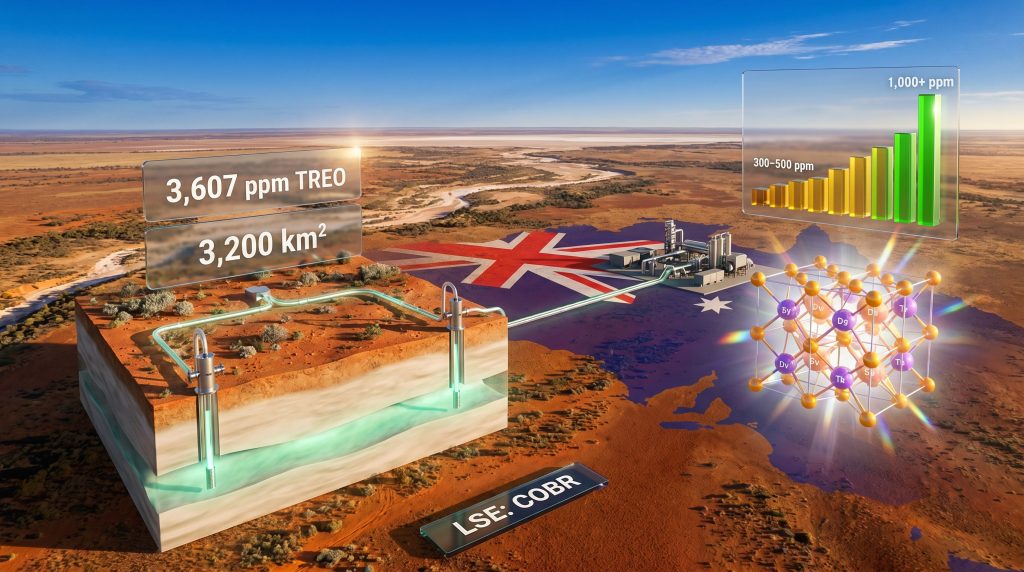
The Wudinna project sits within the Gawler Craton of South Australia, one of the continent's most ancient geological terranes and increasingly recognised as a significant frontier for critical mineral exploration. Cobra holds approximately 3,200 km² of paleochannel systems within this landholding, a scale that points toward regional geological continuity rather than isolated pockets of mineralisation.
Paleochannels are ancient river systems buried beneath younger sediments. These geological features are significant in the context of ionic rare earth exploration because they represent pathways through which weathered material, including rare earth-bearing clay, has been transported and deposited over millions of years. The Pidinga formation, the primary target geology within Cobra's paleochannel systems, is interpreted as likely to extend across the full breadth of the company's tenure.
At both the Boland and Head prospects, mineralisation occurs within a naturally confined aquifer bounded by impermeable clay layers (aquicludes). This hydrological architecture is precisely what ISR operations require. Three distinct lithologies at the Head prospect have been confirmed as amenable to in situ recovery, indicating that mineralogical diversity within the system does not preclude ISR applicability.
Why South Australia's Regulatory Environment Matters
South Australia's experience with uranium ISR operations in the Cooper Basin and elsewhere means that state regulators have existing frameworks for evaluating confined aquifer recovery operations. This is a meaningful practical advantage. Regulatory novelty is one of the most underappreciated risks in critical mineral project development. Where precedent exists, approval timelines compress and stakeholder expectations are better calibrated.
Furthermore, this regulatory context does not constitute project-specific support or accelerated permitting. However, the existence of established frameworks for ISR operations in South Australia reduces one category of development risk that other jurisdictions cannot match. Australia's critical minerals strategy has broadly recognised the importance of building upon such existing regulatory infrastructure.
Drilling Results: What the Numbers Reveal About System Scale and Grade
Cobra has completed 3,200 metres of drilling across 74 holes at both the Boland and Head prospects, representing approximately 80% of the planned programme as of the latest reporting period. Drilling commenced in March 2026 with the objective of generating sufficient data to support a maiden mineral resource estimate.
Head Prospect: High-Grade Continuity Across Five Kilometres
The Head prospect has returned results that define a high-grade, continuous five-kilometre-long mineralised flank, with the system remaining open to both the north and south. This geometric characteristic is critical: open-ended mineralisation indicates that current drilling has not defined the deposit's limits, and that the resource could grow substantially with additional work.
| Intersection | TREO Grade (ppm) | Interval (m) | Depth From (m) |
|---|---|---|---|
| Intersection 1 | 1,232 | 5.9 | 27.8 |
| Intersection 2 | 636 | 6.6 | 26.6 |
| Intersection 3 | 1,322 | 3.8 | 26.1 |
| Intersection 4 | 3,607 | 1.0 | 18.6 |
Results from 12 additional drillholes at the Head prospect remain pending, meaning the full picture of the system has not yet been established. The highest reported intersection of 3,607 ppm TREO over 1 metre is particularly notable. For context, economic cut-off grades at operating ISR mines in Southern China typically sit between 300 and 500 ppm TREO. Intersections exceeding 1,000 ppm are considered high-grade within this framework.
Boland Prospect: Confirming the Original Discovery
The Boland prospect, where Cobra first identified ionic rare earth mineralisation in 2023, continues to deliver consistent results that reinforce the geological model underpinning the entire project.
| Intersection | TREO Grade (ppm) | Interval (m) | Depth From (m) |
|---|---|---|---|
| Intersection 1 | 688 | 3.2 | 40.5 |
| Intersection 2 | 1,004 | 1.05 | 32.6 |
| Intersection 3 | 459 | 5.62 | 21.7 |
The consistency of mineralisation across both prospects, combined with the shallow depths at which most intersections are recorded, supports the viability of ISR extraction. Shallow mineralisation reduces the hydraulic pressure required to circulate leaching solution and simplifies well construction.
Laboratory Metallurgy: The Numbers That Could Redefine Western Rare Earth Economics
Drilling results establish the presence and grade of mineralisation. Metallurgical testing establishes whether that mineralisation can be economically recovered. For Cobra's project, the laboratory data is arguably more significant than the assay results.
Key outcomes from metallurgical testing include:
- Recovery rates of 66 to 68% of target rare earth minerals achieved within a 17-day leaching cycle
- Acid consumption of under 4 kg per tonne of ore, a figure substantially below industry norms for conventional rare earth processing
- Initial product purity of 62.4% TREO, a commercially meaningful concentration for downstream refining
These figures, taken together, suggest an operating cost structure that is qualitatively different from any other Western rare earth project currently in development.
The Self-Generating Acid Phenomenon: A Potential Industry First
The most speculative but potentially transformative characteristic identified at the Wudinna deposit is the suggestion that the ore body may be capable of generating its own sulfuric acid through natural geochemical processes occurring in situ. Sulfuric acid is typically the largest single reagent cost in ISR rare earth operations. If natural acid generation can be demonstrated at field scale, it would effectively eliminate this cost component.
This characteristic has no known precedent among Western rare earth projects. It is important to emphasise that this remains a hypothesis at laboratory and early observational scale. Field validation through the planned pilot programme, targeted for late 2026, will be the critical test of whether this phenomenon can be reliably harnessed at operational scale.
If confirmed, the combination of naturally confined aquifer geometry, low exogenous acid consumption, and in situ acid generation would create a three-layered cost advantage that positions Wudinna at the bottom quartile of the global rare earth production cost curve, competing directly with Chinese ionic clay operations on a cost basis for the first time from a Western jurisdiction.
The Elements That Matter: Heavy Rare Earths and the Magnet Supply Chain
Dysprosium and Terbium: The Bottleneck Elements
The Wudinna project's primary focus is on heavy rare earth elements, specifically dysprosium (Dy) and terbium (Tb). These elements are not the most abundant rare earths, but they are among the most strategically important. Indeed, the strategic importance of rare earths has never been more pronounced than in today's clean energy and defence landscape.
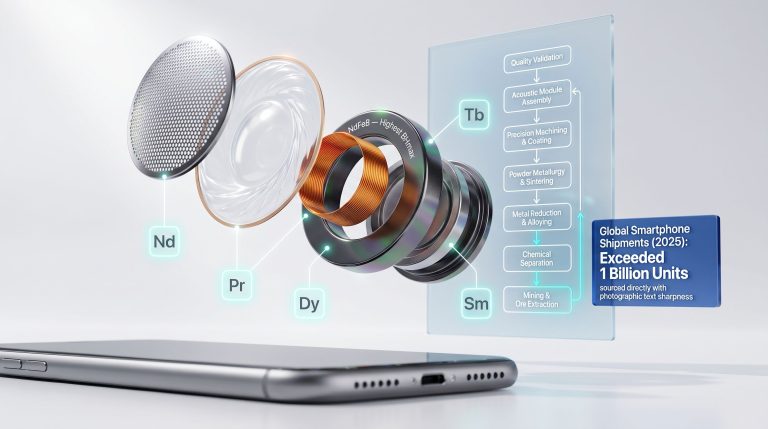
Both dysprosium and terbium are critical additives in neodymium-iron-boron (NdFeB) permanent magnets. Without dysprosium and terbium additions, NdFeB magnets lose their coercivity, meaning their resistance to demagnetisation, at elevated temperatures. This thermal stability is non-negotiable in electric vehicle traction motors and wind turbine generators, where operating temperatures routinely exceed levels that would degrade unmodified magnets.
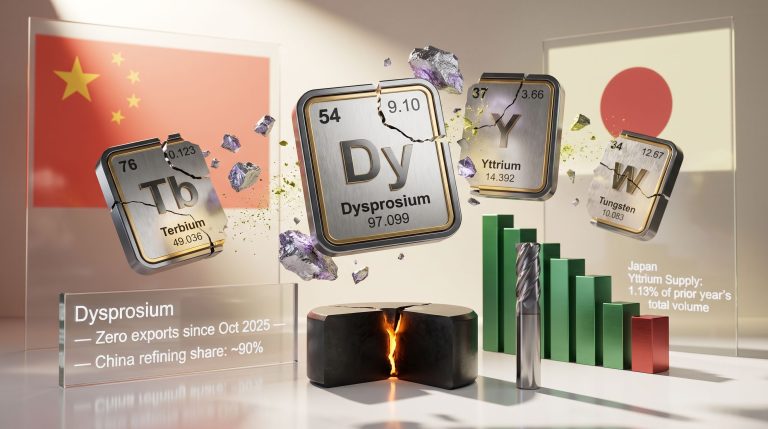
Global supply of both elements is almost entirely sourced from ionic clay deposits in Southern China's Jiangxi and Guangdong provinces. This geographic concentration creates acute supply chain vulnerability for manufacturers in the automotive, defence, and renewable energy sectors. There are no viable technical substitutes for dysprosium and terbium in high-performance magnet applications at current magnet design specifications.
Why This Project Sits at the Intersection of Clean Energy and Defence
The same magnets that drive electric vehicle motors are used in guided munitions, radar antenna systems, and electric drive systems for military vehicles. Heavy rare earth supply security is therefore simultaneously a clean energy imperative and a defence procurement challenge.
The rare earth geopolitical impact of this concentration of supply in a single jurisdiction has prompted Western governments to move swiftly. Australia's own Critical Minerals Strategy acknowledges the need for projects capable of delivering commercially viable non-Chinese supply. Cobra's Wudinna project, as what appears to be the first rare earth ISR operation outside China to demonstrate commercial viability at laboratory scale, sits within this broader strategic context, though no specific government support for the project itself has been confirmed.
The next major ASX story will hit our subscribers first
Comparative Economics: How ISR Stacks Up Against Conventional Rare Earth Mining
| Parameter | Ionic Clay ISR (Wudinna-Style) | Conventional Hard Rock Mining |
|---|---|---|
| Excavation Required | None | Extensive open pit or underground |
| Tailings Generation | Zero | Significant |
| Capital Intensity | Low | Very High |
| Processing Complexity | Moderate | Very High |
| Environmental Footprint | Minimal | Large |
| Time to Production | Faster pathway | Longer development cycle |
| Acid Consumption | Under 4 kg/t (Wudinna) | Much higher |
| Comparable Operations | Southern China ISR mines | Mount Weld, Mountain Pass |
The economic significance of this comparison becomes clear when considering that hard rock rare earth projects in Western jurisdictions routinely require capital expenditure in the hundreds of millions to billions of dollars before first production. The processing infrastructure alone, including cracking and separation circuits, represents a capital barrier that has prevented most Western projects from reaching financial close without substantial government co-investment.
ISR collapses this barrier structurally. The wells, solution management infrastructure, and surface processing plant for an ISR operation represent a fraction of the capital required for equivalent hard rock throughput. This difference in capital architecture is not a marginal improvement; it is a different category of project economics entirely. The rare earth processing challenges facing conventional hard rock developers serve to further highlight why Cobra's approach represents such a significant departure from the norm.
What Comes Next: Resource Modelling and Field Validation
Cobra's managing director Rupert Verco has indicated that the Wudinna project will produce a maiden mineral resource estimate incorporating, for the first time in any global rare earth project, modelling of permeability and acid generation as key economic parameters. This methodological innovation reflects the unique characteristics of the deposit and represents a departure from standard resource estimation practice in the rare earth sector.
The maiden MRE is being targeted across a range of 200 to 400 million tonnes, a scale that, if achieved, would establish Wudinna as one of the more significant ionic rare earth systems identified outside China.
Key development milestones include:
- Completion of the remaining 12 drillhole results from the Head prospect
- Finalisation of the maiden mineral resource estimate incorporating permeability and acid generation modelling
- Field pilot programme scheduled for late 2026 to validate laboratory recovery rates at operational scale
- Downstream infrastructure and processing pathway definition
- Regulatory approvals under South Australia's established ISR framework
No offtake agreements or processing partnerships have been publicly announced at this stage, and downstream commercialisation pathways remain to be defined.
Key Risks Investors Should Understand Before Forming a View
This article contains forward-looking information based on publicly available data and should not be construed as financial advice. All investment decisions should be made with reference to independent professional advice.
Technical and Scale-Up Risks
- Laboratory recovery rates of 66 to 68% must be replicated under field conditions. The transition from controlled laboratory environments to operational ISR wells introduces hydraulic, geochemical, and logistical variables that laboratory testing cannot fully capture.
- The self-generating acid hypothesis is scientifically plausible but unvalidated at field scale. Investors should treat this as a potential upside scenario, not a confirmed operating parameter.
- Resource modelling incorporating permeability and acid generation is methodologically novel. There is no established industry benchmark against which to calibrate the outputs.
Market and Commercial Risks
- Heavy rare earth prices are subject to Chinese export policy decisions, which can create rapid price movements in both directions. China's export controls on rare earths have historically been used as a geopolitical instrument. The critical minerals demand growth trajectory, however, points toward sustained long-term pressure on supply.
- Cobra Resources is listed on the London Stock Exchange (LSE: COBR), not the ASX. Currency exposure, investor base characteristics, and market liquidity differ materially from ASX-listed peers.
- No downstream processing partnerships or offtake agreements have been announced. Commercialisation risk remains a significant open question.
Regulatory and Environmental Risks
- Confined aquifer ISR operations require robust groundwater monitoring frameworks and ongoing stakeholder engagement. Community relations in regional South Australia will be a key pathway management requirement throughout the approval and operating phases.
Frequently Asked Questions
What is in situ recovery mining for rare earths?
ISR is a method that recovers minerals by injecting leaching solution directly into a mineralised aquifer, dissolving target elements, and pumping the resulting solution to surface for processing, without any excavation, blasting, or tailings generation.
What makes Cobra's Wudinna project different from other rare earth projects?
The combination of naturally confined aquifer geometry, laboratory-confirmed low acid consumption, ionic clay mineralisation amenable to ISR, and the potential for in situ acid generation creates a cost structure with no known equivalent among Western rare earth development projects.
What are the highest grades returned by drilling?
The highest reported intersection is 3,607 ppm TREO over 1 metre at the Head prospect. Multiple intersections across both prospects exceed 1,000 ppm TREO, which is considered high-grade relative to operating Chinese ISR benchmarks.
When will a maiden resource estimate be available?
The maiden mineral resource estimate is being targeted following completion of the current drilling programme. Field pilot operations are scheduled for late 2026.
Why does the self-generating acid feature matter economically?
Sulfuric acid is typically the largest single reagent cost in ISR rare earth recovery. If the Wudinna deposit can generate sufficient acid through natural geochemical processes, this cost could be substantially reduced or eliminated, a development with no known precedent in Western rare earth projects.
Is Cobra Resources listed on the ASX?
No. Cobra Resources trades on the London Stock Exchange under the ticker COBR.
A Potential Template for Western Rare Earth Competitiveness
The significance of Cobra Resources rare earth in situ recovery South Australia project extends beyond the boundaries of a single exploration tenement. What the company is attempting to demonstrate is a cost architecture for rare earth production that Western supply chains have never previously possessed.
If field pilots scheduled for late 2026 validate the laboratory recovery rates, and if the self-generating acid hypothesis proves replicable at operational scale, Wudinna would represent the first Western rare earth project capable of competing with Chinese ionic clay operations on a structural cost basis, without requiring permanent government subsidies to remain viable.
The broader implication is systemic. A proven ISR template applicable to ionic clay rare earth deposits could be replicated across similar geological systems wherever they exist, potentially across multiple jurisdictions within the Gawler Craton's 3,200 km² of paleochannel systems alone.
The Wudinna project's value proposition is ultimately not geological. It is architectural. It offers a potential pathway to cost-competitive Western heavy rare earth production that the sector has been searching for since Chinese ISR operations first defined the global cost benchmark decades ago.
For an industry watching China's export control levers tighten and Western magnet supply chains remain structurally exposed, that is a development worth following closely as field validation progresses through 2026 and beyond.
For ongoing coverage of Australia's critical minerals sector and rare earth project developments, readers can explore related reporting available through Mining Weekly.
Want to Track the Next Major ASX Mineral Discovery Before the Market Moves?
Discovery Alert's proprietary Discovery IQ model scans ASX announcements in real time, instantly alerting subscribers to significant mineral discoveries — including critical minerals and rare earths — and translating complex data into actionable investment insights. Explore Discovery Alert's discoveries page to see the historic returns that major mineral discoveries have generated, and begin a 14-day free trial to position yourself ahead of the broader market.