August 20, 2026
Understanding Asia-Pacific's Energy Infrastructure Revolution
Regional power systems across Asia-Pacific are undergoing structural transformation through distributed energy storage architectures that fundamentally alter traditional grid dependencies. Rather than relying on centralised generation models with extensive transmission infrastructure, contemporary energy storage systems enable modular deployment at substations, renewable facilities, and existing power installations using containerised technologies that can achieve commissioning within 81 days.
This shift represents more than technological adoption. Energy storage systems in Asia-Pacific markets create pathways toward energy sovereignty through bankable installations that support grid stability while reducing infrastructure bottlenecks. Unlike conventional power projects requiring multi-year transmission upgrades, modern storage deployments connect at distribution levels, bypassing high-voltage constraints that historically limited renewable integration.
When big ASX news breaks, our subscribers know first
Regional Market Dynamics and Capacity Distribution
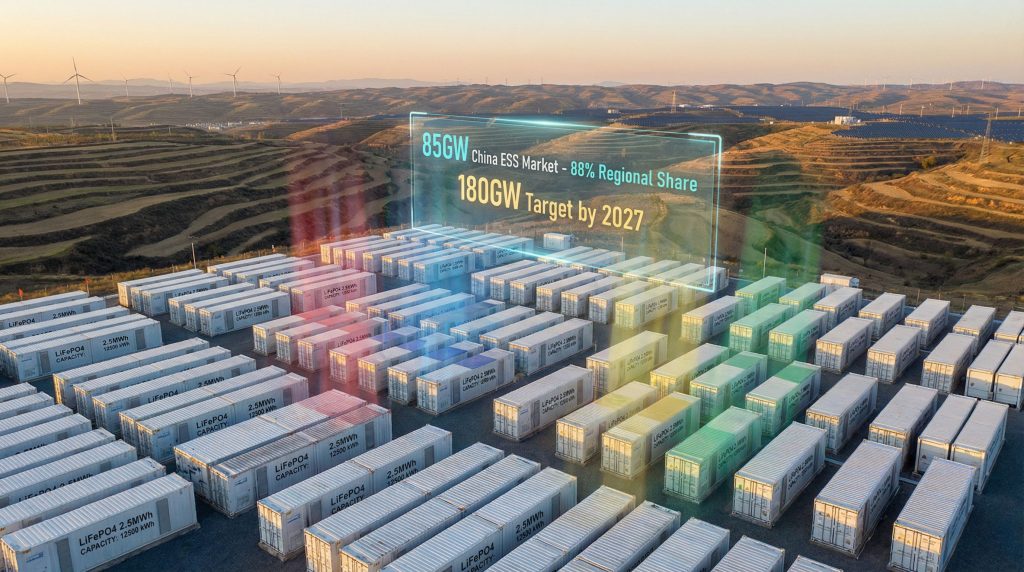
Asia-Pacific energy storage capacity demonstrates concentrated development patterns, with China maintaining 88% of the region's 85GW total capacity as of 2024. Furthermore, this dominance reflects coordinated policy frameworks combined with domestic manufacturing advantages that enable rapid deployment scaling.
| Market | Current Status (2024-2025) | Development Target | Timeline | Strategic Focus |
|---|---|---|---|---|
| China | 85GW (88% regional share) | 180GW capacity | 2024-2027 | Grid stability, renewable integration |
| Australia | Utility-scale concentration | A$500M manufacturing investment | 2025-2030 | Domestic production, energy independence |
| South Korea | 2.22GW target deployment | 563MW auction capacity | 2025-2029 | Industrial pivot, central contract markets |
| Vietnam | 16.3GW capacity target | First major ASEAN commitment | 2025-2030 | Economic diversification strategy |
| Malaysia | 400MW auction launched | Additional auctions planned | 2025-2026 | Dispatchable clean power contracts |
Chinese battery production data illustrates market momentum, reaching 1.29TWh in January-October 2025 compared to 843GWh during the same period in 2024. Additionally, lithium iron phosphate chemistry dominated with nearly 79% of total output, while power-battery installations approached 170GWh in October 2025.
Global Context and Growth Projections
Global energy storage additions reached an estimated 273GWh in 2025, with forecasts indicating 359GWh in 2026, representing 31.5% year-over-year growth. China alone projects 182GWh additions in 2026, accounting for approximately 50.7% of global installations.
Policy Architecture Driving Storage Acceleration
Government frameworks across Asia-Pacific create systematic deployment mechanisms that transform energy storage from experimental technology to essential infrastructure. However, these policies combine direct procurement mandates, integrated renewable-storage requirements, and financial mechanisms that establish bankable investment opportunities.
Chinese Strategic Implementation
- Mandatory storage quotas for renewable project integration
- Grid connection priority designation for storage-equipped facilities
- State-backed financing mechanisms supporting utility-scale deployment
- Domestic manufacturing preferences favouring Chinese battery systems
Regional Government Integration Strategies
Multiple jurisdictions have implemented integrated renewable-storage procurement during 2025, including India, Philippines, Australia, and Malaysia. Consequently, these mechanisms require storage components within renewable projects, creating systematic demand rather than standalone deployment opportunities.
According to EnergyTag Asia Pacific analysis, current regional markets primarily operate through policy-directed mechanisms rather than mature price-signal frameworks. Most jurisdictions lack sophisticated ancillary service structures necessary for merchant energy storage investment, relying instead on tenders, subsidies, regulated tariffs, and state-supported procurement for project bankability.
Market Evolution Pathway
Industry analysis indicates gradual transition potential from policy-dominated deployment toward commercial viability supported by economic fundamentals. However, this evolution remains nascent, with policy mechanisms serving as primary deployment drivers across most regional markets.
Technology Integration and Manufacturing Transitions
Lithium iron phosphate chemistry has emerged as the dominant solution for grid-scale storage across Asia-Pacific markets. This dominance is driven by manufacturing scale advantages, safety characteristics, and project economics supporting 20+ year asset lifecycles.
LFP Technology Advantages
- Enhanced safety profiles suitable for large-scale installations
- Extended cycle life supporting long-term project financing
- Lower material costs enabling competitive project development
- Higher lithium intensity per kWh compared to nickel-rich alternatives
Battery Manufacturer Strategic Repositioning
Leading Asian battery manufacturers are redirecting production capacity from electric vehicle applications toward energy storage systems in Asia-Pacific. This shift reflects market uncertainty in automotive sectors combined with storage market growth potential.
South Korean Manufacturer Transitions
- LG Energy Solution: Planning 1GWh domestic LFP production for ESS applications
- Samsung SDI and SK On: Repurposing EV-dedicated production lines toward storage markets
- Regional Focus: Targeting US ESS opportunities driven by data center and renewable buildout
Furthermore, South Korea's inaugural central contract market auction in 2025 demonstrated significant industry interest, selecting 8 operators from 51 proposals for 563MW capacity deployment.
Lithium Market Implications and Commodity Demand
Energy storage deployment creates substantial new lithium demand streams with different characteristics than automotive applications. In particular, ESS installations typically require 30-50% more lithium per kWh than nickel-rich battery systems due to LFP chemistry requirements and longer-duration applications.
The critical minerals transition demonstrates how energy storage growth influences global supply chains. This transformation affects everything from lithium industry innovations to securing lithium supply strategies across the region.
Demand Structure Analysis
- Grid Storage Applications: Higher lithium intensity per unit capacity
- Renewable Integration: Sustained consumption supporting intermittency management
- Industrial Applications: Stable demand patterns providing market stability
- Policy-Driven Deployment: Government mandates creating demand predictability
Market participants surveyed demonstrate varying degrees of optimism regarding Chinese ESS expansion in 2026. Specifically, estimated growth ranges span 30-100% year-over-year, with consensus emerging that energy storage systems in Asia-Pacific have become the dominant discussion topic in lithium market analysis.
Supply Chain Dynamics
Rapid ESS growth across Asia-Pacific creates new supply chain requirements for battery materials, particularly lithium compounds. Moreover, Chinese domestic storage market expansion, combined with export opportunities, supports sustained commodity demand even during electric vehicle market fluctuations.
Developments such as the battery-grade lithium refinery in India and battery recycling breakthrough initiatives illustrate regional efforts to strengthen supply chain resilience.
Investment Infrastructure and Financial Models
Energy storage systems represent a hybrid asset class combining utility-scale infrastructure characteristics with technology sector growth potential. Consequently, projects typically feature long-term revenue contracts, predictable cash flows, and government policy support appealing to institutional investors.
Investment Characteristics
- Asset Life: 15-20 year operational periods supporting infrastructure investment criteria
- Revenue Streams: Multiple income sources from energy arbitrage and grid services
- Policy Support: Government backing reducing regulatory and development risks
- Grid Services: Frequency regulation, inertia provision, congestion relief capabilities
Regional Development Models
Different Asia-Pacific markets are developing distinct ESS investment frameworks based on regulatory environments, grid characteristics, and economic priorities. Therefore, understanding these patterns enables strategic positioning for technology providers, investors, and commodity suppliers.
European Benchmark Developments
The UK has prioritised 34.5GW of battery storage projects for grid connection, representing approximately one-third of current installed capacity. European annual installations are expected to rise from 10.1GW in 2023 to 17.6GW by 2030, driven by auction mechanisms specifying four-hour duration requirements.
The next major ASX story will hit our subscribers first
Future Development Trajectories Through 2030
Energy storage systems evolution will likely emphasise integration with renewable energy projects, grid modernisation initiatives, and industrial applications. This progression suggests movement from standalone storage toward comprehensive energy system solutions combining generation, storage, and distribution technologies.
Technology Integration Scenarios
Contemporary ESS development increasingly focuses on co-located installations with renewable generation. In China, solar-plus-storage systems accounted for 34% of newly commissioned power-side installations in June 2025, while wind-plus-solar-plus-storage systems represented 46% of new co-located capacity.
Market Maturation Indicators
- Revenue Model Evolution: Transition from subsidised to merchant-based project economics
- Regulatory Development: Integration of storage with renewable energy certificate programs
- Service Market Sophistication: Advanced ancillary service markets supporting project revenues
- Business Model Innovation: Emergence of storage-as-a-service delivery mechanisms
Corporate Sustainability Integration
Greenhouse Gas Protocol consultation on transitioning from annual to hourly clean power matching requirements could substantially increase demand for nighttime clean energy provision. However, proposed requirements generate significant debate and may include flexibility provisions for smaller industries and emerging economies.
Regional Capacity Expansion Commitments
Vietnam's 16.3GW ESS target by 2030 represents the first major ASEAN commitment to grid-scale energy storage, potentially catalysing regional market development. Malaysia's launch of 400MW auctions with additional rounds planned for 2026 demonstrates expanding Southeast Asian participation in energy storage systems in Asia-Pacific markets.
This analysis contains forward-looking projections and market assessments based on current industry data and government policy announcements. Energy storage markets remain subject to regulatory changes, technology developments, and economic conditions that may materially affect deployment timelines and market outcomes. Commodity demand projections should be considered speculative and subject to significant uncertainty.
Want to Capitalise on Asia-Pacific's Energy Storage Boom?
Discovery Alert's proprietary Discovery IQ model provides instant alerts on significant ASX mineral discoveries, including lithium and critical minerals driving the region's energy storage revolution. With Asia-Pacific energy storage capacity projected to reach unprecedented levels by 2030, stay ahead of major discoveries that could transform portfolios and begin your 30-day free trial to secure your competitive advantage.