
August 26, 2026
Energy Infrastructure Development: Regional Oil Export Corridors Transform African Trade Dynamics
Cross-border energy infrastructure projects across Africa increasingly serve as catalysts for regional economic integration, shifting the continent's position within global energy markets. These massive undertakings require sophisticated engineering solutions, multi-billion dollar financing arrangements, and complex diplomatic coordination between sovereign nations. The strategic implications extend far beyond immediate energy exports, creating new trade corridors that reshape regional economic relationships and establish alternative supply chains for international markets.
The emergence of dedicated crude oil export infrastructure represents a fundamental shift in how African petroleum producers access global markets. Traditional export dependencies on established trade routes give way to purpose-built systems designed specifically for regional crude characteristics and production profiles. This transformation creates opportunities for landlocked nations to monetise hydrocarbon reserves while positioning coastal partners as regional energy gateways.
When big ASX news breaks, our subscribers know first
What Makes the East African Crude Oil Pipeline a Game-Changer for Regional Energy Markets?
Transforming East Africa's Energy Export Capabilities
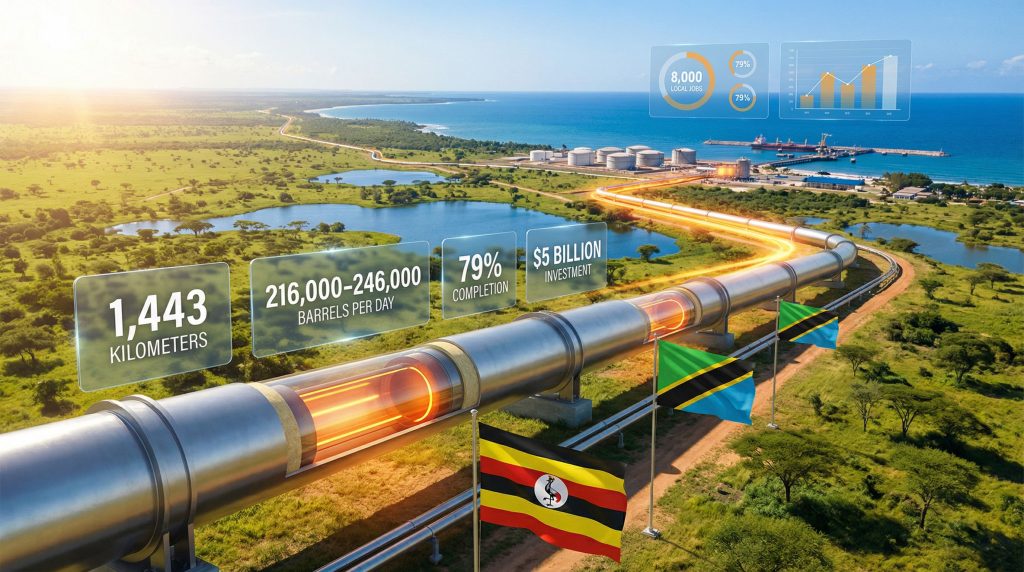
The East African Crude Oil Pipeline establishes the first direct crude oil export corridor connecting Uganda's petroleum reserves to international maritime trade routes through Tanzania. This 1,443-kilometre heated pipeline system addresses a critical infrastructure bottleneck that has prevented the region from monetising significant oil discoveries since 2006.
Key Technical Specifications:
- Total Pipeline Length: 1,443 kilometres from Uganda's Hoima region to Tanzania's coast
- Design Capacity: 216,000 to 246,000 barrels per day export potential
- Advanced Engineering: Heated pipeline technology for waxy crude transportation
- Investment Scale: More than $5 billion total project value
The pipeline's strategic positioning transforms Uganda from a landlocked oil producer dependent on complex logistics into a competitive participant in global crude markets. Furthermore, this geographic connectivity resolves infrastructure constraints that previously limited the region's ability to participate in international energy trade.
Regional export positioning creates strategic advantages through:
• Providing waterborne export access for landlocked petroleum reserves
• Enabling integration of potential Democratic Republic of Congo production (estimated 50,000 barrels per day capacity)
• Creating infrastructure supporting expanded East African energy export capabilities
• Establishing Tanzania as the region's primary crude oil export gateway
Technical Specifications That Define Modern Pipeline Engineering
The East African Crude Oil Pipeline incorporates advanced heating mechanisms specifically required for transporting high-pour-point crude oil across varied terrain and climate zones. This technology maintains temperature levels necessary to prevent waxy crude solidification during the 1,443-kilometre transit from Uganda's production areas to Tanzania's coastal export terminals.
Engineering Challenges Addressed:
- Temperature maintenance across multiple climate zones
- Terrain variations requiring specialised construction techniques
- Flow assurance for waxy crude characteristics
- Environmental protection in sensitive ecological areas
Pipeline burial design minimises surface disruption while maintaining operational efficiency. Consequently, the underground routing protects the system from external interference while preserving ecosystem continuity across protected areas and wildlife corridors.
The heating system represents a critical technical differentiator enabling East African crude exports. Without temperature maintenance, waxy crude would solidify within the pipeline, creating blockages that prevent flow and require costly remediation procedures. For instance, similar global oil futures trends demonstrate how technical specifications directly influence market competitiveness.
How Does EACOP's Construction Progress Impact Regional Investment Flows?
Current Development Milestones and Completion Metrics
Construction progress reached 79% completion as of February 2026, according to EACOP Ltd following an official inspection visit led by Uganda's Minister of Energy and Mineral Development. This advancement represents substantial physical progress on what constitutes one of East Africa's largest ongoing energy infrastructure developments.
Employment Impact Metrics:
- Tanzania Employment: Over 8,000 local jobs created during construction
- Geographic Distribution: Employment concentrated along the pipeline corridor
- Economic Activity: Direct construction spending generating immediate regional economic benefits
The completion status indicates that major construction milestones including pipeline installation, heating system deployment, and terminal infrastructure development have reached advanced stages. However, this progress suggests the project maintains momentum toward operational commencement despite the complex engineering and logistical requirements.
Financial Architecture Behind the $5 Billion Investment
The project's financial structure combines equity and debt financing to fund the massive infrastructure development:
Investment Structure Breakdown:
- Total Project Value: More than $5 billion
- Equity Component: $2 billion from joint venture partners
- Project Financing: $3 billion in debt arrangements
- Risk Management: Performance-based financing tied to completion milestones
Large-scale infrastructure projects of this magnitude typically employ sophisticated risk mitigation strategies including:
• Performance-based financing arrangements linking fund releases to construction milestones
• Insurance and guarantee structures addressing political and commercial risks
• Environmental and social compliance monitoring protocols
• Phased equity deployment reducing early-stage capital exposure
The employment generation of 8,000+ jobs in Tanzania represents direct construction activity rather than permanent operational positions. Nevertheless, this immediate economic impact creates multiplier effects through local spending, skills development, and supply chain engagement in host communities.
What Are the Strategic Implications of July 2026 First Oil Target?
Timeline Analysis and Market Entry Strategy
Tanzania and Uganda target first crude shipment under the East African Crude Oil Pipeline by July 2026, establishing a five-month timeline from announcement to operational commencement. This aggressive schedule requires coordination across multiple complex systems including pipeline operations, marine terminal infrastructure, and export logistics.
Critical Timeline Components:
- Marine Terminal Commissioning: Q1 2026 completion target
- First Oil Shipment: July 2026 operational target
- System Integration: Pipeline-to-port coordination requirements
- Export Preparation: International buyer and shipping arrangements
The July 2026 target moves EACOP from construction and commissioning phases into operational revenue generation. Moreover, this timeline implies that marine terminal infrastructure at Tanzania's coastal export points must reach full operational capability within the next several months, requiring completion of offshore loading systems, tanker berthing facilities, and export logistics coordination.
Understanding how these developments might interact with broader market trends, including oil price rally dynamics and trade war oil market effects, remains crucial for strategic planning.
Regional Port Infrastructure Enhancement Programs
Tanzanian ports including Tanga and Dar es Salaam serve as key export hubs for East African crude oil. Port upgrade initiatives support increased traffic volumes associated with pipeline operations while enhancing Tanzania's position as a regional energy export gateway.
Port Infrastructure Development:
- Crude oil storage capacity expansion at coastal facilities
- Tanker loading systems and marine terminal enhancement
- Quality control and blending capabilities for export operations
- Environmental containment and safety system upgrades
Officials emphasised that ongoing discussions focus on technical aspects related to crude oil export commencement, as well as complementary infrastructure projects including refined petroleum product pipeline systems. In addition, this comprehensive approach positions Tanzania as a multi-energy export corridor supporting both crude and refined product trade.
How Will EACOP Transform Uganda's Economic Landscape?
Unlocking Landlocked Oil Reserves for Global Markets
Uganda's Lake Albert oilfields, discovered in 2006, contain commercially viable reserves that require export infrastructure to generate economic returns. Prior to EACOP development, Uganda lacked the maritime export corridor necessary to participate in international crude oil markets, effectively stranding these petroleum assets.
Reserve Monetisation Framework:
- Discovery Timeline: Lake Albert oilfields identified in 2006
- Production Capacity: 246,000 barrels per day projected output
- Export Capability: 216,000-246,000 barrels per day through EACOP
- Market Access: Direct connection to international crude markets
The pipeline enables Uganda to convert proven hydrocarbon reserves into monetisable assets through direct export capability. Consequently, this transformation shifts Uganda from a petroleum-rich nation dependent on complex logistics arrangements to a competitive participant in global energy markets.
Understanding the broader context of US oil production decline helps illustrate why African production capacity becomes increasingly strategically important.
National Oil Company Integration and Value Chain Development
Uganda National Oil Company (UNOC) participates as a joint venture partner in EACOP operations, providing national government involvement in project ownership and cash flow generation. This structure ensures domestic expertise development while aligning national energy strategy with commercial project operations.
Domestic Value Chain Components:
- Refinery Capacity: 60,000 barrels per day planned processing capability
- Storage Infrastructure: Projected first-place ranking in Africa for new oil storage capacity by 2030
- Production Integration: Tilenga and Kingfisher projects connected through EACOP
- Export Optimisation: Balance between domestic refining and international sales
The 60,000 barrels per day domestic refinery capacity enables Uganda to supply national fuel requirements from domestic crude production. Furthermore, this arrangement reduces dependence on imported petroleum products while creating opportunities for refined product exports to regional markets.
Uganda's projected ranking as Africa's leader in new oil storage capacity by 2030 indicates strategic infrastructure development exceeding immediate production requirements. This storage capability supports export logistics flexibility and enables price risk management through inventory optimisation strategies.
What Environmental and Social Considerations Shape EACOP's Development?
Environmental Impact Management Across Two Countries
The pipeline route incorporates environmental protection measures designed to minimise ecological disruption across sensitive areas including Ramsar wetlands and wildlife corridors. Buried pipeline construction eliminates visible surface infrastructure while maintaining ecosystem continuity.
Environmental Protection Strategies:
- Ramsar wetlands preservation in internationally recognised ecological zones
- Wildlife corridor maintenance through buried pipeline design
- Hydrological impact assessments preventing ecosystem disruption
- Route engineering avoiding critical habitat areas
Pipeline burial design serves multiple environmental objectives including surface restoration, wildlife movement preservation, and agricultural land use continuity. However, this approach enables infrastructure development while maintaining ecological connectivity across protected areas.
Community Engagement and Resettlement Programs
Large-scale infrastructure development requires comprehensive social impact management including displacement mitigation, employment generation, and community investment programs. The project creates immediate employment opportunities while implementing long-term development initiatives in affected areas.
Social Investment Framework:
- Large-scale employment generation during construction phases
- Local skills development and technical training programs
- Community infrastructure investment in affected regions
- Resettlement support and livelihood restoration initiatives
The employment impact of over 8,000 jobs in Tanzania demonstrates immediate economic benefits during construction phases. Nevertheless, sustainable community development requires transition planning from temporary construction employment to permanent economic opportunities linked to operational activities.
The next major ASX story will hit our subscribers first
How Does EACOP Position Tanzania as a Regional Energy Gateway?
Strategic Geographic Advantages for East African Energy Exports
Tanzania's coastal position provides natural advantages for serving as East Africa's primary energy export hub. The country's port infrastructure and maritime connections enable efficient crude oil export while creating opportunities for regional energy trade expansion.
Geographic Strategic Benefits:
- Direct maritime access for landlocked regional petroleum producers
- Established port infrastructure at Tanga and Dar es Salaam
- Regional connectivity enabling multi-country energy integration
- Strategic positioning for expanded East African energy exports
The pipeline establishes Tanzania as the preferred export route for East African crude, creating dependencies that strengthen bilateral trade relationships while generating transit revenues. Consequently, this positioning enables Tanzania to capture value from regional energy development beyond domestic production.
Infrastructure Development Beyond Oil Transportation
EACOP creates foundation infrastructure supporting broader regional energy trade including refined petroleum products, natural gas, and potential cross-border electricity transmission. This multi-energy corridor approach maximises infrastructure utilisation while diversifying Tanzania's energy sector involvement.
Multi-Energy Infrastructure Potential:
- Refined petroleum product pipeline development opportunities
- Natural gas export infrastructure integration possibilities
- Cross-border electricity transmission corridor development
- Regional energy trading hub establishment
Complementary infrastructure projects including refined product pipelines enable Tanzania to serve regional markets requiring processed petroleum products. Moreover, this value-added approach captures higher margins while supporting East African energy security.
What Are the Long-Term Strategic Scenarios for EACOP Operations?
Production Scaling and Capacity Optimisation
Initial operations will focus on system commissioning and production ramping, with capacity utilisation increasing gradually toward full design capability. Technical flexibility enables accommodation of varying crude qualities and volume fluctuations as upstream production develops.
Operational Scaling Framework:
- Phased production increases from initial operations to full capacity
- Technical adaptability for crude quality variations
- Integration with upstream field development timelines
- Maintenance scheduling and system optimisation protocols
The pipeline's design capacity of 216,000-246,000 barrels per day provides flexibility for production optimisation based on upstream development progress and international market conditions. Furthermore, this operational range enables efficient utilisation while accommodating production variability.
Regional Energy Security and Export Diversification
EACOP reduces East African dependence on traditional export routes while creating alternative supply chains for international oil markets. This diversification enhances regional energy security while providing bargaining power in international trade negotiations.
Strategic Security Benefits:
- Reduced dependence on established export corridor bottlenecks
- Alternative supply chain creation for international markets
- Enhanced negotiating position in global energy trade
- Regional energy independence through domestic infrastructure control
The pipeline establishes East Africa as a distinct energy export region with dedicated infrastructure independent of traditional trade routes. In addition, this autonomy enables strategic decision-making aligned with regional interests rather than external corridor dependencies.
How Do International Partnerships Drive EACOP's Success?
Multi-National Joint Venture Structure
The project operates through a joint venture combining international energy companies with national petroleum organisations. TotalEnergies and CNOOC Uganda provide international expertise while Uganda National Oil Company and Tanzania Petroleum Development Corporation ensure national interest representation.
Joint Venture Composition:
- International Partners: TotalEnergies and CNOOC Uganda
- National Companies: UNOC and Tanzania Petroleum Development Corporation
- Technical Expertise: International best practices integration
- Knowledge Transfer: Domestic capability development programs
This partnership structure balances international technical expertise with national ownership, ensuring project success while building domestic petroleum sector capabilities. However, technology transfer arrangements enhance local technical competence for long-term operational sustainability.
Engineering and Construction Partnerships
International contractors including Worley and China Petroleum Pipeline Engineering provide specialised expertise for complex pipeline construction across challenging terrain. These partnerships ensure adherence to international safety standards while meeting aggressive completion timelines.
Construction Management Framework:
- International engineering and construction expertise
- Quality assurance and safety standards implementation
- Technology transfer to local construction partners
- Skills development for regional infrastructure capabilities
International contractor involvement provides access to specialised pipeline construction technologies while creating opportunities for local skills development. Consequently, this approach ensures project quality while building regional infrastructure construction capabilities for future developments.
What Market Dynamics Will Shape EACOP's Commercial Operations?
Global Oil Market Integration Strategy
East African crude will compete in international markets based on quality specifications, pricing competitiveness, and logistics efficiency. The pipeline enables direct market access while reducing transportation costs compared to alternative export routes.
Market Integration Factors:
- International crude pricing and marketing arrangements
- Quality specifications and refinery compatibility assessments
- Long-term offtake agreements and strategic buyer relationships
- Competitive positioning against established crude suppliers
Crude quality characteristics and refinery compatibility determine potential buyer markets and pricing premiums. Furthermore, East African crude specifications influence which international refineries can efficiently process the oil, affecting marketing strategies and long-term commercial arrangements.
These market dynamics must be considered alongside broader trends including OPEC meeting impact on global pricing strategies.
Regional Economic Multiplier Effects
EACOP creates direct economic benefits through construction employment, operational jobs, and infrastructure spending while generating indirect benefits through supply chain development and skills transfer programs.
Economic Impact Categories:
- Direct Employment: Construction and operational job creation
- Supply Chain Development: Local content requirements and business opportunities
- Skills Development: Technical training and technology transfer programs
- Infrastructure Investment: Complementary development projects and regional connectivity
Local content requirements ensure that project spending generates maximum economic benefits within Uganda and Tanzania. Moreover, these provisions create opportunities for local businesses while building supply chain capabilities supporting future energy sector development.
Investment Disclaimer: Energy infrastructure projects involve significant technical, commercial, and political risks. Project timelines, production forecasts, and financial projections are subject to change based on operational performance, market conditions, and regulatory developments. Investors should conduct independent due diligence before making investment decisions related to East African energy infrastructure or petroleum sector developments.
The East African Crude Oil Pipeline represents a transformative infrastructure development with implications extending far beyond immediate energy exports. Success depends on coordinated execution across technical, commercial, and diplomatic dimensions while managing complex environmental and social considerations. The project's impact on regional energy security and economic development will influence East Africa's position in global energy markets for decades to come.
Ready to Capitalise on East Africa's Energy Infrastructure Boom?
Discovery Alert's proprietary Discovery IQ model delivers real-time alerts on significant energy and infrastructure discoveries across the ASX, instantly empowering subscribers to identify actionable opportunities ahead of the broader market. Understand why major mineral and energy discoveries can lead to substantial market returns by exploring Discovery Alert's dedicated discoveries page, showcasing historic examples of exceptional outcomes, and begin your 14-day free trial today to position yourself ahead of the market.