May 11, 2026
Global energy markets navigate unprecedented complexity as traditional supply chain dependencies collide with evolving geopolitical realities. The interconnected nature of crude oil pricing, strategic reserve management, and regional economic planning has created a system where minor diplomatic developments trigger cascading effects across multiple sectors and jurisdictions. Furthermore, the Goldman Sachs oil forecast ceasefire analysis demonstrates how rapidly institutional projections adapt to changing geopolitical circumstances.
Investment Banking Energy Price Modeling Under Uncertainty
Financial institutions deploy sophisticated analytical frameworks to quantify energy market risks, combining historical volatility patterns with forward-looking scenario analysis. These methodologies integrate multiple probability distributions across different time horizons, creating dynamic pricing models that adjust rapidly to changing conditions.
Core modeling components include:
• Geopolitical risk premium calculations using Monte Carlo simulations
• Supply chain disruption probability matrices based on historical precedents
• Demand elasticity modeling under various economic scenarios
• Forward curve arbitrage identification and exploitation opportunities
• Strategic petroleum reserve deployment timing analysis
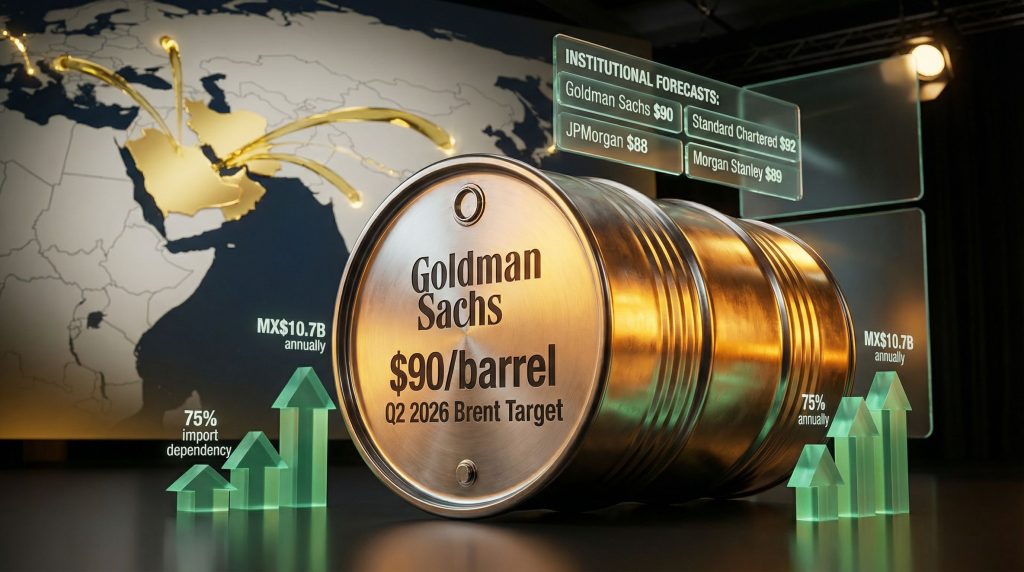
The Goldman Sachs oil forecast revision from $99/barrel to $90/barrel for second quarter 2026 Brent crude exemplifies how quickly institutional projections adapt to evolving circumstances. This $9/barrel adjustment reflects recalibrated risk assessments following diplomatic developments in the Persian Gulf region.
Moreover, this revision aligns with broader industry trends regarding the oil price rally 2025 expectations and their subsequent modifications based on diplomatic progress.
Investment bank forecast convergence patterns:
| Institution | Q2 2026 Brent | Methodology Focus | Risk Range |
|---|---|---|---|
| Goldman Sachs | $90/barrel | Geopolitical modeling | $75-115/barrel |
| JPMorgan | $100/barrel | Physical supply tracking | $85-120/barrel |
| Standard Chartered | $98/barrel | Asian demand integration | $80-110/barrel |
| Morgan Stanley | $80+ structural floor | Long-term fundamentals | $75-105/barrel |
These forecasting variations stem from different analytical emphases rather than fundamental disagreements about market mechanics. Goldman Sachs emphasizes geopolitical risk quantification, while JPMorgan focuses on physical supply tracking and Standard Chartered incorporates Asian demand patterns more heavily into their projections.
When big ASX news breaks, our subscribers know first
Energy Security Risk Premium Decomposition
Energy markets price risk through complex premium structures that reflect multiple layers of uncertainty. The recent diplomatic developments demonstrate how rapidly these premiums can adjust when tail-risk scenarios appear less probable than previously assessed.
Risk premium calculation methodology involves:
• Physical supply threat quantification (measured in millions of barrels daily at risk)
• Transportation chokepoint vulnerability mapping
• Alternative supply route activation cost analysis
• Strategic reserve deployment probability assessments
• Regional demand substitution capacity evaluation
The Strait of Hormuz situation illustrates these dynamics clearly. MarineTraffic data showing more than 400 tankers, 34 LPG carriers, and 19 LNG vessels anchored in the Persian Gulf demonstrates the scale of supply chain disruption beyond simple price volatility.
Pre-ceasefire vs. post-announcement risk adjustments:
| Risk Component | Initial Assessment | Revised Probability | Price Impact |
|---|---|---|---|
| Complete strait closure | 15-20% probability | 5-8% probability | $8-12/barrel premium |
| Alternative routing costs | High uncertainty | Moderate uncertainty | $3-5/barrel premium |
| Strategic reserve timing | 30-day deployment | 60-90 day flexibility | Variable impact |
Regional Economic Exposure Analysis
Resource-dependent economies face multifaceted exposure to energy price volatility, experiencing both revenue opportunities and cost pressures simultaneously. Mexico's fiscal architecture demonstrates these complex dynamics particularly clearly.
In addition, these challenges mirror broader energy transition challenges faced by resource-dependent nations globally as they navigate between traditional energy revenues and diversification imperatives.
Mexico's dual energy exposure structure:
Revenue side benefits:
• Every $1/barrel increase generates approximately MX$10.7 billion in additional federal oil revenues
• 2026 federal budget calibrated at MX$57.8/barrel for Mexican oil mix
• Sustained price elevation above budget assumptions creates fiscal flexibility
Cost side pressures:
• 75% natural gas import dependency from United States creates input cost vulnerability
• Significant refined fuel import requirements expose manufacturing sectors to price volatility
• Transportation and logistics costs transmit energy price changes throughout the economy
This dual exposure creates complex policy trade-offs. Higher oil prices benefit government revenues while simultaneously pressuring industrial competitiveness through elevated energy input costs.
Supply Chain Disruption Economics
Modern energy markets exhibit heightened sensitivity to supply disruptions due to reduced spare capacity and increased just-in-time logistics dependencies. The current situation represents what analysts characterize as the largest oil supply shock on record, with implications extending beyond immediate price effects.
Structural disruption indicators include:
• 2 million barrels per day output loss in severe scenarios
• Strategic inventory rebuilding requirements across multiple regions
• Alternative supply route infrastructure investment acceleration
• Long-term contract renegotiation patterns reflecting new risk assessments
Goldman Sachs maintains its second-half 2026 forecasts at $82/barrel for Q3 and $80/barrel for Q4, suggesting that even diplomatic progress may not fully restore pre-crisis market structures. This indicates a structurally higher price floor relative to historical baselines.
Furthermore, these disruptions intersect with the OPEC production impact assessments, as member countries evaluate optimal production strategies amid geopolitical uncertainties.
Central Bank Monetary Policy Implications
Energy price volatility creates challenging trade-offs for monetary policymakers, particularly in economies with significant commodity exposure. Central banks must balance inflationary pressures from energy imports against disinflationary effects from economic slowdowns.
Policy transmission mechanisms:
• Import price pass-through effects on core inflation measurements
• Exchange rate volatility from commodity revenue fluctuations
• Industrial competitiveness impacts on employment and wage dynamics
• Fiscal-monetary policy coordination requirements during crisis periods
The Banco de México faces particularly complex dynamics as Mexico's energy profile combines export revenue benefits with import cost pressures, requiring nuanced policy responses that consider both inflation control and economic growth objectives.
Market Structure Evolution Under Extended Uncertainty
Prolonged geopolitical tensions drive structural adaptations in global energy trading patterns that often persist beyond the original crisis period. These changes include new bilateral agreements, alternative logistics networks, and enhanced risk management frameworks.
Structural adaptation patterns:
• Enhanced strategic petroleum reserve management protocols
• Diversified supply relationship development
• Alternative transportation infrastructure investment
• Advanced financial risk management instrument creation
Consequently, the US drilling decline patterns observed domestically further complicate global supply calculations as traditional producers reassess investment priorities.
BCA Research analysis suggests that energy and commodity markets are likely to remain on a structurally higher floor regardless of ceasefire outcomes, as governments prioritise strategic stockpiling and supply chain resilience over cost optimisation.
The next major ASX story will hit our subscribers first
Investment Strategy Framework for Energy Volatility
Institutional investors navigate energy sector positioning through sophisticated scenario planning that balances upside capture potential against rapid normalisation risks. This requires dynamic allocation strategies that can adapt to changing probability distributions.
Strategic positioning considerations:
• Upstream versus downstream exposure optimisation based on margin dynamics
• Geographic diversification across energy production basins
• Technology transition timing relative to traditional energy investments
• Currency hedging for international energy asset exposure
European TTF gas price adjustments from €70/MWh to €50/MWh for Q2 2026, with warnings of potential increases above €75/MWh if infrastructure damage occurs, demonstrate the interconnected nature of energy commodity exposures.
Long-term Energy Architecture Transformation
Geopolitical energy crises often accelerate alternative energy investment timelines as governments and corporations seek reduced exposure to volatile supply chains. However, immediate crisis responses may simultaneously delay transition investments as resources focus on short-term security.
Transition acceleration dynamics include:
• Energy independence policy prioritisation across multiple jurisdictions
• Corporate supply chain resilience investment acceleration
• Enhanced funding for alternative energy technology development
• Infrastructure deployment timeline compression in strategic sectors
These competing pressures create investment timing complexities that require careful analysis of both immediate security needs and long-term strategic positioning. For instance, renewable energy transformations in industrial sectors may accelerate as companies seek to reduce dependence on volatile fossil fuel inputs.
Financial Market Integration and Systemic Risk
Energy price volatility transmits through interconnected financial markets via multiple channels, including commodity derivatives, currency markets, and equity sector rotations. The magnitude of recent price movements demonstrates these systemic linkages.
WTI crude fell 16.4% in a single session following ceasefire announcements, while Brent declined 13.3% in the same period. These movements exceeded normal volatility parameters and triggered significant portfolio rebalancing across multiple asset classes.
Cross-asset transmission mechanisms:
• Commodity derivative exposure affecting banking sector stability
• Currency volatility in resource-dependent economies
• Equity market sector rotation between energy and alternative sectors
• Fixed income market impacts through inflation expectation adjustments
Risk Management Evolution in Uncertain Environments
The current environment requires sophisticated risk management frameworks that can adapt to both immediate volatility and longer-term structural changes. Traditional hedging strategies prove insufficient when dealing with unprecedented supply disruption scenarios.
Enhanced risk management approaches include:
• Multi-scenario probability-weighted hedging strategies
• Dynamic correlation modeling across energy commodities
• Geographic diversification optimisation under changing supply patterns
• Alternative energy transition risk integration
Severe scenario planning suggests Brent crude could reach $115/barrel in Q4 2026 under sustained disruption conditions involving approximately 2 million barrels per day of continued output losses. These projections align with Goldman Sachs' warning of potential extreme price scenarios under prolonged disruption conditions.
Regional Policy Coordination Mechanisms
Energy security challenges require coordinated policy responses across multiple jurisdictions, particularly when supply disruptions affect shared transportation infrastructure. The current situation demonstrates both the potential for diplomatic solutions and the fragility of temporary agreements.
International coordination frameworks:
• Strategic petroleum reserve coordination protocols
• Alternative supply route development partnerships
• Diplomatic mediation mechanisms for energy infrastructure protection
• Regional energy market integration acceleration
The two-week ceasefire brokered by Pakistan illustrates how third-party mediation can provide temporary relief while longer-term structural solutions remain under development.
Technology Integration in Energy Market Analysis
Modern energy market analysis increasingly relies on real-time data integration from multiple sources, including satellite monitoring, shipping traffic analysis, and automated trading systems. This technological integration enables more rapid response to developing situations.
Technology-enhanced analysis includes:
• Real-time vessel tracking for supply chain monitoring
• Satellite imagery for infrastructure damage assessment
• Automated trading system response to geopolitical developments
• Enhanced forecasting through machine learning integration
MarineTraffic data providing immediate vessel positioning information demonstrates how technology enables rapid assessment of actual versus announced policy changes.
The Goldman Sachs oil forecast ceasefire adjustment reflects broader challenges in navigating an energy landscape characterised by structural uncertainty and rapid change. While diplomatic developments provide temporary relief from extreme scenarios, the maintained second-half forecasts suggest that fundamental market architectures have shifted toward higher baseline risk premiums.
For investors, policymakers, and energy-dependent economies, this environment requires sophisticated frameworks that balance immediate volatility management with longer-term strategic positioning. The integration of geopolitical risk assessment, financial market dynamics, and regional economic planning becomes increasingly critical as traditional energy security assumptions face ongoing challenges.
Strategic planning priorities include:
• Enhanced supply chain diversification across multiple dimensions
• Flexible policy architectures capable of rapid adaptation
• Investment strategies that capture transition opportunities while managing legacy risks
• International cooperation frameworks that can function under various geopolitical scenarios
The current situation demonstrates that energy market evolution occurs through discrete structural shifts rather than gradual adaptation, requiring analytical frameworks and strategic planning processes designed for discontinuous change rather than incremental adjustment.
Could ASX Energy Investments Navigate Global Market Volatility?
Discovery Alert's proprietary Discovery IQ model delivers real-time alerts on significant energy and commodity discoveries across the ASX, turning complex geopolitical market movements into actionable investment opportunities. With global energy markets experiencing unprecedented complexity and structural shifts, explore Discovery Alert's discoveries page to understand how major mineral discoveries can generate substantial returns, and begin your 14-day free trial today to position yourself ahead of volatile market conditions.