July 19, 2026
Energy Market Risk Premiums and Global Supply Vulnerabilities
Modern commodity markets continuously recalibrate pricing mechanisms to reflect underlying supply-demand fundamentals alongside geopolitical uncertainty. When tensions between major powers intersect with critical energy infrastructure, oil prices rise on U.S.-Iran tensions as markets immediately incorporate potential disruption scenarios into current valuations.
The global energy system operates through interconnected supply chains where regional conflicts can trigger widespread price volatility. Understanding these dynamics requires examining both immediate market responses and longer-term structural shifts that reshape international energy flows. Recent market movements demonstrate how geopolitical events translate into quantifiable economic impacts across interconnected trading networks.
When big ASX news breaks, our subscribers know first
Strategic Waterways and Global Energy Security Frameworks
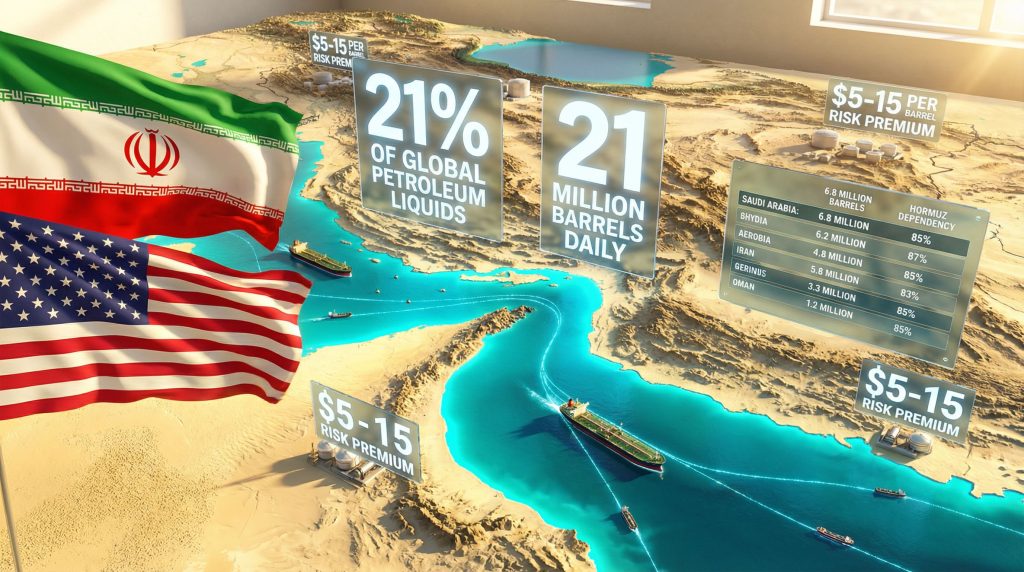
The Strait of Hormuz represents a critical vulnerability in global energy infrastructure, handling approximately one-fifth of worldwide petroleum transit. This narrow waterway between Iran and Oman has become increasingly significant as Asian economies expand their energy consumption profiles. Major Gulf producers including Saudi Arabia, the UAE, Kuwait, and Iraq rely heavily on this transit route for crude oil exports.
Regional Export Concentration:
- Saudi Arabia exports approximately 6.8 million barrels daily, with 85% transiting through Hormuz
- Iran's daily exports of 2.1 million barrels show 95% dependency on the strait
- UAE and Kuwait demonstrate similar reliance patterns for their combined 4.8 million barrel daily exports
- Iraq channels roughly 75% of its 3.8 million barrel daily production through this route
The economic implications of potential disruptions extend far beyond immediate price movements. Maritime insurance rates typically increase by 200-400% during heightened tension periods, while shipping companies implement alternative routing protocols that add 10-15 days to delivery schedules for Asian destinations.
Alternative Transit Infrastructure and Bypass Capabilities
Regional producers have invested substantially in pipeline infrastructure designed to reduce Hormuz dependency. Saudi Arabia's East-West Pipeline can transport up to 5 million barrels daily to Red Sea ports, while the UAE's Abu Dhabi Crude Oil Pipeline provides similar bypass capabilities for 1.8 million barrels daily.
However, these alternatives cannot fully compensate for complete strait closure scenarios. Pipeline capacity limitations and technical constraints mean that sustained disruptions would create significant supply gaps in global markets, particularly affecting Asian consumers who rely heavily on Gulf crude oil imports.
Furthermore, Saudi exploration licenses continue expanding regional production capacity, though this development remains vulnerable to the same transit bottlenecks.
Market Structure Evolution and Price Discovery Mechanisms
Financial Market Integration and Algorithmic Response Systems
Contemporary oil markets feature sophisticated electronic trading platforms where algorithmic systems execute trades based on predetermined risk parameters. When geopolitical events trigger price movements, these systems can amplify volatility through rapid position adjustments across multiple trading venues simultaneously.
Market Participant Response Characteristics:
- Commercial traders typically adjust positions within hours to days following geopolitical developments
- Hedge funds and proprietary trading firms often respond within minutes to hours
- Algorithmic trading systems execute automatic adjustments within seconds to minutes
- Long-term institutional investors generally maintain positions through short-term volatility
This multi-tiered response structure creates complex feedback loops where initial price movements can accelerate through systematic trading responses. Consequently, short-term prices can disconnect from underlying supply-demand fundamentals.
Currency Dynamics and Monetary Policy Transmission
Oil price volatility demonstrates strong correlations with U.S. dollar movements, as global commodity pricing predominantly occurs in dollar-denominated contracts. During geopolitical crises, currency flows often amplify oil price responses through multiple transmission channels.
When tensions escalate, investors frequently seek safe-haven assets, potentially weakening the dollar relative to other major currencies. This currency adjustment makes oil more affordable for international buyers, increasing demand precisely when supply concerns drive prices higher.
In addition, central bank policy responses to oil price volatility can further complicate market dynamics. Rapid price increases often trigger inflation concerns, potentially influencing monetary policy decisions that affect broader economic conditions and energy demand patterns.
Structural Market Changes and Supply Response Capabilities
Unconventional Production Flexibility and Market Responsiveness
The expansion of unconventional oil production, particularly in North American shale formations, has fundamentally altered global market dynamics. These production systems demonstrate significantly faster response times to price signals compared to traditional offshore or complex onshore projects.
However, the US oil production decline in certain mature fields highlights the complexity of maintaining output growth across diverse production regions.
U.S. shale operators typically achieve economic viability at oil prices between $40-60 per barrel, depending on specific geological formations and technological applications. Most importantly, these operations can increase production within 6-12 months of investment decisions, compared to 3-5 year timelines for conventional projects.
This rapid response capability provides market stability during geopolitical disruptions. When oil prices rise on U.S.-Iran tensions, unconventional producers can quickly expand output to partially offset potential supply shortfalls from affected regions.
Strategic Reserve Management and Emergency Response Protocols
Major consuming nations maintain strategic petroleum reserves designed to provide market stability during supply disruptions. The International Energy Agency coordinates emergency response mechanisms among member countries, enabling coordinated reserve releases during crisis periods.
Global Strategic Reserve Capabilities:
- Combined IEA member reserves exceed 1.5 billion barrels
- Emergency release capacity reaches 4-6 million barrels daily
- China maintains additional reserves estimated at 400-500 million barrels
- Coordinated responses can provide 90-120 days of import replacement for major consumers
These reserve systems serve dual purposes: immediate supply replacement during disruptions and psychological market stability through demonstrated government preparedness. Market participants often reduce panic-driven buying when officials announce reserve availability.
Investment Flows and Long-Term Energy Security Strategies
Infrastructure Development and Alternative Supply Routes
Persistent geopolitical risks drive long-term infrastructure investments designed to reduce dependency on vulnerable transit routes. Asian consumers have significantly increased crude oil imports from African producers, reducing relative dependence on Middle Eastern supplies.
Major infrastructure projects reflect these strategic shifts:
- Pipeline connections between Central Asian producers and Asian markets
- LNG terminal expansions enabling flexible natural gas sourcing
- Refinery capacity additions in consuming regions to reduce product import dependency
- Port facility upgrades accommodating larger crude oil tankers for efficient long-distance transport
These investments create more resilient energy supply chains but require substantial capital commitments and extended development timelines. Project economics often depend on sustained geopolitical risk premiums to justify alternative route investments.
For instance, various oil price crash factors could significantly impact the viability of these long-term infrastructure investments.
Technology Innovation and Monitoring Capabilities
Advanced satellite monitoring systems now provide real-time tracking of global oil infrastructure, shipping movements, and production facilities. These technological capabilities enable more accurate assessment of actual supply disruptions versus perceived risks.
Market participants increasingly rely on verified data rather than unconfirmed reports when making trading decisions. This technological evolution reduces information asymmetries that previously amplified geopolitical price volatility through uncertainty and speculation.
Furthermore, recent developments in U.S.-Iran tensions demonstrate how quickly markets respond to verified intelligence regarding potential supply disruptions.
Risk Management Frameworks for Market Participants
Corporate Hedging Strategies and Portfolio Approaches
Professional energy consumers employ sophisticated risk management frameworks combining multiple hedging instruments. Typical strategies involve securing fixed-price contracts for 60-80% of anticipated annual consumption while maintaining flexibility for market opportunities.
Common Hedging Approaches:
- Forward contracts providing price certainty for core consumption requirements
- Options strategies offering upside protection during supply disruptions
- Geographic diversification across multiple crude oil quality specifications
- Financial derivatives enabling risk transfer without physical delivery obligations
Large industrial consumers often establish dedicated trading operations to manage energy price exposure. They treat energy procurement as a specialised financial function rather than simple commodity purchasing.
Scenario Planning and Stress Testing Methodologies
Leading organisations develop comprehensive scenario models incorporating various geopolitical development pathways. These models assess potential operational and financial impacts across different crisis duration and severity assumptions.
Key Modelling Variables:
- Disruption duration ranging from days to multiple months
- Production impact magnitude measured as percentage of global supply
- International coordination effectiveness in emergency responses
- Alternative supply activation speed and capacity utilisation rates
Stress testing results inform both short-term operational decisions and long-term strategic planning processes. This ensures organisational resilience across various geopolitical scenarios.
The next major ASX story will hit our subscribers first
Economic Policy Implications and Trade Dynamics
Tariff Structures and Global Trade Relations
International trade policies significantly influence energy market dynamics, particularly when geopolitical tensions intersect with economic sanctions regimes. The relationship between energy security and trade policy becomes increasingly complex as nations balance domestic production capabilities against import dependencies.
Moreover, Trump tariff implications could reshape global energy trade patterns, affecting how nations approach energy security planning.
Economic sanctions targeting energy infrastructure create cascading effects throughout global supply chains. These impacts extend beyond direct oil trade to affect shipping, insurance, and financial services supporting energy commerce.
Trade War Spillover Effects
Broader trade conflicts often amplify energy market volatility through multiple transmission mechanisms. Currency adjustments, supply chain disruptions, and changing demand patterns create additional complexity for energy market participants.
The US–China trade war impact demonstrates how bilateral trade tensions can affect global energy consumption patterns and investment flows.
These economic dynamics interact with geopolitical risks to create compound effects on oil pricing. When oil prices rise on U.S.-Iran tensions, existing trade tensions can amplify market responses through reduced policy coordination and increased uncertainty.
Market Outlook and Structural Vulnerability Assessment
Supply-Demand Balance Projections and Surplus Conditions
Current market fundamentals suggest growing global oil production capacity relative to demand growth projections. Multiple unconventional production regions demonstrate potential for significant output expansion if economic conditions warrant increased investment.
This supply abundance provides natural market stability during geopolitical crises. When oil prices rise on U.S.-Iran tensions, alternative producers can rapidly increase output to moderate price impacts. Market participants recognise this dynamic, potentially limiting the magnitude and duration of geopolitically-driven price premiums.
However, spare production capacity remains geographically concentrated in specific regions. This creates ongoing vulnerability to coordinated supply disruptions affecting multiple producing areas simultaneously.
Evolving Geopolitical Risk Assessment and Market Adaptation
Energy markets continue developing more sophisticated risk assessment capabilities incorporating historical precedents, current diplomatic developments, and technological monitoring capabilities. Professional traders increasingly distinguish between rhetoric and actionable threats when making position adjustments.
This analytical sophistication reduces market overreactions to routine diplomatic tensions while maintaining appropriate responsiveness to genuine supply threats. The evolution represents market maturation rather than decreased sensitivity to actual geopolitical developments.
Additionally, analysis of oil market tensions provides valuable insights into how professional market participants assess and respond to evolving geopolitical scenarios.
"The integration of advanced monitoring systems with traditional geopolitical analysis creates more nuanced risk assessment capabilities, enabling market participants to distinguish between temporary diplomatic posturing and genuine supply threats," according to leading energy market analysts.
Disclaimer: This analysis is for educational purposes only and does not constitute investment advice. Oil market investments carry substantial risks including price volatility, geopolitical uncertainty, and regulatory changes. Past performance does not predict future results, and investors should conduct comprehensive due diligence before making investment decisions.
Ready to Capitalise on Energy Market Volatility?
Discovery Alert's proprietary Discovery IQ model delivers real-time alerts on significant ASX mineral discoveries, instantly empowering subscribers to identify actionable opportunities ahead of the broader market when geopolitical tensions impact commodity prices. Begin your 14-day free trial today and secure your market-leading advantage across the resources sector.