June 17, 2026
Energy Market Transformation Through Strategic Asset Acquisition
The Asia-Pacific refining sector stands at a critical juncture where decades of market dynamics converge into transformative consolidation patterns. While global energy companies historically maintained regional downstream assets for strategic positioning, evolving demand patterns, demographic shifts, and capital allocation priorities now drive unprecedented asset restructuring across Southeast Asia's most valuable processing hubs.
This transformation reflects deeper structural changes beyond simple ownership transfers. Energy security imperatives, technological advancement cycles, and the emergence of sophisticated trading houses strategies create new competitive dynamics that reshape how refined products reach expanding Asian markets.
The strategic importance of Singapore's refining complex becomes particularly evident when examining current transaction patterns, where Eneos leads bids for Chevron stake in Singapore refinery operations alongside competing offers from major commodity trading entities. This competitive landscape illustrates how different organizational models approach downstream asset valuation, operational integration, and long-term value creation through distinct strategic frameworks.
When big ASX news breaks, our subscribers know first
Understanding the Strategic Context Behind Major Refinery Acquisitions
Japanese Energy Security Imperatives Drive Regional Investment
Japanese energy companies face unprecedented challenges as domestic fuel consumption patterns shift dramatically. The nation imports approximately 90% of its crude oil requirements, creating fundamental vulnerabilities that strategic offshore asset ownership can partially mitigate through supply chain diversification and processing flexibility.
Japan's petroleum demand has declined from 5.5 million barrels per day in 2000 to approximately 3.7 million barrels per day as of 2024, representing a 33% reduction over two decades. This dramatic consumption decrease stems from multiple converging factors: an aging population where 29.1% of citizens exceed age 65 (the highest global proportion), improved energy efficiency standards, and accelerating adoption of electric vehicles in urban transportation networks.
These demographic realities create structural overcapacity in Japanese refining infrastructure. Domestic refineries operate at approximately 71-75% capacity utilisation, compared to Southeast Asian facilities averaging 78-82% utilisation, indicating fundamental market imbalances that strategic offshore investment can address through portfolio rebalancing toward growth markets.
Japanese refinery workers earn approximately ¥5.2 million annually ($47,000 USD), compared to Southeast Asian refinery workers earning $8,000-$15,000 annually, creating substantial operational cost advantages for offshore facilities. When combined with Singapore's regulatory stability and operational excellence, these cost differentials support compelling investment economics for Japanese energy majors seeking margin optimisation.
Currency Diversification Through Strategic Asset Allocation
Japanese energy companies recognise that investing in Southeast Asian refining assets provides geographic diversification that protects corporate portfolios against domestic demand stagnation. Rather than relying solely on aging domestic refinery infrastructure facing declining utilisation rates, companies like Eneos Holdings pursue regional processing hubs to capture higher margins on feedstock processing in growth markets.
The strategic pivot also reflects recognition that Southeast Asian locations offer currency diversification benefits, particularly as the Japanese yen experiences volatility. By investing offshore, Japanese companies hold assets denominated in Singapore dollars, Thai baht, and other regional currencies, creating natural hedges against yen appreciation that can significantly impact import costs and export competitiveness.
Eneos has systematically expanded its Southeast Asian footprint, including stakes in Thai and Vietnamese facilities. The company's 2023 annual report identified downstream Asia-Pacific operations as a strategic growth pillar, with planned capital expenditure exceeding ¥200 billion ($1.8 billion USD) through 2025 for regional refining and trading operations.
Trading House Competitive Advantages Against Integrated Oil Companies
Capital Velocity and Decision-Making Flexibility
Commodity trading houses possess distinct competitive advantages against larger integrated oil companies in certain market conditions. Their organisational flexibility enables rapid decision-making without navigating multi-layered corporate bureaucracies. Trading houses operate profit-maximisation models centred on capturing temporary market inefficiencies rather than pursuing long-term strategic positioning.
Glencore's trading volumes demonstrate this operational scale: the company reported commodities trading revenues of $5.1 billion in 2023, with refining and downstream operations contributing approximately 18% of total revenues ($918 million). Furthermore, Vitol maintains even larger market presence as the world's largest independent crude oil trader, with daily trading volumes exceeding 6 million barrels as of 2023.
Trading houses can redeploy capital 3-4 times annually through rapid portfolio rotations, compared to integrated oil companies with capital locked in long-term assets, enabling higher returns on invested capital despite lower margins per transaction. This capital velocity creates scenarios where trading houses can rationally bid higher prices than integrated competitors because they employ different valuation time horizons.
| Bidder Type | Strategic Advantage | Capital Access | Operational Synergies |
|---|---|---|---|
| Integrated Refiners | Existing infrastructure | Corporate backing | Supply chain integration |
| Trading Houses | Market flexibility | Private capital | Arbitrage opportunities |
| State-backed Entities | Political support | Sovereign funds | National security priorities |
Cost of Capital Differentials and Risk Tolerance
Major integrated oil companies typically access capital at 3.2-3.8% weighted average cost of capital, while private trading houses accessing private equity or sovereign wealth fund capital operate at 5.5-7.2% WACC, creating approximately 2-3% cost disadvantage. However, trading houses compensate through higher risk tolerance and operational agility.
Trading houses maintain higher debt-to-equity ratios (0.8-1.2:1) compared to integrated majors (0.3-0.6:1), reflecting different risk appetites and cost of capital structures. This financial flexibility enables aggressive bidding strategies when market conditions support margin optimisation through arbitrage opportunities.
Regional crude pricing spreads between WTI, Brent Crude, and Dubai Crude create opportunities for trading houses to purchase crude in lower-cost markets and process in premium-margin refining regions. During 2023, WTI-Brent spreads averaged $2.31/barrel, with monthly variations ranging from -$1.25 to +$4.87/barrel, providing substantial arbitrage potential for agile operators.
Glencore's Strategic Refining Acquisition Model
Glencore's 50% joint venture stake in the Shell Bukom refinery sale demonstrates trading house strategy. Rather than acquiring the refinery for long-term production security, Glencore explicitly positioned the asset for margin optimisation through refined product arbitrage, processing crude into finished products and selling into premium-priced Asian markets.
This approach contrasts sharply with integrated oil company acquisition logic, which typically emphasises supply chain integration, operational synergies, and long-term strategic positioning. Trading houses can justify acquisition economics over 5-7 year horizons, accepting higher volatility in returns that would be unacceptable to shareholders of public integrated companies.
Singapore's Strategic Position in Global Refining Markets
Processing Capacity and Global Market Position
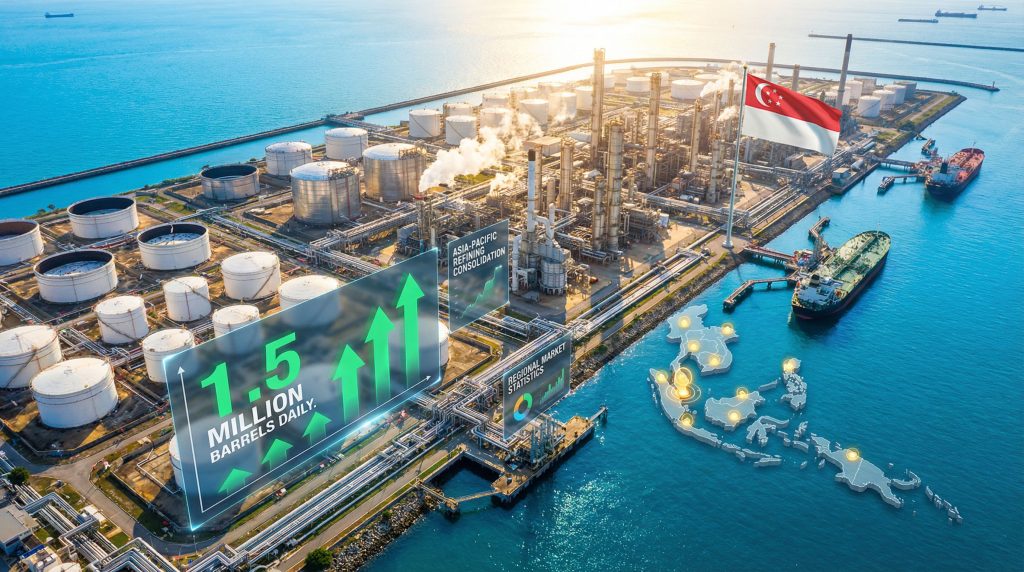
Singapore processes approximately 1.38 million barrels per day across multiple facilities as of 2024, representing the third-largest refining centre globally after Houston (approximately 2.1 million bpd) and Rotterdam (approximately 1.2 million bpd). This scale creates economies of operation and market influence that smaller regional refining centres cannot replicate.
Singapore handles approximately 45% of Asia-Pacific crude oil imports and 40% of petroleum product exports, with total throughput exceeding 2 billion barrels annually across all refining, trading, and storage facilities.
The city-state imports crude oil from approximately 90+ countries, with major suppliers including Saudi Arabia (20%), Russia (15%), Oman (12%), Malaysia (10%), and the United Arab Emirates (9%). This supply diversification reduces vulnerability to single-region disruptions while enabling optimal crude slate selection based on current market pricing and refinery configuration requirements.
Approximately 65-70% of Singapore refined products are exported, compared to 30-35% for domestic consumption, making the location fundamentally export-oriented. This export focus enables operators to capture premium margins in high-demand regional markets while maintaining flexibility to redirect product flows based on changing market conditions.
Infrastructure Advantages and Operational Efficiency
Singapore's deepwater ports accommodate very large crude carriers (VLCCs) with 300,000+ dead-weight tonnage, enabling the lowest per-barrel crude transportation costs globally. Competing ports in Malaysia, Thailand, and Indonesia have depth limitations preventing VLCC access, increasing crude delivery costs by $1.50-$3.00 per barrel.
Jurong Island hosts 25+ petrochemical and refining facilities on a single integrated site, enabling product stream optimisation, shared utilities (steam, water treatment, power), and inter-plant feedstock transfers that reduce operating costs by 8-12% compared to geographically dispersed facilities. This integration creates competitive advantages that are location-specific and difficult to replicate elsewhere in the region.
Singapore's average refinery complexity index of 11.2 is among the highest globally, indicating capability to process challenging crude streams and optimise product yields. Combined with 15-20% higher labour productivity compared to Southeast Asian facilities, these operational metrics demonstrate why Singapore commands premium asset valuations.
Regulatory Environment and Investment Security
Unlike many Southeast Asian jurisdictions with opaque permitting processes and political instability, Singapore offers transparent, predictable regulatory frameworks with minimal expropriation risk. Foreign ownership restrictions are minimal, and environmental standards, while stringent, are clearly defined and consistently enforced.
Singapore has 8 authorised bunkering companies with 45+ service vessels, handling approximately 45 million tonnes of bunker fuel annually, the highest concentration globally. This infrastructure supports the maritime industry while creating additional revenue streams for refinery operators through marine fuel supply contracts.
The regulatory environment distinguishes Singapore from competing refining hubs through institutional characteristics that reduce sovereign risk premiums and regulatory uncertainty costs for foreign investors. These advantages become particularly important when international energy companies evaluate long-term capital deployment across multiple jurisdictional options.
Major Oil Company Divestiture Patterns
Strategic Retreat from Non-Core Regional Assets
Major oil companies have divested approximately $8-12 billion in Asian refining assets since 2020, signalling strategic shift toward upstream and renewables investment priorities. This divestiture pattern reflects fundamental changes in how integrated oil companies approach capital allocation and geographic portfolio optimisation.
Shell's divestiture of the 260,000 bpd Bukom refinery to a Glencore-PT Chandra Asri joint venture represented recognition that non-core refining assets in mature markets no longer aligned with Shell's strategic pivot toward renewables and upstream operations. The sale price reflected strong bidding competition from trading houses seeking margin optimisation opportunities in Asia's high-demand environment.
The current transaction involving Chevron's 50% stake in the 290,000 bpd Singapore Refining Company reflects identical strategic logic where multinational oil majors retreat from non-core downstream operations in favour of capital allocation toward upstream and energy transition investments. Eneos leads bids for Chevron stake in Singapore refinery operations, competing against Glencore and Vitol for this strategic asset.
Capital Reallocation Toward Energy Transition
This divestiture trend accelerates as major oil companies face pressure to demonstrate progress toward carbon neutrality commitments and energy transition investments. Rather than maintaining downstream assets that generate steady but modest returns, these companies increasingly prioritise higher-return upstream projects and renewable energy infrastructure that align with evolving investor preferences.
In addition, the timing of these divestments coincides with record-high refined product margins and strong demand growth in Asian markets. However, this suggests that strategic considerations outweigh short-term financial optimisation in corporate decision-making processes.
Financial Architecture of Modern Refinery Transactions
Valuation Methodologies Across Buyer Categories
Industry analysis suggests integrated oil companies can achieve 8-12% operational synergies when acquiring downstream assets through supply chain integration, compared to trading houses capturing only 2-4% synergies primarily from market arbitrage opportunities. These synergy differentials directly impact valuation approaches and bidding strategies across different buyer categories.
Replacement cost analysis for capacity-constrained markets forms the foundation for most refinery valuations, particularly in regions where environmental regulations and land scarcity prevent new facility construction. Singapore's land constraints and regulatory complexity create substantial barriers to greenfield refinery development, supporting premium valuations for existing facilities.
Cash flow multiples based on regional crack spread projections typically range from 4-7x EBITDA for Asian refineries, depending on facility complexity, product slate optimisation capability, and market access characteristics. Singapore facilities command premium multiples within this range due to operational efficiency and export market access.
Risk Assessment and Due Diligence Considerations
Carbon pricing policies significantly impact long-term refinery competitiveness and investment returns. Singapore's escalating carbon tax trajectory through 2030 creates operational cost pressures that buyers must incorporate into valuation models and investment decision frameworks.
| Carbon Price Level | Operational Impact | Investment Response | Competitive Position |
|---|---|---|---|
| $25-50/tonne | Moderate cost increase | Efficiency upgrades | Maintained viability |
| $50-100/tonne | Significant margin pressure | Technology investment | Selective operations |
| $100+/tonne | Fundamental restructuring | Asset rationalisation | Market consolidation |
Environmental compliance costs represent increasingly significant components of total ownership expenses. Emissions reduction mandates require capital investment, while fuel specification changes create both processing challenges and competitive opportunities for technologically advanced facilities.
The next major ASX story will hit our subscribers first
Regional Demand Patterns and Market Dynamics
Asia-Pacific Fuel Consumption Projections
Southeast Asia's refining capacity has grown from 3.4 million barrels per day in 2010 to approximately 4.8 million barrels per day in 2024, representing a 41% expansion driven by economic development, population growth, and industrial expansion across the region.
Aviation fuel recovery following pandemic travel normalisation creates substantial demand growth potential for refineries capable of producing high-quality jet fuel. Singapore's strategic location for regional air travel hubs makes jet fuel production a particularly valuable capability for facility operators.
Petrochemical feedstock demand from manufacturing expansion throughout Southeast Asia supports higher-value product streams beyond traditional transportation fuels. Facilities with petrochemical integration capabilities can capture premium margins through naphtha and other specialised feedstock production.
Marine fuel specification changes driven by international environmental regulations create processing requirements that favour technologically advanced refineries capable of producing compliant bunker fuels. Singapore's position as a major bunkering hub amplifies this competitive advantage.
Market Concentration Effects and Pricing Power
Refinery acquisitions by major trading houses and integrated companies gradually increase market concentration in Singapore and broader Southeast Asian markets. This consolidation trend can create pricing power advantages for facility operators, particularly during supply disruptions or peak demand periods.
Crack spreads (refining margins) in Singapore average 0.5-2.5% higher than competing Southeast Asian facilities, reflecting operational efficiency and product quality premiums that support sustainable competitive advantages. These margin differentials justify premium acquisition valuations and support long-term investment returns.
Risk Factors and Strategic Considerations
Geopolitical and Regulatory Uncertainties
US-China trade war impacts significantly affect regional commerce patterns and energy flows. Trade tensions can disrupt crude supply routes, alter product demand patterns, and create regulatory compliance challenges for international energy companies operating across multiple jurisdictions.
ASEAN economic integration creates new market opportunities through reduced trade barriers and standardised regulatory frameworks. However, political instability in certain member countries introduces operational risks that sophisticated investors must evaluate when deploying capital across the region.
Maritime security concerns in critical shipping lanes, particularly the Strait of Malacca, create operational vulnerabilities for Singapore-based refineries dependent on crude imports and product exports. These risks require comprehensive contingency planning and insurance coverage that increases operational costs.
Energy Transition Impact Assessment
Japan's commitment to reduce greenhouse gas emissions 46% by 2030 and achieve carbon neutrality by 2050 prompts energy companies to prioritise flexible refining infrastructure capable of processing diverse feedstocks and supporting energy transition initiatives. This regulatory environment influences long-term asset valuations and investment strategies.
Circular economy initiatives create potential revenue streams through recycling and waste-to-energy operations, while carbon capture integration possibilities offer future compliance pathways for facility operators facing increasingly stringent environmental regulations. Consequently, these factors will impact Australia's energy exports challenges moving forward.
Investment Decision Framework and Performance Metrics
Key Performance Indicators for Transaction Success
Utilisation rate optimisation against regional capacity provides fundamental performance measurement for refinery acquisitions. Singapore refineries must maintain high utilisation rates to justify premium acquisition costs and generate acceptable returns on invested capital.
Margin capture efficiency relative to benchmark facilities demonstrates operational excellence and competitive positioning. Successful acquirers must achieve margin performance that exceeds regional averages through operational improvements, feedstock optimisation, or product slate enhancement.
Trading houses typically target 12-18% ROA on refining assets, while integrated oil companies historically accept 6-10% ROA as acceptable given strategic synergy considerations. These return expectations directly influence bidding strategies and acquisition financing structures.
Long-Term Value Creation Strategies
Regional demand growth correlation with facility capacity ensures that refinery investments align with expanding market opportunities rather than mature or declining consumption patterns. Southeast Asian demographic trends and economic development support favourable demand projections for well-positioned facilities.
Technology upgrade pathways for competitive positioning enable facility operators to adapt to changing product specifications, environmental regulations, and feedstock availability. Investment in advanced processing technologies creates sustainable competitive advantages and supports premium market positioning.
Partnership synergy realisation through operational integration allows acquirers to capture value beyond standalone facility operations. Joint venture structures with local partners can provide market access, regulatory expertise, and operational knowledge that enhance long-term returns.
Market Implications and Future Outlook
The current energy market environment reflects broader structural shifts affecting global refining dynamics. While an oil price rally might boost short-term margins, oil price stagnation could pressure long-term investment returns for refinery operators.
For instance, Bloomberg reports that the competition for Chevron's Singapore assets reflects broader industry consolidation trends, where strategic buyers seek to capture synergies through operational integration and market positioning.
The competitive landscape where Eneos leads bids for Chevron stake in Singapore refinery operations demonstrates how different strategic approaches to downstream asset ownership create value through distinct operational models and market positioning strategies. Success in this environment requires sophisticated understanding of regional market dynamics, regulatory frameworks, and long-term energy transition implications that will shape profitability over the asset lifecycle.
Want to Capitalise on Australia's Next Energy Discovery?
Discovery Alert's proprietary Discovery IQ model provides instant notifications when significant ASX energy and mineral discoveries are announced, empowering subscribers to identify actionable opportunities ahead of the broader market. Explore Discovery Alert's dedicated discoveries page to understand how major discoveries can generate substantial market returns, then begin your 30-day free trial to position yourself ahead of the market.