
August 14, 2026
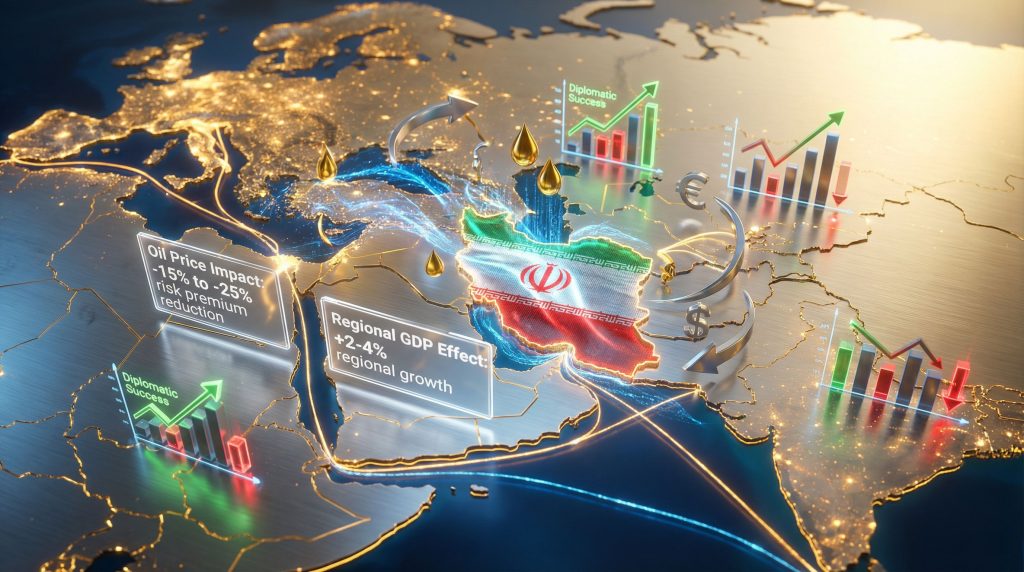
Energy markets face unprecedented complexity as geopolitical tensions intersect with domestic policy uncertainties, creating multi-layered volatility patterns that challenge traditional risk assessment models. The intersection of nuclear diplomacy and economic sanctions represents one of the most significant drivers of global energy pricing dynamics, where diplomatic progress can instantly reshape supply expectations while simultaneously triggering broader macroeconomic concerns about trade policy stability. Furthermore, ongoing Iran nuclear talks demonstrate how diplomatic developments can create immediate market reactions that ripple through global commodity pricing.
Nuclear Negotiations and Energy Market Volatility
The relationship between diplomatic developments and commodity pricing reveals sophisticated market psychology that extends beyond simple supply-demand calculations. Recent trading sessions demonstrate this complexity, with Brent crude futures declining to $71.01 per barrel (down 1.05% or 75 cents) and WTI crude settling at $65.74 per barrel (down 1.11% or 74 cents) as diplomatic signals competed with macroeconomic uncertainty for market attention.
Risk premium calculations in energy markets incorporate multiple probability scenarios, each weighted according to perceived likelihood and potential impact magnitude. The 5% price rally observed in the previous week reflected heightened conflict probability assessments, demonstrating how quickly geopolitical risk premiums can accumulate in commodity pricing structures.
Market sentiment indicators reveal competing forces at work. While diplomatic progress typically reduces supply disruption risks, concurrent policy developments create demand-side uncertainties that offset geopolitical de-escalation benefits. This dynamic illustrates the interconnected nature of modern energy markets, where regional diplomatic developments cannot be analysed in isolation from broader economic policy frameworks.
Energy security implications for major importing nations extend beyond immediate supply availability concerns. Nations must now consider diplomatic volatility as a structural component of energy planning, incorporating probabilistic scenarios for rapid policy shifts that can alter supply chains within weeks rather than months.
Risk Assessment Frameworks
Modern energy risk assessment requires multi-variable modelling that accounts for:
- Diplomatic cycle timing relative to domestic political calendars
- Sanctions architecture complexity and third-party compliance costs
- Alternative supply route development timelines and capacity constraints
- Strategic reserve adequacy under various disruption scenarios
The interconnection between domestic political considerations and international energy policy creates feedback loops that amplify volatility. However, as the us economy tariffs 2025 inflation debt situation demonstrates, analyst assessments suggest that domestic political calendars increasingly influence military decision-making timelines, with voter sentiment considerations becoming integral to geopolitical risk calculations.
When big ASX news breaks, our subscribers know first
Economic Sanctions Architecture and Market Dynamics
Sanctions regimes function as complex economic lever systems, where primary restrictions create cascading effects throughout global trade networks. The current framework demonstrates how economic pressure mechanisms can drive diplomatic engagement by increasing the opportunity costs of continued confrontation relative to negotiated resolution pathways.
Iran's expressed willingness to make nuclear program concessions in exchange for sanctions relief and uranium enrichment recognition rights illustrates the economic calculus underlying diplomatic positioning. This cost-benefit analysis reflects the substantial economic isolation costs accumulated over extended sanctions periods.
The global oil supply chain impact extends beyond direct export restrictions to encompass:
- Banking system limitations affecting trade finance availability
- Shipping and insurance constraints increasing transportation costs
- Technology transfer restrictions limiting infrastructure development
- Investment capital flight reducing long-term capacity building
Secondary sanctions effects create compliance costs for international firms, generating economic pressure that extends sanctions impact beyond target nation boundaries. These spillover effects amplify the economic incentives for diplomatic resolution while simultaneously increasing the political costs of sanctions maintenance for implementing nations.
Regional trading partnership adjustments reflect sanctions-induced economic realignment, with alternative bilateral arrangements emerging to circumvent restrictions. In addition, similar patterns can be observed in canada's energy transition, where these adaptations demonstrate market resilience while simultaneously creating new dependencies that complicate future diplomatic calculations.
Sanctions Relief Economic Modelling
Historical precedent from the Joint Comprehensive Plan of Action (JCPOA) period (2015-2018) provides quantitative insights into sanctions relief impacts:
| Economic Indicator | Pre-Relief Baseline | Post-Relief Change | Recovery Timeline |
|---|---|---|---|
| Oil Production Capacity | ~2.5 million b/d | +52% to ~3.8 million b/d | 18-24 months |
| Non-oil Sector Investment | Severely constrained | Foreign joint ventures resumed | 12-18 months |
| Banking System Integration | SWIFT disconnection | Partial international connectivity | 6-12 months |
| Currency Stability | High volatility | Gradual stabilisation | 24-36 months |
These metrics demonstrate that sanctions relief generates measurable economic benefits across multiple sectors, though full integration requires extended timeframes for infrastructure reconstruction and investor confidence rebuilding.
Regional Energy Security Considerations
Middle Eastern energy producers face strategic calculations that balance production maximisation against infrastructure vulnerability management. The regional security environment creates complex interdependencies where individual nation policies affect collective supply stability through shared infrastructure networks and transportation chokepoints.
Production capacity resilience varies significantly across regional producers, with diversified economies demonstrating greater stability during crisis periods compared to oil-dependent nations. Infrastructure vulnerability assessments reveal concentrated risk points that affect multiple producers simultaneously, particularly in pipeline networks and maritime transportation routes.
The Strait of Hormuz represents a critical vulnerability, with approximately 20-21% of global petroleum transit depending on this single chokepoint. Any disruption scenario affecting this waterway creates immediate global supply constraints that cannot be fully offset through alternative routing, regardless of spare production capacity availability elsewhere.
Alternative supply route development strategies focus on pipeline infrastructure that bypasses vulnerable maritime chokepoints. However, these projects require multi-year development timelines and substantial capital investments that may not provide adequate short-term supply security improvements.
Energy alliance formations increasingly incorporate security partnership elements, with producing nations coordinating defensive capabilities to protect shared infrastructure assets. Furthermore, saudi exploration licenses impact these arrangements represent evolution beyond traditional OPEC production coordination toward comprehensive security cooperation frameworks.
Infrastructure Resilience Analysis
Regional infrastructure vulnerability assessments identify several critical risk factors:
- Concentrated processing facilities creating single-point-of-failure scenarios
- Cross-border pipeline networks subject to multiple jurisdiction risks
- Port infrastructure limitations constraining alternative export routing
- Maintenance capacity constraints during extended crisis periods
Historical damage assessment data from previous conflicts demonstrates that infrastructure recovery timelines extend significantly beyond conflict cessation periods. The 2019 Saudi Aramco facility attacks, for instance, temporarily removed approximately 5.7 million barrels per day from global supply, illustrating the immediate impact potential of targeted infrastructure disruptions.
Recovery protocols require pre-positioned repair capabilities and alternative production scheduling arrangements that many regional producers have developed following previous crisis experiences. However, these preparations cannot fully eliminate vulnerability to coordinated or sustained disruption scenarios.
Consumer Nation Hedging Strategies
Major energy consuming nations employ sophisticated portfolio approaches to manage supply disruption risks, combining strategic reserve management with diversification strategies and emergency response coordination mechanisms. These approaches have evolved significantly following previous supply crisis experiences, incorporating lessons learned from both market-driven and geopolitically-induced disruptions.
Strategic Petroleum Reserve (SPR) utilisation strategies balance immediate crisis response capabilities against long-term reserve adequacy requirements. The optimal reserve level calculations incorporate probability-weighted disruption scenarios, considering both duration and magnitude variables for different crisis types.
Diversification strategies for energy import portfolios focus on supplier geographic distribution and contract term structure optimisation. Nations seek to minimise single-source dependencies while maintaining sufficient supply volume to meet baseline consumption requirements under various disruption scenarios.
Emergency response protocols coordinate between national governments and international organisations, particularly through International Energy Agency (IEA) frameworks that enable coordinated reserve releases and supply sharing arrangements during major disruptions.
Long-term energy transition planning incorporates geopolitical risk reduction as a strategic objective, with renewable energy deployment and efficiency improvements reducing overall import dependencies that create vulnerability to supply disruptions.
Reserve Adequacy Assessment
Current strategic reserve levels relative to potential disruption scenarios vary significantly across major consuming nations:
- United States: SPR capacity covers approximately 140 days of import requirements
- China: Strategic reserves estimated at 90-120 days of import needs
- Japan: Combined reserves provide 200+ days of import coverage
- India: Strategic reserves currently cover approximately 36 days of imports
These reserve levels reflect different vulnerability assessments and economic capacity constraints. Nations with higher import dependencies typically maintain larger strategic reserves relative to consumption patterns, while countries with diverse supply sources may accept lower reserve ratios.
Emergency response coordination mechanisms have been tested through coordinated releases, most notably during the 2022 SPR release program that deployed 240 million barrels globally to address supply concerns. This precedent demonstrates operational coordination capabilities while highlighting the scale of reserves required for significant market impact.
Economic Cost-Benefit Analysis in Diplomatic Strategy
The economics of conflict versus diplomatic engagement involve complex cost calculations that extend beyond immediate military expenditure to encompass long-term regional stability, economic development opportunity costs, and domestic political considerations. These calculations increasingly influence policy decision-making timelines and negotiation strategies.
Military intervention cost modelling incorporates direct operational expenses, regional destabilisation consequences, and domestic political backlash risks. The assessment that military action creates voter discontent during election cycles demonstrates how domestic political costs influence international policy calculations.
Economic impact assessments of prolonged sanctions regimes must account for compliance costs imposed on third-party nations and firms, creating international pressure for diplomatic resolution as sanctions-induced economic disruption extends beyond target nation boundaries. For instance, the us senate uranium ban impact demonstrates similar cascading effects across global supply chains.
Trade opportunity costs during sanctions periods accumulate across multiple sectors, with foregone export revenue, delayed infrastructure development, and reduced foreign investment creating substantial economic losses that incentivise diplomatic engagement from multiple parties.
Investment climate considerations affect long-term economic development prospects, with regulatory uncertainty and counterparty risks increasing capital costs even in non-sanctioned sectors of affected economies.
Comparative Cost Analysis Framework
Economic modelling of different policy approaches reveals substantial cost differentials:
| Policy Approach | Direct Costs | Indirect Costs | Timeline | Success Probability |
|---|---|---|---|---|
| Continued Sanctions | Moderate enforcement costs | High compliance costs globally | Indefinite | Variable |
| Military Action | High operational costs | Massive regional disruption | 6-18 months active | Low sustainability |
| Diplomatic Engagement | Low negotiation costs | Moderate concession costs | 12-36 months | Moderate-High |
This analysis suggests that diplomatic engagement offers the most favourable cost-benefit ratio, particularly when long-term stability and economic development objectives are incorporated into the assessment framework.
The political economy of negotiation timing reflects domestic electoral considerations, with policy decision-makers increasingly factoring voter sentiment and election cycles into international engagement strategies. This dynamic creates predictable windows for diplomatic progress that market participants monitor for investment and hedging decisions.
Financial Incentives for Diplomatic Success
Successful nuclear negotiations would generate substantial economic benefits across multiple sectors, with sanctions relief enabling rapid economic integration and infrastructure development that creates positive feedback loops for continued diplomatic cooperation.
Potential oil export capacity expansion following sanctions relief could increase global supply by 1-2 million barrels per day within 18-24 months, based on historical JCPOA implementation patterns. This supply increase would reduce global energy prices while generating substantial export revenue for the previously sanctioned economy.
Foreign direct investment prospects in energy sectors become viable following sanctions relief, with international firms able to participate in infrastructure development projects that were previously prohibited. These investments typically focus on production capacity expansion and modernisation projects that increase long-term supply stability.
Energy market integration opportunities extend beyond bilateral trade to encompass regional infrastructure development that benefits multiple nations through improved connectivity and supply route diversification.
Regional economic development scenarios following successful negotiations include:
- Cross-border pipeline projects connecting previously isolated production capacity
- Joint venture arrangements for offshore exploration and development
- Regional refining capacity expansion serving multiple export markets
- Technology transfer agreements modernising existing infrastructure
Investment Opportunity Assessment
Market analysts estimate that sanctions relief could unlock investment opportunities worth $50-100 billion across various sectors, with energy infrastructure representing the largest component of potential investment flows.
The timeline for investment realisation varies by project type and complexity:
- Immediate opportunities (0-6 months): Trading relationships, financial services
- Short-term projects (6-18 months): Production optimisation, maintenance contracts
- Medium-term development (1-3 years): Infrastructure expansion, joint ventures
- Long-term investments (3-10 years): Major exploration projects, regional integration
Banking sector normalisation represents a critical enablement factor, with SWIFT system reintegration and correspondent banking relationship restoration required for large-scale investment flows. Historical precedent suggests this process requires 6-12 months for initial connectivity establishment and 2-3 years for full international integration.
The next major ASX story will hit our subscribers first
Global Trade Dynamics and Nuclear Diplomacy
International economic pressures create complex interactions between nuclear negotiations and broader trade policy frameworks, with tariff policies and protectionist measures affecting the economic calculations underlying diplomatic strategies.
Recent tariff policy developments, including the announced increase from 10% to 15% on imports, create macroeconomic uncertainty that affects energy demand projections and complicates the economic incentive structures supporting diplomatic engagement. The tariffs impact on markets demonstrates how these policies create ripple effects throughout global trade relationships.
Risk aversion flows during periods of trade policy uncertainty typically redirect capital from commodities toward safe-haven assets, creating downward pressure on energy prices that offsets geopolitical risk premiums. This dynamic demonstrates how domestic economic policies influence international diplomatic negotiations through market mechanism channels.
Currency fluctuation impacts on energy trade become amplified during periods of combined geopolitical and trade policy uncertainty, with dollar strength reducing purchasing power for energy importers while simultaneously affecting the relative attractiveness of different diplomatic outcomes.
International financing mechanisms for energy projects require stable regulatory frameworks and predictable trade relationships, making successful diplomatic resolution increasingly valuable as trade policy uncertainty persists in other areas.
What Are the Key Trade Policy Scenarios?
The intersection of trade policies and Iran nuclear talks creates several scenario outcomes:
Scenario 1: Successful Negotiations + Stable Trade Policy
- Energy price reduction: 15-25% risk premium decrease
- Regional GDP impact: +2-4% growth acceleration
- Global trade enhancement: Increased energy flow diversification
Scenario 2: Diplomatic Progress + Trade Policy Uncertainty
- Mixed energy price signals: Geopolitical gains offset by demand concerns
- Moderate regional benefits: +1-2% growth with volatility
- Limited trade expansion: Regulatory uncertainty constrains investment
Scenario 3: Negotiation Failure + Escalating Trade Tensions
- Compound energy price volatility: +/-15-20% price swings
- Regional economic isolation: Continued sanctions plus trade disruption
- Global supply chain fragmentation: Reduced efficiency and higher costs
Economic cooperation frameworks supporting diplomatic engagement require coordination between trade policy and foreign policy objectives, with successful outcomes depending on policy coherence across different government departments and international coordination mechanisms.
Long-Term Regional Stability Scenarios
Successful diplomatic resolution creates opportunities for comprehensive regional economic transformation through energy market integration and infrastructure development cooperation that generates sustained stability incentives for all participants.
Energy market integration potential includes cross-border pipeline networks, shared processing facilities, and coordinated export strategies that maximise economic benefits while distributing geopolitical risks across multiple stakeholders.
Infrastructure development opportunities extend beyond energy sector to encompass transportation networks, telecommunications systems, and manufacturing capacity that creates economic interdependencies supporting long-term peace and stability.
Regional trade partnership expansion enables economic diversification away from single-sector dependencies, creating more resilient economies less vulnerable to commodity price volatility and geopolitical disruptions.
Economic modernisation pathways following successful negotiations could transform the regional economy through:
- Technology transfer programs upgrading industrial capacity
- Educational exchange initiatives developing human capital
- Financial system integration enabling efficient capital allocation
- Regulatory harmonisation reducing transaction costs for cross-border commerce
What Happens If Diplomacy Fails?
Alternative scenarios involving diplomatic failure or military escalation create substantial economic risks that affect global stability:
Military Conflict Cost Projections:
- Direct military expenditure: $50-200 billion depending on conflict duration
- Regional economic disruption: -5-10% GDP contraction across affected region
- Global energy price impact: +30-50% immediate price spike potential
- Long-term infrastructure damage: $100-500 billion reconstruction requirements
Regional Economic Disruption Scenarios:
- Extended sanctions regimes create permanent economic isolation
- Alternative economic alignment with non-Western partners
- Reduced global economic integration and efficiency
- Increased systemic risk from concentrated dependencies
Global Supply Chain Vulnerability:
- Single-point-of-failure risks in critical energy infrastructure
- Reduced supply route diversification options
- Increased strategic reserve requirements for consuming nations
- Higher baseline energy costs reflecting permanent risk premiums
The economic case for diplomatic success becomes increasingly compelling when these alternative costs are incorporated into decision-making frameworks, suggesting strong incentives for continued engagement despite periodic setbacks or negotiation difficulties.
Investment and Policy Framework Implications
Energy sector investment strategies must incorporate multiple scenario planning approaches that account for rapid diplomatic developments and their market implications. Portfolio diversification across geopolitical scenarios requires sophisticated risk management techniques that can adapt quickly to changing diplomatic circumstances.
Regional investment opportunities following successful negotiations focus on infrastructure projects that support long-term stability while generating attractive financial returns. These projects typically require patient capital and strong risk management capabilities, but offer substantial upside potential in successful diplomatic scenarios.
Hedging mechanisms for geopolitical volatility include options strategies, futures positioning, and alternative asset allocation approaches that provide downside protection while maintaining upside participation in positive diplomatic outcomes.
Policy frameworks supporting economic stability require international cooperation mechanisms that coordinate diplomatic, economic, and security policies across multiple nations and international organisations.
Recent developments in Iran nuclear talks demonstrate that multilateral diplomatic engagement strategies benefit from economic incentive structures that reward cooperation while imposing costs on non-participation, creating sustainable frameworks for long-term conflict resolution and regional stability.
Investment Disclaimer: The analysis presented involves significant uncertainty regarding future diplomatic outcomes, policy decisions, and market responses. Investors should conduct independent research and risk assessment before making investment decisions based on geopolitical scenarios. Past performance of diplomatic processes does not guarantee future results, and military conflict scenarios could generate substantial losses across multiple asset classes.
The complex interplay between Iran nuclear talks and global economic dynamics demonstrates that modern energy markets require sophisticated analytical frameworks that incorporate diplomatic probability assessments, economic cost-benefit modelling, and scenario-based risk management approaches. Success in this environment depends on understanding that traditional supply-demand analysis must be supplemented with geopolitical intelligence and macroeconomic policy coordination to generate effective investment and policy strategies.
Ready to Capitalise on Geopolitical Market Volatility?
Discovery Alert's proprietary Discovery IQ model delivers real-time alerts on significant ASX mineral discoveries, empowering investors to identify actionable opportunities ahead of broader market movements. As geopolitical tensions create unprecedented energy market complexity, explore Discovery Alert's track record of historic mining discoveries that generated substantial returns, and begin your 14-day free trial today to secure your market-leading advantage.