August 14, 2026
Energy Markets Face Unprecedented Volatility as Regional Powers Contest Global Supply Routes
The transformation of energy security from a market-driven consideration into a geopolitical weapon marks perhaps the most significant shift in international relations since the end of the Cold War. As traditional suppliers leverage their positions to extract political concessions, consuming nations scramble to develop alternative partnerships that prioritise reliability over cost efficiency. This evolution extends beyond temporary price fluctuations, fundamentally restructuring how nations approach energy independence and strategic planning.
Maritime chokepoints have emerged as critical leverage points where regional conflicts translate into global economic consequences. The concentration of energy flows through narrow passages creates vulnerabilities that ambitious powers exploit to project influence far beyond their immediate territories. Understanding these dynamics becomes essential for predicting how energy markets will evolve as geopolitical tensions intensify across multiple regions simultaneously.
When big ASX news breaks, our subscribers know first
Regional Tensions Transform Global Energy Architecture
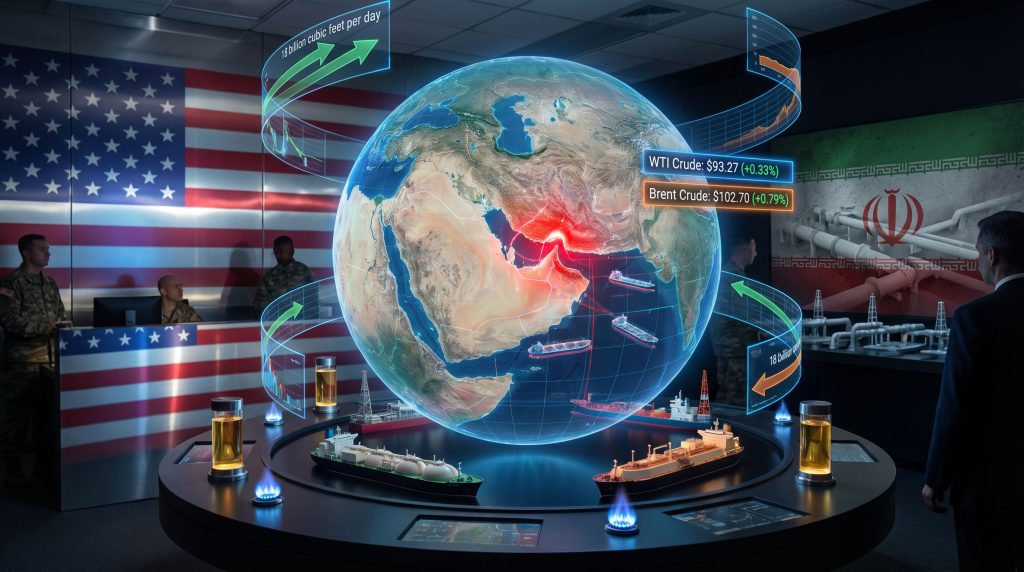
Current market indicators reveal the immediate impact of escalating U.S.-Iran tensions escalate across global energy systems. WTI Crude trades at $93.27 (+0.33%) while Brent Crude reaches $102.70 (+0.79%), demonstrating how regional conflicts immediately affect worldwide pricing mechanisms. Furthermore, the divergent movement in Natural Gas at $2.603 (-4.37%) suggests traders differentiate between supply disruption risks and demand destruction concerns.
Critical chokepoint statistics underscore the strategic importance of current confrontations. Maritime traffic through the Strait of Hormuz and Bab el-Mandeb Strait accounts for approximately 45% of global oil flows, with the Hormuz passage alone handling 20% of worldwide oil transit routes. Recent reports from CNN indicate escalating tensions, with reports of Iran firing on passing ships causing traffic in the Strait of Hormuz to grind to a halt repeatedly.
The petroleum product complex shows mixed signals reflecting market uncertainty about supply security. Heating Oil trades at $3.936 (-0.04%) while Gasoline reaches $3.373 (+0.43%), indicating selective concerns about specific product availability. Additionally, crude benchmarks reveal broader market stress, with Murban Crude at $104.8 (+1.58%) and the OPEC Basket at $97.74 (-1.87%) over recent trading sessions.
Strategic Maritime Control Points
The concentration of global energy flows through narrow maritime passages creates immediate vulnerabilities when regional powers contest control. Current enforcement mechanisms extend beyond traditional sanctions, incorporating comprehensive maritime interdiction strategies that target energy export capabilities directly. These operations represent new models of economic pressure that could be replicated in future conflicts involving energy-producing nations.
Naval positioning around critical shipping lanes demonstrates how quickly regional tensions translate into global supply chain disruptions. Consequently, the strategic significance of these chokepoints means that even threats of closure or inspection regimes can trigger immediate market responses, as evidenced by current price volatility across energy commodities.
Accelerated Development of Alternative Energy Alliances
American liquefied natural gas production has positioned Washington as the dominant global supplier, fundamentally altering international energy dependencies. Current U.S. LNG export capacity processes approximately 18 billion cubic feet per day (Bcf/d), representing a dramatic expansion from 11.4 Bcf/d reached by the end of 2022. The Energy Information Administration projects this capacity will double by 2031 compared with 2024 levels, demonstrating sustained strategic investment in energy dominance.
Qatar's significant supply disruptions have accelerated shifts toward American suppliers. Following Iranian missile attacks in March on Qatar's North Dome gas facilities, Qatari officials estimate repair time requiring three to five years with Qatar extending force majeure on gas supplies potentially beyond mid-June 2026. This $20 billion LNG blackout forces major importers like Pakistan back to spot markets, with many considering switches to U.S. LNG supplies.
Key Infrastructure Developments:
- Iraq's first floating LNG (FLNG) import platform targets 500 million standard cubic feet per day (MMscf/d) baseline capacity
- Technical ceiling capabilities reach up to 1 Bcf/d for expanded operations
- Scheduled operational date: June 2026 under U.S. firm Excelerate operations
- KBR serves as consultant representing strategic U.S. technology partnership
- Five-year renewable agreement with Iraq's Electricity Ministry establishing long-term relationship
Strategic Positioning Through Infrastructure Investment
The Iraq FLNG platform represents more than commercial partnership, serving as a strategic mechanism to reduce Iranian dependence while re-establishing American influence in Baghdad. According to analysis from energy industry sources, this facility represents both commercial partnership and strategic enhancement of Iraq's long-term energy security through reduced reliance on Iranian supplies.
European responses demonstrate coordinated diversification strategies following the 2022 Ukraine crisis. Major European oil and gas companies have moved aggressively to establish new ventures in Egypt, Libya, and Iraq, reducing traditional supply concentration. These developments represent permanent structural changes rather than temporary crisis responses, reflecting growing energy transition challenges across the continent.
Market Positioning Reflects Geopolitical Risk Assessment
Energy trading activity demonstrates sophisticated market positioning around geopolitical events. Traders placed $430 million in positions minutes before Trump extended Iran ceasefire negotiations, indicating active speculation around scenario outcomes. This trading volume suggests energy markets increasingly function as geopolitical risk assessment mechanisms rather than purely commodity exchanges.
Operational impacts extend across multiple sectors beyond direct energy trading. Air Canada scrapped key U.S. routes amid high fuel prices, while Lufthansa cancelled unprofitable European summer routes to save jet fuel consumption. These operational adjustments demonstrate how energy price volatility cascades through interconnected economic sectors.
Current supply indicators reveal structural tightening across global markets:
- U.S. oil exports set to hit record highs as domestic production exceeds consumption
- Global oil inventories drift toward record lows despite ongoing geopolitical tensions
- Pakistan paying record premiums for fuel imports following Qatar supply disruptions
- Norway pumps near capacity as spare output buffer disappears from global supply cushion
Trading Pattern Analysis
The world's biggest physical oil trader warns of months of price volatility ahead, suggesting current market conditions represent structural rather than temporary disruptions. Oil markets no longer trade like traditional commodity markets, incorporating geopolitical risk premiums that persist regardless of immediate diplomatic outcomes.
Energy prices demonstrate divergent risk assessment across different commodities. While crude oil prices incorporate supply disruption premiums, natural gas forecasts reflect concerns about demand destruction from economic slowdown. This divergence suggests sophisticated market evaluation of different supply vulnerability scenarios.
Scenario Planning for Extended Crisis Periods
Diplomatic Resolution Scenario (Moderate Probability):
Market impacts include oil prices potentially retreating to $85-90/barrel range with temporary reduction in geopolitical risk premiums. However, structural changes in energy relationships would persist even following diplomatic settlements. Normal shipping patterns could restore, but alternative supply arrangements developed during crisis periods remain operational.
Extended Standoff Scenario (High Probability):
Sustained price volatility with $100+ oil becoming normalised represents the most likely medium-term outcome. This scenario accelerates development of alternative supply routes and partnerships, potentially creating parallel energy systems aligned with different geopolitical blocs. Furthermore, permanent reconfiguration of global energy flows occurs regardless of eventual diplomatic resolution.
Military Escalation Scenario (Low Probability, High Impact):
Direct military confrontation could trigger oil price spikes to $150-200/barrel with fundamental disruption of global energy architecture. Emergency response mechanisms include strategic petroleum reserve releases and emergency LNG diversions to critical allies. This scenario requires pre-positioned crisis management protocols for supply disruption management.
Strategic Reserve Management
China's strategic positioning demonstrates preparation for extended volatility periods. Beijing had built up LNG reserves during the year prior to the 2022 Ukraine conflict, providing insulation from immediate supply disruptions. This approach suggests anticipation of energy weaponisation in geopolitical competition.
Emergency allocation protocols become critical for managing crisis scenarios. Enhanced sanctions enforcement capabilities extend beyond traditional market mechanisms, incorporating comprehensive maritime interdiction strategies and alternative transportation route development.
Long-Term Implications for Energy Security Framework
The emergence of distinct energy partnerships aligned with broader geopolitical alliances represents a fundamental departure from globalised energy markets. Current tensions accelerate formation of separate energy systems serving different political blocs, potentially creating permanent fragmentation in global energy trade.
Investment Priorities Shifting Toward:
- Floating LNG terminals for enhanced supply flexibility and reduced chokepoint dependence
- Enhanced strategic reserve capacities for extended crisis period management
- Alternative transportation routes avoiding traditional chokepoints through pipeline and shipping diversification
- Advanced early warning systems for supply disruption management incorporating geopolitical risk assessment
Technology developments focus on infrastructure resilience rather than efficiency optimisation. Multiple supplier arrangements replace single-source dependencies, whilst enhanced storage and buffer capacity provide cushions against supply disruptions. These infrastructure adaptations represent permanent changes in energy system architecture.
Regulatory Framework Evolution
Governments develop new legal frameworks extending beyond traditional market mechanisms to include emergency allocation protocols and strategic partnership agreements. Enhanced sanctions enforcement capabilities incorporate maritime interdiction authorities and alternative route development mandates.
Policy coordination between allied nations becomes essential for effective crisis management. In addition, synchronised strategic reserve management and emergency supply sharing agreements require unprecedented international cooperation on energy security matters. These coordination mechanisms represent institutional changes that persist beyond immediate crisis periods.
The next major ASX story will hit our subscribers first
Risk Management Strategies for Market Participants
Energy companies and traders must develop sophisticated hedging strategies accounting for geopolitical risk factors as traditional price forecasting models prove inadequate for politically-driven market disruptions. Current trading patterns suggest fundamental changes in market structure requiring new analytical approaches.
Infrastructure Resilience Requirements:
- Multiple supply source development reducing single-supplier dependencies
- Enhanced storage and buffer capacity providing cushions against supply interruptions
- Flexible transportation and processing infrastructure enabling rapid supply source transitions
- Advanced monitoring and early warning systems incorporating geopolitical intelligence into operational planning
Crisis management protocols require pre-positioned response capabilities rather than reactive crisis response. Supply disruption scenarios must incorporate geopolitical escalation pathways, not just technical or commercial factors. Moreover, risk assessment frameworks expand beyond traditional commodity analysis to include political stability evaluation.
Market Structure Adaptation
Energy markets increasingly function as geopolitical risk assessment mechanisms rather than pure commodity exchanges. Trading strategies must account for policy announcement timing, diplomatic negotiation outcomes, and military positioning intelligence alongside traditional supply-demand fundamentals.
Volatility persistence suggests structural market changes rather than temporary crisis impacts. Consequently, market participants require enhanced risk management capabilities incorporating scenario planning across multiple geopolitical outcomes. Traditional hedging instruments may prove insufficient for managing politically-driven price movements.
What Does This Mean for Oil Production Strategies?
Current tensions simultaneously accelerate strategic considerations around OPEC production impact and complicate renewable energy transition efforts across multiple regions. Energy security concerns drive increased investment in domestic clean energy sources whilst immediate supply security needs reinforce reliance on traditional hydrocarbon infrastructure. This dual pressure creates complex transition pathway challenges.
Key Transition Framework Adjustments:
- Accelerated domestic renewable energy development prioritising energy independence over efficiency optimisation
- Enhanced focus on energy independence versus cost efficiency in policy framework development
- Potential delays in phase-out timelines for strategic fossil fuel infrastructure maintaining supply security capabilities
- Increased investment in energy storage and grid resilience technologies supporting supply security during transition periods
European responses demonstrate accelerated clean energy investment alongside enhanced fossil fuel diversification. Rooftop solar orders triple as gas prices surge, whilst clean energy funding targets $20 billion for developing economy projects. These parallel developments suggest energy security drives both renewable acceleration and fossil fuel supply diversification simultaneously.
Strategic Infrastructure Balance
The resolution of current tensions will significantly influence whether global energy markets evolve toward greater integration or further fragmentation along geopolitical lines. Market participants must prepare for multiple scenarios whilst governments balance immediate security needs with long-term sustainability objectives.
Investment strategies require scenario planning across different geopolitical outcome pathways. Energy transition timelines may accelerate in some regions whilst extending in others, depending on supply security considerations and geopolitical alliance structures. For instance, this variability creates complex planning challenges for long-term energy infrastructure development.
Energy independence considerations increasingly influence renewable energy project location and timing decisions. Domestic energy production capabilities become strategic assets regardless of comparative cost advantages from international suppliers. This shift fundamentally alters renewable energy investment criteria beyond traditional economic factors.
How Are Global Markets Adapting to New Tensions?
The current environment has highlighted significant vulnerabilities in global energy systems, particularly regarding WTI & Brent dynamics and regional price differentials. However, market adaptations are occurring rapidly across multiple sectors, with significant implications for long-term energy security.
The oil price trade war dynamics demonstrate how geopolitical tensions reshape traditional market relationships. According to analysis from the Council on Foreign Relations, these structural changes extend beyond temporary crisis responses to fundamental alterations in global energy architecture.
As U.S.-Iran tensions escalate further, market participants must navigate increasingly complex scenarios involving supply disruption risks, alternative partnership development, and enhanced security requirements. These developments require sophisticated risk management approaches that incorporate geopolitical intelligence alongside traditional market analysis.
The resolution of current tensions will determine whether global energy markets evolve toward greater integration or further fragmentation along geopolitical lines. Therefore, strategic planning must account for multiple scenarios whilst maintaining operational flexibility to respond to rapidly changing geopolitical conditions.
Disclaimer: This analysis is based on current market conditions and geopolitical developments as of the publication date. Energy markets involve significant volatility and risk factors beyond those discussed. Readers should conduct independent research and consult qualified advisors before making investment decisions. The scenarios presented represent analytical frameworks rather than predictions of specific outcomes.
Ready to Navigate Energy Market Volatility?
With energy markets increasingly driven by geopolitical tensions and supply disruptions, investors need real-time intelligence to identify opportunities in resource companies. Discovery Alert's proprietary Discovery IQ model delivers instant notifications on significant ASX mineral discoveries, helping subscribers capitalise on market movements in critical commodities including uranium, lithium, and rare earth elements that are reshaping global energy security. Begin your 14-day free trial today to position yourself ahead of the market during these unprecedented times.