June 23, 2026

Energy markets across the globe operate under constant pressure from geopolitical uncertainty, with modern trading systems amplifying volatility through sophisticated algorithms that can trigger massive price swings within minutes. The interconnected nature of global energy infrastructure means that disruptions in one region cascade through supply chains, affecting everything from manufacturing costs to central bank monetary policy decisions. Understanding these complex dynamics requires examining how political communications, supply disruptions, and market psychology interact to create the extreme price movements that characterise today's energy landscape.
Understanding Market Psychology During Energy Infrastructure Threats
The relationship between political rhetoric and energy market pricing reveals sophisticated mechanisms of risk assessment that extend far beyond simple supply-demand calculations. When examining recent market behaviour, oil plunges as Trump postpones military strikes against Iranian energy infrastructure demonstrated the immediate power of executive communication channels to reshape commodity pricing within trading sessions.
Furthermore, the oil price rally patterns observed in previous months illustrate how quickly market sentiment can shift based on policy announcements. These movements reflect broader concerns about regional stability and its impact on global energy supplies.
The Architecture of Risk Premium Pricing
Modern energy markets embed complex risk premiums that reflect multiple probability scenarios simultaneously. The postponement of military action against Iranian facilities triggered a 12.35% decline in Brent crude prices, falling to $99.90 per barrel within hours of the announcement. This dramatic price movement illustrates how markets price tail risks and rapidly recalibrate when perceived threats diminish.
Statistical analysis of this price action reveals several critical insights about modern energy trading. Speed of information processing allowed markets to adjust within 2-3 hours of the announcement, while price stabilisation patterns saw crude stabilise around $100/barrel rather than continuing to decline.
Cross-market correlation demonstrated synchronised global pricing, with US West Texas Intermediate falling 10.68% to $88.36. Volume amplification through algorithmic trading systems likely amplified the initial price movement through programmed risk-off protocols.
The mathematical precision of these movements suggests that energy futures markets now operate with minimal information friction. Consequently, they process geopolitical developments through sophisticated probability models that instantly adjust risk premiums across global benchmarks.
Strategic Communication Channels and Market Response
The evolution from traditional diplomatic communication to direct social media announcements has fundamentally altered how energy markets interpret policy signals. Trump's social media declaration stating he had instructed postponement of military strikes for a five-day period created measurable market impacts that differ significantly from conventional policy communication patterns.
This communication approach introduces several unique market dynamics. Direct Policy Transmission eliminates interpretation layers that traditionally existed between policy formation and market pricing. Conditional De-escalation Signalling preserved military options while creating negotiation windows through specific postponement language.
Real-time Risk Recalibration allowed markets to immediately reprice the probability of imminent military action from high likelihood to a five-day negotiation window. Energy market analysts note that this communication strategy creates both opportunities and risks for traders, as the speed of information transmission can trigger algorithmic trading cascades.
When big ASX news breaks, our subscribers know first
Supply Chain Vulnerability Assessment in Critical Energy Corridors
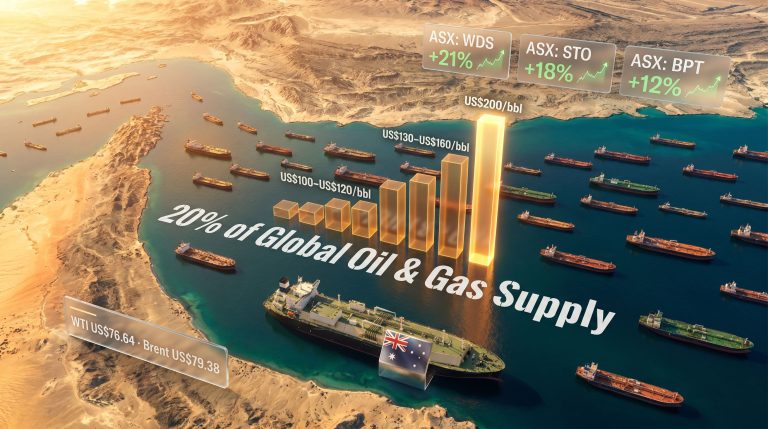
The concentration of global energy flows through strategic chokepoints creates systemic vulnerabilities that extend far beyond regional conflicts. The Strait of Hormuz, handling approximately 20% of global oil and liquefied natural gas flows, represents a critical vulnerability point where disruptions can trigger worldwide economic consequences within days rather than weeks.
Moreover, analysing oil price movements during previous supply disruptions provides valuable insight into how markets respond to infrastructure threats. These historical patterns help investors understand the potential scale and duration of price volatility during geopolitical crises.
Quantifying Production Disruption Scenarios
Recent analysis of Middle Eastern production capacity reveals the scale of potential supply disruptions. Current estimates suggest 7-10 million barrels per day of oil production face direct risk from regional conflict, representing a significant portion of global daily consumption of approximately 100 million barrels.
The specific impact on Iraqi production illustrates how quickly force majeure declarations can reshape global supply patterns. Basra Oil Company Output fell from 3.3M bpd to 900,000 bpd, representing a 72.7% reduction. Iraqi Force Majeure Status shifted from none to complete coverage of all foreign-developed fields.
These production cuts trigger cascading effects through international supply chains. Refineries must rapidly reconfigure procurement strategies and potentially accept higher costs for alternative crude sources.
Alternative Sourcing Strategies and Technical Challenges
Asian refineries face particular challenges when traditional Middle Eastern supply sources become unavailable. Indian refiners' plans to resume purchasing Iranian crude while navigating international sanctions frameworks represents the complex decision-making required during supply crises.
Technical considerations for refinery operators include crude quality differentials, where Iranian crude characteristics may differ from traditional Basra crude in sulphur content and density. Processing configuration adjustments require refineries to modify operations for different feedstock specifications.
Blending requirements mean alternative crude sources may require sophisticated blending to maintain product quality standards. Timeline constraints present challenges, as procurement agreement execution can require weeks or months to finalise.
The International Energy Agency's executive director has characterised the current crisis as very severe. In addition, they compared it unfavourably to the combined impact of the 1970s oil shocks, suggesting that current supply chain vulnerabilities exceed historical precedents for complexity and potential economic impact.
Economic Ripple Effects Through Manufacturing and Transportation Networks
Energy price volatility creates multiplier effects throughout the global economy that extend far beyond direct fuel costs. When oil plunges as Trump postpones military strikes against Iranian energy infrastructure, the price movements reflect not just immediate supply concerns but broader economic recalibration across multiple sectors simultaneously.
The broader implications of these market movements connect to ongoing concerns about US-China trade war impact on global supply chains. Energy price volatility adds another layer of complexity to international trade relationships already strained by tariff disputes.
Transportation Cost Multipliers and Insurance Premiums
Shipping costs represent one of the most immediate transmission mechanisms for energy market volatility. Alternative routing options carry significant cost premiums that ultimately affect global trade patterns.
Cape of Good Hope Routing requires ships avoiding Middle Eastern routes to travel approximately 6,000 additional nautical miles. This increases voyage time by 10-14 days and fuel consumption proportionally.
War Risk Insurance Escalation can increase maritime insurance premiums for energy cargo by 300-500% during active conflict periods. These costs are ultimately passed through to end consumers.
Port Capacity Constraints occur because alternative loading and discharge facilities often lack the throughput capacity of major Middle Eastern terminals. This creates bottlenecks that extend delivery timelines.
These transportation disruptions create particularly acute challenges for Asian economies. Manufacturing supply chains in these regions depend on predictable energy input costs and delivery schedules.
Central Bank Policy Responses to Energy-Driven Inflation
Energy price volatility presents complex challenges for monetary policy makers, who must distinguish between temporary supply shocks and persistent inflationary pressures. The current crisis demonstrates how quickly energy market disruptions can complicate central bank decision-making processes.
Key policy considerations include supply-side versus demand-side price pressures. Central banks typically avoid responding to temporary supply disruptions but must act if energy costs trigger broader inflationary expectations.
Exchange rate implications mean currency movements can either amplify or dampen energy price impacts for import-dependent economies. Growth versus inflation trade-offs emerge when sustained high energy costs simultaneously reduce economic growth while increasing inflation, creating stagflationary conditions.
Historical analysis suggests that energy-driven inflation episodes require carefully calibrated policy responses. These must avoid both premature tightening and excessive accommodation that could embed inflationary expectations into wage and price-setting behaviour.
Force Majeure Mechanisms and Contract Law Implications
The declaration of force majeure on Iraqi oilfields developed by foreign companies demonstrates how legal frameworks interact with geopolitical crises to reshape global energy markets. These declarations carry specific contractual implications that extend beyond immediate production impacts to affect long-term investment and development patterns.
However, the relationship between geopolitical tensions and market volatility extends beyond oil markets. Understanding tariffs and investments provides insight into how political decisions create ripple effects across multiple asset classes and geographic regions.
Legal Framework of Energy Contract Suspensions
Force majeure clauses in energy development agreements typically require extraordinary circumstances beyond reasonable control of the contracting parties. They also require material impediment to contract performance, proper notice procedures to counterparties, and mitigation efforts demonstrating good faith attempts to maintain operations.
Iraq's comprehensive force majeure declaration affecting all foreign-developed oilfields represents an unusual application of these legal provisions. This suggests that security conditions have deteriorated sufficiently to justify widespread contract suspensions under international commercial law.
International Investment Implications
Force majeure declarations create cascading effects through international energy investment patterns. Companies that have invested billions of dollars in Iraqi field development face immediate revenue cessation while maintaining ongoing operational costs and debt service obligations.
The comprehensive nature of Iraq's force majeure declaration signals to international energy companies that Middle Eastern investment carries heightened political risk premiums that must be factored into future project economics.
This development likely influences capital allocation decisions across the energy sector. It potentially accelerates investment in more politically stable regions while creating barriers to future Middle Eastern project financing.
Historical Context and Comparative Crisis Analysis
Understanding current energy market volatility requires comparison with historical precedents that established frameworks for crisis management and policy response. The assertion that current Middle Eastern disruptions exceed the severity of 1970s oil shocks provides important context for assessing potential economic impacts and policy effectiveness.
Statistical Comparison with Historical Oil Crises
The 1973 Arab Oil Embargo saw a 300% peak price increase over 6 months, leading to US recession managed through price controls and rationing. The 1979 Iranian Revolution brought a 250% increase over 18 months, causing global stagflation addressed through monetary tightening.
The 1990-91 Gulf War created a 100% increase over 6 months, causing brief recession managed through strategic reserve releases. The current crisis shows 12.35% daily volatility with ongoing duration and diplomatic intervention responses.
The comparison reveals that while current daily volatility matches historical precedents, the overall price level impacts remain significantly lower. These remain well below the transformative oil shocks of the 1970s and early 1980s.
Evolution of Crisis Management Mechanisms
Modern energy crisis management benefits from institutional frameworks developed through previous disruptions. Strategic Petroleum Reserve Systems allow major consuming countries to maintain emergency stockpiles that can offset supply disruptions for 90+ days in most cases.
International Energy Agency Coordination provides established protocols for coordinated reserve releases and demand management during supply crises. Financial Market Tools offer sophisticated hedging instruments that allow commercial participants to manage price risk more effectively than during historical crises.
These institutional developments suggest that while current supply risks are severe, the global economy possesses more robust tools. Furthermore, these tools for managing energy supply disruptions are more advanced than those that existed during previous major crises.
Investment Strategy Implications and Portfolio Positioning
Energy market volatility creates both risks and opportunities for investors across multiple asset classes. The dramatic price movements following geopolitical developments illustrate how quickly market conditions can shift and the importance of maintaining flexible positioning strategies.
The broader economic context includes mounting US economy pressures from multiple sources, including inflation concerns and debt burdens. Energy price volatility adds another variable to an already complex economic environment that investors must navigate.
Sector Rotation Patterns During Energy Crises
Historical analysis reveals predictable patterns in equity market performance during energy supply crises. Energy Sector Performance typically sees energy company stocks outperform during supply disruptions, but may underperform if crisis resolution appears imminent.
Transportation Sector Vulnerability affects airlines, shipping companies, and logistics providers who face immediate margin pressure from higher fuel costs. Defensive Sector Allocation shows utilities, consumer staples, and healthcare typically provide portfolio stability during energy market volatility.
Regional Market Divergence benefits energy-exporting economies from higher prices while importers face economic headwinds.
Currency and Commodity Hedging Strategies
International investors must navigate currency risk alongside energy price volatility. Petrodollar flow patterns can significantly affect exchange rates during major oil price movements.
USD Strengthening typically occurs as higher oil prices strengthen the US dollar through petrodollar recycling. Emerging Market Pressure creates dual pressures from higher import costs and currency weakness for energy-importing emerging markets.
Commodity Currency Correlation affects the Canadian dollar, Norwegian krone, and other resource-linked currencies that track energy price movements.
Portfolio managers increasingly utilise sophisticated hedging strategies that account for correlations. These strategies consider relationships between energy prices, currency movements, and broader asset class performance during geopolitical crises.
The next major ASX story will hit our subscribers first
Future Market Structure and Technology Integration
The integration of algorithmic trading systems and real-time information processing has fundamentally altered how energy markets respond to geopolitical developments. The speed and magnitude of recent price movements reflect technological changes that continue to evolve market structure and price discovery mechanisms.
Algorithmic Trading and Price Discovery
Modern energy futures markets process information through multiple technological layers. News sentiment analysis algorithms scan communication channels for policy signals, while high-frequency trading systems execute trades within microseconds of data release.
Cross-asset arbitrage programs maintain price relationships across related commodities. Risk management protocols automatically adjust position sizing based on volatility measures.
These technological systems can amplify both upward and downward price movements beyond levels justified by fundamental supply-demand factors. Consequently, they create opportunities for sophisticated traders while increasing overall market volatility.
Infrastructure Investment and Market Resilience
Current supply disruptions highlight infrastructure vulnerabilities that could attract significant investment capital. Alternative Pipeline Routes involving projects that bypass traditional chokepoints may receive accelerated development timelines and enhanced financing terms.
LNG Terminal Expansion provides supply flexibility through liquid natural gas infrastructure that reduces dependence on pipeline networks through conflict zones. Renewable Energy Integration benefits from high fossil fuel prices that increase the economic competitiveness of renewable energy investments and grid storage technologies.
Strategic Storage Capacity may see expansion by both government and commercial entities to provide buffer capacity during future supply disruptions.
These infrastructure investments represent multi-decade commitments that reshape global energy flows. For instance, they reduce vulnerability to geopolitical supply disruptions over time.
What Does This Mean for Global Energy Security?
The recent market volatility demonstrates that oil plunges as Trump postpones military strikes against Iranian energy infrastructure represents more than a single policy decision. It reflects the complex interplay between geopolitical communications, market psychology, and technological trading systems that define modern energy markets.
The speed of price adjustments following policy announcements illustrates how quickly global energy markets can recalibrate risk assessments. However, the underlying supply vulnerabilities that created the initial price premiums remain largely unchanged.
Energy security increasingly depends on diversified supply sources, robust emergency response mechanisms, and sophisticated risk management tools. The current crisis provides valuable insights into how these systems function under pressure and where improvements may be necessary.
How Can Investors Navigate Energy Market Volatility?
Investment strategies during periods of energy market instability require careful balance between opportunity recognition and risk management. The dramatic price movements create both potential profits and significant losses for unprepared market participants.
Diversification across energy subsectors, geographic regions, and related asset classes provides some protection against concentrated risks. However, the interconnected nature of modern markets means that traditional diversification strategies may prove less effective during systemic energy supply crises.
Professional portfolio management increasingly incorporates geopolitical risk assessment alongside traditional financial analysis. Understanding the relationship between political communications, supply chain vulnerabilities, and market pricing mechanisms becomes essential for successful navigation of volatile energy markets.
Modern investors benefit from sophisticated hedging instruments and real-time information systems that were unavailable during historical energy crises. However, the same technological systems that provide these advantages can also amplify volatility and create new categories of systemic risk that require careful management.
The current environment demonstrates that energy market investment success requires not only financial expertise but also geopolitical awareness and technological sophistication. As global energy systems continue to evolve, these requirements are likely to become even more demanding for serious market participants.
Disclaimer: This analysis incorporates market data, expert opinions, and geopolitical assessments that are subject to rapid change. Energy market investments carry significant risk, and past performance does not guarantee future results. Readers should conduct independent research and consider professional financial advice before making investment decisions related to energy markets or geopolitical events. All price data and expert quotes are sourced from publicly available information and verified through reporting from major financial news outlets and international energy market analysts as of March 23, 2026.
Ready to Capitalise on Global Energy Market Volatility?
Discovery Alert's proprietary Discovery IQ model delivers real-time alerts on significant ASX mineral discoveries, instantly empowering subscribers to identify actionable opportunities whilst energy market disruptions create broader commodity volatility. Understand why historic discoveries can generate substantial returns during periods of market uncertainty, and begin your 14-day free trial today to position yourself ahead of the market.