August 12, 2026
Understanding the Energy-Mining Cost Nexus During Regional Conflicts
Energy markets serve as the primary transmission mechanism through which geopolitical instability affects mining operations worldwide. The complex interdependencies between petroleum pricing, electricity markets, and industrial inputs create cascading effects that extend far beyond simple fuel cost fluctuations. Mining companies face multifaceted exposure through direct energy consumption, supply chain disruptions, and currency volatility that compound during periods of regional conflict.
The relationship between Middle East tensions and mining economics demonstrates how integrated global commodity markets have become. Operations spanning continents find themselves vulnerable to supply chain disruptions originating thousands of miles away, requiring sophisticated risk management frameworks to maintain operational stability. Furthermore, understanding Middle East conflict cost risks in mining becomes essential for strategic planning and operational continuity.
When big ASX news breaks, our subscribers know first
Direct Energy Cost Transmission Mechanisms
Fuel Price Volatility Impact on Mining Operations
Mining operations consume substantial quantities of diesel fuel across multiple operational components. Heavy machinery including excavators, haul trucks, and drilling equipment rely on diesel-powered engines for mobility and operation. Transportation networks moving ore concentrates from mine sites to processing facilities face direct cost exposure to oil price movements.
Remote mining locations often depend on diesel generators for electrical power generation, creating additional vulnerability to crude oil price movements. Equipment maintenance costs also escalate during geopolitical crises as petroleum-based lubricants and hydraulic fluids increase in price.
Atalaya Mining's experience during the 2026 Middle East conflict illustrates these dynamics. CEO Alberto Lavandeira identified diesel price volatility as a specific monitoring priority, noting that "diesel price has an influence in the mining rates" and operational cost structures. Despite the company's renewable energy hedges for electricity consumption, diesel dependency for mobile equipment remained a concern.
Electricity Market Disruptions and Grid Stability
Industrial electricity costs represent a significant portion of mining operational expenses, particularly for energy-intensive processes like grinding, flotation, and smelting. Grid-connected operations face power price spikes when natural gas or coal markets experience disruption from geopolitical events.
Regional differences in energy infrastructure create varying levels of exposure. Mining operations in jurisdictions with developed renewable energy capacity demonstrate greater resilience to fossil fuel price shocks. Atalaya Mining's operations in Spain benefit from the country's "strong renewable energy base, including wind, solar and hydro generation", providing structural protection against natural gas price volatility.
The company's approach combines on-site solar generation with "long-term PPA [power purchase agreement], which covers a good portion of our costs". This multi-layered strategy provides both direct renewable generation and contracted price stability for grid-supplied electricity. Consequently, this approach demonstrates clear decarbonisation benefits for mining operations.
Supply Chain Cost Amplification Through Chemical Inputs
Critical Reagent Price Correlations
Mining operations depend heavily on chemical reagents whose production costs correlate directly with petroleum markets. Sulfuric acid, essential for copper leaching operations, requires significant energy inputs during manufacturing, creating price sensitivity to crude oil fluctuations.
| Reagent Category | Primary Application | Cost Sensitivity |
|---|---|---|
| Sulfuric Acid | Heap leaching, hydrometallurgy | High petroleum correlation |
| Flotation Chemicals | Mineral separation processes | Moderate energy dependency |
| Industrial Explosives | Blasting operations | Direct petroleum input costs |
| Polymer Flocculants | Tailings management | Chemical feedstock exposure |
Transportation and Logistics Cost Escalation
Concentrate transportation from mine sites to ports or processing facilities faces direct exposure to diesel fuel pricing. Shipping costs for international concentrate movements correlate with bunker fuel prices, which track crude oil markets closely. Moreover, trade war impacts can further exacerbate these transportation challenges.
Remote mining operations experience amplified transportation cost impacts due to longer haul distances and limited route alternatives. Infrastructure bottlenecks during geopolitical crises can further compound these effects through supply chain congestion.
Sector-Specific Vulnerability Patterns
Copper Mining Exposure Analysis
Copper operations demonstrate particular sensitivity to energy cost fluctuations due to processing requirements and global supply chain dependencies. Pyrometallurgical smelting requires sustained high-temperature operations consuming substantial electricity or natural gas.
Hydrometallurgical processing, including solvent extraction and electrowinning, demands consistent electrical supply for maintaining process temperatures and electrolysis operations. Sulfuric acid consumption for heap leaching creates additional exposure to petroleum-derived input costs.
Atalaya Mining's 2026 cost guidance of $2.60/lb to $2.90/lb in C1 costs and $3.10/lb to $3.14/lb in all-in sustaining costs reflects the company's ability to maintain competitive cost structures despite geopolitical uncertainties. The executive noted that many mining peers are "approaching $3.50/lb AISC levels", highlighting Atalaya's relative cost advantage.
Geographic Risk Distribution Factors
Mining operations in different regions face varying degrees of energy cost exposure based on local infrastructure and energy sourcing strategies. European operations like Atalaya's Spanish facilities benefit from developed renewable energy networks and interconnected electricity grids providing supply diversity.
African mining operations often rely more heavily on diesel generation and imported fuel supplies, creating higher vulnerability to crude oil price shocks. Remote locations with limited grid connectivity face particular challenges during supply chain disruptions. However, Australia's focus on green metals leadership provides a model for reducing these vulnerabilities.
Strategic Risk Mitigation Frameworks
Power Purchase Agreement Optimization
Long-term electricity contracts provide crucial price stability during volatile market conditions. Mining companies increasingly pursue power purchase agreements spanning multiple years to establish predictable energy cost bases for project economics.
Atalaya's experience demonstrates the effectiveness of combining renewable energy generation with long-term contracted supplies. The company's solar plant provides direct cost control while PPAs offer grid-supplied electricity at predetermined pricing structures.
Renewable energy contracts also provide hedge value against carbon pricing mechanisms and environmental compliance costs that may emerge in various jurisdictions.
Alternative Energy Technology Integration
Mining operations increasingly evaluate hybrid renewable energy systems combining solar, wind, and battery storage technologies. These systems can reduce dependence on diesel generation while providing operational cost predictability.
Energy storage integration enables operations to optimise electricity consumption patterns, utilising renewable generation during peak production periods and storing excess capacity for night operations or cloudy conditions.
Investment Decision Framework Adjustments
What Changes Are Required for Project Economics?
Mining investment evaluations must incorporate geopolitical risk scenarios into financial modelling. Traditional discounted cash flow analysis requires adjustment for energy cost volatility and supply chain disruption probabilities. Additionally, understanding current industry evolution trends helps inform these adjustments.
Cost escalation modelling scenarios:
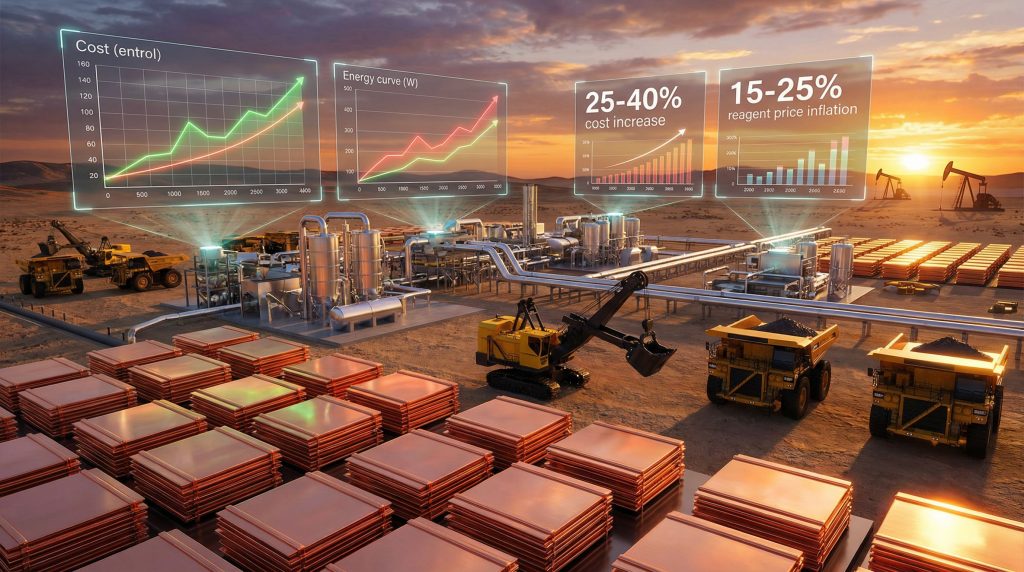
• Short-term disruptions (3-6 months): 8-15% operational cost increases
• Medium-term instability (6-18 months): 15-25% cost escalation
• Extended conflict periods (18+ months): 25-40% cost structure impacts
Technology Investment Prioritisation
Capital allocation strategies increasingly favour technologies that reduce energy intensity and supply chain dependencies. Automation systems can decrease labour costs while improving operational efficiency during periods of input cost inflation.
Process optimisation technologies enabling higher recovery rates or lower reagent consumption provide natural hedges against input cost volatility. Digital monitoring systems offer real-time cost control capabilities during rapidly changing market conditions.
The next major ASX story will hit our subscribers first
Currency Exchange Rate Compounding Effects
Revenue-Cost Currency Mismatches
Mining operations face additional complexity when commodity revenues are denominated in US dollars while operating costs are incurred in local currencies. Energy cost inflation combined with currency depreciation can create severe margin compression.
Companies operating in multiple jurisdictions must evaluate natural hedging opportunities by aligning cost structures with revenue currencies where possible. Furthermore, Middle East conflict cost risks in mining operations become particularly acute when currency volatility compounds energy cost pressures.
Financial Risk Management Integration
Mining companies increasingly utilise currency hedging instruments to protect against exchange rate volatility compounding energy cost pressures. Forward contracts and options can provide short-term protection while operational adjustments address longer-term exposure.
According to recent industry analysis, global miners are implementing comprehensive cost management strategies to address Middle East-related pressures.
Long-Term Structural Industry Transformation
Energy Independence Initiative Acceleration
The mining sector demonstrates increasing commitment to energy self-sufficiency through renewable generation investment. On-site solar, wind, and battery systems reduce exposure to external energy market volatility.
Microgrid development enables mining operations to maintain power supply stability during grid disruptions while optimising renewable energy utilisation patterns.
Supply Chain Regionalisation Trends
Mining companies pursue supplier diversification strategies to reduce dependence on single-source reagent supplies. Regional sourcing initiatives can minimise transportation costs and currency exposure while improving supply security.
Local processing facility development enables mining operations to capture additional value while reducing concentrate transportation requirements and associated fuel cost exposure. In addition, this strategy provides greater insulation from geopolitical disruptions.
Insurance and Financial Protection Strategies
Political Risk Coverage Evaluation
Mining operations increasingly evaluate specialised insurance products covering geopolitical risk exposure. Business interruption coverage can protect against supply chain disruptions affecting operational continuity.
Political risk insurance options include:
• Currency inconvertibility protection
• Supply chain disruption coverage
• Force majeure event compensation
• Political violence operational impact insurance
Cost-Benefit Analysis for Risk Transfer
Insurance premiums must be evaluated against potential operational loss exposure and alternative risk mitigation investments. Self-insurance through operational resilience building may offer superior long-term value compared to third-party risk transfer.
Companies must consider claims processing timelines during crisis periods and coverage limitations that may reduce insurance effectiveness during actual geopolitical events. Research from metals analysts suggests that escalating Middle East conflicts create significant downside risks requiring comprehensive protection strategies.
Building Resilient Mining Operations for Future Uncertainties
The intersection of Middle East conflict cost risks in mining operations with global supply chain vulnerabilities reveals the interconnected nature of modern resource extraction economics. Mining companies that develop comprehensive risk management frameworks incorporating energy diversification, supply chain resilience, and financial hedging strategies will maintain competitive advantages during future geopolitical uncertainties.
Success requires transitioning from reactive cost management toward proactive strategic planning that incorporates geopolitical risk as a fundamental business consideration rather than an external shock to be absorbed. Atalaya Mining's ability to maintain 2026 cost guidance despite acknowledging Middle East conflict risks demonstrates the value of renewable energy integration and long-term contract strategies.
The evolution toward energy-independent mining operations supported by regional supply chains represents a structural shift that will define competitive positioning in an increasingly uncertain geopolitical environment. Consequently, companies that invest in operational resilience today will be better positioned to navigate future crisis periods while maintaining cost competitiveness in global commodity markets. This transformation reflects broader Middle East conflict cost risks in mining that require sustained strategic attention and investment.
Want to Capitalise on Resilient Mining Opportunities?
Discovery Alert's proprietary Discovery IQ model identifies mining companies with robust operational frameworks and strategic advantages during volatile market conditions, delivering real-time alerts on significant ASX discoveries. Begin your 14-day free trial today to access actionable insights that help position your portfolio ahead of market movements.