June 16, 2026
Energy Partnership Economics in Emerging Market Dynamics
The global energy landscape increasingly reflects a shift toward non-traditional partnerships as established powers reassess risk tolerance in frontier markets. While Western energy majors retreat from politically volatile regions, state-backed enterprises from emerging economies step forward with different risk calculations and strategic objectives. This transformation reveals fundamental changes in how energy resources are developed, financed, and controlled across developing nations.
Turkey's engagement with Somalia represents a broader pattern of South-South cooperation in the energy sector, where partnerships extend beyond simple resource extraction to encompass comprehensive state-building initiatives. The Turkey and Somalia offshore oil deal combines security provision, infrastructure development, and diplomatic recognition in ways that traditional Western energy relationships have historically avoided. These integrated approaches create operational synergies that independent commercial operators cannot replicate in high-risk environments.
When big ASX news breaks, our subscribers know first
Strategic Resource Positioning in Horn of Africa Energy Markets
Turkey's Multi-Dimensional Africa Strategy Framework
Turkey's approach to African energy engagement emerged from a comprehensive diplomatic and economic strategy launched in 1998 and substantially expanded in 2005. The "Africa Opening" initiative transformed Turkish continental presence from 12 diplomatic missions to 44 while escalating bilateral trade volumes from $5.4 billion in 2003 to over $40 billion by 2023—representing approximately 640% growth over two decades.
This expansion strategy prioritizes countries with strategic maritime positions and untapped energy potential, positioning Turkey as an alternative to traditional Western-dominated energy relationships. The approach emphasises "African solutions for African problems" while building institutional capacity through infrastructure development, security sector reform, and educational initiatives.
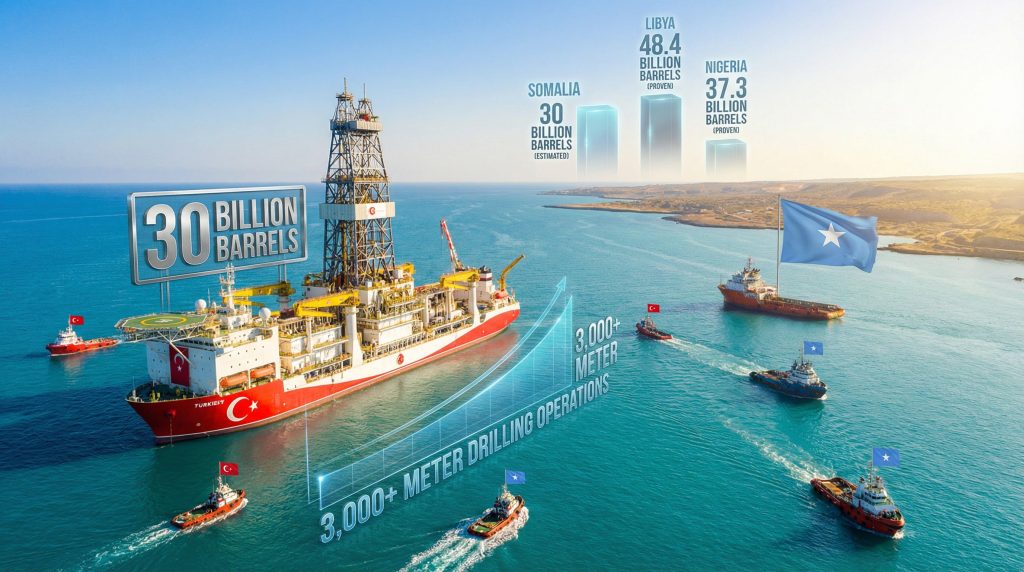
Somalia's selection as a priority partner reflects both opportunity and necessity. The country's 3,333-kilometre coastline provides strategic access to Indian Ocean shipping lanes, while its estimated 30 billion barrels of oil reserves represent one of the world's largest undeveloped hydrocarbon deposits. Turkey's willingness to operate in this high-risk environment stems from energy security imperatives that outweigh conventional commercial considerations.
Infrastructure Integration and Operational Efficiency
Turkey's comprehensive engagement model creates operational advantages unavailable to traditional energy companies. Turkish firms currently manage critical infrastructure including:
• Mogadishu's primary airport operations (Favori LLC)
• Major seaport facilities (Albayrak Group)
• Military training facilities (Camp TURKSOM)
• Healthcare infrastructure (Erdogan Hospital)
• Educational institutions and vocational training centres
This integrated infrastructure control reduces logistical costs and security risks for energy operations while generating independent revenue streams for the Somali government. The arrangement provides Turkey with comprehensive supply chain control from initial exploration through potential export operations. Furthermore, this comprehensive approach may influence the OPEC production impact on global energy markets.
Somalia's Hydrocarbon Resource Assessment and Market Significance
Comparative Regional Energy Potential Analysis
| Country | Reserve Estimate | Classification | Development Status |
|---|---|---|---|
| Somalia | 30 billion barrels | Estimated/Unproven | Early exploration phase |
| Libya | 48.4 billion barrels | Proven reserves | Established but disrupted production |
| Nigeria | 37.3 billion barrels | Proven reserves | Mature fields with declining output |
| Kenya | 600-800 million barrels | Estimated | Recent discoveries under development |
Somalia's estimated reserves position the country as potentially Africa's third-largest oil holder, though the "estimated" classification indicates substantial exploration risk. Unlike Libya's fragmented political control over proven reserves or Nigeria's aging infrastructure and production decline, Somalia's resources represent undeveloped upside potential requiring significant capital investment and technical expertise.
At current Brent crude pricing of approximately $67.42 per barrel, Somalia's theoretical gross resource value approaches $2.023 trillion. However, realistic economic calculations must account for typical recovery rates of 30-50%, operational cost recovery arrangements, and infrastructure development requirements spanning decades.
Ultra-Deepwater Technical Parameters and Challenges
The Turkish Petroleum Corporation (TPAO) faces extreme technical challenges in Somalia's offshore environment. Operations target ultra-deepwater zones at 3,480 metres (11,411 feet) water depth, with additional subsea drilling extending 3,500 metres (11,483 feet) below the seabed. Turkey's drillship deployment represents a significant technical milestone. Total well depths could reach 6,980 metres (22,894 feet) below sea surface.
Completed Seismic Survey Results:
• Survey vessel: Oruç Reis
• Duration: 234 days (October 2024 – July 2025)
• Area covered: 4,464 square kilometres across three offshore blocks
• Data type: 3D seismic imaging for geological analysis and drilling site optimisation
• Current status: Data analysis informing initial drilling locations
These extreme depths subject wells to pressures exceeding 350 bar with seabed temperatures near 2-4°C, requiring specialised high-pressure equipment, advanced metallurgy, and sophisticated well design. Supply chain logistics from Turkish ports to Mogadishu add complexity and cost to routine operations.
Capital Requirements and Economic Risk Assessment
Deep-Water Drilling Cost Structure
Ultra-deepwater exploration represents one of the energy industry's most capital-intensive activities. Individual exploratory wells cost between $40-100 million, while comprehensive field development requires infrastructure investments of $2-5 billion for production facilities, subsea pipelines, and export terminals.
Project Capital Requirements Breakdown:
• Single well drilling: $40-100 million per well
• Seismic surveys: $50-150 million per block (completed for Somalia)
• Production infrastructure: $2-5 billion for field development
• Security premiums: Additional 15-30% in high-risk jurisdictions
• Insurance costs: Elevated rates for conflict-affected maritime operations
Somalia's security environment adds 20-30% risk premiums to all operational costs compared to established producing regions. For an initial exploration programme targeting 6-8 wells, total capital requirements could reach $2.64-6.67 billion when including risk adjustments and infrastructure development. This substantial investment must consider the broader oil futures outlook.
Revenue-Sharing Model Analysis
The Turkey and Somalia offshore oil deal structure reflects Somalia's limited negotiating position and capital constraints. Key financial terms include:
Turkey's Cost Recovery: Up to 90% of operational expenses recovered from initial production
Somalia's Royalty Rate: Approximately 5% of gross production value
Tax Exemptions: Turkish operations exempt from Somali taxation
Bonus Payments: No signature, development, or production bonuses required
Legal Jurisdiction: Disputes settled in Istanbul courts rather than international arbitration
These terms heavily favour Turkey but reflect Somalia's inability to finance independent exploration or attract traditional energy majors. The arrangement allows Somalia to avoid upfront financial risks while accessing advanced technology and security protection that would otherwise be unavailable.
Traditional Energy Company Risk Avoidance Patterns
Political Stability and Operational Security Concerns
Major international energy companies including Shell and ExxonMobil maintain dormant contracts in Somalia but avoid active operations due to comprehensive risk assessments. Key deterrent factors include:
Governance Challenges:
• Federal structure with competing regional jurisdictions (Puntland, Jubaland)
• Ongoing Al-Shabaab insurgency affecting coastal security
• Limited rule of law and contract enforcement mechanisms
• Jurisdictional disputes over resource rights between federal and regional authorities
Operational Security Risks:
• Piracy threats in Indian Ocean maritime zones
• Non-state armed group capabilities near offshore operations
• Insurance premium escalation for conflict-affected regions
• Personnel security and evacuation contingency requirements
Traditional energy majors operate under shareholder value maximisation imperatives that make high-risk frontier exploration economically unjustifiable. Corporate risk management frameworks typically exclude regions with active insurgencies, weak legal systems, and jurisdictional disputes over resource ownership.
Alternative Partnership Models vs. Commercial Optimisation
Turkey's state-owned energy company operates under different strategic imperatives than publicly-traded energy majors. TPAO can absorb losses and extended development timelines that would be unacceptable to commercial operators focused on quarterly earnings and investor returns.
The Turkish approach reflects geopolitical energy security considerations rather than pure economic optimisation. Access to diversified energy supplies justifies accepting unfavourable contract terms and elevated operational risks that commercial entities would reject. This strategic positioning contrasts with the US oil production decline affecting traditional suppliers.
Regional Security Architecture and Maritime Protection
Military and Naval Security Integration
Turkey's energy operations benefit from comprehensive security infrastructure unavailable to independent operators. The Turkish naval task force protecting the Cagri Bey drillship represents an extension of Turkey's broader regional military presence.
Security Infrastructure Components:
• Camp TURKSOM: Turkey's largest overseas military base in Mogadishu
• Naval task force: Dedicated protection for offshore drilling operations
• Trained local forces: Elite "Gorgor" brigade and "Haramcad" police units
• Counterterrorism operations: Active Al-Shabaab suppression activities
• Maritime patrol capabilities: Coverage of Somalia's extensive coastline
The 10-year defence and economic agreement signed in February 2024 commits Turkey to building Somalia's naval capabilities while securing maritime zones for energy development. This integrated security approach reduces operational risks and insurance costs that would otherwise make deepwater exploration economically unfeasible. Furthermore, Turkey's offshore drilling efforts demonstrate significant regional commitment.
Economic Impact of Security Provision
Security costs represent a significant component of frontier energy development economics. Traditional operators might face security expenses equivalent to 15-30% of total project costs in high-risk maritime environments. Turkey's military commitment effectively subsidises these costs through state defence spending rather than project-specific budgets.
The security provision creates positive feedback loops where successful energy development generates revenue to fund expanded security capabilities, further reducing operational risks for additional exploration activities.
The next major ASX story will hit our subscribers first
Long-Term Economic Development Implications
Resource Revenue Management and Economic Diversification
Somalia faces classic "resource curse" risks where hydrocarbon development could undermine broader economic diversification and institutional development. Historical examples from other African producers demonstrate both positive and negative outcomes from large-scale energy resource development.
Critical Success Factors:
• Transparent revenue management systems
• Sovereign wealth fund establishment for long-term savings
• Investment in education and technology transfer
• Economic diversification beyond hydrocarbon dependence
• Institutional capacity building for regulatory oversight
The current agreement structure concentrates benefits with Turkish operations while providing limited technology transfer or local capacity building. Long-term economic development requires renegotiation toward more balanced partnership arrangements as Somalia's institutional capacity improves.
Infrastructure Development and Regional Integration
Successful energy development could catalyse broader infrastructure improvements with regional economic implications. Potential developments include:
Transportation Infrastructure:
• Expanded port facilities for energy sector logistics
• Road networks connecting coastal and inland regions
• Airport capacity increases for personnel and equipment transport
Energy Infrastructure:
• Domestic refinery capacity for local fuel supply
• Power generation from associated gas production
• Regional pipeline networks for export optimisation
Economic Integration:
• Enhanced trade relationships with East African partners
• Regional energy market participation
• Foreign investment attraction through improved infrastructure
Global Energy Market and Supply Chain Implications
Alternative Energy Partnership Models
The Turkey and Somalia offshore oil deal represents emerging trends in South-South energy cooperation that bypass traditional Western-dominated development models. These arrangements often feature:
• State-to-state agreements rather than commercial contracts
• Integrated development approaches combining infrastructure and security
• Long-term strategic relationships beyond single-project focus
• Alternative financing mechanisms through development banks and sovereign funds
This model could influence other African nations seeking energy development partnerships outside traditional Western frameworks. Success in Somalia might encourage similar arrangements across the continent, potentially reshaping global energy development patterns. However, broader market dynamics including trade war oil impact continue to affect regional strategies.
Supply Chain Diversification and Energy Security
Turkey's African energy engagement reflects broader supply chain diversification strategies among emerging economies. Rather than competing directly with established energy majors in proven reserves, these countries target frontier regions with undeveloped potential.
The approach creates alternative supply chains less vulnerable to Western sanctions or political pressure while building technical capabilities in challenging operational environments. Success in Somalia could position Turkey as a preferred partner for other high-risk energy development projects across Africa and beyond. In addition, the US-China trade war impact continues to shape global energy partnerships.
Regulatory Framework Development and Legal Considerations
Petroleum Law Evolution in Post-Conflict States
Somalia's energy legal framework remains underdeveloped, creating both opportunities and risks for development partnerships. Current challenges include:
Legal Framework Gaps:
• Incomplete petroleum law implementation
• Unclear federal versus regional authority divisions
• Limited contract enforcement mechanisms
• Absence of transparent bidding processes
• Insufficient environmental protection standards
The requirement for legal disputes to be settled in Istanbul rather than through international arbitration has generated significant controversy. Critics argue this arrangement compromises Somali legal sovereignty and creates unfair advantages for Turkish interests.
Transparency and Governance Development Requirements
Sustainable energy development requires institutional capacity building that the current agreement structure does not adequately address. Key requirements include:
• Independent regulatory agency establishment
• Revenue transparency and public disclosure systems
• Environmental impact assessment capabilities
• Local content requirements for technology transfer
• Community consultation and benefit-sharing mechanisms
Future agreement modifications should incorporate governance improvement requirements tied to development milestones, ensuring that energy development contributes to broader institutional capacity building.
Economic Scenario Analysis and Development Pathways
High-Impact Discovery Scenario
Successful discovery and development of commercial hydrocarbon reserves could transform Somalia's economic trajectory within 15-20 years. Potential impacts include:
Economic Transformation Timeline:
• Years 1-5: Infrastructure development and initial production ramp-up
• Years 5-10: Significant revenue generation and economic diversification initiatives
• Years 10-20: Regional energy hub development and sustained economic growth
• Beyond 20 years: Economic maturity with diversified industrial base
GDP Growth Implications:
Conservative estimates suggest successful energy development could increase Somalia's GDP by 300-500% over two decades, though this depends heavily on governance improvements and economic diversification success.
Limited Success and Alternative Development Pathways
Exploration failure or limited commercial discoveries would require alternative development strategies while preserving the value of Turkey's comprehensive infrastructure and security investments. Potential pivot strategies include:
• Enhanced focus on onshore exploration blocks
• Development of smaller discoveries for domestic energy supply
• Expansion of Turkey-Somalia economic cooperation beyond energy sector
• Utilisation of built infrastructure for broader economic development initiatives
The integrated nature of Turkey's engagement provides resilience against pure exploration failure, as infrastructure and security investments generate independent value through expanded trade and economic cooperation.
This analysis is based on publicly available information and industry standard assumptions. Actual development outcomes depend on numerous variables including commodity prices, political stability, and technological advancement. Readers should conduct independent research before making investment decisions.
Want to Capitalise on Major Energy Discoveries Before the Market Catches On?
Discovery Alert's proprietary Discovery IQ model delivers instant notifications about significant ASX mineral discoveries, helping investors identify actionable opportunities ahead of the broader market. Explore how historic discoveries have generated substantial returns by visiting Discovery Alert's dedicated discoveries page, then begin your 14-day free trial today to secure your market-leading advantage.