August 22, 2026
Understanding the Legal Framework Behind Energy Sanctions
The intricate web of U.S. sanctions on Venezuelan oil operates through a sophisticated regulatory architecture that has evolved considerably since 2017. Built upon the foundation of the International Emergency Economic Powers Act (IEEPA) of 1977, this framework grants the Treasury Department's Office of Foreign Assets Control (OFAC) extensive authority to designate entities and restrict international transactions.
The sanctions mechanism distinguishes between two primary enforcement approaches. Primary sanctions directly prohibit U.S. persons from engaging with designated Venezuelan entities, carrying civil penalties up to $308,456 per violation and criminal penalties reaching $1 million with 20 years imprisonment. Secondary sanctions create a broader enforcement net by threatening non-U.S. entities with designation if they conduct prohibited transactions, effectively extending American regulatory reach globally.
The regulatory framework includes specific exemptions through general licenses for humanitarian transactions and limited commercial activities. These carve-outs require detailed compliance documentation and typically include sunset provisions requiring periodic Treasury Department renewal, creating ongoing compliance burdens for participating entities.
Legislative Foundation and Executive Authority
The statutory foundation rests on IEEPA's peacetime sanctions authority, which replaced the Trading with the Enemy Act as the primary mechanism for economic warfare. This legislative framework enables presidential action through executive orders that establish the legal basis for Treasury enforcement, following an executive order precedent established in recent years.
Three key executive orders shaped the Venezuelan sanctions regime:
• Executive Order 13808 (August 2017): Initial financial sector restrictions targeting Venezuelan government debt and equity transactions
• Executive Order 13850 (November 2018): Expanded OFAC designation authority for Venezuelan entities
• PDVSA Designation (January 2019): Comprehensive oil sector sanctions freezing approximately $7 billion in assets
The dual-track approach creates enforcement complexity through its extraterritorial application. Secondary sanctions operate through SWIFT messaging protocols and correspondent banking relationships, enabling Treasury monitoring of dollar-denominated transactions while forcing participants toward alternative payment mechanisms that increase counter-party risks.
When big ASX news breaks, our subscribers know first
What Are the Core Enforcement Mechanisms?
The enforcement architecture operates through multiple interconnected systems designed to isolate Venezuelan petroleum transactions from global financial infrastructure. Asset freezing represents the most direct mechanism, with PDVSA's January 2019 designation preventing access to frozen assets within U.S. jurisdiction while prohibiting most transactions between American entities and the Venezuelan state oil company.
Financial system restrictions create comprehensive barriers to Venezuelan oil commerce. Dollar-denominated transactions face monitoring through SWIFT messaging systems, while U.S. banking services become unavailable to Venezuelan government entities through correspondent banking restrictions. Furthermore, trade financing disappears as banks cannot issue letters of credit for Venezuelan oil transactions, forcing cash-in-advance requirements that significantly increase buyer risks.
| Restriction Type | Scope | Enforcement Method |
|---|---|---|
| Dollar transactions | All PDVSA dealings | SWIFT monitoring |
| Banking services | Government entities | Correspondent restrictions |
| Trade financing | Oil exports | Letter of credit prohibitions |
| Insurance coverage | Tanker operations | Lloyd's compliance requirements |
Physical Enforcement and Vessel Interdiction
The December 2025 seizure of the M/T Skipper carrying 1.9 million barrels of Venezuelan heavy crude represents the first significant physical enforcement action since comprehensive sanctions implementation. This Coast Guard operation utilised satellite tracking and maritime interdiction procedures under Title 50 USC § 1705 enforcement authority, demonstrating expanded physical enforcement capabilities.
The seized vessel transported Merey crude oil with 15 degrees API gravity and 2.15% sulfur content, Venezuela's main export-grade heavy oil. The tanker operated in defiance of U.S. sanctions through ship-to-ship transfers in international waters, flag changes, and informal ownership transfers designed to evade detection, as reported by Reuters.
Insurance restrictions create additional enforcement layers independent of Treasury action. Lloyd's of London and other major insurance carriers face reputational and legal risks for insuring sanctioned Venezuelan cargo, creating effective insurance blockades that complement financial restrictions.
How Have Sanctions Evolved Across Different Administrations?
The evolution of U.S. sanctions on Venezuelan oil reflects distinct policy approaches across three presidential administrations, each adapting enforcement mechanisms to changing geopolitical circumstances and domestic priorities.
Trump Administration Maximum Pressure (2017-2021)
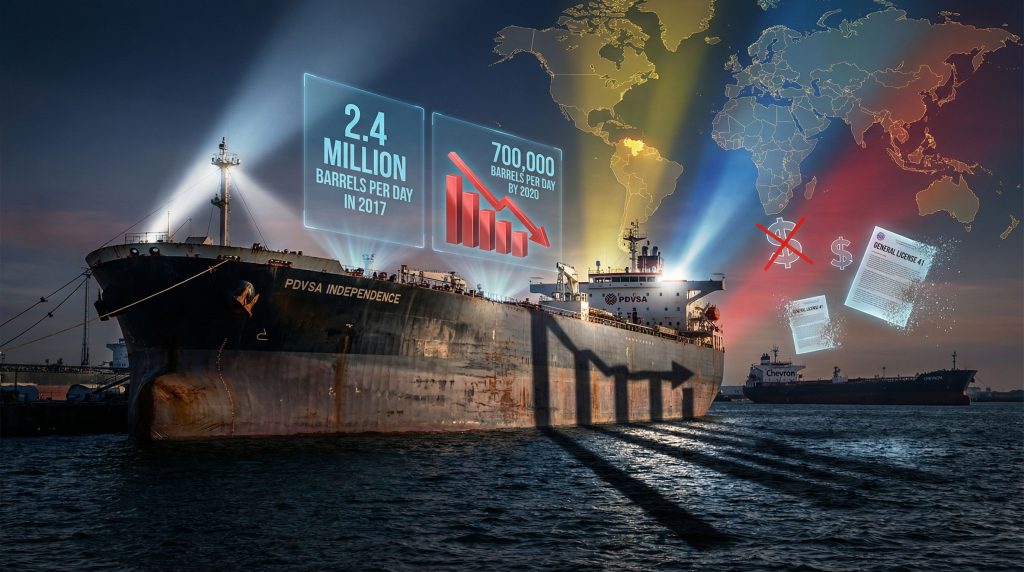
The initial Trump approach began with targeted individual sanctions before expanding to comprehensive sectoral measures. Venezuelan crude production declined from 2.08 million barrels per day in 2017 to approximately 0.77 million barrels per day by January 2019, coinciding with PDVSA's designation and comprehensive oil sector sanctions.
The maximum pressure campaign achieved significant production disruption but failed to accomplish stated political objectives. Academic analyses indicate this strategy generated unintended humanitarian consequences, including migration flows exceeding 7.7 million Venezuelan emigrants by 2024 and domestic fuel shortages that influenced subsequent policy recalibration.
Biden Administration Conditional Engagement (2021-2025)
The Biden administration introduced nuanced conditional licensing designed to create negotiation pathways while maintaining pressure architecture. General License 41, issued in October 2023, permitted limited Venezuelan oil transactions contingent on electoral process adherence, representing pragmatic acknowledgment of maximum pressure strategy limitations.
This policy shift reflected recognition that absolute sanctions had not yielded regime change while creating regional instability. The conditional engagement framework attempted to balance diplomatic leverage with humanitarian considerations through calibrated sanctions relief mechanisms.
Trump Administration Return (2025): Enforcement Intensification
Recent developments signal renewed emphasis on maximum pressure through increased naval presence and expanded secondary sanctions targeting third-country facilitators. The M/T Skipper seizure demonstrates enforcement intensification following the January 2025 return of Trump administration policies.
Current enforcement appears to consolidate prior designations without introducing new carve-outs, effectively closing operational access previously available through Biden-era general licenses. This represents policy reversal toward comprehensive sanctions enforcement rather than conditional engagement.
What Are the Economic Impacts of Sanctions Implementation?
The economic consequences of sanctions implementation extend far beyond direct production impacts, creating systemic disruptions across Venezuela's petroleum sector and broader economy while forcing fundamental changes in global oil trading patterns. In addition, these developments have created complex trade war market impact dynamics across global energy markets.
Production Collapse and Recovery Patterns
Venezuelan crude production experienced devastating decline from 2.08 million barrels per day in 2017 to a minimum of 0.47 million barrels per day in 2020, representing a 77% reduction during peak sanctions enforcement. Current production stands at approximately 934,000 barrels per day as of September 2025, according to OPEC data.
The production collapse reflected combined impacts of sanctions-related investment restrictions, operational difficulties from equipment degradation, and brain drain as technical personnel emigrated. While sanctions represented one factor among several contributing to decline, enforcement mechanisms prevented access to Western technology and financing essential for heavy crude extraction.
Economic impact extended beyond petroleum sector through GDP contraction reaching 75% between 2013-2020 according to International Monetary Fund data. Per capita income declined from $12,400 in 2011 to approximately $1,800 by 2020, though these figures reflect combined impacts of oil price collapse, sanctions, and domestic mismanagement rather than sanctions alone.
Global Market Adaptation and Trading Pattern Changes
Sanctions enforcement forced fundamental adaptations in global petroleum trading infrastructure. Venezuelan crude exports increasingly relied on shadow fleet operations using aging tankers, ship-to-ship transfers in international waters, and non-dollar payment mechanisms to circumvent banking restrictions.
Alternative trading relationships emerged with countries operating outside U.S. jurisdiction. China and India became key buyers of sanctioned Venezuelan crude, while Russia and Iran provided technical expertise and equipment to maintain production capabilities. These relationships strengthened ties between sanctioned states while reducing Western influence over Venezuelan petroleum sector.
U.S. imports of Venezuelan crude declined dramatically from 41 million barrels in September 2005 to 3 million barrels in September 2025, representing less than 1/13 of historical volumes. This decline coincided with domestic U.S. production growth from 4.2 million barrels per day in 2005 to 13.8 million barrels per day by 2025.
Infrastructure Degradation and Investment Requirements
Sanctions-related investment restrictions accelerated infrastructure deterioration across Venezuela's petroleum sector. Corroded wellheads, degraded pipelines, and deteriorating processing facilities require substantial capital investment for restoration to major export capacity.
Industry analyses indicate $58 billion investment would be required to restore production to modest 1-2 million barrels per day. Achieving major exporter status would require $10-12 billion annually for at least a decade to rebuild heavily damaged infrastructure, making military seizure economically impractical given reconstruction timelines and costs.
Which Compliance Challenges Do Companies Face?
The complexity of Venezuelan sanctions creates significant compliance burdens for multinational corporations operating in global energy markets. Companies must navigate overlapping jurisdictions, evolving licensing requirements, and sophisticated sanctions evasion networks while maintaining comprehensive risk management programs.
Enhanced Due Diligence Framework
Corporate compliance programs require multi-layered screening procedures to avoid sanctions violations. Due diligence frameworks must address ownership verification through complex corporate structures, often involving shell companies and beneficial ownership obscured across multiple jurisdictions.
Critical compliance components include:
- Ownership verification – Tracing beneficial ownership through complex corporate structures and offshore entities
- Transaction monitoring – Real-time screening of payments and cargo movements against OFAC designations
- Third-party risk assessment – Evaluating suppliers, customers, and service providers for sanctions exposure
- Geographic tracking – Monitoring vessel movements and cargo origins through satellite and AIS data
Companies must maintain documentation demonstrating compliance efforts, including transaction records, screening protocols, and third-party certifications. Violations carry substantial penalties, with recent enforcement actions resulting in multi-million dollar settlements for sanctions violations.
General License Management and Reporting Requirements
The general license system creates additional compliance complexity through specific activity limitations and reporting requirements. Companies operating under licenses must navigate sunset clauses requiring periodic renewal, interaction between multiple overlapping licenses, and detailed documentation standards for Treasury review.
General License management requires understanding of specific authorisation scope, activity limitations within each license, mandatory reporting timelines, and procedures for licence renewal. Companies must also monitor licence modifications and revocations that can occur without advance notice.
Chevron's operations under restricted licensing illustrate compliance complexity. The company extracted approximately 200,000-210,000 barrels per day by mid-2025 under Treasury authorisation requiring detailed operational reporting, revenue limitations, and restrictions on new investment or expansion activities.
How Do Secondary Sanctions Extend Regulatory Reach?
Secondary sanctions represent the most powerful tool for extending U.S. regulatory authority beyond American borders, creating global compliance pressure through threats of designation and exclusion from U.S. financial systems.
Non-U.S. Entity Exposure and Global Compliance
The threat of secondary sanctions designation creates compliance obligations for companies regardless of their domicile or operational jurisdiction. Non-U.S. companies risk losing access to U.S. markets, banking relationships, and dollar-denominated transactions if they engage in prohibited activities with Venezuelan oil entities.
Recent enforcement actions demonstrate expanding secondary sanctions application across multiple sectors:
• European shipping companies – Sanctions for vessel ownership and chartering services
• Asian trading houses – Designations for crude oil purchasing and resale activities
• Caribbean refining facilities – Restrictions for processing Venezuelan crude
• Latin American service providers – Sanctions for technical and logistical support
The extraterritorial application creates enforcement challenges for multinational corporations with operations spanning multiple jurisdictions. Companies must balance U.S. sanctions compliance with local law requirements and business relationships in other markets.
Jurisdictional Conflicts and Blocking Statutes
The global reach of secondary sanctions creates tension with other regulatory frameworks designed to protect domestic companies from foreign sanctions. European Union blocking statutes and similar measures attempt to shield companies from U.S. secondary sanctions effects, creating complex compliance dilemmas.
These jurisdictional conflicts force companies to choose between compliance regimes, often resulting in conservative approaches that exceed minimum legal requirements. Legal uncertainty increases compliance costs and operational complexity while reducing business efficiency and profitability.
International cooperation becomes essential for effective sanctions enforcement, particularly with European and Latin American partners. However, divergent policy approaches among allies can undermine sanctions effectiveness while creating arbitrage opportunities for sanctions evasion networks.
The next major ASX story will hit our subscribers first
What Role Do General Licenses Play in Policy Implementation?
General licences serve as precise policy instruments enabling administrations to calibrate sanctions pressure without complete designation removal. These authorisations create narrow exemptions for specific activities while maintaining broader sanctions architecture and enforcement authority.
Calibrated Pressure Mechanisms and Policy Flexibility
The licensing system enables linkage between sanctions relief and political concessions, creating incentives for behavioural change while preserving pressure mechanisms. Recent licensing evolution demonstrates policy flexibility across changing political circumstances.
Key licensing examples include:
• General License 8A – Permitted wind-down activities for U.S. companies with specific timelines
• General License 41 – Authorised limited oil sector transactions under Biden administration
• Chevron-specific licences – Enabled continued operations under strict compliance conditions
Each licence includes detailed operational limitations, reporting requirements, and sunset clauses requiring periodic renewal. This structure enables Treasury Department monitoring while maintaining policy flexibility for changing circumstances.
Conditional Engagement Framework and Political Linkage
The Biden administration's licensing approach attempted to create negotiation pathways by linking sanctions relief to electoral process commitments. General License 41 represented this conditional engagement strategy, permitting limited transactions contingent on Venezuelan government adherence to democratic processes.
This framework acknowledged maximum pressure strategy limitations while maintaining leverage for diplomatic engagement. However, licence effectiveness depends on Venezuelan government compliance with conditions and sustained political commitment from U.S. administration.
Trump administration return appears to eliminate conditional licensing approaches in favour of comprehensive enforcement. The consolidation of prior designations without new carve-outs suggests policy reversal toward maximum pressure rather than calibrated engagement.
How Effective Are Current Enforcement Strategies?
Measuring sanctions effectiveness requires examination of multiple metrics including revenue reduction, production capacity impact, political system stability, and unintended consequences across regional and global contexts.
Direct Economic Impact Assessment
Sanctions achieved significant reduction in Venezuelan government petroleum revenues through production decline and export limitations. The 77% production reduction from 2017-2020 represents substantial economic pressure on government finances dependent on oil exports for foreign currency earnings. Moreover, these developments have contributed to oil price rally dynamics in global markets.
However, economic pressure failed to achieve stated political objectives including regime change or democratic transition. The Maduro government adapted to sanctions pressure through alternative trading relationships, domestic economic controls, and enhanced security apparatus consolidation.
Revenue replacement through non-dollar transactions, barter arrangements, and shadow trading networks reduced sanctions impact over time. Iran's technical assistance and Russian condensate supplies enabled partial production recovery and refinery operations despite equipment restrictions.
Unintended Consequences and Regional Spillovers
Sanctions implementation generated significant secondary effects extending beyond intended targets. Venezuelan migration flows increased substantially, with over 7.7 million emigrants by 2024 creating humanitarian pressures on neighbouring countries, particularly Colombia and Brazil.
Regional diplomatic relationships suffered strain through sanctions-related tensions. Colombian and other Latin American government criticism of enforcement actions indicates declining regional support for U.S. sanctions approaches, potentially undermining broader diplomatic objectives, as documented by Treasury Department statements.
Sanctions evasion networks strengthened ties between designated states including Venezuela, Russia, and Iran. These relationships reduced Western influence while creating alternative economic and political arrangements outside U.S.-led international systems.
What Are the Future Policy Implications?
The Venezuelan sanctions experience offers critical insights for future energy sanctions design, including the importance of realistic political objectives, comprehensive impact assessment, and technological adaptation to evolving evasion methods.
Technological Evolution and Enforcement Adaptation
Sanctions evasion increasingly relies on sophisticated technological tools including cryptocurrency payments, satellite spoofing, and digital identity manipulation. Regulatory frameworks must evolve to address these emerging challenges through enhanced monitoring capabilities and international cooperation mechanisms.
Blockchain technology and digital currencies create alternative payment systems outside traditional banking infrastructure monitored by Treasury Department. These developments require new enforcement approaches and regulatory tools to maintain sanctions effectiveness.
Artificial intelligence and machine learning applications enable more sophisticated vessel tracking, beneficial ownership analysis, and pattern recognition for sanctions evasion detection. However, the same technologies assist evasion efforts through improved operational security and counter-surveillance capabilities.
Multilateral Coordination Requirements
Effective future sanctions enforcement requires enhanced international cooperation, particularly with European and Latin American partners whose regulatory approaches significantly impact sanctions effectiveness. Divergent policy positions among allies create enforcement gaps and arbitrage opportunities for targeted entities.
Regional diplomatic engagement becomes essential for sustainable sanctions effectiveness. Latin American government criticism of current enforcement approaches suggests need for enhanced consultation and coordination to maintain regional support for U.S. policy objectives.
Long-term Strategic Considerations
The Venezuelan case demonstrates importance of clear, achievable political objectives supported by realistic timelines and comprehensive cost-benefit analysis. Maximum pressure strategies require sustained political commitment and alternative policy pathways for achieving stated goals.
Future sanctions design should incorporate humanitarian impact assessment, regional stability considerations, and unintended consequence mitigation strategies. The Venezuelan experience illustrates how economic pressure can generate migration, diplomatic tensions, and alternative alliance formation that complicate broader strategic objectives. Consequently, these considerations become particularly relevant for energy transition insights and strategic planning.
Investment and Infrastructure Reality Check
Any future policy approach must acknowledge infrastructure reconstruction requirements. Restoring Venezuelan petroleum sector to major export capacity would require over a decade and tens of billions in investment, making immediate energy security benefits unrealistic regardless of political changes.
This timeline reality suggests need for alternative policy approaches recognising that Venezuelan petroleum resources cannot provide short-term energy security benefits even under optimistic political scenarios. Current U.S. domestic production growth to projected 18 million barrels per day by early 2030s reduces strategic dependence on Venezuelan resources regardless of sanctions outcomes.
Ready to Capitalise on the Next Major Energy Investment Opportunity?
Discovery Alert's proprietary Discovery IQ model delivers instant notifications on significant ASX mineral discoveries, enabling subscribers to identify actionable opportunities in the energy and commodities sectors ahead of the broader market. Explore Discovery Alert's dedicated discoveries page to understand how major mineral discoveries can lead to substantial market returns, then begin your 30-day free trial today to position yourself ahead of evolving global energy markets.