August 20, 2026
Energy Sector Capital Allocation Frameworks Drive Infrastructure Investment Pivots
The global energy infrastructure landscape has entered a phase of strategic recalibration, where traditional capital allocation models face unprecedented pressure from competing investment opportunities, regulatory complexity, and evolving market dynamics. Pipeline companies now navigate between two fundamentally different development pathways: domestic pipeline expansion projects that offer predictable returns and shorter development cycles, versus liquefied natural gas export facilities that promise higher revenue potential but demand substantially greater capital commitments and extended project timelines. This strategic tension has reached a critical inflection point, as evidenced by recent high-profile Energy Transfer LNG project suspension and capital reallocation decisions across major energy infrastructure operators.
The fundamental economics of energy infrastructure development have shifted dramatically over the past five years. Pipeline projects typically require capital investments ranging from $500 million to $5 billion per major regional expansion, with development timelines spanning 3-5 years from initial concept to commercial operation. These projects benefit from established regulatory frameworks, proven construction methodologies, and predictable demand patterns through long-term service agreements with anchor customers. Return profiles generally achieve payback periods within 10-15 years, supported by inflation-indexed tariff structures and capacity reservation fees that provide revenue stability regardless of utilization fluctuations.
Conversely, LNG export facility development demands significantly higher capital commitments, often exceeding $10-20 billion for world-scale facilities, with development cycles extending 7-10 years from feasibility studies through commercial operations. These megaprojects face complex regulatory approval processes, technology integration challenges, and exposure to global commodity price volatility that can fundamentally alter project economics during extended development periods. Despite potentially higher absolute returns, the risk-adjusted return profiles often favor pipeline investments when evaluated through modern capital allocation frameworks that emphasize deployment speed, regulatory predictability, and market visibility.
When big ASX news breaks, our subscribers know first
Energy Transfer LNG Project Suspension Reveals Industry-Wide Strategic Realignment
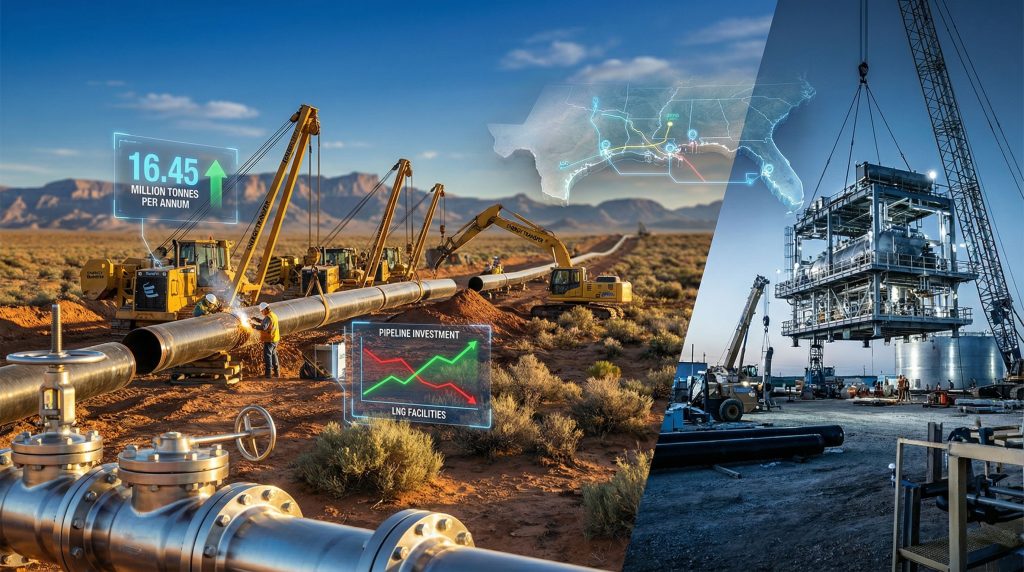
The December 2025 suspension of Energy Transfer LP's Louisiana LNG export project represents more than an isolated corporate decision; it signals a fundamental shift in how major pipeline operators evaluate competing infrastructure investment opportunities. Led by billionaire Kelcy Warren, Energy Transfer's strategic pivot away from the 16.45 million tonnes per annum Louisiana facility toward domestic pipeline expansion reflects broader industry recognition that current market conditions favor domestic infrastructure over export-oriented megaprojects.
The suspension of Energy Transfer's Louisiana project highlights how US Economic Trends directly impact major infrastructure investment decisions. Furthermore, this strategic realignment demonstrates the interconnected nature of domestic energy policy and capital allocation priorities.
| Project Component | Specification | Strategic Significance |
|---|---|---|
| Planned Capacity | 16.45 MTPA | Equivalent to ~2.2 bcf/d export capability |
| Location Advantage | Louisiana Gulf Coast | Direct access to Henry Hub pricing and marine infrastructure |
| Committed Customers | Chevron Corp., Shell Plc | Major integrated energy companies providing demand certainty |
| Development Status | Suspended December 2025 | Investment decision deferred indefinitely |
| Alternative Investment | Southwest U.S. pipeline expansion | Capital reallocation toward domestic infrastructure |
The involvement of Chevron Corporation and Shell Plc as committed offtake customers demonstrates that demand-side certainty alone cannot overcome financing and development challenges facing greenfield LNG export projects. These major integrated energy companies possess substantial balance sheet capacity and long-term LNG portfolio requirements, yet their participation proved insufficient to secure project financing at acceptable terms. This outcome reflects broader capital market discipline across the energy sector, where investors increasingly demand shorter payback periods and reduced technology risk exposure.
Engineering partnerships with established contractors including KBR and Technip Energies had positioned the project for technical execution success. KBR brings extensive process engineering expertise in liquefaction train design, while Technip Energies provides specialized subsea engineering capabilities and megaproject delivery experience. However, technical competency cannot address fundamental project economics when capital costs escalate and financing markets restrict availability for long-duration energy infrastructure investments.
The Louisiana facility represented a terminal conversion opportunity, adapting existing gas-import infrastructure constructed before the U.S. shale revolution enabled net LNG export capability. This conversion approach typically reduces capital requirements compared to greenfield facility development, as existing marine terminals, storage capacity, and pipeline connections provide foundation infrastructure. Nevertheless, conversion projects still require substantial investment in liquefaction trains, compression equipment, and regulatory re-permitting for export operations versus historical import functions.
According to Energy Transfer's official announcement, the company stated: "The suspension of Energy Transfer's LNG project reflects broader difficulties in securing project financing for new export facilities, despite strong global demand fundamentals and committed customer relationships with major energy companies."
Pipeline Infrastructure Investments Demonstrate Superior Capital Efficiency Metrics
Energy Transfer's simultaneous announcement of expanded Southwest U.S. pipeline development illustrates the comparative advantages driving capital reallocation decisions across the midstream energy sector. Pipeline projects offer fundamentally different risk-return profiles that align more effectively with current capital market preferences and corporate strategic objectives focused on near-term cash flow generation and predictable operational performance.
Capital Efficiency Comparison Analysis:
| Investment Category | Pipeline Projects | LNG Export Facilities |
|---|---|---|
| Typical Capital Range | $500M – $5B per major expansion | $10B – $25B+ per facility |
| Development Timeline | 3-5 years concept to operation | 7-10+ years concept to operation |
| Regulatory Approval Success | 60-70% achieve certification | 40-50% reach final investment decision |
| Technology Risk | Proven, standardised methodologies | Complex liquefaction train integration |
| Revenue Predictability | 15-20 year service agreements | Exposure to global LNG price volatility |
| Expected Payback Period | 10-15 years | 15-20+ years |
The Southwest pipeline expansion addresses specific supply-demand imbalances created by Permian Basin shale gas production growth and increasing industrial consumption across Arizona, Nevada, and California markets. Natural gas production in the Permian Basin has expanded substantially since 2015, creating egress capacity constraints that limit producer access to premium consumption markets. Pipeline utilisation rates in major Southwest corridors currently operate at 75-95% capacity, indicating robust demand fundamentals that support expansion investment decisions.
Pipeline projects benefit from anchor shipper arrangements where major customers contract 50-75% of capacity before construction commencement, providing revenue certainty that facilitates project financing at attractive terms. These long-term service agreements typically include inflation-indexed tariff escalations and minimum volume commitments that protect pipeline operators from demand fluctuations while ensuring customers receive priority capacity access during peak consumption periods.
Industrial demand drivers supporting Southwest pipeline expansion include:
- Power generation sector growth: Natural gas-fired electricity generation expansion in Western U.S. markets
- Petrochemical industry development: New chemical manufacturing facilities requiring reliable feedstock supply
- Industrial heating applications: Manufacturing operations converting from alternative fuels to natural gas
- Data centre expansion: Technology sector infrastructure requiring reliable backup power generation capability
The regulatory approval framework for interstate pipeline projects follows established Federal Energy Regulatory Commission (FERC) procedures that, while still complex, offer greater predictability than LNG export facility environmental review processes. Pipeline environmental assessments focus primarily on route optimisation, land use impacts, and construction methodologies, whereas LNG facilities undergo comprehensive air quality, marine environment, and cumulative impact evaluations that extend review timelines and increase approval uncertainty.
Global LNG Market Saturation Pressures Challenge New Project Economics
The United States maintains its position as the world's largest LNG exporter, with 2024 exports reaching approximately 13.1 billion cubic feet per day, representing roughly 10-12% of global LNG supply. However, this leadership position faces challenges from expanding global export capacity and increasingly competitive international market dynamics that affect new project development viability across all major LNG-producing regions.
Global LNG export capacity has expanded dramatically, reaching approximately 546 million tonnes per annum in operational facilities worldwide, with additional projects under construction adding 80+ MTPA by 2030. The OPEC Production Outlook influences global energy market dynamics, which in turn affects LNG pricing and project economics. Major LNG exporting nations have accelerated capacity development, including:
- Australia: ~90 MTPA operational capacity with additional projects planned
- Qatar: ~126 MTPA plus major expansion programmes through 2030
- Russia: ~34 MTPA (currently constrained by international sanctions)
- Malaysia: ~40 MTPA with targeted Southeast Asian market focus
- United States: ~80 MTPA operational across Gulf Coast facilities
This capacity expansion creates competitive pressures on pricing and project economics for new entrants, as global LNG markets demonstrate increasing price sensitivity and buyer preference for diversified supply portfolios. Asian LNG importing nations, particularly Japan, South Korea, and China, have developed sophisticated procurement strategies that leverage multiple suppliers to optimise pricing and reduce supply chain concentration risks.
Financing Environment Challenges
The Energy Transfer LNG project suspension reflects broader capital market constraints affecting energy infrastructure development globally. Despite maintaining access to committed customers and technical expertise, project financing has become significantly more restrictive due to:
- Enhanced capital market discipline: Stricter risk-adjusted return requirements for energy infrastructure investments
- ESG investment considerations: Environmental, social, and governance criteria affecting institutional investor participation
- Rising cost of capital: Higher interest rates and reduced debt availability for long-duration projects
- Technology complexity concerns: Investor preference for proven technologies over complex liquefaction processes
- Market saturation awareness: Recognition that global LNG capacity growth may exceed demand growth through 2030
Financial institutions have reduced LNG project financing availability by approximately 40-50% compared to 2015-2018 levels, reflecting both market saturation concerns and enhanced risk assessment methodologies. This financing constraint affects even well-positioned projects with strong customer relationships and technical capabilities, as demonstrated by multiple high-profile project deferrals across the global LNG development pipeline.
Strategic Investment Reallocation Impacts Natural Gas Market Dynamics
The reallocation of capital from LNG export development toward domestic pipeline infrastructure creates significant implications for North American natural gas market structure, pricing dynamics, and supply chain optimisation. Energy Transfer's strategic pivot represents part of a broader industry trend that prioritises domestic market development over international export capacity expansion.
Domestic Natural Gas Market Benefits
Pipeline capacity expansion directly supports domestic industrial competitiveness by:
- Reducing transportation bottlenecks that constrain gas flow from production regions to consumption centres
- Improving price stability through enhanced market connectivity and reduced regional price differentials
- Supporting industrial expansion in energy-intensive manufacturing sectors
- Enhancing grid reliability for natural gas-fired electricity generation facilities
- Enabling energy security through diversified domestic supply chain infrastructure
Regional pipeline capacity constraints have created persistent price differentials between major U.S. natural gas trading hubs. Henry Hub pricing in Louisiana serves as the national benchmark, while regional markets often trade at significant premiums during peak demand periods due to transportation limitations. Southwest pipeline expansion can reduce these differentials by providing alternative transportation routes and increasing market connectivity.
Furthermore, current Oil Price Dynamics demonstrate the interconnected nature of energy markets, where natural gas pricing often correlates with broader hydrocarbon commodity trends. Industrial customers benefit substantially from improved pipeline infrastructure through enhanced supply reliability and more competitive pricing.
Manufacturing operations requiring consistent natural gas supply, including steel production, chemical manufacturing, and cement production, depend on reliable transportation infrastructure to maintain operational continuity and cost competitiveness versus international producers.
Natural Gas Demand Growth Projections
The U.S. Energy Information Administration projects domestic natural gas consumption will continue expanding through 2030, driven by:
- Power generation sector: Natural gas-fired electricity generation maintaining market share advantages over coal-fired generation
- Industrial applications: Manufacturing sector natural gas consumption growth of 2-3% annually
- Commercial and residential: Building heating and commercial applications supporting baseline demand
- Transportation: Limited but growing compressed natural gas vehicle adoption in specific market segments
The Natural Gas Intel report highlighted that the Energy Transfer LNG project suspension reflects these shifting market priorities. Additionally, US Natural Gas Forecasts suggest continued domestic demand growth supporting pipeline investment strategies.
Pipeline utilisation rates across major U.S. corridors currently range from 75-95%, indicating robust demand fundamentals that support continued infrastructure investment. The Permian-to-Gulf Coast corridor operates at particularly high utilisation due to shale gas production growth and limited egress capacity relative to production volumes.
Critical Performance Indicators Guide Future Infrastructure Investment Decisions
Energy sector stakeholders require comprehensive analytical frameworks to evaluate competing infrastructure investment opportunities as market conditions continue evolving and capital allocation decisions become increasingly complex. The Energy Transfer LNG project suspension provides valuable lessons for assessing similar strategic choices across the midstream energy sector.
Essential Monitoring Metrics
- Pipeline utilisation rates: Quarterly reporting on capacity utilisation across major transportation corridors
- LNG export facility financing success rates: Tracking project approval and financing achievement percentages
- Natural gas demand growth: Monthly consumption data by sector and geographic region
- Capital market accessibility: Interest rate trends and debt availability for energy infrastructure projects
- Regulatory approval timelines: Average duration for FERC and state-level project certifications
- Competitive positioning metrics: Market share analysis and pricing benchmarks versus alternative suppliers
Strategic Decision Framework Components
Energy infrastructure operators should evaluate projects through multifaceted assessment criteria that address both quantitative financial metrics and qualitative strategic considerations:
Financial Analysis Requirements:
- Net present value calculations using appropriate discount rates for project risk profiles
- Sensitivity analysis for commodity price, demand growth, and capital cost scenarios
- Capital efficiency metrics comparing investment requirements per unit of cash flow generation
- Payback period analysis accounting for development timeline and operational ramp-up phases
- Return on invested capital targets aligned with corporate financial objectives
Risk Assessment Categories:
- Regulatory approval probability based on historical success rates and project-specific factors
- Technology execution risk considering complexity and contractor track records
- Market demand sustainability through long-term supply-demand modelling
- Environmental compliance requirements and potential impact on project timelines
- Financing market accessibility given current capital market conditions
Competitive Positioning Evaluation:
- Market share implications for maintaining or expanding geographic presence
- Customer relationship impacts through service reliability and capacity availability
- Strategic asset portfolio optimisation considering existing infrastructure synergies
- Long-term competitive advantages created through enhanced market access or operational efficiency
The next major ASX story will hit our subscribers first
Future Outlook for Natural Gas Infrastructure Development Strategies
The Energy Transfer LNG project suspension reflects broader structural changes in energy infrastructure development that will likely persist through the remainder of this decade. Capital market discipline, regulatory complexity, and global market dynamics have fundamentally altered the risk-return calculations that guide major infrastructure investment decisions across the energy sector.
Pipeline Network Expansion Priorities
Domestic pipeline development will likely receive continued investment preference due to:
- Shorter development cycles enabling faster capital deployment and return generation
- Established regulatory frameworks reducing approval uncertainty and timeline variability
- Domestic demand growth supporting long-term utilisation and revenue stability
- Technology maturity minimising execution risk and operational complexity
- Capital efficiency advantages requiring lower absolute investment levels per revenue unit
Regional pipeline expansion priorities will focus on addressing specific supply-demand imbalances, including Permian Basin egress capacity, Northeast market access, and Southeast industrial demand growth. These targeted investments offer superior risk-adjusted returns compared to large-scale export infrastructure development.
LNG Export Facility Development Pipeline
New LNG export project development faces continued challenges despite strong global demand fundamentals:
- Capital market restrictions limiting financing availability for megaproject development
- Environmental review complexity extending regulatory approval timelines beyond historical norms
- Global competition intensification as international suppliers expand export capacity
- Technology cost escalation affecting project economics and return profiles
- Market saturation risks as global capacity growth potentially exceeds demand expansion
Successful LNG projects will likely require enhanced financial structures, including government policy support, strategic customer equity participation, or modular development approaches that reduce capital intensity and development risk.
Policy and Regulatory Evolution
Federal energy policy will continue influencing infrastructure development priorities through:
- Environmental review modernisation potentially streamlining approval processes for domestic infrastructure
- Energy security considerations supporting domestic pipeline network resilience and capacity expansion
- International trade policy affecting LNG export market access and competitive positioning
- Climate policy integration influencing long-term natural gas infrastructure investment strategies
The intersection of energy security, economic competitiveness, and environmental objectives will shape regulatory frameworks that affect both pipeline and LNG facility development timelines and approval criteria. Moreover, Tariffs' Impact on Investments demonstrates how trade policy influences energy infrastructure investment decisions.
Investment Market Evolution
Capital allocation trends across the energy infrastructure sector indicate continued preference for:
- Shorter payback periods through pipeline and regional infrastructure investments
- Predictable cash flow generation via established customer relationships and proven technologies
- Domestic market focus reducing exposure to international commodity price volatility and geopolitical risks
- Modular expansion capability enabling phased capital deployment and risk management
- Operational efficiency optimisation through technology integration and asset portfolio synergies
The Energy Transfer LNG project suspension demonstrates that even well-positioned projects with strong customer commitments and technical capabilities face substantial challenges in current market conditions. This outcome provides valuable guidance for industry stakeholders evaluating similar strategic decisions and capital allocation priorities in the evolving energy infrastructure landscape.
Disclaimer: This analysis is based on publicly available information and industry data. Energy infrastructure investments involve substantial risks including regulatory approval uncertainty, commodity price volatility, and capital market accessibility. Prospective investors should conduct independent due diligence and consult qualified financial advisors before making investment decisions.
Looking to Capitalise on Energy Sector Infrastructure Shifts?
Discovery Alert's proprietary Discovery IQ model delivers real-time alerts on significant energy and resource discoveries across the ASX, enabling subscribers to identify actionable opportunities ahead of broader market recognition. Explore how major mineral discoveries can generate substantial returns by examining historical examples of exceptional investment outcomes, then begin your 30-day free trial today to position yourself ahead of the market.