
June 25, 2026
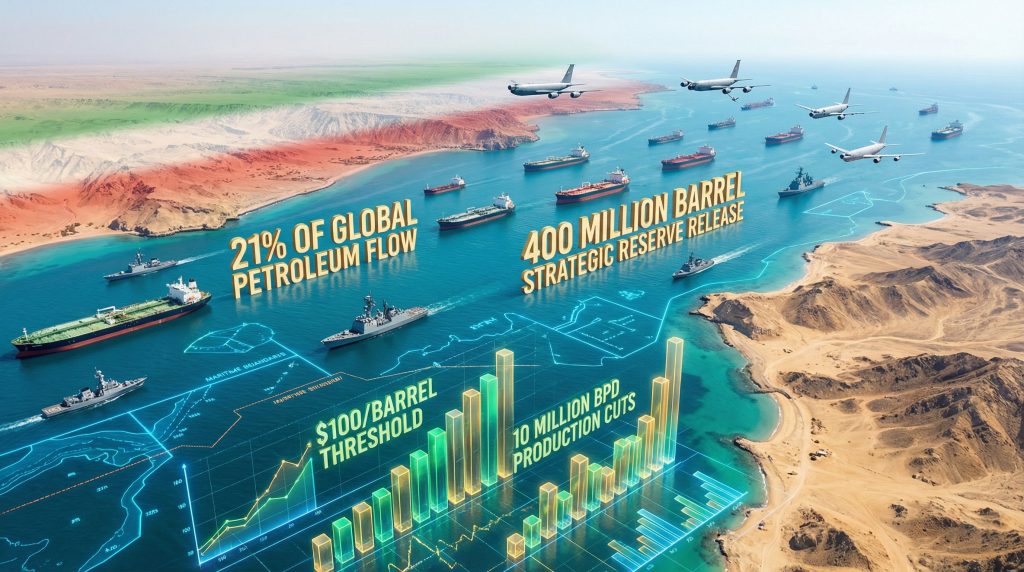
Global energy markets operate within complex regulatory frameworks that determine how supply disruptions translate into price volatility. These mechanisms become particularly critical when strategic chokepoints face operational constraints, triggering coordinated policy responses across multiple jurisdictions. Understanding these regulatory dynamics provides insight into how energy security policies shape market behavior during periods of geopolitical uncertainty.
Strategic Energy Transit Vulnerabilities and Policy Response Mechanisms
Maritime energy transportation relies on several critical passages where regulatory oversight and security protocols directly influence global oil prices Strait of Hormuz dynamics. The narrow waterway connecting the Persian Gulf to international shipping lanes represents approximately one-fifth of global petroleum liquids transit, making it subject to intensive international maritime law and security coordination frameworks.
Recent geopolitical tensions have activated emergency protocols across multiple energy-consuming nations. According to Reuters reporting from March 2026, the International Energy Agency coordinated what officials described as the largest-ever strategic petroleum reserve deployment, totaling 400 million barrels globally. Furthermore, the United States contributed 40 percent of this release, representing approximately 160 million barrels from American strategic stockpiles.
This coordinated response demonstrates how international energy security frameworks operate during supply disruptions. The IEA's emergency response protocols involve multilateral coordination among member nations, with predetermined allocation formulas for reserve deployments during market stress events.
Production Disruption Scale and Market Impact
The magnitude of production adjustments reflects both operational constraints and strategic policy decisions across major producing regions. Middle Eastern oil-producing nations reduced combined output by approximately 10 million barrels per day, equivalent to roughly 10 percent of global demand, according to IEA assessments reported in March 2026.
However, this OPEC production impact extends beyond simple supply calculations. The geopolitical tensions affecting energy markets create cascading effects throughout the global supply chain.
Key Production Impact Metrics:
- Total production reduction: 10 million bpd
- Global demand percentage: 10%
- Strategic reserve deployment: 400 million barrels
- U.S. contribution to reserves: 160 million barrels
- Price escalation: 6% daily increase approaching $100 per barrel
The IEA characterized this production disruption as representing the most significant oil supply interruption in the history of global energy markets. Such assessments carry particular weight given the organisation's role in coordinating energy policy responses amongst major consuming nations.
Maritime Security Policy Development and Naval Escort Operations
Naval security policies for energy transportation corridors involve complex coordination between military capabilities and civilian maritime operations. U.S. Energy Secretary Chris Wright indicated in March 2026 that naval escort capabilities through critical waterways remained limited at that time, though such operations could become more feasible by month's end.
These security considerations directly influence energy transportation costs and risk assessments. Maritime insurance frameworks adjust premium structures based on geopolitical risk evaluations, creating additional cost pressures on energy supply chains beyond fundamental production economics.
Pentagon officials acknowledged operational limitations regarding escort capabilities through strategic waterways. Consequently, these constraints highlight the complex relationship between military capacity and energy infrastructure protection, influencing both short-term supply chain operations and longer-term energy security planning frameworks.
Insurance Market Response to Geopolitical Risk
Maritime insurance markets respond rapidly to changing geopolitical conditions affecting energy transportation. Premium adjustments for vessels transiting high-risk corridors reflect underwriter assessments of operational dangers and potential cargo losses.
Risk Assessment Framework Components:
- War risk insurance premiums
- Hull and machinery policy adjustments
- Cargo insurance rate modifications
- Route-specific risk classifications
- Temporal risk evaluation periods
These insurance market mechanisms create direct cost transmission channels from geopolitical tensions to energy pricing structures. When transportation risks increase, these costs ultimately influence delivered energy prices across global markets.
Emergency Energy Policy Activation and Consumer Protection
Multiple jurisdictions implement emergency energy policies designed to mitigate consumer impact from sustained high energy prices. These frameworks typically include fuel subsidy mechanisms, strategic reserve utilisation protocols, and alternative supply chain acceleration measures.
The rapid price escalation witnessed in March 2026, with oil prices Strait of Hormuz jumping 6 percent to approach $100 per barrel, triggered various emergency policy responses across consuming nations. This price movement occurred despite the coordinated strategic reserve deployment, highlighting the scale of supply disruption concerns.
According to Reuters reporting, the price surge coincided with incidents involving two tankers that caught fire in an Iraqi port following suspected attacks. These operational disruptions compound supply chain vulnerabilities and influence policy response timing, reflecting complex oil price surge dynamics that extend beyond simple supply calculations.
Central Banking Coordination During Energy Price Volatility
Central banking institutions coordinate monetary policy responses to manage inflation pressures from sustained energy price increases. These coordination mechanisms include foreign exchange intervention protocols and inflation targeting adjustments to accommodate energy-driven price pressures.
In addition, analysts must consider how potential price volatility affects broader economic stability measures and monetary policy frameworks.
Monetary Policy Response Tools:
| Policy Instrument | Implementation Scale | Target Objective |
|---|---|---|
| Currency intervention | Multi-national coordination | Exchange rate stability |
| Interest rate adjustment | Coordinated timing | Inflation management |
| Quantitative measures | Variable by jurisdiction | Liquidity provision |
| Forward guidance | Synchronized messaging | Market expectation management |
These monetary policy frameworks aim to prevent energy price volatility from creating broader economic instability. Furthermore, they maintain price stability mandates across different economic regions whilst addressing concerns about inflation and tariffs.
Infrastructure Protection and Alternative Route Development
Energy infrastructure protection regulations focus particularly on chokepoint vulnerability assessment and mitigation strategies. These frameworks influence operational costs and strategic planning for energy companies operating in high-risk transit corridors.
Alternative transportation route development receives accelerated policy support during periods of primary corridor vulnerability. These initiatives include pipeline infrastructure expansion, alternative shipping corridor utilisation, and diversified supply chain development projects.
Alternative Route Development Priorities:
- Pipeline capacity expansion projects
- Secondary shipping corridor enhancement
- Storage facility strategic positioning
- Supply chain redundancy implementation
- Regional energy hub development
Governments implement enhanced regulatory frameworks for critical infrastructure protection, with particular emphasis on single-point-of-failure vulnerabilities in energy transportation networks. These policies create both compliance costs and strategic investment opportunities for energy infrastructure operators.
Long-term Energy Security Policy Acceleration
Energy independence policies receive acceleration during supply disruption periods, including domestic production enhancement, renewable energy transition programmes, and strategic stockpile expansion initiatives. These policy frameworks aim to reduce vulnerability to geopolitical supply interruptions over extended time horizons.
International cooperation protocols for energy security undergo enhancement during crisis periods. Consequently, these include expanded information sharing mechanisms, coordinated response capabilities, and joint strategic planning frameworks that improve collective energy security resilience through multilateral coordination.
Investment Policy Implications and Market Structure Evolution
Regulatory frameworks adjust to incentivise investment in energy infrastructure resilience, including alternative transportation routes, enhanced storage capabilities, and supply chain diversification projects. These policy modifications create investment opportunities whilst addressing strategic vulnerabilities identified during supply disruptions.
Financial regulatory frameworks governing energy market risk management evolve to address increased volatility and geopolitical risk factors. Enhanced capital requirements for energy trading, improved risk disclosure mechanisms, and strengthened market stability protocols represent key areas of regulatory development.
For instance, effective investment strategy insights must account for these evolving regulatory landscapes and their implications for portfolio construction.
Investment Incentive Framework Elements:
- Tax credit mechanisms for infrastructure projects
- Accelerated depreciation schedules for strategic assets
- Risk-sharing partnerships between public and private sectors
- Strategic project designation and preferential treatment
- Enhanced regulatory certainty for long-term investments
These policy developments influence capital allocation decisions across the energy sector, with particular impact on infrastructure development timelines and project economics for strategic energy assets.
Market Psychology and Regulatory Response Coordination
Energy market psychology responds not only to physical supply constraints but also to the perceived effectiveness of policy response mechanisms. Coordinated regulatory action across multiple jurisdictions can influence market sentiment and price discovery processes beyond the immediate impact of supply fundamentals.
The timing and scale of policy interventions, such as strategic reserve releases and production coordination agreements, directly influence market participant expectations regarding supply adequacy and price stability. However, these psychological factors can amplify or moderate the physical impact of supply disruptions on oil prices Strait of Hormuz dynamics.
Market Psychology Response Factors:
| Factor | Impact Level | Timeline |
|---|---|---|
| Policy coordination effectiveness | High | Immediate |
| Reserve deployment scale | Moderate | Short-term |
| Alternative route viability | Low | Long-term |
| Insurance market response | Moderate | Medium-term |
Understanding these psychological components becomes crucial for policymakers attempting to stabilise markets during periods of geopolitical tension. The interplay between actual supply constraints and market perceptions creates complex feedback loops that influence both short-term price movements and longer-term oil prices Strait of Hormuz trends.
Disclaimer: This analysis is based on publicly available information and should not be construed as investment advice. Energy markets involve significant volatility and geopolitical risk factors that can result in substantial financial losses. Readers should conduct independent research and consult qualified professionals before making investment decisions related to energy markets or related securities.
The complex interplay between regulatory frameworks, geopolitical events, and market mechanisms continues to shape global energy security policies. Understanding these dynamics provides valuable context for assessing how supply disruptions translate into market outcomes and policy responses across different jurisdictions and time horizons.
Want to Capitalise on Energy Market Volatility?
Discovery Alert's proprietary Discovery IQ model delivers real-time notifications on significant ASX mineral discoveries, including critical energy transition metals that drive market movements during periods of geopolitical uncertainty. Our subscribers gain instant access to actionable investment opportunities, transforming complex geological data into clear trading insights that help position portfolios ahead of major discoveries with substantial return potential.