June 25, 2026
The Engineering Reality Behind Removing Operators from Harm's Way in Open-Pit Mining
RCT remote automation for surface mining safety represents a genuine engineering response to one of the industry's most compounded hazard profiles. Every decade or so, the mining sector confronts a category of risk that existing safety frameworks are simply not designed to handle. The transition from underground extraction to open-pit surface mining over historically mined ground is one such scenario. It combines two entirely separate hazard domains into a single operational environment, and the consequences of underestimating that combination can be catastrophic.
When big ASX news breaks, our subscribers know first
Why the Underground-to-Surface Transition Creates a Uniquely Compounded Hazard
Most surface mining safety frameworks are built around a relatively stable set of assumptions: known ground conditions, predictable equipment trajectories, and manageable personnel proximity risks. When a mine has operated underground for years before transitioning to open-pit methods, those assumptions break down immediately.
Subsurface voids left behind by prior underground extraction create a fundamentally unpredictable ground stability environment. Heavy surface equipment operating above a network of mined-out cavities faces collapse and sinkhole risk that cannot be fully mapped or predicted in real time. This is not a marginal hazard. It is a condition where a single machine movement can trigger cascading ground failure beneath an operator who has no warning and no escape.
Layered on top of this is the open-pit geometry itself, which introduces:
- Bund and embankment edges that represent high-consequence fall zones for equipment and personnel
- Dam crest proximity risks where vehicles operating in low-visibility or fatigued-operator conditions can breach safe boundaries
- High-traffic surface zones where the interaction between heavy equipment and ground personnel multiplies exposure
- Extreme ambient temperatures in northern Canadian operations that directly impair operator reaction time and sustained alertness
"The intersection of void-network instability below and open-edge geometry above means that surface operations at transitional mines carry compounded risk from two directions simultaneously. Conventional in-cab operation places the operator at the centre of both hazard domains at once."
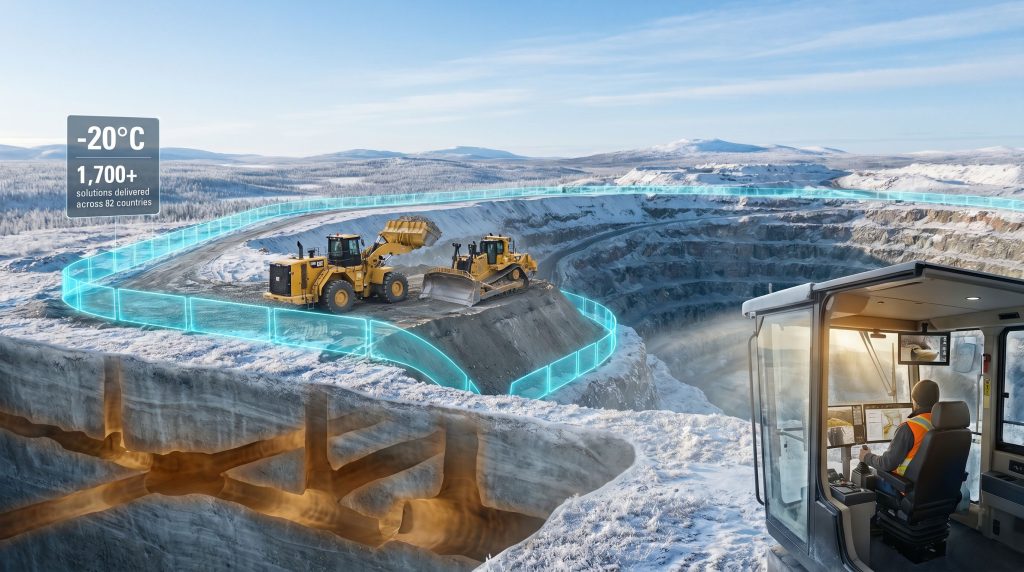
In documented Canadian nickel mining operations, ambient temperatures reaching -20 degrees Celsius have been recorded during active surface mining shifts. At these temperatures, fatigue accumulation accelerates, fine motor control degrades, and the cognitive bandwidth available for hazard recognition narrows significantly. These are not peripheral concerns. They are primary safety variables.
Furthermore, mining's safety transformation has accelerated significantly in response to exactly these kinds of compounded environmental and geotechnical risks, pushing operators and technology providers alike to rethink in-cab exposure entirely.
How RCT Remote Automation for Surface Mining Safety Works in Practice
The OEM-Agnostic Architecture: Why Fleet Compatibility Changes Everything
One of the least-discussed but most operationally significant aspects of RCT remote automation for surface mining safety is its OEM-agnostic design architecture. Most automation solutions are built around specific equipment manufacturers, meaning a mine operator running a mixed fleet must either standardise around a single OEM or deploy multiple incompatible automation platforms.
RCT's approach eliminates this constraint entirely. The system is engineered to integrate with any make or model of heavy equipment, which means:
- Legacy equipment at long-operating mines can be automated without replacement
- Mixed fleets can be controlled from a single unified operator interface
- Capital expenditure for automation does not require fleet homogenisation as a precondition
- First-of-kind deployments become possible, as demonstrated by the first-ever remote deployment on a CAT 992 wheel loader model at a Canadian nickel operation
This last point carries more technical significance than it might initially appear. Each new machine model integration represents engineering validation work that expands the total addressable fleet for remote automation. Every first-of-kind deployment adds a verified configuration to the platform's capability library. In addition, the mining automation transformation that has reshaped the industry over recent years has been built substantially on OEM-agnostic foundations like these.
AutoNav Tele: Technical Deployment at a Canadian Nickel Mine
The documented deployment at the Canadian nickel operation involved AutoNav Tele remote control systems installed across two CAT D10 dozers and one CAT 992 wheel loader. Operators were relocated from machine cabs to an AutoNav Cabin, an ergonomic and climate-controlled workstation that addresses both safety and fatigue management simultaneously.
The cabin design is a deliberate engineering response to the thermal environment. By removing operators from exposed machine cabs in a region experiencing temperatures as low as -20 degrees Celsius, the system achieves two independent safety outcomes: it eliminates operator exposure to the void-risk and edge-risk hazard zones, and it removes the physiological fatigue variables introduced by extreme cold.
| System Component | Function | Safety Outcome |
|---|---|---|
| AutoNav Tele | Remote tele-operation of surface equipment | Operator physically removed from hazard zone |
| AutoNav Cabin | Climate-controlled operator workstation | Fatigue reduction, sustained alertness |
| Geofence Zone | Virtual boundary enforcement | Prevents equipment from entering high-risk perimeter zones |
| Crest Detection | Edge proximity identification | Stops vehicles before dam wall and pit edge boundaries |
| Site Communications | Extreme-weather signal infrastructure | Maintains remote control reliability in adverse conditions |
RCT also assumed full responsibility for site communications design and implementation, a capability that distinguishes it from vendors who supply automation hardware but leave communications integration to third parties. Engineering communications for signal reliability in sub-zero temperatures is a specialised problem. Solving it as part of an integrated deployment reduces the systemic failure risk that comes from stitching together incompatible vendor solutions.
Remote Shutdown Systems: Closing the Emergency Response Gap
Among the capabilities deployed and advocated by RCT, the remote shutdown system addresses what is arguably the most acute gap in current surface mining safety frameworks. In any scenario where an operator becomes incapacitated, the conventional response requires physical approach to a running machine. In an environment with ground instability, edge proximity, or active equipment traffic, that approach itself creates serious secondary injury risk for first responders.
A remote shutdown system allows nearby personnel to bring a machine to a complete stop without entering the hazard zone around the machine. The safety logic is straightforward: the technology removes the obligation for a physical rescue approach to a running, potentially unstable piece of heavy equipment. CSIRO's research into mining safety and automation reinforces this principle, highlighting remote intervention capability as a critical frontier in reducing operator exposure to high-consequence incidents.
"RCT has publicly positioned remote shutdown capability as a candidate for mandatory industry standard status across all bulldozers and graders. The precedent for mandatory remote intervention capability already exists in aviation and maritime industries, where the regulatory principle is well established."
Geofencing and Crest Detection: From Reactive Response to Predictive Enforcement
How Geofence Zones Are Engineered for Open-Pit Environments
Geofencing in surface mining is not simply a digital perimeter. Effective geofence zone design requires detailed geotechnical mapping of the specific hazard geometry at each site, including dam crest profiles, embankment angles, void proximity estimates, and equipment operating radii. Virtual boundaries must be positioned with enough buffer to account for machine braking distances, GPS signal latency, and terrain variability.
At the Canadian nickel operation, geofence zones with integrated crest detection were designed specifically to prevent vehicles from travelling beyond the safe operating boundary near the dam wall. This is a high-consequence risk category. Equipment or personnel going over an embankment edge represents one of the highest-fatality incident types in open-pit operations globally.
The transition from reactive safety management to predictive boundary enforcement that geofencing represents is conceptually important. Traditional safety management responds to incidents after threshold violations occur. Geofencing, however, enforces the threshold itself, intervening before the machine reaches the point of no return. Consequently, data-driven mining operations are increasingly integrating geofence data as a live safety variable rather than a static boundary reference.
What Makes Extreme-Environment Geofencing Technically Different?
Standard geofencing implementations are not designed for the signal degradation, hardware stress, and positional drift that sub-zero operating environments introduce. RCT's communications infrastructure for the Canadian deployment was specifically engineered to maintain signal integrity in the extreme cold conditions characteristic of northern Canadian mining regions.
This matters because a geofencing system that operates intermittently is operationally worse than no system at all. It creates false confidence while leaving boundary enforcement gaps. The engineering commitment to communications reliability in adverse weather is therefore not a secondary feature. It is a foundational requirement for any geofencing system to function as a genuine safety control rather than a theoretical one.
The Operational and Workforce Dimensions of Automation Deployment
Measurable Benefits Beyond Immediate Hazard Removal
The safety case for RCT remote automation for surface mining safety is the primary driver of deployment, but the operational benefits extend further:
- Operator health: Elimination of in-cab vibration, dust exposure, and thermal stress across full shift cycles
- Sustained precision: Climate-controlled cabin conditions maintain operator cognitive performance, correlating with reduced error rates in machine control
- Workforce retention: Improved working conditions in remote, harsh-climate operations address one of the most persistent challenges in northern Canadian mining, attracting and retaining qualified operators
- Productivity continuity: Operators unaffected by environmental fatigue maintain consistent throughput rates across shifts that would otherwise see performance degradation
Training Transfer: Building Internal Capability, Not Vendor Dependency
A frequently overlooked dimension of automation deployment at remote mine sites is what happens after installation. Systems that require ongoing vendor presence to function introduce their own operational fragility, particularly at sites located far from major service centres.
RCT's deployment model at the Canadian nickel operation included structured training programmes designed to transfer operational and maintenance capability to site personnel. The objective was explicit self-sufficiency: the mine's internal team would manage, operate, and maintain the automation systems without requiring RCT's continued on-site involvement.
"Technology transfer as part of safety solution delivery is increasingly recognised as a critical differentiator in remote mining contexts. A safety system that cannot be maintained independently by site personnel is a safety liability, not just a capability gap."
Moreover, predictive maintenance in mining has emerged as a complementary capability that extends this self-sufficiency model, enabling site teams to anticipate equipment failures before they become safety incidents. Meanwhile, AI in mining operations is increasingly supporting the kind of intelligent boundary enforcement and real-time hazard recognition that geofencing and crest detection systems rely upon. Epiroc's documented collaboration with RCT on autonomous machine deployment further illustrates how technology partnerships are accelerating this self-sufficiency capability across diverse operating environments.
Global Deployment Scale and the Path Toward Industry Standard Status
RCT's automation platform has reached more than 1,700 solutions delivered across 82 countries, a deployment scale that provides meaningful validation data across diverse operating environments, equipment types, and regulatory frameworks. This breadth of deployment distinguishes the platform from early-stage automation concepts and positions it as a mature industrial technology with a documented performance record.
| Scale Metric | Data Point |
|---|---|
| Global automation solutions delivered | 1,700+ |
| Countries of active operation | 82 |
| Temperature extremes documented | Down to -20°C |
| Equipment compatibility | Any OEM make and model |
| Emergency intervention capability | Remote shutdown without physical contact |
The company has identified excavators as the next priority category for remote shutdown technology expansion, extending the safety architecture beyond bulldozers and wheel loaders toward a more comprehensive fleet-wide coverage model. This trajectory reflects a deliberate strategy of building toward site-wide safety architecture rather than machine-specific point solutions.
The broader industry implications are significant. As more mines transition from underground to surface operations over historically mined ground, as Arctic and subarctic mining expands, and as mixed-fleet operations at legacy mines become the norm rather than the exception, the structural demand for OEM-agnostic remote automation will intensify. The regulatory pressure to formalise remote shutdown capability as a mandatory standard, rather than a voluntary upgrade, appears likely to build alongside that demand.
The next major ASX story will hit our subscribers first
Frequently Asked Questions: RCT Remote Automation for Surface Mining Safety
What does OEM-agnostic mean in the context of mining automation?
OEM-agnostic automation systems are engineered to integrate with heavy equipment from any original equipment manufacturer, regardless of brand or model. This allows a single remote automation platform to control CAT, Komatsu, Hitachi, or any other manufacturer's machines without requiring fleet replacement or brand-specific hardware.
How does a remote shutdown system reduce risk to surface mining personnel?
A remote shutdown system enables nearby workers to bring a machine to a complete stop without physically approaching or entering the cab. When an operator is incapacitated or unresponsive, this capability eliminates the need for first responders to approach a running, potentially unstable machine, significantly reducing secondary injury risk.
Why is crest detection particularly important in open-pit mining?
Open-pit operations involve working near embankment edges and dam walls where a vehicle travelling beyond the safe boundary can result in catastrophic equipment loss or fatality. Crest detection technology provides automated boundary enforcement that does not rely solely on operator awareness, particularly critical in low-visibility or high-fatigue conditions.
Can remote automation systems operate reliably in extreme cold weather?
Yes. RCT's systems are engineered for deployment in sub-zero environments, with documented operations in Canadian mining regions experiencing temperatures as low as -20 degrees Celsius. Communications infrastructure is specifically designed to maintain signal integrity in adverse weather, and AutoNav Cabins provide climate-controlled environments that sustain operator performance regardless of external conditions.
What training is provided with RCT automation installations?
RCT delivers structured on-site training programmes as part of the installation process, equipping mine personnel with the technical knowledge to operate, manage, and maintain automation systems independently. This self-sufficiency model reduces long-term vendor dependency, which is particularly important for remote operations far from major service centres.
Want to Stay Ahead of the Next Major ASX Mining Discovery?
Discovery Alert's proprietary Discovery IQ model delivers real-time alerts on significant ASX mineral discoveries — instantly turning complex data across more than 30 commodities into clear, actionable insights for both traders and long-term investors. Explore historic examples of exceptional discovery returns and start your 14-day free trial at Discovery Alert to position yourself ahead of the broader market.