
May 21, 2026
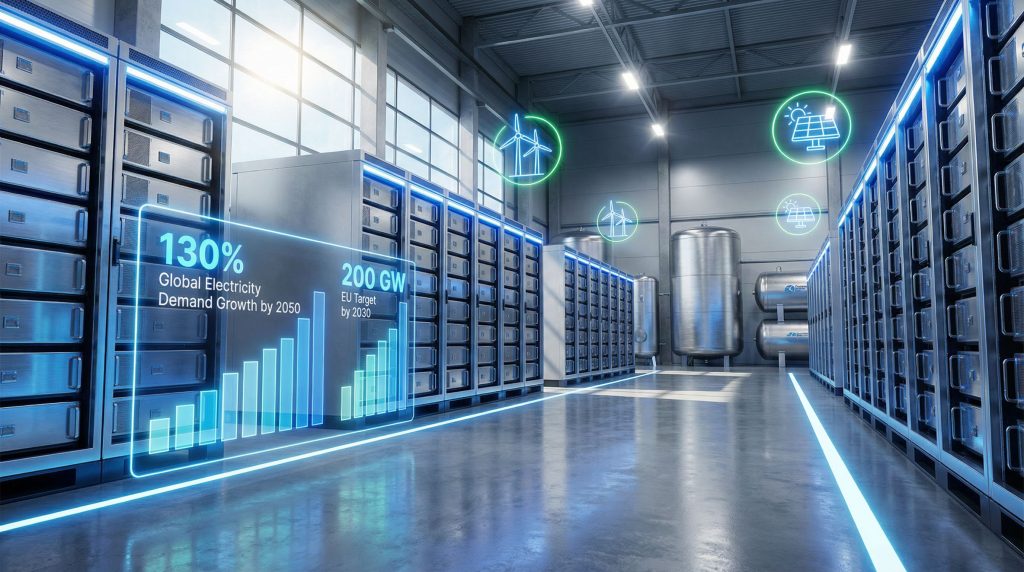
The fundamental architecture of global energy systems stands at a critical inflection point. Traditional centralized generation models, built around predictable demand patterns and dispatchable fossil fuel plants, face unprecedented disruption from renewable energy integration requirements. This transformation extends beyond technical upgrades to encompass strategic national competitiveness, economic resilience, and industrial policy frameworks.
Modern energy storage strategic imperative emerges from the convergence of three powerful forces: exponential renewable capacity growth, grid stability requirements under variable generation profiles, and the economic imperative to maximise asset utilisation across energy infrastructure investments. Nations positioning themselves as leaders in this transformation recognise storage not as auxiliary technology, but as foundational infrastructure enabling energy independence and industrial competitiveness.
This strategic shift represents a fundamental reframing of energy planning from supply-side optimisation to demand-supply temporal matching through advanced storage deployment. The implications extend across multiple sectors, from heavy industry requiring reliable 24/7 power to residential consumers expecting uninterrupted service during extreme weather events.
Grid Modernisation Pressures Drive Storage Adoption
Infrastructure Investment Displacement Mechanisms
Traditional grid expansion follows linear capacity scaling models that require decades for implementation. New transmission infrastructure projects typically face 7-12 year development timelines, including environmental impact assessments, land acquisition, regulatory approvals, and construction phases. Energy storage systems offer fundamentally different deployment characteristics, enabling distributed capacity additions within 18-24 month project cycles.
The economic logic centres on infrastructure cost avoidance through strategic storage placement. Rather than building new transmission capacity to handle peak demand periods occurring perhaps 50-100 hours annually, storage systems can serve multiple grid functions simultaneously:
- Peak demand reduction through load shifting
- Transmission congestion relief during high-demand periods
- Voltage regulation and frequency response services
- Backup power during maintenance outages
- Renewable integration support for variable generation
Regional grid operators increasingly recognise storage as the lowest-cost solution for meeting reliability requirements while deferring capital-intensive transmission investments. This represents a fundamental shift from traditional utility planning models focused on generation adequacy to comprehensive grid services optimisation.
Renewable Curtailment Economic Recovery
Grid operators face growing economic losses from renewable energy curtailment when generation exceeds transmission capacity or demand requirements. Wind and solar installations operate with near-zero marginal costs, making curtailment decisions purely economic waste rather than operational optimisation.
European grid systems experience curtailment rates ranging from 3-8% of total renewable generation during peak production periods, representing billions in wasted clean energy annually. Storage systems convert this waste stream into valuable grid assets by absorbing excess generation for dispatch during peak demand periods.
The mathematics favour storage deployment when curtailment recovery value exceeds storage system costs. With renewable capacity additions accelerating globally, curtailment rates will increase proportionally without corresponding storage infrastructure development.
When big ASX news breaks, our subscribers know first
Technology Portfolio Optimisation Across Duration Requirements
Short-Duration Applications and Grid Services
The energy storage strategic imperative encompasses multiple technology pathways optimised for specific duration and power requirements. Lithium-ion battery systems dominate short-duration applications due to rapid response characteristics and mature supply chains, serving critical grid stability functions:
| Service Type | Response Time | Duration Required | Value Stream |
|---|---|---|---|
| Frequency Regulation | Milliseconds | 15-30 minutes | $20-50/kW-month |
| Voltage Support | Seconds | 1-2 hours | $10-25/kW-month |
| Peak Shaving | Minutes | 2-4 hours | $15-40/kW-month |
| Renewable Firming | Real-time | 1-6 hours | $25-60/kW-month |
These revenue streams enable storage systems to generate returns through multiple value stacking opportunities rather than single-purpose deployment. Advanced energy management systems optimise storage dispatch across services to maximise economic returns while meeting grid reliability requirements.
Long-Duration Storage for Seasonal Management
Hydrogen-based storage systems address seasonal energy storage requirements that exceed battery system economic thresholds. Industrial hydrogen production enables energy storage durations measured in weeks or months rather than hours, supporting renewable energy integration during low-generation periods.
Compressed air energy storage (CAES) provides intermediate-duration solutions leveraging geological formations for large-scale energy storage. These systems offer capacity scalability that battery installations cannot match economically for utility-scale applications requiring 8+ hour discharge durations.
Thermal storage integration with industrial processes captures waste heat and provides process optimisation alongside grid services. This dual-purpose approach maximises asset utilisation while supporting industrial decarbonisation objectives through critical minerals for energy transition.
Economic Drivers Behind Strategic Storage Investment
Supply Chain Resilience and Manufacturing Localisation
Global battery supply chains exhibit extreme geographic concentration, with approximately 85% of lithium-ion cell production located in China, South Korea, and Japan. This concentration creates strategic vulnerabilities for nations developing renewable energy infrastructure dependent on imported storage systems.
Recent trade policy developments illustrate these risks:
- U.S. tariffs on Chinese battery imports reaching 25-100% depending on technology and end-use application
- European Union battery regulation requirements mandating recycled content and supply chain transparency
- Export restrictions on critical materials including lithium, cobalt, and rare earth elements
Nations implementing the energy storage strategic imperative must address supply chain vulnerabilities through domestic manufacturing capability development, strategic material stockpiling, and technology diversification initiatives.
Alternative Chemistry Development Pathways
Sodium-ion battery technology offers reduced critical material dependency while maintaining compatibility with existing lithium-ion manufacturing infrastructure. These systems eliminate cobalt and nickel requirements whilst utilising abundant sodium feedstocks, though with reduced energy density compared to lithium-ion alternatives.
Furthermore, iron-air battery systems provide ultra-low-cost long-duration storage using abundant iron and oxygen as active materials. While offering limited cycle life and power density, these systems enable seasonal storage applications at costs approaching $10-20/kWh for 100+ hour discharge applications.
Additionally, direct lithium extraction advancements promise enhanced resource recovery whilst reducing environmental impact. Solid-state battery development promises enhanced safety, energy density, and cycle life improvements over conventional lithium-ion technology, though commercial deployment remains 5-10 years from widespread availability.
Renewable Energy Integration Through Storage Optimisation
Temporal Mismatch Resolution Strategies
Solar generation profiles demonstrate predictable daily patterns peaking during midday hours (11 AM – 3 PM) while electrical demand typically peaks during evening periods (6 PM – 9 PM). This 3-7 hour temporal mismatch requires energy storage systems to capture midday solar generation for evening demand satisfaction.
Wind generation patterns vary significantly by geographic location and seasonal conditions, often producing peak output during overnight periods when demand reaches daily minimums. Storage systems enable wind energy monetisation by shifting generation to peak demand periods rather than accepting low wholesale electricity prices during overnight hours.
Regional generation-demand analysis reveals systematic patterns requiring different storage deployment strategies:
- Desert regions: High solar resources with cooling-driven afternoon/evening peaks
- Coastal areas: Offshore wind resources with variable generation timing
- Industrial zones: Consistent baseload demand requiring reliable renewable supply
- Residential areas: Morning/evening peaks with midday solar generation surplus
Grid Stability Enhancement Through Fast Response Services
Modern electrical grids require precise frequency maintenance at 50 Hz (Europe/Asia) or 60 Hz (North America) to prevent equipment damage and system instability. Traditional power plants provide inertial response through rotating machinery, but renewable energy systems lack this physical inertia.
Battery energy storage systems deliver synthetic inertia through power electronics capable of injecting or absorbing power within 100-200 milliseconds of frequency deviations. This response speed exceeds traditional generation capabilities by orders of magnitude, providing superior grid stability support.
Energy storage transforms renewable energy from an intermittent resource into a dispatchable asset capable of providing the same grid services as conventional power plants while delivering zero operational emissions.
Advanced storage systems provide multiple grid services simultaneously:
- Primary frequency response (0-30 seconds)
- Secondary frequency control (30 seconds – 15 minutes)
- Tertiary reserves (15 minutes – multiple hours)
- Black start capability for grid restoration
- Reactive power support for voltage regulation
Strategic Scenarios for National Energy Storage Planning
Scenario 1: Renewable Energy Acceleration
Accelerated renewable deployment scenarios assume renewable energy comprising 70-85% of electricity generation by 2040, requiring proportional storage capacity scaling to maintain grid reliability. This scenario demands comprehensive planning across multiple storage technologies and deployment scales.
Grid-scale storage requirements under high renewable penetration include:
- Daily cycling storage: 10-20% of peak demand capacity
- Weekly balancing storage: 5-10% of peak demand capacity
- Seasonal storage: 2-5% of peak demand capacity for extreme weather resilience
Investment requirements reach $2-4 trillion globally for storage infrastructure supporting 85% renewable electricity systems, representing the largest infrastructure deployment in human history.
Scenario 2: Energy Security Prioritisation
Geopolitical tensions affecting energy trade flows elevate the energy storage strategic imperative beyond economic optimisation to national security requirements. Strategic storage reserves provide buffer capacity during supply disruptions whilst supporting energy independence objectives.
Critical infrastructure protection through distributed storage deployment reduces single points of failure that could compromise national energy security. Military installations, hospitals, emergency services, and communication infrastructure require guaranteed power availability regardless of grid conditions.
Regional analysis indicates storage deployment strategies must account for:
- Import dependency ratios for electricity and primary energy
- Critical infrastructure vulnerability to extended outages
- Industrial competitiveness requirements for reliable power supply
- Population density affecting outage impact severity
Scenario 3: Industrial Competitiveness Focus
Energy-intensive industries including aluminium smelting, steel production, cement manufacturing, and data centres require consistent, reliable electricity supply to maintain operational efficiency and product quality. Power outages or voltage fluctuations can damage equipment worth millions of dollars while disrupting production schedules.
Industrial storage deployment enables manufacturers to:
- Access renewable energy during 24/7 production schedules
- Reduce electricity costs through peak demand management
- Improve power quality and reliability beyond grid standards
- Participate in demand response programmes for additional revenue
- Demonstrate environmental sustainability to customers and investors
Manufacturing competitiveness increasingly depends on access to clean, reliable, and cost-effective electricity. Nations providing superior energy infrastructure through storage integration attract industrial investment while supporting existing manufacturing employment.
Regional Leadership in Storage Deployment
European Union's Integrated Approach
The European Union pursues comprehensive energy storage strategic imperative through regulatory harmonisation, cross-border infrastructure development, and industrial policy coordination. EU storage capacity targets include 200 GW by 2030 scaling to 600 GW by 2050, supported by €150 billion in public and private investment.
Regulatory framework advantages include:
- Simplified permitting for storage projects co-located with renewable generation
- Revenue stacking authorisation across multiple grid services
- Cross-border capacity trading enabling optimisation across national grids
- Battery recycling requirements creating circular economy incentives
European industrial policy links storage deployment to manufacturing competitiveness, with domestic battery production capacity targets reaching 500 GWh annually by 2030. This approach reduces import dependency whilst supporting high-value manufacturing employment through green metals leadership.
North American Market Dynamics
State-level renewable energy mandates drive storage deployment across diverse market structures and regulatory environments. California's storage procurement mandate requires 11.5 GW of storage capacity by 2026, while Texas deploys storage through competitive wholesale markets without regulatory mandates.
Regional transmission organisations (RTOs) develop storage participation rules enabling revenue optimisation across:
- Energy arbitrage through wholesale market participation
- Capacity payments for reliability contributions
- Ancillary services including frequency regulation and reserves
- Transmission upgrade deferral through strategic placement
Federal research funding supports next-generation storage technology development through Department of Energy laboratories and university partnerships, targeting cost reductions and performance improvements across multiple technology pathways.
The next major ASX story will hit our subscribers first
Implementation Frameworks for Organisations
Risk Assessment and Technology Selection
Organisations implementing energy storage strategic imperative must evaluate multiple risk factors affecting technology selection, project economics, and operational requirements. Technology maturity assessment should consider:
Lithium-ion systems:
- Proven performance and established supply chains
- Declining costs but potential raw material constraints
- Suitable for 2-6 hour discharge applications
- Well-understood safety and operational requirements
Emerging technologies:
- Higher risk but potential cost and performance advantages
- Limited operational track record requiring careful vendor evaluation
- Possible technology obsolescence affecting resale value
- Regulatory uncertainty for newer technologies
Financial Planning and Revenue Optimisation
Capital expenditure requirements vary significantly across storage technologies and deployment scales, ranging from $300-800/kWh for lithium-ion systems to $50-150/kWh for long-duration alternatives. These costs continue declining but at decelerating rates as technologies mature.
Revenue stream diversification maximises storage system economics through multiple value sources. However, battery metals investment trends suggest careful market timing considerations:
- Capacity revenue from grid reliability services
- Energy arbitrage through wholesale market participation
- Demand charge reduction for commercial and industrial customers
- Backup power services during grid outages
- Grid services including frequency regulation and voltage support
Project financing increasingly favours storage deployments with diversified revenue streams and long-term contracts providing cash flow certainty. Power purchase agreements (PPAs) for storage-coupled renewable projects offer 15-25 year terms supporting debt financing.
Workforce Development and Operational Readiness
Energy storage deployment creates new employment categories requiring specialised training in electrical systems, power electronics, safety protocols, and maintenance procedures. Technical workforce development addresses skills gaps in:
- System design and engineering
- Installation and commissioning
- Operations and maintenance
- Safety and emergency response
- Performance optimisation and troubleshooting
Training programmes must evolve with technology advancement whilst providing portable skills applicable across multiple storage technologies and applications. Regional technical colleges and universities develop curriculum addressing local industry requirements and career pathways.
Long-Term Strategic Implications
Grid Architecture Evolution and Decentralisation
The energy storage strategic imperative accelerates fundamental changes in electrical grid architecture from centralised generation models to distributed energy resource (DER) integration. Future grids operate as platforms enabling bidirectional power flows rather than unidirectional transmission from central plants to end users.
Smart grid technologies coordinate millions of distributed storage systems to provide grid services whilst optimising local energy management. Advanced algorithms predict renewable generation, demand patterns, and storage requirements across multiple time scales from seconds to seasons.
This transformation creates new market opportunities in software development, data analytics, cybersecurity, and system integration whilst requiring workforce retraining across traditional utility operations.
Economic Transformation and Industrial Development
Nations leading the energy storage strategic imperative capture disproportionate economic benefits through technology export opportunities, manufacturing employment, and industrial competitiveness. Storage manufacturing creates high-value employment requiring advanced materials science, precision manufacturing, and quality control expertise.
Supply chain integration across battery materials, cell production, system assembly, and recycling creates vertically integrated industrial clusters supporting regional economic development. Consequently, the battery recycling breakthrough demonstrates how these clusters attract additional investment in research and development, advanced manufacturing, and related technologies.
International trade in storage technologies and services represents growing economic opportunities for nations developing technological leadership and manufacturing capabilities.
Climate Policy Alignment and Decarbonisation
Energy storage strategic imperative enables deeper decarbonisation across economic sectors by supporting renewable energy integration, electrification of transportation and heating, and industrial process optimisation. Carbon reduction targets become achievable through reliable renewable energy availability rather than intermittent generation limiting decarbonisation potential.
Sector coupling through storage systems connects electricity, transportation, heating, and industrial energy systems for comprehensive optimisation. Electric vehicle batteries provide grid storage when vehicles are parked whilst industrial thermal storage captures waste heat for beneficial use.
This integrated approach maximises carbon reduction benefits whilst minimising economic disruption from energy system transformation.
Strategic Positioning for the Storage Economy
Energy storage represents a fundamental transformation in how nations, organisations, and communities approach energy security, economic competitiveness, and environmental sustainability. The convergence of technological advancement, policy support, and economic necessity creates compelling opportunities for immediate action whilst building foundations for long-term prosperity.
Organisations recognising storage as strategic infrastructure rather than auxiliary technology position themselves to capture emerging opportunities whilst contributing to broader societal objectives. Furthermore, why energy storage is becoming a strategic imperative emphasises that this transformation requires comprehensive planning across technology selection, workforce development, financial strategies, and operational readiness.
The energy storage strategic imperative demands immediate action to avoid competitive disadvantages whilst building capabilities for future market leadership. Meanwhile, powering the future strategies for battery energy storage developers demonstrates how strategic storage deployment today enables tomorrow's energy-resilient, economically competitive, and environmentally sustainable economy.
Please note that market predictions, technology development timelines, and investment projections involve inherent uncertainties and should be considered alongside other analytical frameworks and expert opinions when making strategic decisions.
Considering Small-Cap ASX Energy Storage Opportunities?
Discovery Alert's proprietary Discovery IQ model delivers instant notifications on significant mineral discoveries across the critical materials powering energy storage systems, from lithium and rare earths to copper and nickel. Stay ahead of market movements by exploring historic examples of exceptional discovery returns and begin your 14-day free trial today to position yourself strategically in the energy transition economy.