August 14, 2026
Energy storage systems are experiencing a technological renaissance, driven by the urgent need to solve renewable energy's intermittency challenges. While lithium-ion batteries have dominated the landscape, researchers worldwide are exploring alternative chemistries that could deliver superior performance characteristics for specific applications. Among these emerging technologies, 2D carbon selenide sodium-ion batteries represent a particularly compelling frontier, combining abundant raw materials with theoretical performance metrics that could reshape grid-scale energy storage economics. Furthermore, recent advances in critical minerals energy transition highlight the strategic importance of diversifying battery technologies.
Understanding the Fundamental Properties of 2D Carbon Selenide Materials
The atomic architecture of 2D carbon selenide creates unique opportunities for sodium-ion intercalation that conventional materials cannot match. This monolayer crystalline structure features selenium atoms strategically bonded to a carbon framework, creating an indirect bandgap ranging from 1.544 eV to 2.1 eV. This electronic configuration proves critical for battery performance, as it enables the material to transform from semiconducting to metallic states during sodium intercalation.
Electronic Structure and Intercalation Mechanisms
Research from TU Delft demonstrates that β-CSe maintains exceptional structural integrity through multiple validation techniques. The material exhibits remarkable thermodynamic stability, confirmed through phonon spectrum analysis and molecular dynamics simulations across temperature ranges from 300K to 400K. This temperature range encompasses both ambient conditions and elevated battery operating scenarios, ensuring practical applicability. Moreover, this research aligns with broader mining industry innovation trends focused on developing next-generation materials.
The transformation mechanism during sodium intercalation represents a fundamental breakthrough. When sodium atoms intercalate into the 2D carbon selenide structure, the material undergoes an electronic state change from semiconducting to metallic, dramatically enhancing conductivity pathways. This transition occurs without compromising structural stability, unlike conventional materials that experience significant lattice distortion during ion insertion and extraction. For instance, research published in Applied Surface Science provides detailed insights into these structural transformations.
Computational Validation Framework
Advanced computational modeling validates these properties through multiple methodologies:
- Density Functional Theory (DFT): Electronic structure calculations confirming bandgap properties and quantifying adsorption energies
- Ab Initio Molecular Dynamics (AIMD): Real-time thermal stability assessments across operational temperatures
- Nudged Elastic Band (NEB): Energy barrier determination for sodium migration pathways
- Basin-Hopping Monte Carlo (BHMC): Global structural optimization confirming lowest-energy configurations
The convergence of results across these diverse computational approaches provides high confidence in the material's predicted performance characteristics. Additionally, comprehensive analysis from PV Magazine's detailed coverage demonstrates the commercial potential of these advancements.
When big ASX news breaks, our subscribers know first
Addressing Critical Sodium-Ion Battery Performance Limitations
Traditional anode materials face fundamental challenges that limit commercial sodium-ion battery adoption. Volume expansion during charge-discharge cycles causes mechanical degradation, while high ion diffusion barriers limit charging speeds. 2D carbon selenide addresses both limitations through its unique structural properties, particularly when considered within the context of emerging battery recycling breakthrough technologies.
Volume Expansion Mitigation
Perhaps the most significant advancement involves volume management during cycling. Conventional silicon-based anodes expand by approximately 300% during sodium intercalation, causing severe mechanical stress and rapid capacity degradation. Even graphite anodes, considered relatively stable, experience 10-12% volume expansion.
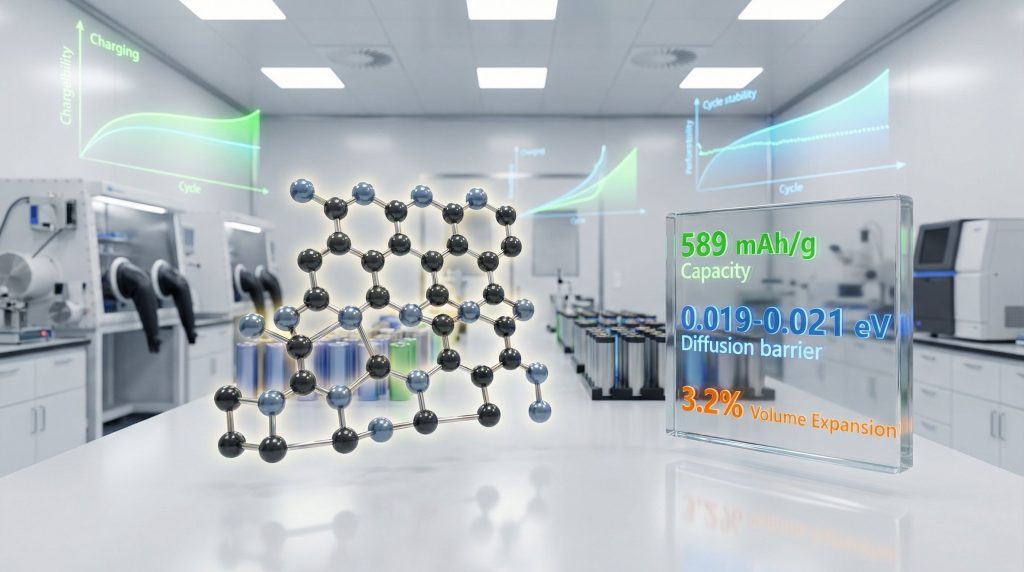
In contrast, β-CSe demonstrates remarkable dimensional stability with only 3.2% volume expansion during sodium intercalation. This represents a 73% improvement over graphite and a 99% improvement over silicon alternatives. The minimal expansion results from anisotropic mechanical properties that accommodate strain preferentially in specific crystallographic directions rather than expanding uniformly.
Ultra-Fast Ion Transport Mechanisms
Ion mobility represents another critical performance differentiator. Sodium diffusion barriers in β-CSe measure just 0.019-0.021 eV, compared to 0.3-0.5 eV for conventional graphite anodes. This 93% reduction in energy barriers enables exponentially faster ion transport, as diffusion kinetics follow exponential relationships with activation energy.
The mechanism involves sodium atoms binding at hollow sites on carbon-side surfaces, creating uniform distribution patterns that prevent dendrite nucleation. Sodium dendrites represent a critical failure mode in batteries, forming needle-like metallic structures that can penetrate separators and cause short circuits.
| Performance Parameter | β-CSe Value | Conventional Graphite | Performance Improvement |
|---|---|---|---|
| Theoretical Capacity | 589 mAh/g | 372 mAh/g | +58% |
| Diffusion Barrier | 0.019-0.021 eV | 0.3-0.5 eV | -93% |
| Volume Expansion | 3.2% | 10-12% | -73% |
| Operating Temperature | Up to 400K | Up to 350K | +14% |
Performance Advantages of β-CSe Anode Architecture
The theoretical capacity of 589 mAh/g positions 2D carbon selenide sodium-ion batteries significantly ahead of current commercial alternatives. This capacity advantage stems from the material's ability to accommodate more sodium ions per unit mass while maintaining structural integrity throughout cycling. However, successful implementation requires strategic consideration of battery metals investment trends and market dynamics.
Enhanced Rate Capability
Fast-charging applications particularly benefit from β-CSe's unique properties. The combination of ultra-low diffusion barriers and metallic conductivity transformation enables rapid charge acceptance without the polarisation effects that limit conventional materials. This capability proves essential for grid-scale applications requiring rapid response to renewable energy fluctuations.
The material's high-rate performance maintenance across extended cycling periods results from:
- Minimal structural degradation during repeated intercalation cycles
- Electronic conductivity enhancement through metallic state transformation
- Uniform ion distribution preventing localised current concentration
- Reduced mechanical stress from minimal volume expansion
Comparative Analysis with Alternative 2D Materials
When benchmarked against other advanced anode materials, β-CSe demonstrates superior performance across multiple metrics:
| Material Category | Capacity (mAh/g) | Diffusion Barrier (eV) | Volume Change (%) |
|---|---|---|---|
| β-CSe | 589 | 0.019-0.021 | 3.2 |
| MXenes | 200-400 | 0.05-0.15 | 5-15 |
| Phosphorene Derivatives | 300-500 | 0.08-0.25 | 8-20 |
| Graphite | 372 | 0.3-0.5 | 10-12 |
This comparative analysis reveals β-CSe's advantages extend beyond individual parameters to encompass the complete performance profile required for commercial applications.
Computational Modelling Validation Techniques
The reliability of 2D carbon selenide sodium-ion battery predictions depends heavily on computational validation methodologies. Multiple independent techniques confirm material properties, providing confidence for experimental synthesis efforts.
Density Functional Theory Applications
DFT calculations form the foundation of electronic structure predictions. For β-CSe, these calculations determine:
- Electronic band structure revealing indirect bandgap characteristics
- Adsorption energy quantification at various surface binding sites
- Mechanical property predictions under operational stress conditions
- Thermodynamic stability assessment across temperature ranges
The 1.544-2.1 eV bandgap range influences electronic behaviour during sodium intercalation, enabling the semiconducting-to-metallic transition that enhances conductivity.
Molecular Dynamics Simulations
AIMD simulations provide time-resolved insights into material behaviour under realistic conditions. Key findings include:
- Thermal stability confirmation at 300K and 400K operational temperatures
- Ion diffusion pathway mapping through the crystal lattice structure
- Structural deformation analysis during charge-discharge cycling
- Real-time observation of sodium intercalation mechanisms
The dual-temperature validation approach ensures materials maintain integrity across ambient and elevated battery operating scenarios.
Advanced Energy Barrier Analysis
NEB method calculations map the energy landscape for sodium migration between binding sites. This analysis reveals:
- Ultra-low activation energies of 0.019-0.021 eV for ion transport
- Transition state geometries defining migration pathways
- Mechanism identification for ion movement through the crystal lattice
- Rate-limiting step determination for overall battery performance
The exceptionally low barriers result from optimal geometric arrangements of carbon and selenium atoms creating low-energy pathways for sodium migration.
Manufacturing and Synthesis Considerations
Translating computational predictions into practical 2D carbon selenide sodium-ion batteries requires addressing synthesis challenges and quality control requirements. Consequently, this development must align with evolving energy minerals strategy initiatives across the industry.
Material Preparation Challenges
Controlled monolayer formation represents the primary manufacturing hurdle. Key requirements include:
- Precise synthesis conditions for single-layer crystalline structure
- Selenium incorporation into carbon matrix without phase separation
- Scalability considerations for industrial production volumes
- Cost optimisation while maintaining material purity
Laboratory synthesis of similar 2D materials has been successfully demonstrated, providing confidence that β-CSe synthesis lies within current technological capabilities.
Quality Assurance Protocols
Commercial viability depends on consistent material properties across production batches:
- Crystalline structure verification through advanced characterisation techniques
- Impurity level monitoring affecting electrochemical performance
- Surface area optimisation for maximum active site availability
- Batch-to-batch consistency ensuring predictable battery performance
The transition from laboratory samples to industrial-scale production will require extensive process optimisation and validation.
Applications and Market Positioning
2D carbon selenide sodium-ion batteries align particularly well with stationary storage applications where performance requirements favour durability and cost-effectiveness over maximum energy density.
Grid-Scale Energy Storage Integration
Large-scale renewable energy systems benefit significantly from β-CSe's characteristics:
- Renewable energy intermittency management through rapid response capabilities
- Load balancing for solar and wind power fluctuations
- Long-duration storage applications requiring extensive cycle stability
- Grid stabilisation services enabled by fast charge-discharge capabilities
The ultra-low diffusion barriers enable rapid response to grid demand changes, while minimal volume expansion ensures long-term reliability essential for grid applications.
Safety and Transportation Advantages
Sodium-ion chemistry provides inherent safety benefits compared to lithium-ion alternatives:
- Zero-volt discharge capability for safe shipping and storage
- Reduced thermal runaway risks due to sodium's lower reactivity
- Environmental sustainability through abundant sodium resources
- Supply chain independence from geographically concentrated lithium deposits
These advantages position 2D carbon selenide sodium-ion batteries favourably for applications prioritising safety and sustainability.
The next major ASX story will hit our subscribers first
Economic Implications and Cost Analysis
The economic case for 2D carbon selenide sodium-ion batteries extends beyond material costs to encompass system-level advantages.
Cost Structure Benefits
Sodium's abundance provides fundamental economic advantages:
- Raw material costs significantly lower than lithium equivalents
- Supply chain stability through geographically distributed sodium resources
- Reduced geopolitical risks from supply concentration
- Manufacturing simplification compared to lithium extraction processes
Market Positioning Strategy
Target applications align with β-CSe's performance strengths:
- Stationary storage systems prioritising longevity over weight
- Industrial backup power requiring high reliability and safety
- Off-grid renewable installations in remote locations
- Grid-scale applications where cost per kWh matters more than energy density
The 58% capacity improvement over graphite, combined with superior cycling stability, creates compelling value propositions for these market segments.
Experimental Validation Requirements
Translating computational predictions into commercial reality requires comprehensive experimental validation across multiple performance dimensions.
Laboratory Synthesis Priorities
Immediate research needs include:
- Experimental confirmation of computational capacity predictions
- Electrode-electrolyte compatibility testing with practical electrolyte formulations
- Long-term cycling validation under realistic operating conditions
- Rate capability verification across various charge-discharge rates
Scale-Up Development Path
Commercial deployment requires systematic scale-up:
- Industrial synthesis pathway development from laboratory methods
- Quality assurance protocol establishment for mass production
- Complete battery system integration and testing
- Field demonstration projects validating real-world performance
Key Technical Specifications Summary
Theoretical Capacity: 589 mAh/g (58% higher than graphite)
Diffusion Barriers: 0.019-0.021 eV (ultra-low resistance)
Volume Expansion: 3.2% (minimal structural stress)
Operating Temperature: Stable up to 400K
Charging Speed: Enhanced through metallic conductivity transformation
Future Research Directions and Industry Impact
The development of 2D carbon selenide sodium-ion batteries represents part of broader industry trends toward alternative battery chemistries optimised for specific applications.
Research Trajectory
Critical research areas include:
- Experimental synthesis optimisation to achieve theoretical performance
- Electrode engineering for practical battery integration
- Electrolyte compatibility studies for optimal performance
- Manufacturing process development for commercial viability
Industry Transformation Potential
Successfully developed β-CSe anodes could catalyse broader sodium-ion battery adoption:
- Cost-competitive stationary storage enabling greater renewable energy deployment
- Supply chain diversification reducing dependence on lithium resources
- Safety improvements in large-scale energy storage installations
- Performance standardisation across sodium-ion battery platforms
The combination of superior performance metrics and abundant raw materials positions 2D carbon selenide as a potentially transformative technology for sustainable energy storage systems.
Disclaimer: This analysis is based on computational research findings and does not constitute investment advice. Actual battery performance requires experimental validation, and commercial viability depends on successful synthesis, manufacturing scale-up, and market adoption. Performance predictions represent theoretical maximums that may not be achievable in practical applications.
Looking to capitalise on emerging battery technology breakthroughs?
Discovery Alert instantly identifies ASX companies at the forefront of battery metals and energy storage innovations, powered by our proprietary Discovery IQ model. Our AI-powered alerts help investors spot critical mineral discoveries and technology developments before they gain widespread market attention, providing the edge needed to position ahead of significant industry shifts. Begin your 14-day free trial today and gain access to real-time insights that could identify the next major player in the evolving battery technology landscape.