
July 27, 2026
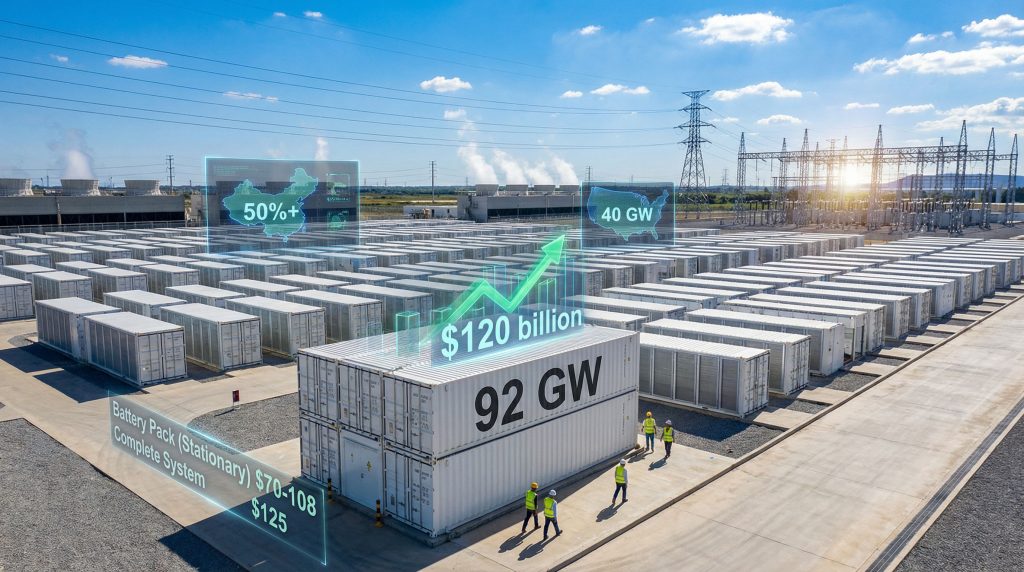
The global power sector stands at a pivotal transformation point as energy storage trends 2025 mature beyond experimental deployment into essential grid infrastructure. Economic forces spanning manufacturing overcapacity, institutional capital allocation, and regulatory frameworks are converging to reshape electricity markets fundamentally. This evolution extends far beyond simple cost reductions, encompassing revenue model transitions, geographic market expansion, and technological diversification that will define power system operations through the decade ahead.
Market Fundamentals Reshaping the Energy Storage Landscape
Economic Drivers Accelerating Global Storage Deployment
Manufacturing overcapacity in battery production facilities has created unprecedented deflationary pressure across energy storage systems. Industry analysis reveals that cell manufacturing overcapacity, economies of scale, low metal and component prices, adoption of lower-cost lithium-iron-phosphate (LFP) batteries, and a slowdown in electric vehicle sales growth collectively contributed to dramatic price declines throughout 2025.
Furthermore, this battery recycling breakthrough has enhanced the sustainability profile of storage systems while contributing to cost reductions across the supply chain.
Global capacity additions are projected to reach 92 GW (247 GWh) in 2025, representing 23% growth over the previous year. This expansion reflects not merely technological advancement but fundamental shifts in how institutional capital approaches energy infrastructure investments, with annual investment flows exceeding $120 billion as long-term returns become increasingly attractive.
Key Economic Forces Driving Deployment:
- Manufacturing surplus creating cost deflation across supply chains
- Data center electricity demand surge requiring 53 GW of flexible load management solutions
- Institutional capital recognition of storage as essential infrastructure asset class
- Policy transitions from technology-specific to technology-neutral support mechanisms
The convergence of these factors has fundamentally altered project economics, though revenue sustainability remains challenging in mature markets where pricing competition intensifies alongside falling system costs.
Regional Market Response to Storage Economics Evolution
China maintains dominant market positioning despite removing renewable energy storage mandates effective June 1, 2025. Previously, these requirements drove up to 75% of the nation's energy storage demand, with more than 20 provinces implementing mandatory storage ratios reaching 20% in some jurisdictions.
Regional Pricing Dynamics (2025):
| Market Region | Battery Pack Price ($/kWh) | Premium vs China |
|---|---|---|
| China | $94 | Baseline |
| United States | $123-130 | 31-48% premium |
| Europe | $123-130 | 31-48% premium |
The United States market achieved 40 GW deployments by Q3 2025, surpassing targets established years prior, though revenue challenges have created significant project viability concerns. California net annual revenues declined from $103/kW in 2022 to $53/kW in 2024, while Texas (ERCOT) revenues fell nearly 90% since 2023.
European markets demonstrated remarkable expansion beyond traditional UK-centred activity. Germany's battery storage grid-connection queue swelled beyond 500 GW, with 78 GW of large battery storage already approved for connection. Poland allocated subsidies for 172 projects representing 3.9 GW power capacity and 14.5 GWh energy storage through 2028.
European Market Milestones:
- Italy's inaugural MACSE auction awarded 10 GWh at €37,000/MWh/year
- Germany leading 2026 deployment pipeline with massive approved capacity
- Central and Eastern European acceleration across Poland, Romania, Hungary
- Baltic States strategic investments following Russian grid desynchronisation
In addition, lithium industry innovations continue to support these regional market developments. Emerging economies in Latin America and Middle East regions captured 42% growth rates, though specific capacity figures require additional verification from regional development banks and energy ministries.
When big ASX news breaks, our subscribers know first
Technology Economics and Cost Structure Evolution
Price Dynamics Reshaping Market Viability
Battery pack pricing for stationary storage reached $70/kWh in 2025, representing a 45% decrease from 2024 and making stationary storage the cheapest lithium-ion battery application category. This dramatic cost reduction reflects multiple convergent factors rather than single technological breakthrough.
Complete System Cost Structure (2025):
| Component Category | Cost Range ($/kWh) | Year-over-Year Change |
|---|---|---|
| Battery Pack (Stationary Global) | $70 | -45% |
| Complete System (ex-China/US) | $125 | -35% |
| Installation & Grid Connection | ~$50 | Stable |
| Chinese Market System Average | $65-75 | -50% |
Regional cost variations reflect market maturity differences and production scale economies. Chinese regional battery pack prices averaged $94/kWh, while US and European equivalents commanded 31-48% premiums, reflecting relative market immaturity, higher production costs, and lower manufacturing volumes.
Critical pricing analysis reveals system-level costs in Chinese tenders reached $65/kWh, described by industry observers as figures that have startled Western markets. This aggressive pricing environment, driven by oversupply and intense competition, has eroded margins across the sector and threatens long-term market participant viability.
US Market Economic Reality Check:
- 2023 modelled economics: $192/kW revenue with $100/kWh battery costs
- 2025 actual economics: $55/kW revenue with $130/kWh costs
- Result: 79 GW of planned US battery storage capacity cancelled in 2025
Industry specialists emphasise that true storage costs extend far beyond headline $/kWh metrics. Critical purchasing considerations include clearly communicating project use cases to suppliers, ensuring usable energy warranty alignment with project requirements, and understanding supply chain ownership structures including AC and DC block providers, cell specifications, and whether components originate from official factories or alternative manufacturing facilities with potentially lower quality standards.
Meanwhile, developments in battery-grade lithium refinery operations are helping to stabilise upstream costs and improve supply chain security.
Manufacturing Scale Economies and System Architecture Evolution
Utility-scale energy storage systems experienced remarkable capacity increases throughout 2025, with energy density improvements driving fundamental changes in project economics and deployment strategies. Container-based systems reached unprecedented capacities, with Gotion launching a 20 MWh DC container and BYD introducing a 14.5 MWh system.
2025 Utility-Scale System Capacity Progression:
| Manufacturer | Technology Type | Capacity | Architecture |
|---|---|---|---|
| Tesla | AC Hybrid | 20 MWh (Megablock) | Pre-engineered MV AC |
| Gotion | DC Container | 20 MWh | 40-foot container |
| BYD | DC Container | 14.5 MWh | Container-based |
| Sungrow | AC Modular | 12.5 MWh (PowerTitan 3.0) | Modular architecture |
| IPS | AC System | 8.1 MWh (Exeron) | Integrated AC |
| Fluence | AC Platform | 7.5 MWh (Smartstack) | Modular platform |
Market dynamics demonstrate rapid obsolescence cycles, where 5 MWh containers quickly displaced 3 MWh systems, and even larger units continued this trend throughout 2025. Energy density improvements drive multiple economic benefits including reduced land requirements, lower balance-of-system costs, and decreased civil construction expenses.
Technical Architecture Solutions:
Two primary approaches emerged to address weight and logistics constraints:
- 10-foot container designs optimising transportation weight limits
- Modular open-frame architectures allowing independent cabinet operation
These solutions streamline logistics and on-site installation while maintaining high energy density advantages and layout flexibility. Sungrow's PowerTitan 3.0 features 684 Ah cell technology, fully liquid-cooled systems, and silicon carbide PCS architecture, while Tesla's Megablock combines four Megapack 3 units with integrated megavolt transformer and switchgear.
Weight and logistical challenges intensify as energy density rises, from road weight limits to crane lifting constraints. Industry adaptation through architectural innovation addresses these practical deployment barriers while preserving economic benefits of high energy density configurations.
Revenue Model Transformation and Market Dynamics
Revenue Stream Sustainability Challenges
Energy storage trends 2025 reveal that revenue models face fundamental restructuring as markets mature and competitive dynamics intensify. The collapse of key revenue streams in major markets has created project viability crises despite favourable technology cost trends.
US Market Revenue Analysis (2022-2024):
| Market | 2022 Revenue ($/kW) | 2024 Revenue ($/kW) | Revenue Decline |
|---|---|---|---|
| California | $103 | $53 | -48% |
| Texas (ERCOT) | Peak levels | 90% decline noted | -90% since 2023 |
| National Average | $192 (2023 modelled) | $55 (2025 actual) | -71% |
These revenue declines reflect multiple market factors including increased storage penetration, reduced peak-hour power prices, and ancillary services market saturation. Texas battery revenues experienced particularly dramatic decreases, falling nearly 90% since 2023 as market fundamentals shifted.
China's policy transition eliminates renewable energy storage mandates, forcing market-based revenue model reliance. However, making energy storage profitable under market-based models remains challenging with limited wholesale power market operations and unavailable energy arbitrage revenue streams across much of the country. Beijing targets unified national electricity market establishment by 2030, with supply and demand price determination.
European Capacity Auction Results:
Italy's inaugural MACSE (Mercato a Termine degli Stoccaggi) auction significantly exceeded expectations, awarding 10 GWh capacity at €37,000/MWh/year. This milestone represents major progress toward European energy storage market maturation and provides revenue certainty for project developers.
For investors seeking to navigate these changing dynamics, comprehensive investment strategies 2025 have become essential for project success.
Market Transition Reality: Projects once modelled at $192/kW revenue with $100/kWh battery costs in 2023 now face approximately $55/kW revenue alongside $130/kWh costs, contributing to 79 GW of planned US battery storage capacity cancellations in 2025.
Policy Framework Adaptation to Market Maturity
The Inflation Reduction Act entered a new phase in 2025, shifting from technology-specific credits to technology-neutral clean electricity tax credits. Standalone energy storage maintains eligibility for base Investment Tax Credit up to 30% through 2032, preserving critical market support mechanisms.
However, tighter domestic content and Foreign Entity of Concern (FEOC) requirements have added complexity and uncertainty around project eligibility. These regulatory developments create additional development costs and timeline uncertainties for project sponsors.
Policy Evolution Impacts:
- Technology-neutral tax credit transition maintaining 30% ITC eligibility
- FEOC compliance requirements creating supply chain constraints
- Domestic content mandates influencing component sourcing decisions
- Interconnection delays constraining project development timelines
Industry voices within China's manufacturing sector increasingly advocate for price controls, higher technical and safety standards, and structural reforms to safeguard product quality and ensure long-term market stability. This mirrors consolidation dynamics observed in China's photovoltaic supply chain evolution.
Geographic Market Expansion and Strategic Positioning
European Market Transformation Beyond UK Concentration
European energy storage markets demonstrated remarkable geographic diversification in 2025, expanding far beyond traditional UK-centred activity to encompass comprehensive continental deployment strategies. This transformation reflects improved grid-scale economics and policy support mechanisms across diverse regulatory environments.
Germany emerged as the dominant European market, with battery storage grid-connection requests exceeding 500 GW in the development queue. Grid connections for an additional 78 GW have already received approval, positioning Germany as the primary market for 2026 deployment activity.
Central and Eastern European Acceleration:
- Poland: 172 subsidised projects totalling 3.9 GW/14.5 GWh through 2028
- Romania: Utility-scale battery deployment ramp-up with largest 400 MWh project commissioned
- Hungary: Residential battery subsidy programme launch with HUF 100 billion ($303 million) allocation
- Czech Republic: Regulatory changes unlocking utility-scale BESS deployment potential
Baltic States demonstrated particularly vibrant battery storage activity following desynchronisation from the Russian grid earlier in 2025. This strategic transition necessitated significant energy infrastructure investments to ensure grid stability and security of supply.
Italy achieved a major milestone with its first MACSE auction, aimed at securing 50 GWh capacity by 2030. The inaugural procurement awarded 10 GWh at record-low prices of €37,000/MWh/year, establishing competitive benchmark pricing for European capacity markets.
Spain continued laying foundations for large-scale storage deployment following major blackout events, seeking to reinforce grid resilience through comprehensive storage integration strategies.
Residential Market Acceleration Drivers
The residential energy storage market demonstrates robust growth trajectories, with projected market value reaching $45.8 billion by 2030 at a 9.3% CAGR. This expansion reflects multiple convergent factors including AI-powered energy management systems, virtual power plant aggregation opportunities, and high solar attachment rates in key markets.
Residential Market Growth Catalysts:
- AI-powered energy management optimising household consumption patterns
- Virtual power plant aggregation creating new revenue opportunities for homeowners
- Solar attachment rates exceeding 80% in California and Arizona markets
- Grid interconnection delays driving behind-the-meter storage adoption
Hungary's residential battery energy storage subsidy programme exemplifies European governmental recognition of distributed storage value. The HUF 100 billion programme aims to help families with solar panels achieve long-term energy self-sufficiency while contributing to grid stability.
Technical innovations in residential systems include improved energy density configurations, integrated solar-plus-storage solutions, and enhanced grid-interactive capabilities that enable household participation in wholesale electricity markets through aggregation platforms.
Technology Diversification Beyond Lithium-Ion
Alternative Technology Commercial Viability Pathways
Energy storage technology diversification accelerated in 2025 as alternative chemistries and storage mechanisms achieved increasing commercial viability for specific applications. This evolution addresses duration limitations inherent in lithium-ion systems while targeting cost-sensitive market segments.
Emerging Technology Commercial Status:
| Technology Type | Duration Focus | Key Applications | Commercial Maturity |
|---|---|---|---|
| Flow Batteries | 4-12 hours | Grid stabilisation | Early deployment phase |
| Sodium-Ion | 2-6 hours | Cost-sensitive markets | Production scaling |
| Thermal Storage | Days-weeks | Seasonal balancing | Pilot project stage |
| Aluminium-Ion | High power | Fast response applications | First system demonstrations |
The world's first high-power aluminium-ion battery system achieved successful testing for energy storage applications, demonstrating that lithium-free, high-power batteries can deliver stability, fast response capabilities, and enhanced recyclability for next-generation grid applications. This development represents significant progress toward diversified storage technology portfolios.
Sodium-ion batteries gained particular traction in cost-sensitive markets, offering lower material costs and reduced supply chain concentration risks compared to lithium-ion alternatives. Production scaling efforts throughout 2025 positioned sodium-ion technology for broader commercial deployment in specific market niches.
Consequently, critical raw materials insights have become increasingly important for understanding supply chain security and pricing dynamics.
Innovation Pathways for Duration Extension:
- Lithium-air and lithium-sulphur chemistries targeting 10+ hour applications
- Solid-state technologies improving energy density and safety profiles
- Hybrid systems combining multiple technologies for optimised performance curves
- Ocean-based and geological storage solutions for utility-scale seasonal applications
Flow battery systems demonstrated particular promise for 4-12 hour duration applications, offering advantages in grid stabilisation services where power and energy can be independently scaled. Early deployment projects provided operational data supporting broader commercial adoption.
Thermal storage technologies advanced toward days-to-weeks duration capabilities, addressing seasonal energy balancing requirements that exceed practical lithium-ion system economics. Pilot projects explored integration with renewable energy systems and district heating networks.
Long-Duration Storage Market Development
Long-duration energy storage (LDES) markets experienced significant development activity in 2025, driven by recognition that 4+ hour storage requirements necessitate technology solutions beyond conventional lithium-ion systems. This market segment addresses seasonal renewable energy variability and multi-day grid balancing requirements.
LDES Technology Development Priorities:
- Cost competitiveness achievement for 8+ hour applications by 2026
- Grid-forming inverter capabilities becoming standard requirements
- Energy-as-a-service models gaining traction in commercial and industrial segments
- Integration with renewable energy curtailment reduction strategies
Industry analysis suggests long-duration technologies will achieve cost competitiveness for 8+ hour applications during 2026, representing critical threshold for broader market adoption. Grid-forming inverter capabilities are becoming standard requirements as storage systems assume greater grid support responsibilities.
Commercial and industrial market segments demonstrate increasing interest in energy-as-a-service models that reduce capital expenditure requirements while providing operational flexibility. These arrangements enable storage deployment in applications where direct ownership models face economic or technical barriers.
Investment Climate and Financial Market Integration
Capital Market Valuation of Storage Assets
Energy storage assets gained recognition as distinct infrastructure investment category throughout 2025, with institutional investors developing dedicated allocation strategies and risk assessment frameworks. Utility-scale project Internal Rates of Return (IRR) range 8-15% depending on specific market structures and revenue certainty mechanisms.
However, merchant revenue volatility creates financing challenges despite strong fundamental growth trajectories. Infrastructure funds established dedicated storage investment mandates, while corporate Power Purchase Agreements (PPAs) provide revenue certainty essential for long-term project financing structures.
Investment Considerations by Market Segment:
| Market Type | IRR Range | Key Risk Factors | Financing Approach |
|---|---|---|---|
| Utility-Scale (Contracted) | 10-15% | Policy changes, technology obsolescence | Project finance, infrastructure funds |
| Utility-Scale (Merchant) | 8-12% | Revenue volatility, market saturation | Corporate PPAs, revenue diversification |
| Commercial/Industrial | 12-18% | Customer credit risk, technology performance | Energy-as-a-service models |
| Residential (Aggregated) | 15-20% | Operational complexity, regulatory changes | Virtual power plant structures |
Corporate PPAs emerged as crucial revenue certainty mechanism, enabling project developers to secure financing against predictable cash flows rather than volatile wholesale market revenues. This development particularly benefits projects in markets experiencing rapid revenue declines.
Infrastructure investment funds allocated increasing capital to storage assets, recognising long-term grid modernisation requirements and renewable energy integration needs. These investors typically seek contracted revenue streams and stable regulatory environments.
Risk Factor Analysis Shaping Investment Decisions
Investment decision-making processes increasingly incorporate comprehensive risk assessment frameworks addressing technology, policy, market, and operational uncertainties. These factors significantly influence project viability and financing terms.
Primary Investment Risk Categories:
- Policy uncertainty: Tax incentive modifications and trade restriction implementations
- Supply chain concentration: Critical mineral sourcing and geopolitical disruptions
- Technology obsolescence: Innovation cycle acceleration and performance improvements
- Grid interconnection delays: Development timeline extensions and cost increases
Policy uncertainty around tax incentives and trade restrictions creates project development challenges, particularly with Foreign Entity of Concern (FEOC) compliance requirements affecting supply chain decisions. These regulatory complexities increase development costs and timeline uncertainties.
Supply chain concentration risks in critical mineral sourcing gained attention as geopolitical tensions influence material availability and pricing. Diversification strategies include domestic content requirements and alternative chemistry development to reduce dependency concentrations.
Technology obsolescence concerns intensify as innovation cycles accelerate and energy density improvements continue. Investors evaluate technology lock-in risks against performance improvement trajectories when making long-term capital allocation decisions.
Grid interconnection delays constrain project development timelines across multiple markets, creating financing challenges and revenue timing uncertainties. These delays particularly impact merchant revenue projects where market timing affects project economics significantly.
The next major ASX story will hit our subscribers first
Future Market Structure and Competitive Landscape
Market Consolidation and Industry Dynamic Reshaping
The energy storage industry approaches significant consolidation as competitive dynamics intensify and profit margins face pressure from aggressive pricing environments. Chinese manufacturers pursue vertical integration strategies while European and US companies focus on system integration and software capability development.
Competitive Strategy Evolution:
- Chinese manufacturers: Vertical integration across supply chain components
- European companies: System integration and software platform development
- US companies: Technology licensing and service-based business model focus
- Emerging players: Specialised technology solutions and market niche targeting
Technology licensing models emerged as alternatives to direct manufacturing, enabling companies to monetise intellectual property without capital-intensive production facility investments. This approach particularly benefits companies with innovative chemistry or system design capabilities.
Service-based business models capture operational value streams beyond hardware sales, including energy trading optimisation, predictive maintenance services, and performance guarantee structures. These models provide recurring revenue opportunities and customer relationship deepening.
Industry Consolidation Indicators:
- Aggressive pricing environment eroding sector-wide margins
- Manufacturing overcapacity forcing market share competition
- Technology standardisation reducing differentiation opportunities
- Capital allocation toward innovation rather than capacity expansion
China's energy storage sector mirrors photovoltaic industry evolution, transitioning from unchecked expansion toward strategic consolidation with greater emphasis on innovation, sustainability, and quality rather than purely aggressive pricing strategies.
Structural Changes Defining 2026 Market Evolution
The 2026 energy storage trends 2025 analysis suggests that markets will likely experience fundamental structural changes as economic realities force business model adaptations and technology transitions. Project cancellation waves are anticipated as revenue-cost gaps widen in mature markets.
Expected 2026 Market Dynamics:
- Project cancellation surge: Revenue-cost gap widening forcing project abandonment
- Long-duration competitiveness: 8+ hour applications achieving cost competitiveness
- Grid-forming standards: Inverter capabilities becoming universal requirements
- Service model adoption: Energy-as-a-service gaining commercial/industrial traction
Long-duration energy storage technologies are expected to achieve cost competitiveness for 8+ hour applications, creating new market opportunities and competitive dynamics. This development addresses seasonal energy storage requirements and multi-day grid balancing needs.
Grid-forming inverter capabilities will become standard requirements as storage systems assume greater grid support responsibilities. This technical evolution reflects utility recognition of storage systems as active grid infrastructure rather than passive load-shifting resources.
Energy-as-a-service models are projected to gain significant traction in commercial and industrial market segments, reducing capital expenditure barriers while providing operational flexibility and risk management benefits for end customers. According to the World Economic Forum's energy technology trends, service-based models represent the future of energy infrastructure deployment.
Market Structure Transition Timeline:
- 2026: Project cancellation wave and technology transition acceleration
- 2027-2028: Long-duration storage commercial deployment scaling
- 2029-2030: Service-based models becoming dominant in C&I segments
The transition from growth-driven to value-driven market dynamics represents fundamental shift requiring strategic positioning adjustments across the industry value chain. Success demands understanding both technological capabilities and evolving market structure requirements.
Furthermore, comprehensive analysis from the International Renewable Energy Agency confirms that battery energy storage systems are becoming increasingly critical for managing renewable power supply-demand gaps, supporting the broader transition to sustainable energy systems.
Disclaimer: This analysis contains forward-looking projections and market forecasts based on current industry trends and available data. Actual market developments may vary significantly from projections due to regulatory changes, technological breakthroughs, economic conditions, or unforeseen market disruptions. Investment decisions should be based on comprehensive due diligence and professional financial advice rather than solely on market analysis and projections presented in this article.
Ready to Capitalise on Energy Storage Investment Opportunities?
Discovery Alert provides instant notifications on significant ASX mineral discoveries, powered by its proprietary Discovery IQ model, helping investors identify actionable opportunities in the critical materials sector that powers energy storage technologies. With mining companies increasingly focused on battery metals and rare earth elements essential for energy storage systems, subscribers gain rapid insights into transformative discoveries that could drive substantial returns as demand for storage infrastructure accelerates globally.