
July 11, 2026
Energy Supply Disruptions and Fiscal Policy Responses
The global economy increasingly relies on sophisticated emergency energy reserve mechanisms to navigate unprecedented supply chain disruptions. These strategic stockpiles have evolved beyond simple crisis management tools into complex instruments of economic stabilisation, representing billions of dollars in carefully managed petroleum assets designed to cushion national economies during periods of severe market volatility.
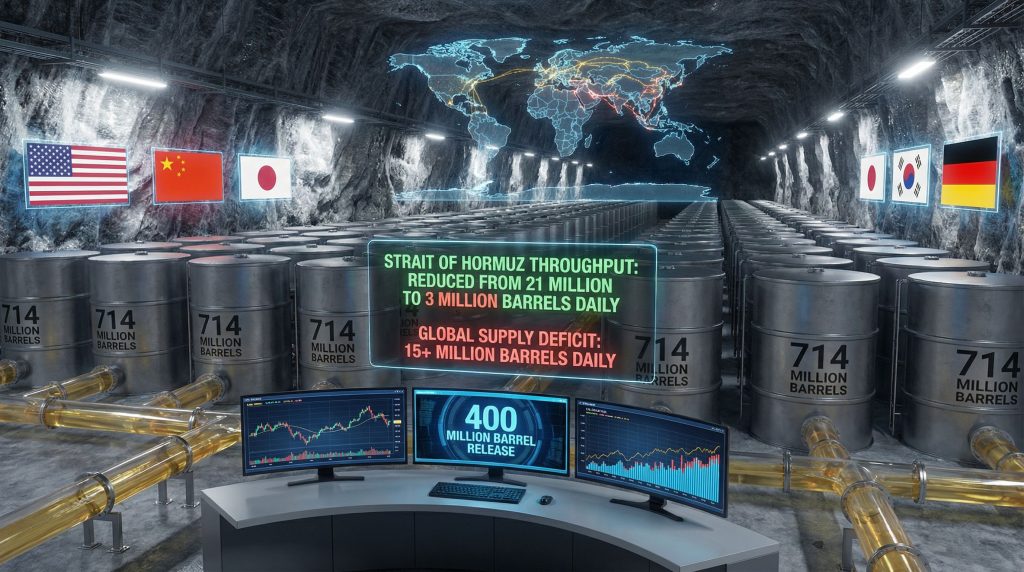
Governments tap oil reserves as Iran war strains supply chains worldwide, triggering the largest coordinated release of emergency petroleum stocks in recorded history. This deployment underscores how modern energy security measures have become integral to maintaining economic stability during geopolitical crises.
When big ASX news breaks, our subscribers know first
Strategic Reserve Architecture in Contemporary Energy Markets
Emergency Stockpile Systems and Storage Infrastructure
Strategic petroleum reserves operate through a network of underground salt caverns, depleted oil fields, and specialised above-ground facilities distributed across multiple geographic regions to minimise vulnerability to localised disruptions. These systems typically maintain between 90 and 180 days of import coverage, calculated based on average consumption patterns and supply dependency ratios.
Global Reserve Capacity Distribution:
| Country/Region | Estimated Capacity | Coverage Period | Primary Storage Type |
|---|---|---|---|
| United States | 700+ million barrels | 140+ days | Salt caverns |
| China | 500+ million barrels | 90-120 days | Mixed facilities |
| European Union | 450+ million barrels | 90 days | Various |
| Japan | 320+ million barrels | 180+ days | Above-ground tanks |
| South Korea | 140+ million barrels | 100+ days | Underground/tanks |
The infrastructure supporting these reserves includes sophisticated monitoring systems, automated injection and withdrawal capabilities, and integrated transportation networks connecting storage facilities to refineries and distribution terminals.
Technical Specifications and Operational Mechanisms
Modern reserve systems employ advanced geological storage techniques, particularly in salt dome formations that provide natural containment and maintain crude oil quality over extended periods. The withdrawal process involves complex engineering systems that can inject water or nitrogen to maintain pressure whilst extracting petroleum products at rates exceeding several million barrels per day.
Key Technical Parameters:
- Maximum withdrawal rates: 1-4 million barrels daily
- Quality preservation: Nitrogen blanketing systems
- Inventory tracking: Real-time monitoring networks
- Distribution capacity: Pipeline and marine terminal integration
Crisis Activation Protocols and Market Intervention Thresholds
Supply Disruption Triggers and Response Mechanisms
Emergency reserve deployments follow established protocols triggered by specific market conditions and supply disruption metrics. These frameworks consider multiple factors including percentage of global supply offline, price volatility patterns, duration of anticipated disruptions, and potential economic impact assessments.
Activation Threshold Framework:
| Disruption Severity | Supply Impact | Price Threshold | Typical Response |
|---|---|---|---|
| Minor | 2-5% supply loss | 20-30% price increase | Monitoring phase |
| Moderate | 5-10% supply loss | 30-50% price increase | Limited release |
| Major | 10-15% supply loss | 50-75% price increase | Coordinated response |
| Severe | 15%+ supply loss | 75%+ price increase | Full deployment |
Historical precedents demonstrate that coordinated international responses generate significantly greater market stabilisation effects compared to unilateral national deployments. Furthermore, this reflects both the psychological impact on trading behaviour and the actual volume effects on global supply balances.
Current Middle East Crisis: Unprecedented Scale of Response
The ongoing conflict involving Iran has triggered the most extensive strategic reserve deployment in modern history, with international coordination reaching unprecedented levels of cooperation among major consuming nations. Moreover, current market conditions reflect severe supply constraints through the Strait of Hormuz, affecting approximately 20% of global oil transit routes.
Crisis Timeline and Market Response:
- March 2026: Brent crude reaches $116+ per barrel, representing the highest levels since conflict eruption
- Supply Impact: Multiple shipping lanes compromised, affecting global distribution networks
- Reserve Deployment: International Energy Agency coordinates multi-national release programmes
- Economic Projections: Analysts project potential $150+ oil if disruptions persist for extended periods
According to recent government analysis, sustained oil prices at $150 per barrel for four months could trigger global recession conditions. Consequently, the world economy faces approximately two percentage point reductions in growth forecasts compared to pre-crisis projections.
Inflation Dynamics and Consumer Protection Strategies
Energy Price Pass-Through and Macroeconomic Impacts
Strategic reserve releases function as automatic economic stabilisers, reducing the inflationary transmission from energy price spikes into broader consumer price indices. Economic modelling demonstrates that well-coordinated releases can mitigate peak inflation impacts by substantial margins through both direct supply effects and expectations management.
Projected Global Economic Impacts (2026):
- Global inflation forecast: 7.7% (approaching 2022 peak levels)
- GDP impact: Approximately two percentage points below previous growth projections
- Regional variations: European and Asian economies expected to experience larger contractions
- Recovery timeline: Economic rebound anticipated in 2027
The speed and scale of current energy market disruptions create unprecedented challenges for monetary policymakers, who must balance inflation control objectives against economic growth preservation during supply-driven price increases. In addition, this situation directly affects the broader context of US inflation and tariffs policy decisions.
Supply Chain Vulnerabilities and Industrial Protection
Critical industries face immediate threats from energy supply disruptions, particularly those requiring specialised petroleum products for manufacturing processes. Current shortages extend beyond crude oil to include diesel fuel, jet fuel, and petrochemical feedstocks essential for semiconductor, fertiliser, and manufacturing sectors.
Industrial Impact Assessment:
- Transportation sector: Diesel shortages threaten freight movement and food distribution
- Manufacturing: Shortages in aluminium, sulphur, naphtha affecting production schedules
- Chemicals: Helium and specialised hydrocarbon feedstock constraints
- Agriculture: Fertiliser production disruptions impacting global food security
Expert analysis indicates that diesel, jet fuel, and shipping fuel shortages could inflict greater economic damage than crude oil price increases alone. This is because these refined products directly impact transportation networks and industrial operations that cannot easily substitute alternative energy sources.
International Coordination and Diplomatic Energy Security
Multi-National Reserve Management Frameworks
The International Energy Agency facilitates emergency response coordination among member nations, representing approximately 75% of global strategic petroleum reserves. Member countries maintain commitments to hold 90-day import equivalent stocks and participate in coordinated releases during qualifying emergency situations.
Coordination Mechanisms and Benefits:
| Coordination Advantage | Implementation Challenge |
|---|---|
| Amplified psychological market impact | Varying national reserve capacities |
| Distributed financial burden | Different political release criteria |
| Enhanced diplomatic leverage | Complex logistics coordination |
| Reduced speculation premiums | Timing disagreements among members |
Recent coordination efforts demonstrate improved international cooperation compared to historical precedents. However, governments prioritise global economic stability over narrow national energy security concerns during major supply disruptions.
Regional Economic Vulnerability Assessments
Import-dependent economies face disproportionate risks during global energy supply crises, making strategic reserves particularly valuable for economic resilience. The United Kingdom exemplifies high-vulnerability characteristics due to substantial import dependence for essential goods and recent challenges managing inflation and productivity growth.
UK-Specific Economic Vulnerabilities:
- Expected to experience second-highest G7 inflation levels during current crisis
- Projected second-lowest G7 growth rates for 2026
- High dependence on imported energy and industrial materials
- Government response includes emergency meetings with banking, energy, and military officials
The Organisation for Economic Co-operation and Development assessment highlights how import-dependent developed economies may experience more severe economic contractions. This particularly affects those nations compared to energy-producing countries or those with greater domestic resource availability.
Economic Modelling and Reserve Effectiveness Analysis
Market Stabilisation Impact Quantification
Research demonstrates that strategic reserve releases generate disproportionate market calming effects relative to their actual volume contribution to global supply. The psychological and speculative market dynamics often amplify the price reduction benefits beyond what pure supply-demand mathematics would suggest.
Cost-Benefit Framework Components:
- Direct costs: Storage infrastructure, maintenance, and capital opportunity costs
- Indirect benefits: Reduced GDP contraction, lower unemployment rates, decreased consumer inflation
- Strategic value: Enhanced energy security positioning and diplomatic negotiating capacity
- Market confidence: Reduced volatility premiums and speculative trading activity
The current deployment represents a significant test of international coordination capabilities. Furthermore, the scale of releases approaches limits of available emergency stocks in some participating nations.
Future Reserve Strategy Evolution and Modernisation
Strategic petroleum reserve management increasingly incorporates refined product stockpiles alongside crude oil, recognising that supply disruptions often create more severe shortages in specific fuel types. Additionally, some nations explore virtual reserve concepts through long-term supply contracts and strategic partnerships.
Emerging Reserve Management Concepts:
- Product-specific stockpiles (diesel, petrol, jet fuel)
- Regional cooperation agreements and shared storage facilities
- Private sector partnership models for reserve management
- Integration with renewable energy storage and grid stabilisation systems
The relationship between current reserve deployment and ongoing oil price rally dynamics demonstrates the complex interplay between emergency response measures and market fundamentals.
The next major ASX story will hit our subscribers first
Global Supply Chain Resilience and Industrial Adaptation
Manufacturing Sector Impact Mitigation Strategies
Energy-intensive industries face immediate production disruptions from current supply constraints, affecting global manufacturing networks and international trade flows. Industries such as petrochemicals, steel, aluminium, and cement require consistent energy inputs that cannot easily accommodate price volatility or supply interruptions.
Critical Industry Protection Priorities:
- Petrochemical feedstock security for plastics and synthetic materials production
- Transportation fuel availability for freight and logistics networks
- Power generation fuel supplies for electricity grid stability
- Essential infrastructure energy requirements for telecommunications and data centres
Current market disruptions demonstrate how energy supply shocks cascade through interconnected global supply chains. Consequently, this affects industries far removed from direct energy consumption through transportation costs and input material availability.
Shipping and Maritime Industry Transformations
Major shipping companies implement emergency fuel surcharges as Middle East conflicts disrupt marine supply chains, affecting global trade costs and delivery schedules. Asian markets experience particular stress as liquefied natural gas prices reach three-year highs, forcing some regions to increase coal consumption for power generation.
According to maritime industry analysis, these disruptions are creating unprecedented challenges for global trade networks. This situation is also contributing to the broader pattern of stagnating oil prices observed in recent months.
Maritime Industry Adaptations:
- Emergency fuel surcharging by major carriers
- Route modifications to avoid high-risk shipping lanes
- Alternative fuel sourcing and supply chain diversification
- Strategic inventory management for critical cargo shipments
Policy Implications and Economic Governance Frameworks
Balancing Market Intervention with Fiscal Responsibility
Strategic reserve deployments represent substantial government intervention in energy markets, requiring careful consideration of timing, scale, and coordination. Moreover, this maximises economic benefits whilst minimising long-term market distortions.
Policymakers must evaluate short-term crisis response against potential impacts on market efficiency and private sector investment incentives. Additionally, this involves considering the broader implications of OPEC production impact on global supply dynamics.
Governance Framework Considerations:
- Transparent decision-making processes and release criteria
- Regular assessment of reserve capacity adequacy and maintenance requirements
- International cooperation framework development and diplomatic coordination
- Private sector communication strategies and market guidance protocols
Current government responses include emergency policy meetings among senior officials, fuel tax reductions in some jurisdictions, and enhanced coordination with financial sector institutions to monitor economic stability risks.
Long-Term Energy Security Strategy Development
The current crisis highlights the continuing importance of strategic petroleum reserves despite global energy transition efforts toward renewable sources. Future energy security frameworks must balance traditional petroleum reserves with emerging technologies whilst maintaining resilience against supply disruptions.
Strategic Planning Priorities:
- Reserve capacity optimisation based on evolving consumption patterns
- Integration with renewable energy storage and grid modernisation initiatives
- Enhanced international cooperation mechanisms and burden-sharing agreements
- Private sector partnership development for reserve management and crisis response
In conclusion, governments tap oil reserves as Iran war strains supply chains, demonstrating the critical importance of strategic petroleum reserves in maintaining global economic stability. The current unprecedented coordination of emergency releases represents a significant evolution in international energy security cooperation.
Disclaimer: This analysis is based on publicly available information and expert assessments as of the referenced time period. Energy market conditions and geopolitical situations remain highly volatile and subject to rapid change. Economic forecasts involve inherent uncertainty and should not be considered guaranteed outcomes.
Ready to Capitalise on Energy Market Opportunities?
Discovery Alert's proprietary Discovery IQ model delivers real-time alerts on significant ASX mineral discoveries across critical energy transition commodities, empowering investors to identify actionable opportunities ahead of broader market recognition. Explore how major mineral discoveries can generate substantial returns and begin your 14-day free trial today to position yourself strategically in the evolving energy landscape.