June 13, 2026
The suspension of Energy Transfer's Lake Charles LNG export facility development represents far more than a single project cancellation. This strategic decision illuminates fundamental shifts occurring across the US economic outlook landscape, where established operators are reassessing capital deployment strategies based on evolving risk-return profiles and market dynamics. Energy Transfer halts Lake Charles LNG operations signal a broader recalibration within the midstream sector.
Energy Transfer's announcement to halt plans for the 16.5 million tonnes per annum Lake Charles LNG terminal underscores a broader recalibration within the midstream sector. Instead of pursuing greenfield LNG development, the company has chosen to redirect resources toward pipeline expansion projects that leverage existing infrastructure networks and offer more predictable regulatory pathways.
Capital Allocation Framework Analysis
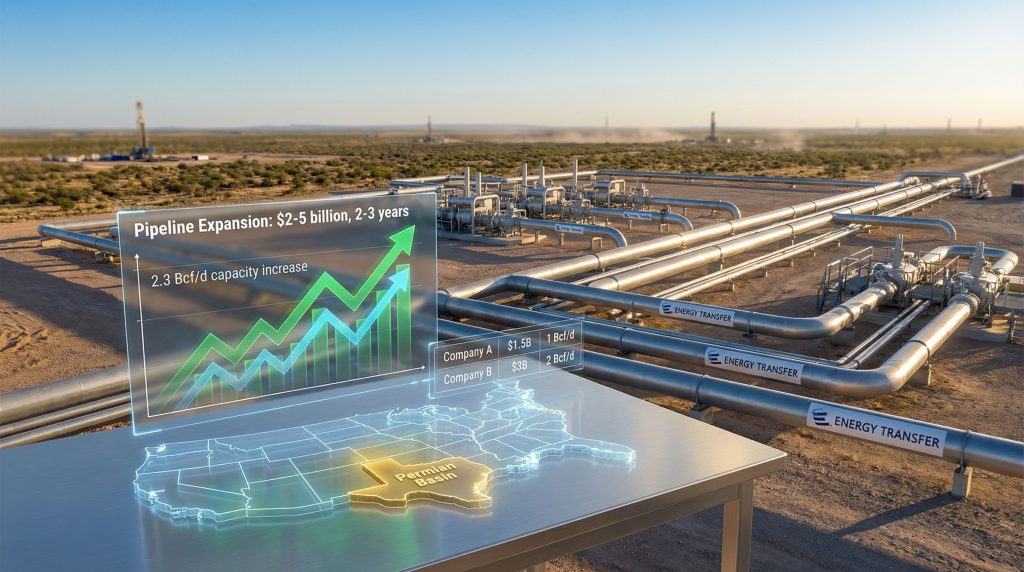
The decision reflects sophisticated capital allocation modeling that considers multiple risk factors beyond simple return calculations. Pipeline expansion projects typically require 2-3 years from final investment decision to cash flow generation, while LNG export terminals demand 5-7 year development timelines before achieving operational status.
This timeline differential creates substantial opportunity cost implications for capital deployment. During the extended LNG development period, pipeline investments can generate multiple cash flow cycles while maintaining lower regulatory complexity through established FERC authorisation processes rather than navigating the more complex DOE export licensing requirements for LNG terminals.
The financial architecture of these investment types also differs significantly. Pipeline expansion projects can leverage existing right-of-way agreements, established customer relationships, and proven operational frameworks, reducing both development risk and capital intensity compared to greenfield LNG facilities.
When big ASX news breaks, our subscribers know first
Industry-Wide Strategic Implications
Energy Transfer halts Lake Charles LNG reflects broader industry recognition that core competencies in pipeline operations may not translate effectively to LNG export terminal development and operations. As co-chief executive Mackie McCrea articulated in November 2025, the company emphasised its identity as a pipeline operator rather than a specialised LNG company.
This strategic positioning acknowledges that successful LNG export terminal development requires distinct capabilities including:
- Complex international offtake agreement negotiation
- Multi-billion dollar project financing across extended development periods
- Global commodity market exposure management
- Specialised liquefaction technology integration and operation
The contrast with pipeline operations becomes apparent when considering that pipeline companies primarily focus on transportation services with predictable fee-based revenue structures, while LNG operations involve commodity price exposure and international market dynamics.
How Are Permian Basin Pipeline Constraints Driving Infrastructure Investment Priorities?
The Permian Basin continues experiencing a structural imbalance between natural gas production growth and available transportation capacity. This dynamic creates compelling investment opportunities for pipeline operators while simultaneously demonstrating the superior risk-return characteristics that Energy Transfer cited in its strategic reallocation decision.
Permian Production-Transportation Imbalance Analysis
Crude oil-driven drilling activity in the Permian Basin generates substantial associated natural gas volumes as a byproduct of primary crude production. This production profile has created a situation where associated gas output growth has systematically outpaced the development of gas evacuation infrastructure.
The resulting supply-demand imbalance has produced some of the lowest natural gas prices in the United States within the Permian Basin, creating significant economic incentives for producers to secure additional transportation capacity. Pipeline operators can capture this value differential through transportation fee structures that move gas from oversupplied basins to higher-priced demand centres.
Energy Transfer's decision to upsize its Desert Southwest expansion by 800 million cubic feet per day, bringing total capacity to 2.3 Bcf/d, directly addresses this market opportunity. The expansion achieved final investment decision in August 2025, demonstrating the streamlined approval process compared to LNG export terminal development.
Desert Southwest Expansion Strategic Value
The Transwestern pipeline system's Desert Southwest expansion represents a critical east-west transmission corridor connecting Permian Basin production to southwestern United States consuming markets. Furthermore, this geographic positioning allows the system to capture price differentials between oversupplied production regions and demand centres experiencing growth in gas consumption.
Key Strategic Advantages:
- Existing Infrastructure Leverage: Expansion utilises established pipeline corridors and operational systems
- Predictable Demand Profile: Southwest US market growth provides stable foundation for capacity contracts
- Reduced Regulatory Risk: FERC pipeline approval processes offer greater certainty than LNG export licensing
- Shorter Development Timeline: 2-3 year project execution versus 5-7 years for LNG terminals
The expansion also positions Energy Transfer to serve growing demand from southwestern utilities, industrial customers, and potential power generation facilities, creating multiple revenue stream opportunities within a consolidated geographic footprint.
What Financial Metrics Are Driving the Shift from LNG Export to Pipeline Investment?
The financial architecture underlying Energy Transfer's strategic pivot reveals fundamental differences in investment profiles between LNG export terminals and pipeline expansion projects. These differences extend beyond simple capital requirements to encompass risk characteristics, cash flow timing, and return predictability.
Investment Profile Comparison
| Investment Type | Capital Requirements | Timeline to Cash Flow | Risk Profile | Return Characteristics |
|---|---|---|---|---|
| LNG Export Terminal | $15-20 billion | 5-7 years | High regulatory/market | Project-dependent |
| Pipeline Expansion | $2-5 billion | 2-3 years | Moderate | Stable, fee-based |
| Brownfield Conversion | $8-12 billion | 4-5 years | Medium-high | Volume-dependent |
Note: These ranges reflect general industry characteristics based on project scale and complexity. Specific project economics vary based on capacity, location, and market conditions.
Return on Investment Analysis
Pipeline expansion projects offer several financial advantages that influenced Energy Transfer's capital reallocation decision. Fee-based revenue models provide cash flow predictability independent of commodity price fluctuations, contrasting with LNG export margins that depend on global pricing dynamics and competitive supply conditions.
The revenue stability stems from long-term firm transportation agreements where shippers commit to reserved capacity regardless of actual utilisation. In addition, these contracts typically feature:
- Demand charges: Fixed monthly fees per unit of reserved capacity
- Contract terms: 10-20 year initial periods with renewal options
- Rate escalation: Built-in inflation adjustments protecting against cost increases
LNG export terminal economics present a different risk-return profile. Revenue depends on the spread between input natural gas costs and realised LNG sale prices, creating exposure to both domestic gas markets and international LNG pricing.
Market Risk Assessment
Energy Transfer's partnership challenges with the Lake Charles LNG project illustrate broader market-based financing constraints affecting LNG development. The company's requirement for 80% equity divestment before pursuing final investment decision, combined with the inability to finalise MidOcean Energy's 30% funding arrangement, demonstrates the elevated capital partnership requirements for LNG projects.
However, these financing challenges reflect several market dynamics including equity partner risk assessment, offtake agreement complexity, global competition from Qatar and Australia, and regulatory uncertainty affecting DOE export licensing processes.
How Is the Global LNG Export Market Influencing US Project Development Decisions?
The global LNG market's evolution significantly impacts how US companies evaluate export terminal investments. For instance, tariffs and investment markets considerations alongside Energy Transfer halts Lake Charles LNG reflect broader industry recognition of changing competitive dynamics and market saturation concerns affecting project economics.
Global Supply-Demand Balance Impact
Approximately 229 million tonnes per annum of new LNG export capacity has reached final investment decision globally, with delivery scheduled through 2030. This substantial capacity addition raises questions about market absorption capacity and competitive positioning for US projects.
The supply growth trajectory occurs alongside evolving demand patterns in key importing regions. Asian markets, traditionally the highest-value LNG destinations, face increasing competition from domestic production growth, renewable energy deployment, and alternative fuel sources.
US LNG export projects must compete within this global context while managing higher development costs and more complex regulatory environments compared to some international competitors. Consequently, projects in Qatar benefit from lower resource costs and established infrastructure networks that can offer competitive advantages in global markets.
US LNG Export Market Positioning
The United States has rapidly expanded LNG export capacity over the past decade, establishing significant market presence in both Atlantic and Pacific basin trade flows. However, this success creates challenges for new project development as market share expansion becomes more difficult and competitive.
Competitive Challenges for US LNG Development:
- Cost Structure: US projects often require higher capital investment per tonne of capacity
- Regulatory Complexity: DOE export authorisation processes add development uncertainty
- Feedstock Pricing: Henry Hub-linked pricing structures may lack competitiveness in certain market conditions
- Infrastructure Constraints: Gulf Coast export terminal concentration creates potential logistical bottlenecks
These factors contributed to Energy Transfer's assessment that pipeline investments offer superior risk-adjusted returns compared to LNG export terminal development within current market conditions.
What Role Do Partnership Structures Play in Large-Scale Energy Infrastructure Development?
Energy Transfer's inability to secure adequate equity partnerships for Lake Charles LNG highlights critical factors in structuring major energy infrastructure investments. The partnership development process reveals how market participants evaluate and price different types of infrastructure risk.
Equity Partnership Requirements Analysis
Large-scale LNG export projects typically require complex equity structures due to their substantial capital requirements and extended development timelines. Industry standard practice involves project sponsors securing 60-80% of required equity from strategic or financial partners before achieving final investment decision.
The partnership imperative stems from capital scale requirements, risk distribution needs, market access considerations, and technical expertise requirements for specialised LNG operations. Energy Transfer's requirement for 80% equity divestment before proceeding demonstrates conservative risk management but also indicates the project's substantial capital demands.
Strategic Partner Evaluation Criteria
The failed MidOcean Energy partnership arrangement illustrates the complexity of aligning partner interests in LNG project development. MidOcean's preliminary agreement offered 30% construction funding in exchange for 30% offtake rights, creating a structure where the financial partner also secured product marketing rights.
This arrangement type reflects industry trends where equity partners seek financial returns, commodity access, strategic positioning, and operational control. The involvement of Saudi Aramco through its 49% stake in MidOcean Energy demonstrates how national oil companies use equity partnerships to secure LNG supply chains.
The next major ASX story will hit our subscribers first
How Are Regulatory and Permitting Considerations Affecting Project Prioritisation?
Regulatory pathway differences between pipeline expansion and LNG export terminal development significantly influence capital allocation decisions across the midstream sector. Furthermore, US‑China trade dynamics add complexity to export licensing considerations for LNG projects.
Pipeline expansion projects typically navigate more established regulatory frameworks through FERC authorisation processes, while LNG export terminals must secure both FERC facility approvals and DOE export licensing, creating additional complexity and timeline uncertainty.
Permitting Timeline Comparison
The regulatory approval processes for different infrastructure types involve distinct agencies, evaluation criteria, and stakeholder engagement requirements:
Pipeline Expansion Projects:
- Primary Authority: Federal Energy Regulatory Commission (FERC)
- Environmental Review: National Environmental Policy Act (NEPA) assessment
- Timeline: Typically 12-24 months from application to approval
- Precedent: Extensive regulatory history provides predictable framework
LNG Export Terminals:
- Facility Authorisation: FERC approval for construction and operation
- Export Licensing: Department of Energy authorisation for international sales
- Environmental Review: Comprehensive NEPA evaluation with broader scope
- Timeline: Often 3-5 years from application to final approvals
Policy Risk Assessment
Export licensing policy represents a unique risk factor for LNG projects that pipeline expansions avoid. DOE export authorisation considers geopolitical factors, trade relationships, and national security implications beyond traditional infrastructure regulation.
Climate policy considerations also create differential impacts across infrastructure types. LNG export terminals face scrutiny regarding lifecycle greenhouse gas emissions, while pipeline projects may benefit from positioning as enabling domestic energy security.
What Strategic Scenarios Could Reshape US Midstream Investment Priorities?
Several market scenarios could fundamentally alter the relative attractiveness of different infrastructure investments, potentially reversing current trends favouring pipeline expansion over LNG development.
Market Scenario Analysis
High Natural Gas Price Scenario:
Sustained periods of elevated domestic gas prices could improve LNG export economics by increasing margin potential while simultaneously reducing pipeline expansion economics as producer drilling activity moderates. US oil production trends could significantly influence these price dynamics.
Renewable Energy Acceleration:
Rapid renewable energy deployment could reduce long-term gas demand forecasts, affecting pipeline investment justification while potentially maintaining LNG export attractiveness for international markets with different energy transition strategies.
Geopolitical LNG Demand Surge:
International conflicts or supply disruptions could create sustained high-value LNG demand that justifies premium development costs for US export capacity, potentially reversing current project economics.
Technology and Innovation Factors
Technological developments could alter competitive dynamics between infrastructure types:
- Carbon Capture Integration: Pipeline networks may offer advantages for CO2 transportation infrastructure
- Hydrogen Compatibility: Existing pipeline systems could provide foundation for hydrogen transportation networks
- Floating LNG Technology: Reduced capital requirements for offshore LNG development could improve project economics
- Digital Optimisation: Advanced pipeline monitoring and optimisation could enhance capacity utilisation and returns
How Should Investors Evaluate Midstream Company Strategic Positioning?
Energy Transfer's strategic decision provides a framework for evaluating how midstream companies approach capital allocation and core competency focus in evolving market conditions.
Investment Thesis Framework
Core Competency Alignment:
Companies demonstrating clear strategic focus on their fundamental capabilities may offer superior risk-adjusted returns compared to entities pursuing diversification into unfamiliar business segments. Consequently, Energy Transfer's emphasis on pipeline operations over LNG development exemplifies this approach.
Geographic Footprint Advantages:
Operators with dominant positions in key production regions like the Permian Basin can leverage existing infrastructure and customer relationships to capture growth opportunities with lower incremental investment requirements.
Performance Metrics for Strategic Assessment
Key Performance Indicators:
- Return on Invested Capital (ROIC): Tracking across different project types reveals strategic execution effectiveness
- Distribution Coverage Ratios: Indicating financial sustainability of growth investment strategies
- Market Share Positioning: Measuring competitive advantages in critical transportation corridors
- Project Execution Track Record: Demonstrating ability to deliver projects on time and budget
According to Reuters, Energy Transfer's suspension announcement highlighted the company's strategic focus on pipeline operations rather than LNG development.
What Are the Long-Term Implications for US Energy Infrastructure Development?
The broader implications of Energy Transfer's strategic pivot extend beyond individual company decisions to industry-wide trends affecting US energy infrastructure development patterns.
Industry Consolidation Trends
The increasing capital requirements and specialised expertise needs for different infrastructure types may drive industry consolidation around core competencies. Companies may increasingly focus on either pipeline operations or LNG development rather than pursuing integrated strategies.
This specialisation trend could result in strategic divestitures, targeted acquisitions within expertise areas, and partnership evolution replacing diversification strategies for cross-segment exposure.
Future Investment Outlook
Capital availability for different infrastructure types will likely reflect demonstrated execution capabilities and market-proven business models. The pipeline sector's established regulatory framework and predictable cash flow characteristics may continue attracting institutional investment compared to higher-risk LNG development projects.
Investment Flow Implications:
- Pipeline Infrastructure: Continued institutional investor appetite for fee-based utility-like returns
- LNG Export Development: Potentially concentrated among specialised developers with proven track records
- Energy Transition Infrastructure: Growing capital allocation toward hydrogen-ready pipeline systems and carbon transportation networks
Bloomberg reports that Energy Transfer's decision reflects industry-wide shifts toward specialisation and strategic focus on core competencies.
The US energy infrastructure landscape appears to be evolving toward greater specialisation and strategic focus, with Energy Transfer's Lake Charles LNG suspension serving as a prominent example of this broader industry transformation. Companies that successfully align capital deployment with core competencies and market fundamentals may achieve superior long-term performance in this changing environment.
Disclaimer: This analysis is for informational purposes only and should not be considered as financial or investment advice. Energy infrastructure investments involve significant risks including regulatory changes, market volatility, and operational challenges. Past performance does not guarantee future results, and potential investors should conduct thorough due diligence and consult with qualified financial advisors before making investment decisions.
Are You Ready to Capitalise on ASX Energy Infrastructure Opportunities?
Discovery Alert's proprietary Discovery IQ model delivers instant notifications when significant ASX mineral and energy discoveries are announced, empowering investors to identify actionable opportunities before the broader market responds. Explore how major discoveries have generated substantial returns by visiting Discovery Alert's discoveries page, then begin your 30-day free trial to secure your competitive advantage in the evolving energy sector.