
August 7, 2026
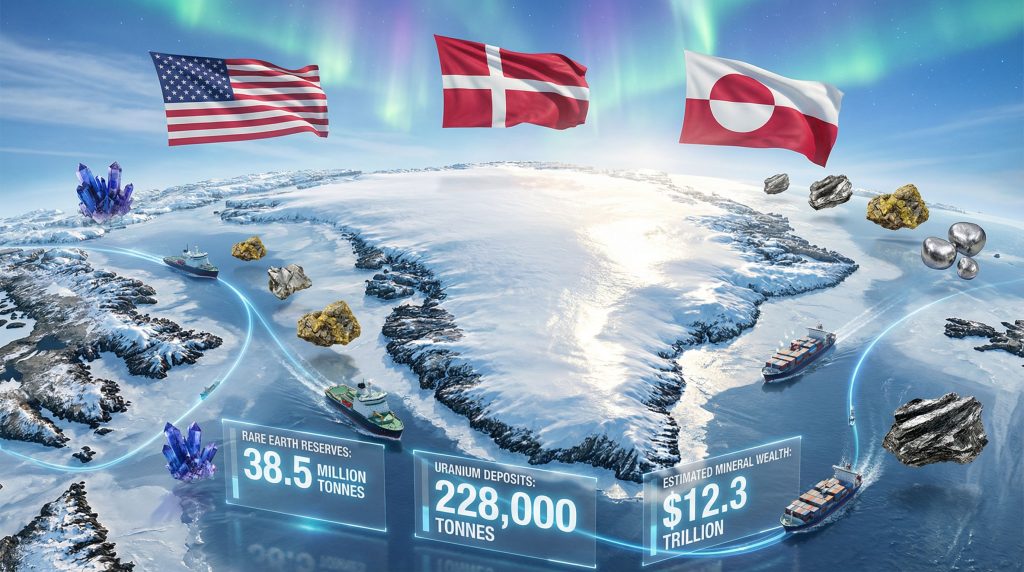
Global energy transition minerals demands are fundamentally reshaping international strategic calculations around critical resource access. As nations pursue decarbonisation targets by 2050, control over rare earth elements, lithium, and other essential minerals has become a cornerstone of national security policy. Arctic territories, previously considered peripheral to global commerce, now represent potential chokepoints for supply chains that underpin renewable energy infrastructure and advanced military systems.
This transformation occurs against a backdrop of accelerating climate change that is opening previously inaccessible Arctic shipping routes and mineral deposits. The intersection of resource scarcity, technological advancement, and geopolitical competition has elevated remote territories like Greenland from scientific curiosities to strategic assets worthy of unprecedented political attention when Trump wants Greenland.
Arctic Geography as Strategic Infrastructure
The Arctic region's transformation from isolated frontier to contested strategic space reflects broader changes in global trade patterns and military positioning. Climate-induced ice retreat has fundamentally altered navigation possibilities through northern waters, creating new pathways that bypass traditional chokepoints like the Suez Canal and Panama Canal.
Emerging Transportation Corridors and Economic Projections
Arctic sea ice extent declined to 3.99 million square kilometres in September 2024, representing approximately 13% reduction per decade since systematic monitoring began in 1979. This retreat pattern has opened seasonal navigation windows through the Northwest Passage, potentially reducing shipping distances between Asian and European markets by up to 40% compared to traditional southern routes.
Economic modelling suggests that Arctic shipping could capture significant portions of global maritime trade as ice-free periods extend. The Panama Canal currently generates approximately $2.4 billion annually in toll revenues, providing a baseline for understanding potential returns from controlling Arctic transit corridors. However, Arctic navigation requires specialised vessels and infrastructure investments that differentiate these routes from established shipping lanes.
Temperature increases in Arctic regions occur at approximately four times the global average rate, a phenomenon known as Arctic amplification. This acceleration suggests that seasonal navigation windows may extend beyond current projections, though climate modelling uncertainties create substantial variance in timeline predictions ranging from the 2030s to 2050s.
Military Positioning and Alliance Dynamics
NATO's 2023 Strategic Concept explicitly identifies the Arctic as a region of increased strategic competition, reflecting concerns about Russian military modernisation and Chinese economic engagement in Arctic territories. The alliance has coordinated enhanced military presence and joint exercises among Arctic member states, expanding beyond Cold War-era defensive positions.
Russia maintains approximately 40% of the world's operational icebreaker fleet and has reopened numerous Arctic military installations since 2014, including facilities supporting Northern Sea Route operations. These developments include approximately 40 military icebreakers and bases on remote Arctic islands, representing the most significant Russian Arctic military presence since the Soviet era.
China's designation of itself as a "near-Arctic state" and publication of its Arctic Strategy document in 2018 outline intentions to develop polar shipping corridors and resource extraction partnerships. Chinese investments in Arctic-adjacent projects have exceeded $10 billion cumulatively through 2024, despite China's geographic distance from Arctic territories.
Greenland's mineral significance creates what strategic analysts characterise as a monitoring station for North Atlantic security and a potential control point for emerging Arctic trade routes. The island's proximity to North American airspace and its location relative to Russian Arctic activities enhance its strategic significance for NATO alliance coordination.
When big ASX news breaks, our subscribers know first
Critical Mineral Dependencies and Supply Chain Vulnerabilities
The global transition to renewable energy systems has elevated certain minerals from industrial commodities to strategic resources essential for national security. Rare earth elements, lithium, cobalt, and other materials required for wind turbines, solar panels, and energy storage systems are concentrated in relatively few geographic locations, creating supply chain vulnerabilities for nations pursuing decarbonisation goals.
Greenland's Geological Significance
Geological surveys indicate that Greenland contains substantial deposits of materials critical to clean energy infrastructure. The Kvanefjeld project area contains estimated resources of approximately 38.5 million tonnes of rare earth oxide equivalent, representing roughly 8-10% of identified global rare earth resources according to current USGS assessments.
| Resource Category | Estimated Resources | Global Proportion | Strategic Applications |
|---|---|---|---|
| Rare Earth Elements | 38.5 million tonnes REO | 8-10% of known resources | Wind turbines, electric vehicle motors |
| Uranium | 228,000 tonnes U3O8 | 12% of global reserves | Nuclear power generation |
| Zinc | 1-2 million tonnes | 3-5% of global reserves | Infrastructure development |
| Natural Graphite | Significant deposits | 4-15% of global resources | Battery manufacturing |
Note: These figures reflect current geological assessments and may change as exploration activities expand.
The United States currently imports approximately 80% of its rare earth element requirements, with 60% sourced from Chinese suppliers. This dependency creates strategic vulnerabilities in manufacturing defence electronics and renewable energy systems, particularly as International Energy Agency projections indicate critical mineral demand will increase by 300-600% by 2050 to meet clean energy transition targets.
Processing Infrastructure and Development Challenges
Rare earth element extraction and processing generate significant environmental residues and require specialised beneficiation facilities. Furthermore, lithium refinery trends demonstrate that Greenland's limited industrial infrastructure would necessitate substantial capital investment to establish processing capabilities before exporting refined products suitable for manufacturing applications.
Mining operations in Arctic environments require specialised equipment designed for extreme cold conditions, deepwater port facilities for year-round logistics, and environmental management systems adapted to permafrost and limited growing seasons. These requirements substantially elevate operational costs compared to mining operations in temperate climates.
The U.S. Department of Defense maintains a National Defense Stockpile with specified targets for critical materials, though current assessments indicate that 47 materials on the Critical Materials List lack adequate domestic supply security. Establishing reliable Arctic mineral supply chains would require 5-10 years of development time from permitting through operational production, contingent upon geopolitical stability and infrastructure investment.
Materials scientists emphasise that many critical minerals, particularly rare earth elements used in permanent magnets, have limited substitute materials for high-performance applications required in wind turbines and defence systems. This constraint amplifies the strategic importance of diversifying supply sources beyond current Chinese dominance in processing capabilities.
Competing Claims and International Law Frameworks
Arctic territorial disputes occur within established international legal frameworks, though climate change and technological advancement are testing traditional assumptions about territorial boundaries and resource access rights. The United Nations Convention on the Law of the Sea provides the primary mechanism for resolving competing claims, though the process involves complex scientific assessments and diplomatic negotiations.
Great Power Competition in Arctic Waters
China has invested approximately $9-10 billion in Arctic-related projects including mining ventures, port development, and shipping infrastructure through 2024. The "Polar Silk Road" initiative represents Chinese efforts to integrate Arctic shipping corridors with broader Belt and Road connectivity projects, though these investments face increasing scrutiny from Arctic Council members.
Chinese companies, including General Nice Group and Shenghe Resources, have pursued rare earth and mineral exploration concessions in Greenland. However, the Greenlandic government has implemented restrictions on certain Chinese investments following Danish national security reviews, reflecting broader concerns about foreign control over critical infrastructure.
Russia maintains territorial claims encompassing approximately 1.2 million square kilometres under UNCLOS Article 76 extended continental shelf provisions. These claims overlap with potential submissions from other Arctic nations, including Denmark through Greenland, creating the possibility of future territorial disputes requiring international arbitration.
Current Russian operations transit approximately 1-2% of global maritime trade through the Northern Sea Route, though strategic objectives aim to increase this proportion as Arctic ice retreat accelerates. In addition, Russian Arctic development demonstrates both the opportunities and challenges of establishing reliable Arctic shipping operations.
European Union Strategic Response
The European Union's updated Arctic Strategy emphasises cooperation, climate research, and indigenous rights while acknowledging increased geopolitical competition in the region. NATO Arctic Council members have coordinated enhanced military presence and joint exercises, representing the most significant expansion of Arctic defence cooperation since the Cold War ended.
Denmark maintains formal sovereignty over Greenland under the Kingdom of Denmark constitutional structure, with Danish policy emphasising self-determination rights while maintaining territorial claims. This arrangement provides legal frameworks for territorial governance while preserving indigenous political participation.
Greenland's 200-nautical-mile Exclusive Economic Zone encompasses approximately 900,000 square kilometres of maritime territory with exclusive rights to fish stocks, minerals, and potential hydrocarbon resources. Current fishing operations generate approximately $250-300 million in annual revenues, primarily from cod, shrimp, and halibut.
Climate-driven changes to fish stock distributions are creating disputes over fishing rights as species migrate northward across traditional boundary lines. These shifts demonstrate how environmental changes can complicate established resource management agreements and territorial arrangements.
Legal Mechanisms for Territorial Transfer
Historical precedent provides limited guidance for contemporary territorial acquisitions, though past transactions offer insights into legal and diplomatic frameworks. The complexity of modern international law, indigenous rights recognition, and democratic governance standards creates substantially more complex requirements than 19th-century territorial purchases.
Constitutional and International Law Requirements
The United States' Alaska Purchase from Imperial Russia in 1867 cost $7.2 million, approximately $152 million in current purchasing power. However, this transaction occurred before modern international legal frameworks governing indigenous rights, environmental protection, and democratic self-determination were established.
The 1917 U.S. Virgin Islands purchase from Denmark cost $25 million, equivalent to approximately $475 million today. These historical transactions provide precedent for peaceful territorial transfers, though contemporary legal requirements would necessitate substantially different processes including indigenous consent, environmental impact assessments, and international law compliance.
Modern territorial transfers require adherence to United Nations principles of self-determination, indigenous rights frameworks, and environmental protection standards that did not exist during earlier territorial acquisitions. These requirements would necessitate extensive consultation processes with Greenlandic citizens and indigenous communities before any sovereignty changes could occur.
Danish constitutional law requires parliamentary approval for territorial changes affecting the Kingdom of Denmark. This process would involve both Danish and Greenlandic democratic institutions, creating multiple decision-making requirements that complicate any potential territorial transfer scenarios.
Financial Valuation and Investment Requirements
Economic assessments of territorial value must consider both existing economic activities and potential resource extraction revenues. Current Danish subsidies to Greenland total approximately $591 million annually, representing baseline financial obligations for any governing authority.
Infrastructure development required for large-scale resource extraction would necessitate substantial capital investment in transportation, processing, and environmental management systems. Comparable Arctic development projects suggest capital requirements ranging from billions to tens of billions of dollars depending on extraction scale and environmental compliance standards.
Revenue-sharing models from resource extraction would need to address both federal revenue requirements and territorial economic development needs. Alaska's Permanent Fund Dividend system provides one model for distributing resource revenues to territorial residents, though Greenland's smaller population and different economic structure would require customised approaches.
Economic analysts note that establishing operational mineral extraction in Greenland would require 5-10 years of development from initial investment through production capacity, assuming favourable regulatory and logistical conditions.
Realistic Scenarios and Democratic Considerations
Greenland's political future involves complex interactions between economic development aspirations, cultural preservation priorities, and geopolitical positioning. Understanding these dynamics requires examining various governance models and their implications for residents' economic and political autonomy when Trump wants Greenland.
Enhanced Autonomy Within Existing Frameworks
Greenland could pursue expanded self-governance powers similar to the Faroe Islands model, which maintains Danish sovereignty while exercising substantial autonomous authority over domestic affairs. This arrangement would allow enhanced revenue retention from natural resource extraction while preserving security and diplomatic relationships with Denmark and NATO allies.
Implementation of enhanced autonomy could occur over a 2026-2030 timeline, involving negotiations between Greenlandic, Danish, and possibly EU institutions. Such arrangements would require constitutional modifications within the Kingdom of Denmark framework while preserving existing international commitments and alliance relationships.
Expanded self-governance would enable Greenlandic authorities to negotiate directly with international mining companies and establish resource extraction policies aligned with local priorities. This approach would address economic development aspirations while maintaining political stability and international recognition.
Revenue retention modifications could allow Greenland to capture larger proportions of mining industry innovation royalties and taxation from resource extraction activities. Current arrangements channel most resource revenues through Danish fiscal systems, limiting Greenlandic fiscal autonomy despite local resource ownership.
Full Independence Pathway Assessment
Economic viability assessments for Greenlandic independence must consider both resource extraction potential and ongoing fiscal requirements for territorial governance. With a population of approximately 57,000 residents, Greenland would represent one of the world's smallest sovereign nations by population, though potentially among the largest by territory.
International recognition requirements for new sovereign states involve United Nations membership processes and bilateral recognition from existing nations. Greenland's strategic location and resource endowments would likely facilitate international recognition, though ongoing territorial disputes could complicate certain diplomatic relationships.
Defence and security arrangements would require negotiation with NATO allies, particularly given Greenland's strategic location for North Atlantic security. Independent Greenland would need to address missile defence installations, airspace management, and maritime security responsibilities currently managed through Danish sovereignty.
Resource extraction revenue projections suggest potential fiscal viability for independent governance, though economic modelling depends heavily on commodity price assumptions and extraction timeline forecasts. However, volatile mineral markets create substantial uncertainty in long-term fiscal planning for resource-dependent territories.
Strategic Partnership Models
Enhanced U.S.-Greenland cooperation could occur without sovereignty transfers through expanded defence agreements, joint resource development ventures, and infrastructure investment partnerships. Such arrangements would address American strategic interests while preserving existing political relationships and avoiding complex sovereignty transfer requirements.
Joint resource development partnerships could provide American companies with preferential access to critical minerals while ensuring Greenlandic communities receive substantial revenue shares and employment opportunities. This approach would leverage American capital and technology while maintaining local political control over resource extraction policies.
Infrastructure investment partnerships could address transportation, communications, and processing facility requirements necessary for resource extraction operations. American investment in Greenlandic infrastructure would support broader strategic objectives while providing economic development benefits for local communities.
Public Opinion and Democratic Governance
Understanding Greenlandic perspectives on political and economic futures requires examining polling data, demographic trends, and cultural priorities that influence democratic decision-making processes. These considerations are essential for evaluating the feasibility of various political scenarios.
Citizen Preferences and Cultural Priorities
Recent polling indicates that Greenlandic opinions on independence vary significantly by age group, with younger residents generally more supportive of increased autonomy or independence compared to older demographics. Economic concerns about employment opportunities and public service funding significantly influence political preferences.
Cultural preservation priorities often conflict with large-scale economic development proposals, particularly regarding environmental protection and traditional land use practices. Indigenous Inuit communities emphasise self-determination rights and environmental stewardship in political discussions about resource extraction and territorial governance.
Language preservation and cultural autonomy represent priority concerns for many Greenlandic residents, who worry that rapid economic development could undermine traditional social structures and cultural practices. These concerns influence political support for various governance arrangements and development policies.
Educational and employment opportunities for young Greenlanders often require migration to Denmark or other countries, creating demographic pressures that influence political preferences about economic development and territorial autonomy. Retaining educated young residents requires economic diversification beyond traditional fishing and subsistence activities.
Indigenous Rights and Environmental Considerations
Inuit self-determination movements emphasise indigenous rights to territorial governance and resource management according to traditional knowledge systems and environmental stewardship principles. These movements support political autonomy while emphasising sustainable development approaches that preserve traditional hunting and fishing practices.
Environmental protection concerns focus on potential impacts from large-scale mining operations on wildlife habitats, traditional food sources, and climate-sensitive ecosystems. Greenlandic communities depend on marine and terrestrial wildlife for both subsistence and cultural practices that could be affected by industrial development.
Land rights frameworks recognise both individual property ownership and collective indigenous claims to traditional territories. Resource extraction proposals must address both types of land rights through consultation processes and benefit-sharing agreements that respect indigenous decision-making authority.
Climate change impacts on traditional economic activities, including hunting, fishing, and reindeer herding, create economic pressures that influence political support for alternative development strategies. Adapting to environmental changes while preserving cultural practices represents a central challenge for Greenlandic political decision-making.
The next major ASX story will hit our subscribers first
Global Economic Implications and Market Dynamics
Potential changes to Greenlandic governance and resource extraction policies would generate significant ripple effects through global critical mineral markets, affecting everything from renewable energy costs to defence manufacturing capabilities. Understanding these broader implications helps contextualise the strategic calculations driving political interest in Arctic territories.
Critical Mineral Market Disruption Scenarios
Large-scale Greenlandic rare earth element production could reduce global dependence on Chinese processing capabilities, though establishing operational extraction would require several years of development time and substantial infrastructure investment. Current Chinese dominance in rare earth processing creates supply chain vulnerabilities for manufacturing sectors in North America and Europe.
Price volatility scenarios for critical minerals suggest that new supply sources could stabilise markets currently subject to geopolitical tensions and trade disputes. However, uranium market dynamics demonstrate that mineral markets typically require 5-10 years to adjust to new supply sources, meaning short-term price impacts would be limited even with immediate policy changes.
Technology manufacturing companies, particularly those producing electric vehicle batteries, wind turbines, and defence electronics, would benefit from diversified critical mineral supply chains that reduce dependency on single-source suppliers. Investment in alternative supply sources represents strategic hedging against supply chain disruptions.
Sovereign wealth funds and institutional investors are increasingly factoring critical mineral supply security into investment strategies, particularly for renewable energy infrastructure projects. Greenlandic resource development could attract substantial capital investment from entities seeking exposure to critical mineral supply chains.
Arctic Development Precedents and Revenue Models
Norway's petroleum fund management approach demonstrates how Arctic territories can convert resource extraction revenues into long-term economic stability through sovereign wealth fund mechanisms. Norway's $1.4 trillion Government Pension Fund Global provides a model for managing volatile resource revenues across economic cycles.
Alaska's Permanent Fund Dividend system distributes annual payments to residents from oil revenue investments, currently providing approximately $1,000-$2,000 per resident annually depending on fund performance. This model demonstrates how resource revenues can provide direct economic benefits to territorial populations.
Resource curse mitigation strategies emphasise economic diversification, transparent revenue management, and democratic governance institutions to prevent the negative social and economic impacts often associated with resource-dependent economies. Small populations and limited economic diversification create particular challenges for sustainable development in Arctic territories.
Comparative analysis with other small-population, resource-rich territories suggests that successful development requires substantial investment in education, healthcare, and economic diversification beyond extractive industries. Maintaining social cohesion and democratic governance while managing rapid economic change represents a consistent challenge across resource development scenarios.
Military Strategy and Regional Security Architecture
Arctic military positioning reflects broader strategic competition between major powers, with territorial control providing advantages for monitoring, missile defence, and power projection capabilities. Understanding these military dimensions helps explain the strategic calculations driving political interest in Arctic territories when Trump wants Greenland.
NATO Article 5 and Alliance Implications
Any military action against Denmark, as a NATO member, would trigger Article 5 collective defence obligations, making military approaches to territorial acquisition legally and politically untenable. NATO alliance structures provide security guarantees that essentially preclude territorial acquisition through military means.
Congressional authorisation requirements for military intervention would create substantial domestic political obstacles for any administration considering military approaches to territorial disputes. American democratic institutions and constitutional requirements make unauthorised military action politically and legally problematic.
International law constraints on territorial acquisition emphasise peaceful resolution of disputes and respect for existing sovereignty arrangements. Modern international legal frameworks provide limited recognition for territorial changes achieved through military force or coercion.
Arctic military cooperation among NATO allies has expanded significantly since 2014, including joint exercises, intelligence sharing, and infrastructure development projects. These arrangements strengthen collective defence capabilities while maintaining existing territorial boundaries and sovereignty arrangements.
Defence Infrastructure and Strategic Positioning
Greenland's geographic location provides strategic advantages for missile defence systems, satellite communications, and military logistics supporting North Atlantic security. Existing U.S. installations at Thule Air Base demonstrate the island's military significance for aerospace defence and early warning systems.
Submarine detection capabilities in Arctic waters benefit from acoustic monitoring stations and underwater sensor networks that can track vessel movements through emerging Arctic shipping corridors. These capabilities become increasingly important as Arctic accessibility expands maritime traffic.
Space surveillance and satellite communications benefit from high-latitude installations that provide coverage of polar orbits and Arctic airspace. Climate change is increasing Arctic shipping and aviation activity, requiring enhanced monitoring and air traffic management capabilities.
Logistics and supply chain considerations for Arctic military operations require specialised equipment, transportation capabilities, and maintenance facilities designed for extreme cold conditions. Supporting military operations in Arctic environments represents substantial ongoing costs compared to temperate-zone installations.
Economic Valuation and Investment Scenarios
Assessing the economic value of territorial acquisition requires considering both existing economic activities and potential future revenues from resource extraction, though substantial uncertainties affect all financial projections for Arctic development.
Territorial Valuation Methodologies
Valuation approaches for sovereign territory must consider strategic value, resource extraction potential, infrastructure replacement costs, and ongoing governance obligations. Traditional real estate valuation methods provide limited guidance for territories with substantial mineral resources and strategic military significance.
Infrastructure debt and subsidy obligations represent immediate financial liabilities for any territorial acquisition. Denmark's annual subsidies to Greenland of approximately $591 million represent baseline fiscal obligations that would transfer to any new governing authority.
Resource extraction revenue projections depend heavily on commodity price assumptions, extraction timeline forecasts, and infrastructure development costs that create substantial uncertainty in long-term financial modelling. Mineral markets exhibit significant volatility that complicates financial planning for resource-dependent territories.
Comparative analysis with other strategic asset acquisitions, such as military base leasing arrangements or long-term resource extraction concessions, suggests alternative approaches to achieving strategic objectives without territorial sovereignty transfers.
Investment Requirements and Development Timelines
Large-scale mining operations in Greenland would require substantial capital investment in transportation infrastructure, processing facilities, and environmental management systems. Comparable Arctic development projects suggest capital requirements ranging from $5-20 billion depending on extraction scale and environmental standards.
Environmental impact assessment and regulatory compliance processes typically require 3-5 years before construction can begin on major mining projects. Arctic environments create additional regulatory complexity due to wildlife protection requirements and climate change concerns.
Transportation and logistics infrastructure must address year-round operations despite Arctic weather conditions, requiring specialised port facilities, icebreaker capabilities, and storage systems for seasonal supply deliveries. These infrastructure requirements substantially increase operational costs compared to mining operations in temperate climates.
Skilled workforce development represents a major challenge for Arctic mining operations, requiring either substantial immigration programmes or extensive training initiatives for local residents. Greenland's limited population base means most technical positions would require recruiting international workers.
Long-Term Strategic Outlook and Arctic Governance
Arctic geopolitical dynamics will continue evolving as climate change accelerates ice retreat and technological advancement reduces extraction costs. Understanding these trends helps contextualise current political discussions within broader historical patterns of territorial competition and international cooperation.
Climate Change Acceleration and Geopolitical Implications
Arctic ice-free projections suggest that summer navigation through northern waters could become routine by 2040-2050 under current emission trajectories, fundamentally altering global shipping patterns and strategic calculations. Earlier ice retreat would accelerate these timeline estimates.
Technology advancement in Arctic resource extraction, including automated mining equipment and cold-weather processing systems, could reduce operational costs and increase economic viability for previously marginal projects. These improvements would intensify international competition for Arctic territories and resources.
Multilateral cooperation frameworks, including the Arctic Council and various scientific research agreements, provide institutional mechanisms for managing increased Arctic activity while preventing conflicts. However, great power competition could strain these cooperative arrangements.
Environmental protection requirements may become more stringent as Arctic ecosystems face increasing pressure from climate change and industrial development. Balancing economic development with environmental protection represents an ongoing challenge for Arctic territorial governance.
Investment and Infrastructure Development Projections
Transportation infrastructure development for Arctic operations requires specialised engineering approaches adapted to permafrost conditions, extreme cold, and seasonal accessibility limitations. These requirements create substantial upfront costs but enable year-round operations once established.
Processing facility development could transform Greenland from raw material exporter to value-added manufacturer, capturing more revenue from resource extraction while creating local employment opportunities. However, establishing processing capabilities requires substantial technical expertise and capital investment.
Environmental monitoring and remediation systems represent ongoing operational costs for Arctic mining operations, though these investments help ensure long-term sustainability and regulatory compliance. Modern mining operations incorporate environmental management from initial design through post-closure monitoring.
Regional economic integration could connect Greenlandic resource extraction with North American and European manufacturing sectors, creating supply chain relationships that enhance economic stability while supporting strategic objectives for critical mineral security.
Furthermore, understanding why Trump wants to acquire Greenland requires examining these complex interactions between resource availability, strategic positioning, and geopolitical competition. Arctic territorial competitions reflect broader patterns of great power rivalry, resource scarcity, and technological advancement that will continue shaping international relations throughout the 21st century. Trump wants Greenland represents one manifestation of these broader strategic calculations affecting polar regions and their resources.
Want to Stay Ahead of Critical Minerals Market Shifts?
Major discoveries in energy transition minerals like those found in Greenland can create substantial market opportunities for investors. Discovery Alert's proprietary Discovery IQ model delivers real-time alerts on significant ASX mineral discoveries, transforming complex resource data into actionable investment insights and positioning subscribers ahead of broader market movements through immediate notifications when critical discoveries are announced.