August 22, 2026
The Engineering Economics of Modern Mining: Why Dragline Restoration Drives Surface Mining Success
Surface mining operations increasingly rely on sophisticated engineering strategies to maximize asset utilization while controlling capital expenditure. Modern mining companies face complex decisions between equipment replacement and comprehensive restoration programs, particularly for large-scale excavation machinery that represents substantial capital investments. The Liberty Coal dragline refurbishment demonstrates how strategic equipment restoration can deliver exceptional operational and financial returns. Furthermore, these engineering challenges require specialized technical expertise across multiple disciplines, from structural integrity assessment to advanced control system integration.
Recent developments in the South African mining sector illustrate these principles through comprehensive restoration projects that demonstrate the financial and operational benefits of strategic equipment refurbishment over complete replacement.
When big ASX news breaks, our subscribers know first
Understanding Heavy Mining Equipment in Contemporary Operations
Technical Specifications of Large-Scale Draglines
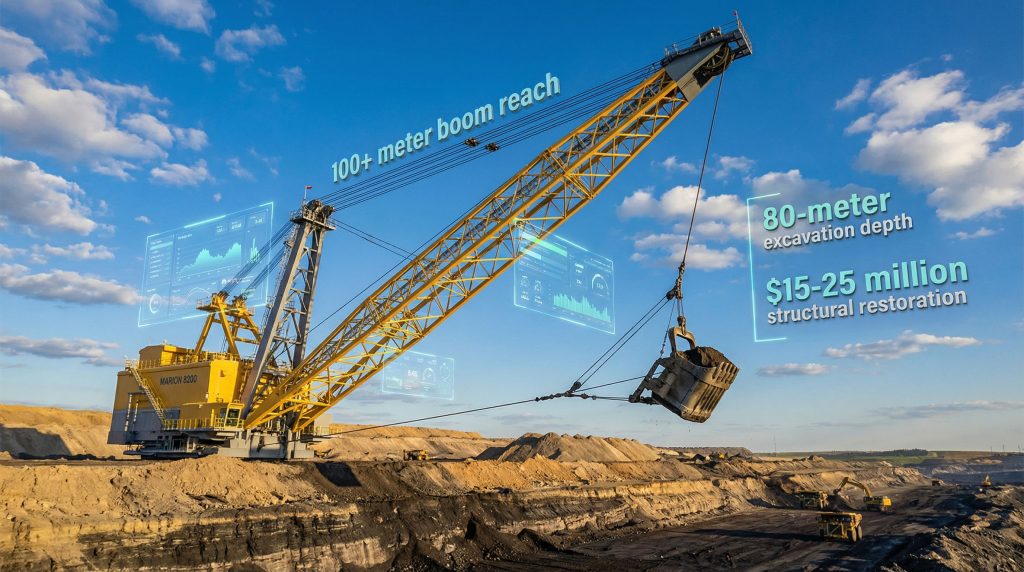
The Marion 8200 class represents the upper tier of walking dragline engineering, designed for substantial overburden removal operations in large-scale coal mining environments. These massive machines demonstrate remarkable engineering capabilities that justify major refurbishment investments.
Key Performance Specifications:
- Operational reach: Boom extensions exceeding 100 meters
- Excavation depth capability: Nearly 80-meter operational range
- Single-scoop capacity: Approximately 135 tonnes per lifting cycle
- Classification: Among the world's largest walking dragline configurations
Strategic Role in Overburden Management Systems
Large draglines serve as primary tools for exposing underlying coal seams through systematic overburden removal. Their operational efficiency directly influences mining economics by optimizing stripping ratios and enabling consistent material handling volumes. The restoration of such equipment can dramatically enhance production capacity, with some operations targeting monthly production increases to 1 million tonnes following comprehensive refurbishment programs.
Comprehensive Restoration Program Implementation
Phase 1: Structural Assessment and Validation
Engineering teams initiate dragline restoration through rigorous structural evaluation protocols that exceed standard maintenance procedures. Non-destructive testing (NDT) methodologies provide comprehensive analysis across all load-bearing components without compromising structural integrity during assessment. Moreover, this approach aligns with broader mining industry evolution trends toward more sophisticated maintenance strategies.
Assessment Scope Includes:
- Compliance verification with original design specifications
- Alignment with current operational safety standards
- Identification of wear patterns and stress concentration areas
- Material fatigue analysis across critical structural elements
Phase 2: Critical Component Restoration
Successful dragline refurbishment requires systematic attention to components that directly influence operational efficiency and equipment longevity. Engineering teams prioritize specific subsystems based on their impact on material handling performance. Additionally, these restoration efforts increasingly incorporate data-driven operations principles to optimize component selection and maintenance scheduling.
Primary Component Focus Areas:
| Component System | Restoration Objective | Performance Impact |
|---|---|---|
| Bucket System | Optimal digging performance | Enhanced material capture efficiency |
| Rigging Components | Reduced operational wear | Extended component service life |
| Fairlead Assemblies | Improved load distribution | Optimized material handling cycles |
These component systems directly influence the dragline's capacity for high-volume overburden removal operations, making their restoration critical for achieving production targets.
Phase 3: Mechanical System Overhaul
Comprehensive mechanical system restoration addresses the fundamental operational mechanisms that enable dragline functionality. Engineering teams focus on three primary mechanical systems that determine overall equipment reliability.
Walking Mechanism Servicing:
The walking mechanism enables precise repositioning across mining sites while maintaining load stability. Proper calibration ensures optimal weight distribution and prevents structural stress during movement operations.
Slew System Restoration:
Rotational efficiency directly impacts operational cycle times and material handling productivity. Restored slew systems provide consistent rotational performance across the full operational arc, reducing cycle time variations.
Lubrication System Maintenance:
Comprehensive lubrication system overhaul delivers enhanced reliability across all moving components. Modern lubrication systems incorporate advanced filtration and monitoring capabilities that extend component service intervals.
Advanced Technology Integration in Dragline Upgrades
Modern Operator Environment Systems
Contemporary dragline restoration programs incorporate state-of-the-art operator environments that enhance both productivity and safety outcomes. Modern operator installations represent significant improvements over historical configurations, particularly in ergonomic design and environmental control. Furthermore, these systems increasingly integrate AI in mining technology to enhance operational decision-making capabilities.
Operator Cabin Enhancements Include:
- Ergonomic control layouts optimized for extended operational periods
- Advanced climate control systems for operator comfort
- Enhanced visibility systems with panoramic viewing capabilities
- Integrated safety features including emergency communication systems
Digital Monitoring and Control Technologies
Modern dragline restoration incorporates sophisticated monitoring systems that provide real-time operational data and predictive maintenance capabilities. These systems represent substantial advances in equipment management and operational optimization.
Technology Integration Components:
- Computerized offsite camera systems: Enhanced visibility for remote monitoring and safety oversight
- Advanced performance monitoring: Real-time tracking of operational parameters and equipment performance
- Engine diagnostic systems: Predictive maintenance capabilities through continuous performance analysis
Safety and Compliance System Upgrades
Restoration programs must address modern safety requirements that exceed original equipment specifications. Comprehensive functional testing protocols ensure all systems meet current operational standards before returning equipment to service.
Critical System Validation:
- Hoist system testing: Load capacity verification and operational safety validation
- Drag system assessment: Material handling efficiency and mechanical reliability testing
- Swing system evaluation: Rotational mechanism performance and safety protocol compliance
Project Management Excellence in Complex Restoration Operations
Multi-Disciplinary Team Coordination
Large-scale dragline restoration requires careful coordination between internal engineering teams and specialized contractors with expertise in heavy mining equipment. Successful project execution depends on integrating diverse technical specialties while maintaining strict quality standards. However, this complex coordination also requires sophisticated investment risk management protocols to ensure project success.
Team Structure Requirements:
- Internal engineering oversight: Technical continuity and design knowledge preservation
- Specialist contractor expertise: Component-specific restoration capabilities
- Quality assurance protocols: Comprehensive testing and validation procedures
- Safety coordination: Integrated safety management across all restoration phases
Project success requires careful engineering oversight, specialist technical expertise, and close coordination between maintenance, engineering, and operations teams to ensure restoration objectives align with operational requirements.
Risk Management in Large-Scale Equipment Restoration
Technical Risk Mitigation:
- Component obsolescence planning for discontinued parts
- Performance guarantee structures with restoration contractors
- Alternative equipment deployment during refurbishment periods
- Comprehensive testing protocols before operational deployment
Financial Analysis of Dragline Restoration Investment
Investment Scale and Economic Justification
Recent restoration programs demonstrate substantial financial commitments that require careful economic analysis. The Liberty Coal dragline refurbishment project, valued at approximately R500 million (equivalent to roughly USD 27.5 million), illustrates the scale of investment required for comprehensive dragline restoration. According to Mining Weekly, this investment represents a strategic commitment to operational excellence.
Economic Benefits Analysis:
| Investment Category | Financial Impact | Operational Return |
|---|---|---|
| Structural restoration | 40-60% of new equipment cost | 15-25 year service extension |
| Technology upgrades | Enhanced operational efficiency | Reduced maintenance costs |
| Safety compliance | Regulatory requirement fulfillment | Risk mitigation value |
| Performance optimization | Production capacity increases | Revenue enhancement potential |
Cost-Effectiveness Compared to New Equipment Acquisition
Dragline restoration typically requires 40-60% of new equipment costs while providing 15-25 additional operational years. This economic advantage becomes particularly significant when considering the extended delivery timelines for new dragline orders and the immediate production benefits of restored equipment. Consequently, these restoration projects exemplify effective asset management strategies that maximize capital efficiency.
Immediate Operational Benefits:
- Faster return to production compared to new equipment procurement
- Integration with existing operational procedures and workforce expertise
- Enhanced performance through modern control system integration
- Improved fuel efficiency through upgraded engine technology
The next major ASX story will hit our subscribers first
Operational Performance Optimization Through Strategic Restoration
Production Capacity Enhancement
Restored draglines enable significant improvements in overburden removal efficiency and coal seam exposure capabilities. Modern restoration programs target substantially improved stripping ratios and enhanced efficiency in overburden removal cycles, supporting increased run-of-mine coal production objectives.
The operational impact extends beyond equipment performance to encompass broader mining operation optimization. Enhanced stripping capacity supports long-term production objectives while creating employment opportunities through increased operational activity.
Technology-Driven Efficiency Improvements
Performance Enhancement Through Modern Systems:
- Real-time monitoring enables optimized operational parameters
- Predictive maintenance reduces unplanned downtime
- Enhanced operator environments improve productivity and safety
- Digital systems integration provides comprehensive operational data
Future-Proofing Mining Operations Through Strategic Equipment Investment
Sustainability Considerations in Equipment Restoration
Modern dragline restoration incorporates sustainability principles through enhanced fuel efficiency, emissions reduction, and waste minimization strategies. These considerations align with industry trends toward more environmentally responsible mining operations.
Environmental Performance Improvements:
- Advanced engine technology reduces fuel consumption per operational hour
- Improved emissions control systems minimize environmental impact
- Enhanced operational efficiency reduces overall energy requirements
- Longer equipment service life reduces replacement material requirements
Long-Term Asset Management Strategy
Strategic dragline restoration represents a comprehensive approach to mining asset management that balances immediate operational needs with long-term sustainability objectives. This approach demonstrates mining industry evolution toward more sophisticated capital allocation strategies that maximize asset utilization while maintaining operational excellence.
The restoration approach enables mining operations to maintain competitive production costs while investing in modern technology systems that enhance both safety and efficiency outcomes.
Performance Metrics and Success Measurement
Operational Excellence Indicators
Successful dragline restoration programs demonstrate measurable improvements across multiple performance dimensions. These metrics provide quantitative validation of restoration investment effectiveness.
Key Performance Measurements:
- Material handling efficiency: Tonnes processed per operational hour
- Equipment availability: Percentage of scheduled operating time achieved
- Maintenance cost reduction: Comparison to pre-restoration baseline performance
- Production capacity achievement: Meeting or exceeding design specification targets
Financial Return Analysis
Investment returns from comprehensive dragline restoration typically materialize within 3-5 years through enhanced production capacity, reduced maintenance costs, and improved operational efficiency. The financial benefits extend beyond direct operational improvements to include workforce development and regional economic impact.
Industry Evolution and Best Practices
Emerging Trends in Mining Equipment Management
The mining industry increasingly recognizes comprehensive equipment restoration as a strategic alternative to complete replacement, particularly for large-scale machinery with substantial remaining structural life. This trend reflects sophisticated capital allocation strategies that maximize asset utilization while incorporating modern technology systems. For instance, Liberty Coal has demonstrated exceptional results through their comprehensive restoration programme.
Industry Development Patterns:
- Integration of IoT sensor networks for comprehensive equipment monitoring
- Remote monitoring capabilities for operational optimization
- Data analytics platforms for performance enhancement and predictive maintenance
- Enhanced safety systems integration across all equipment platforms
Modern mining operations demonstrate that strategic equipment restoration, executed with appropriate technical expertise and comprehensive planning, provides substantial operational and financial benefits while supporting long-term sustainability objectives. The success of such programs depends on coordinated engineering excellence across multiple technical disciplines and careful integration of modern technology systems with proven mechanical engineering principles.
Disclaimer: This article contains analysis of mining industry trends and equipment restoration practices. Investment decisions should be based on comprehensive due diligence and professional financial advice. Operational and financial projections are subject to various risk factors including commodity price volatility, regulatory changes, and operational challenges.
Considering Investments in Mining Equipment and Heavy Industry Companies?
Discovery Alert's proprietary Discovery IQ model delivers real-time alerts on significant ASX mineral discoveries, instantly empowering subscribers to identify actionable opportunities in mining, equipment manufacturing, and industrial sectors ahead of the broader market. Begin your 14-day free trial today and secure your market-leading advantage in discovering the next breakthrough mining opportunity.