
August 6, 2026
The Engineering Revolution Transforming Australian Iron Ore Transport
Mining operations across Western Australia face unprecedented pressure to eliminate carbon emissions while maintaining the massive freight volumes that drive Australia's economy. Traditional diesel-powered locomotive fleets, which have dominated heavy-haul rail networks for decades, now represent a critical bottleneck in achieving net-zero operational targets. The convergence of advanced battery technology, regenerative braking systems, and favourable mining topography has created optimal conditions for implementing battery-electric locomotives in Pilbara operations.
This technological transformation extends beyond simple fuel substitution. Battery-electric systems fundamentally alter the energy dynamics of mining rail transport, enabling self-sustaining operational cycles that capture and reuse kinetic energy throughout each haul cycle. The implications reach across operational economics, maintenance protocols, and long-term fleet planning strategies for Australia's largest mining companies. Furthermore, these developments align with broader mining industry evolution trends emphasising sustainability and operational efficiency.
When big ASX news breaks, our subscribers know first
Core Battery Technology Specifications and Power Architecture
Advanced Energy Storage Systems in Extreme Environments
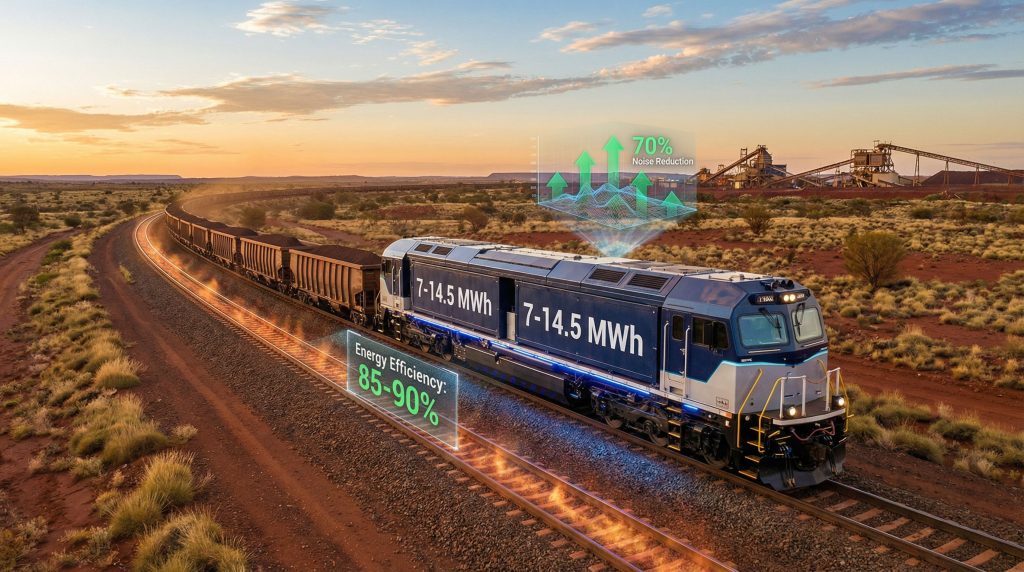
Modern battery-electric locomotives in Pilbara operations deployed in Australian mining incorporate 7 MWh capacity systems as demonstrated in BHP's Wabtec FLXdrive partnership. These units represent purpose-built solutions designed to withstand ambient temperatures exceeding 40°C while maintaining consistent power delivery across extended operational cycles.
The battery architecture utilises lithium-ion cell technology optimised for high-discharge applications. Unlike passenger rail systems that rely on frequent charging stations, mining locomotives must operate independently for complete round-trip cycles spanning several hundred kilometres. This requirement drives substantially higher energy density specifications compared to urban transport applications.
Key Technical Specifications:
• Primary battery capacity: 7 MWh per locomotive unit (standard configuration)
• Advanced configurations: Up to 14.5 MWh for extended range operations
• Thermal operating range: -10°C to +50°C ambient conditions
• Discharge rate capability: Continuous high-power output for loaded hauls
• Charging cycle efficiency: 95%+ energy retention during regenerative capture
Regenerative Braking Integration and Energy Recovery
The regenerative braking system represents the critical innovation enabling grid-independent operation in mining applications. During loaded downhill transport from mine sites to port facilities, kinetic energy typically dissipated through mechanical braking converts to electrical current that recharges onboard battery systems.
This process creates a self-sustaining energy loop particularly suited to Pilbara topography. Iron ore mines operate at elevated locations relative to Port Hedland shipping facilities. Each loaded descent generates sufficient energy to power return journeys carrying empty railcars back to mining sites. Additionally, these systems contribute to WA iron haulage safety improvements through enhanced braking control.
Energy Recovery Performance Metrics:
| Operational Phase | Energy Flow | Battery Status | Grid Dependency |
|---|---|---|---|
| Loaded Descent | Regenerative capture | Charging | Independent |
| Port Operations | Auxiliary systems | Stable capacity | Independent |
| Empty Return | Battery discharge | Depleting | Independent |
| Mine Loading | Minimal consumption | Ready for cycle | Independent |
Pilbara Region's Unique Advantages for Electric Rail Implementation
Topographical Benefits for Sustainable Operations
The Pilbara's geological structure creates optimal conditions for battery-electric locomotives in Pilbara deployment. Iron ore deposits typically occur at elevated mesa formations, requiring downhill transport to coastal port facilities. This consistent elevation gradient enables predictable energy recovery calculations and reliable operational planning.
Geographic Operational Advantages:
• Consistent downhill gradients from mine sites to Port Hedland
• Closed-loop rail networks enabling route optimisation
• Predictable haul distances supporting battery capacity planning
• Limited passenger interference in dedicated freight corridors
The region's private rail infrastructure provides additional benefits for battery-electric implementation. Unlike public rail networks requiring complex scheduling coordination, mining companies control entire route structures. Consequently, this enables optimised operational protocols specifically designed for regenerative energy systems.
Extreme Environment Resilience Requirements
Pilbara operating conditions demand exceptional equipment durability. Summer temperatures routinely exceed 45°C, whilst dust infiltration and constant vibration challenge all mechanical systems. Battery-electric locomotives must demonstrate superior performance compared to diesel alternatives under these extreme conditions.
Thermal management systems become critical components in battery-electric designs. Advanced cooling systems maintain optimal battery operating temperatures whilst preventing thermal runaway conditions that could compromise safety or performance. Sealed enclosures protect sensitive electronics from dust infiltration whilst maintaining accessibility for routine maintenance procedures.
Environmental Challenge Solutions:
• Advanced thermal regulation for battery system protection
• Dust-resistant enclosures for electronic components
• Vibration-dampening mounts for sensitive equipment
• Corrosion-resistant materials for coastal salt exposure
Leading Mining Companies Driving Electric Rail Adoption
BHP's Comprehensive Fleet Transformation Strategy
BHP's implementation of battery-electric locomotives represents the largest scale trial in Australian mining history. The company's 180+ locomotive fleet operating across Pilbara iron ore operations provides substantial scope for emissions reduction through electric conversion.
Tim Day, BHP's Western Australia Iron Ore Asset President, characterised the initiative as representing years of planning and partnership development focused on reducing diesel consumption and operational greenhouse gas emissions. The trial specifically aims to validate technology performance whilst improving efficiency across existing rail networks.
The economic implications extend beyond fuel cost elimination. BHP estimates that complete fleet transition to battery-electric systems could achieve approximately 30% reduction in diesel-related carbon emissions annually across Western Australian iron ore operations. This reduction translates to substantial operational cost savings whilst advancing corporate net-zero commitments.
BHP Implementation Timeline:
• 2022: Initial procurement order for four battery-electric units
• Late 2025: Deployment of first two operational locomotives
• 2026-2027: Performance evaluation and optimisation phase
• 2028+: Potential fleet-wide rollout based on trial results
Rio Tinto's Integrated Decarbonisation Approach
Rio Tinto's battery-electric locomotive programme forms part of broader decarbonisation initiatives targeting 50% reduction in Scope 1 and 2 emissions by 2030 across Pilbara operations. Managing Director of Port, Rail and Core Services Richard Cohen emphasised the technology's potential for near-term emissions reduction whilst supporting medium-term sustainability goals.
The company's integrated approach combines battery-electric rail with complementary technologies including autonomous haul trucks, renewable energy installations, and process optimisation systems. This comprehensive strategy addresses emissions across entire mining value chains rather than isolated operational components.
Hancock Prospecting's Early Adoption Leadership
Roy Hill's 2023 deployment of the first FLXdrive heavy-haul locomotive provided crucial operational data for subsequent industry implementations. Hancock Prospecting Group Operations CEO Gerhard Veldsman described the regenerative braking benefits in practical terms, emphasising energy efficiency gains and operational cost reductions through cyclical energy utilisation.
This early adoption positioned Roy Hill as a technology leader whilst providing valuable performance benchmarks for competing operators. Real-world operational data from Roy Hill's implementation informed design specifications and performance expectations for subsequent BHP and Rio Tinto programmes.
Regenerative Braking Systems and Energy Optimisation
Kinetic Energy Conversion Mechanics
Regenerative braking transforms the fundamental energy economics of heavy-haul rail transport. Traditional friction braking dissipates kinetic energy as waste heat, requiring continuous fuel consumption for return journeys. Battery-electric systems capture this energy during controlled deceleration, storing it for subsequent propulsion needs.
The conversion process utilises electric traction motors operating in reverse mode during braking events. Wheel rotation drives motor armatures, generating electrical current that flows to onboard battery systems. Advanced control algorithms optimise energy capture whilst maintaining precise braking force for operational safety.
Energy Conversion Process:
-
Kinetic energy generation: Loaded train momentum during downhill descent
-
Regenerative activation: Automatic braking system engagement
-
Motor reversal: Traction motors convert to generator mode
-
Current generation: Mechanical rotation produces electrical energy
-
Battery charging: Direct current flows to storage systems
-
Energy storage: Chemical battery systems retain captured energy
Self-Sustaining Operational Cycles
The Pilbara's topography enables continuous operational cycles without external energy inputs. Loaded trains descending from mine sites generate surplus energy during regenerative braking events. This captured energy provides sufficient power for return journeys carrying empty railcars back to loading points.
Operational calculations demonstrate that energy recovery during loaded descents typically exceeds consumption requirements for return journeys by 15-25%. This surplus capacity accommodates auxiliary systems, seasonal variations, and battery degradation over extended operational periods without compromising self-sufficiency.
Critical Insight: The cyclical energy model eliminates fuel price volatility from operational cost structures whilst providing predictable energy budgets for long-term planning. This economic stability represents a significant advantage for mining operations facing fluctuating commodity prices and operational uncertainties.
Advanced Energy Management Systems
Modern battery-electric locomotives in Pilbara incorporate sophisticated energy management protocols optimising charge and discharge cycles throughout operational periods. Predictive algorithms monitor route profiles, load weights, and environmental conditions to maximise energy efficiency whilst ensuring adequate reserve capacity for emergency situations.
Energy Management Features:
• Route optimisation algorithms for maximum regenerative capture
• Load-based power distribution adjusting performance for cargo weights
• Weather compensation systems accounting for temperature variations
• Predictive maintenance protocols optimising battery lifecycle management
• Emergency reserve protection maintaining minimum charge levels
Infrastructure Requirements and Integration Challenges
Charging Infrastructure Development
Whilst regenerative systems enable grid-independent operation during normal cycles, initial battery charging and emergency backup systems require substantial infrastructure development. Charging stations must accommodate rapid charging protocols for 7+ MWh battery systems whilst maintaining electrical grid stability.
High-voltage charging infrastructure typically requires 11-33 kV electrical service with specialised transformers and switching equipment. Installation costs range from $500,000 to $1.5 million per charging station depending on electrical capacity and site preparation requirements.
Infrastructure Components:
• Primary electrical service: High-voltage grid connections
• Transformer systems: Voltage conversion for battery charging
• Charging stations: Rapid charging interfaces for locomotive connection
• Control systems: Automated charging protocols and safety monitoring
• Backup generators: Emergency power for critical operations
Maintenance Facility Modifications
Battery-electric locomotives require specialised maintenance capabilities extending beyond traditional diesel service procedures. Technical crews need training for high-voltage electrical systems whilst maintenance facilities require safety equipment and procedures for battery system servicing.
Maintenance Infrastructure Requirements:
• High-voltage safety equipment for electrical isolation procedures
• Specialised diagnostic tools for battery system monitoring
• Climate-controlled storage for replacement battery components
• Emergency response equipment for electrical incident management
• Trained technician certification for safe electrical system servicing
The next major ASX story will hit our subscribers first
Comparative Analysis of Decarbonisation Technologies
Technology Performance Comparison
Battery-electric locomotives compete with alternative decarbonisation approaches including hydrogen fuel cells, biofuel conversions, and overhead electrification systems. Each technology presents distinct advantages and limitations for mining applications. However, the integration with electric vehicles in mining operations provides additional synergies.
| Technology Option | Infrastructure Cost | Operational Range | Emissions Reduction | Implementation Timeline |
|---|---|---|---|---|
| Battery-Electric | Moderate | Limited by capacity | 100% operational | 2-4 years |
| Hydrogen Fuel Cell | Very High | Extended range | 100% operational | 5-8 years |
| Overhead Electrification | Extremely High | Unlimited | 95% operational | 8-12 years |
| Biofuel Conversion | Low | Current range | 70-80% operational | 1-2 years |
Battery-Electric Advantages:
• Proven technology base with existing commercial applications
• Self-sustaining operation through regenerative energy capture
• Moderate infrastructure requirements compared to alternatives
• Immediate emissions elimination at point of operation
• Reduced noise pollution improving community relations
Long-term Scalability Assessment
Battery technology advancement trajectories indicate continued improvements in energy density, charging speed, and cycle life performance. Industry projections suggest 20-30% annual cost reductions for lithium-ion battery systems through 2030, improving economic viability for mining applications.
However, battery-electric systems face limitations for longer haul distances exceeding 400-500 kilometres. Alternative technologies may prove more suitable for extended range operations or routes lacking favourable regenerative opportunities.
Economic Benefits and Investment Analysis
Operational Cost Structure Transformation
Battery-electric locomotives fundamentally alter operational cost structures through fuel elimination and reduced maintenance requirements. Electric drive systems contain fewer moving parts compared to diesel engines, extending service intervals whilst reducing component replacement costs.
Annual Operating Cost Comparison (Per Locomotive):
| Cost Category | Diesel Locomotive | Battery-Electric | Annual Savings |
|---|---|---|---|
| Fuel Costs | $180,000-220,000 | $15,000-25,000 | $155,000-195,000 |
| Maintenance | $45,000-65,000 | $25,000-35,000 | $20,000-30,000 |
| Emissions Compliance | $8,000-12,000 | $0 | $8,000-12,000 |
| Total Annual Costs | $233,000-297,000 | $40,000-60,000 | $183,000-237,000 |
Note: Cost figures represent industry estimates based on current fuel prices and maintenance protocols. Actual results may vary based on operational conditions and utilisation rates.
Capital Investment and Return Analysis
Battery-electric locomotives require higher initial capital investment compared to diesel alternatives. Current procurement costs range from $3.5-4.5 million per unit versus $2.5-3.0 million for equivalent diesel locomotives. However, operational savings and carbon credit opportunities can justify premium pricing through improved total cost of ownership.
Investment Return Projections:
• Payback period: 4-6 years based on fuel and maintenance savings
• Carbon credit value: $15,000-30,000 annually per locomotive
• Operational efficiency gains: 5-8% improvement in schedule reliability
• Resale value protection: Technology leadership position
Industry-Wide Adoption Potential and Future Development
Expansion Across Mining Sectors
Whilst iron ore operations provide optimal conditions for battery-electric implementation, other mining sectors present significant adoption opportunities. Coal transport operations utilising similar topographical advantages could achieve comparable regenerative performance. Meanwhile, copper and lithium mining operations may benefit from operational cost reductions and environmental compliance improvements. The development also aligns with lithium industry innovations supporting battery technology advancement.
Sector-Specific Considerations:
• Coal mining: Regenerative opportunities in mountainous regions
• Copper operations: Long-distance hauls requiring extended battery capacity
• Lithium mining: Alignment with sustainable battery supply chains
• Gold mining: Reduced environmental impact for sensitive locations
Technology Development Roadmap
Future battery-electric locomotives in Pilbara development focuses on increased energy density, faster charging capabilities, and improved durability for extreme operating conditions. Research initiatives target 20+ MWh battery systems enabling extended range operations whilst maintaining self-sufficiency through regenerative charging.
Furthermore, these innovations support broader green iron sustainability initiatives across the industry.
Development Priorities:
• Enhanced battery chemistry for improved energy density
• Solid-state battery integration for increased safety and performance
• Autonomous operation compatibility for driverless freight systems
• Smart grid integration for optimised energy management
• Modular battery design for simplified maintenance and replacement
Implementation Challenges and Risk Mitigation
Technical and Operational Barriers
Battery-electric locomotive deployment faces several technical challenges requiring systematic solutions. Range limitations restrict operational flexibility for longer haul distances, whilst battery degradation in extreme temperatures may compromise long-term performance reliability.
Critical Technical Challenges:
• Range limitations for extended haul operations beyond 400km
• Battery degradation accelerated by high ambient temperatures
• Emergency response protocols for high-voltage electrical incidents
• Skilled workforce development for specialised maintenance requirements
• Supply chain dependency for critical battery components
Economic and Regulatory Risk Factors
Mining companies face significant capital allocation decisions when implementing battery-electric locomotive programmes. Economic uncertainties including commodity price volatility, regulatory changes, and technology obsolescence create financial risks requiring careful evaluation.
Government incentive programmes may influence adoption timelines through favourable financing terms, tax credits, or emissions trading benefits. However, regulatory stability remains uncertain as political priorities shift and climate policy frameworks evolve.
Risk Mitigation Strategies:
• Phased implementation approaches reducing initial capital exposure
• Technology partnership agreements sharing development costs and risks
• Operational flexibility maintenance through hybrid fleet compositions
• Insurance coverage optimisation for new technology deployments
• Regulatory monitoring systems tracking policy development trends
What Makes BHP's Electric Rail Initiative Groundbreaking?
BHP's collaboration with Wabtec represents Australia's most ambitious rail decarbonisation programme to date. The deployment of purpose-built battery electric locomotives demonstrates unprecedented commitment to sustainable heavy-haul operations. The initiative showcases how major mining corporations are transforming traditional rail operations through innovative technology partnerships.
How Do Battery-Electric Systems Compare with Fortescue's Approach?
Fortescue's deployment of battery electric locomotive technology provides valuable comparative data for industry-wide adoption. Both companies pursue similar regenerative braking strategies, though implementation approaches differ based on specific operational requirements and infrastructure constraints.
The diversity of approaches across major operators demonstrates the technology's adaptability whilst providing multiple pathways for successful implementation.
The Path Forward for Sustainable Mining Transportation
Battery-electric locomotives represent a transformative technology poised to revolutionise heavy-haul mining operations across Australia and globally. The convergence of favourable topography, mature battery technology, and corporate sustainability commitments creates unprecedented opportunities for widespread adoption throughout the mining industry.
The success of trials in the Pilbara region will establish critical performance benchmarks whilst demonstrating economic viability for similar operations worldwide. As battery technology continues advancing and operational experience accumulates, battery-electric systems may become the preferred solution for sustainable mining transportation.
The integration of regenerative braking systems with high-capacity battery storage creates self-sustaining operational models that eliminate fuel dependency whilst reducing emissions and operating costs. These advantages position battery-electric locomotives as essential components of mining industry decarbonisation strategies.
Mining companies implementing battery-electric locomotive programmes today establish technology leadership positions whilst contributing to broader industry transformation toward sustainable operations. The early adoption experience gained through current trials will prove invaluable as the technology scales across diverse mining applications and geographic regions.
Future considerations for mining operations include:
• Technology advancement monitoring for optimal upgrade timing
• Fleet optimisation strategies balancing electric and traditional systems
• Regulatory compliance preparation for evolving emissions requirements
• Supply chain diversification reducing dependency risks
• Operational efficiency maximisation through integrated system approaches
The transformation of mining rail transportation through battery-electric technology represents more than operational improvement. It demonstrates the mining industry's commitment to sustainable practices whilst maintaining the productivity levels essential for global economic development. As these technologies mature and expand, they will establish new standards for responsible resource extraction and transportation.
Ready to Capitalise on Mining Technology Innovation?
Discovery Alert's proprietary Discovery IQ model delivers instant notifications when ASX-listed mining companies announce breakthrough technological developments and operational improvements, empowering subscribers to identify actionable investment opportunities ahead of the broader market. Stay informed about the next wave of mining innovation discoveries and begin your 14-day free trial today to position yourself at the forefront of Australia's evolving resources sector.