August 11, 2026
The Promise of Enhanced Sodium-Ion Battery Longevity
The global push toward sustainable energy storage has intensified scrutiny of material degradation mechanisms that limit battery performance across various chemistries. Traditional lithium-ion systems, while mature, face supply chain vulnerabilities and cost pressures that have accelerated research into alternative electrochemical storage technologies. Among these alternatives, sodium-ion batteries represent a particularly promising pathway due to sodium's abundant availability and favourable electrochemical properties. However, the widespread adoption of sodium-ion technology has been constrained by fundamental materials science challenges, particularly rapid capacity degradation in cathode materials during repeated charge-discharge cycling. Fortunately, mitigating sodium-ion battery degradation through scandium doping offers a targeted solution that addresses these structural instabilities at the atomic level.
Recent breakthroughs in materials engineering have identified targeted doping strategies that address these degradation mechanisms at the atomic level. Understanding how specific elemental substitutions can stabilise crystal lattice structures while preserving electrochemical activity opens new pathways for developing commercially viable sodium-ion storage systems with extended operational lifespans. Furthermore, this approach aligns with broader trends in critical minerals in energy transition research.
When big ASX news breaks, our subscribers know first
What Makes Sodium-Ion Battery Cathodes Degrade So Rapidly?
The fundamental challenge in sodium manganese oxide cathodes stems from structural instabilities that occur during normal electrochemical operation. Unlike the relatively stable crystal frameworks found in established lithium-ion cathode materials, sodium-based systems experience more pronounced lattice distortions that progressively degrade their capacity to store and release electrical energy effectively.
The Jahn-Teller Distortion Challenge in Layered Oxide Structures
At the molecular level, sodium manganese oxide cathodes undergo complex structural changes during each charging cycle that create cumulative damage over time. The primary mechanism responsible for this degradation involves Jahn-Teller distortions – a quantum mechanical effect where transition metal ions distort their local coordination environment to minimise electronic energy.
In Na₂⁄₃MnO₂ cathodes, manganese exists predominantly in the +3 oxidation state (Mn³⁺), which possesses a d⁴ electronic configuration. This configuration creates orbital degeneracy that the system attempts to resolve through geometric distortion of the octahedral oxygen cage surrounding each manganese centre.
During battery operation, as sodium ions are extracted and inserted, manganese undergoes repeated oxidation state transitions between Mn³⁺ and Mn⁴⁺, triggering cyclical distortions that generate mechanical stress throughout the crystal lattice. This process significantly impacts the mining industry innovation required for sustainable battery material production.
Key characteristics of this degradation mechanism include:
• Cooperative distortion patterns: Unlike isolated local distortions, P′2-type structures exhibit long-range correlated distortions where multiple manganese sites distort simultaneously
• Crystallinity loss: Progressive lattice strain leads to amorphisation of the originally ordered crystal structure
• Anisotropic lattice expansion: Distortions occur preferentially along specific crystallographic directions, creating internal mechanical stress
• Particle fragmentation: Accumulated stress eventually causes physical breakdown of cathode particles
Quantifying Capacity Fade in Untreated Sodium Manganese Oxide
Research from Tokyo University of Science has established baseline performance metrics for conventional Na₂⁄₃MnO₂ cathodes that demonstrate the severity of this degradation challenge. In controlled half-cell testing, undoped P′2-type sodium manganese oxide retains only 35% of its initial capacity after 300 charge-discharge cycles. This represents a capacity fade rate of approximately 0.22% per cycle, which far exceeds the degradation rates acceptable for commercial energy storage applications.
For context, established lithium-ion cathode materials such as lithium nickel manganese cobalt oxide (NMC) typically retain 85-90% capacity under equivalent testing protocols, highlighting the dramatic performance gap that has hindered sodium-ion commercialisation.
| Material Type | Capacity Retention (300 cycles) | Fade Rate per Cycle |
|---|---|---|
| Undoped P′2 Na₂⁄₃MnO₂ | 35% | 0.22% |
| Standard LiNMC (Li-ion) | 85-90% | 0.03-0.05% |
| Commercial LiFePO₄ | 95-98% | 0.007-0.017% |
Electrolyte Interface Degradation Pathways
Beyond structural degradation within the cathode material itself, untreated sodium manganese oxide suffers from unstable interactions with liquid electrolytes. The highly reactive manganese surface sites catalyse electrolyte decomposition reactions that form resistive films on the cathode surface, further impeding sodium-ion transport and contributing to capacity loss.
These side reactions are particularly problematic because they consume electrolyte irreversibly, reducing the effective ionic conductivity of the battery cell over time. Additionally, the decomposition products can migrate to the anode, potentially affecting overall cell balance and safety characteristics.
How Does Scandium Doping Transform Battery Cathode Stability?
The breakthrough research conducted by Prof. Shinichi Komaba's team at Tokyo University of Science demonstrates that strategic scandium substitution can dramatically improve sodium manganese oxide cathode stability through multiple complementary mechanisms. Rather than simply replacing manganese atoms randomly, scandium integration follows specific chemical principles that target the root causes of degradation while preserving the electrochemical activity necessary for energy storage. In fact, mitigating sodium-ion battery degradation through scandium doping represents one of the most promising advances in battery recycling breakthrough technology.
Atomic-Level Integration Mechanisms
Scandium's effectiveness as a stabilising dopant stems from its unique combination of ionic and electronic properties that complement the sodium manganese oxide crystal structure. Scandium (Sc³⁺) possesses a d⁰ electronic configuration, meaning it has no unpaired d electrons and therefore exhibits no Jahn-Teller activity. When scandium substitutes for manganese at specific lattice sites, it creates "anchor points" that resist the cooperative distortions responsible for capacity fade.
Critical doping concentration analysis reveals:
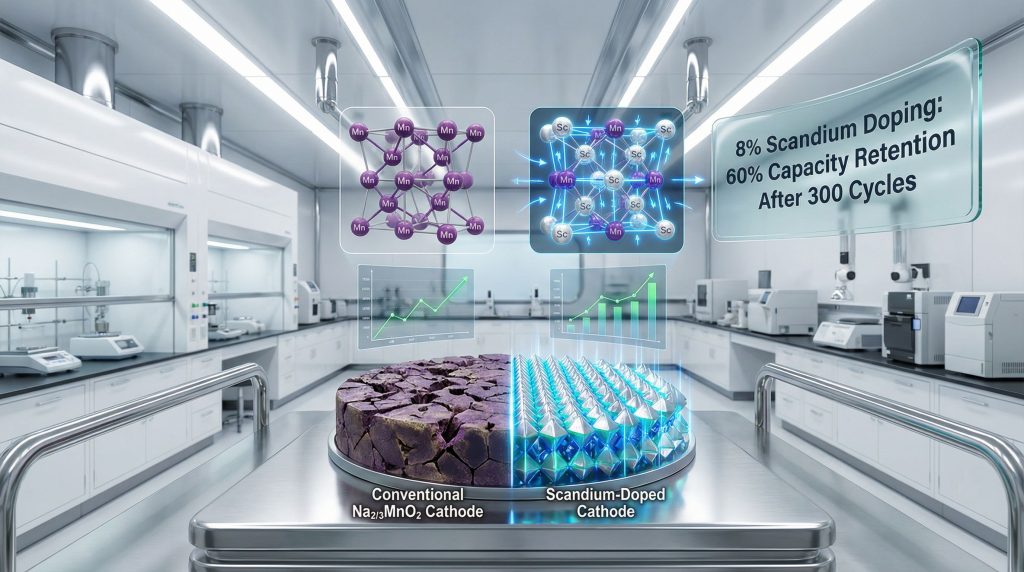
• 8% scandium content (Sc₀.₀₈): Optimal performance with 60% capacity retention after 300 cycles
• 4% scandium content (Sc₀.₀₄): Moderate improvement with 45% capacity retention after 300 cycles
• 12% scandium content (Sc₀.₁₂): Diminished performance at 55% capacity retention, indicating over-doping effects
• 0% (undoped control): Baseline 35% capacity retention after 300 cycles
The optimal 8% scandium concentration represents a careful balance: sufficient scandium content to interrupt cooperative Jahn-Teller distortion patterns while maintaining adequate manganese sites for electrochemical activity. At higher concentrations, scandium begins to suppress the redox reactions necessary for energy storage, reducing overall capacity.
Ionic radius compatibility analysis:
| Ion | Ionic Radius (Å) | Electronic Configuration | Oxidation States |
|---|---|---|---|
| Mn³⁺ | 0.645 | d⁴ (high spin) | +2, +3, +4 |
| Sc³⁺ | 0.745 | d⁰ | +3 (fixed) |
The larger ionic radius of scandium (0.745 Å vs. 0.645 Å for Mn³⁺) creates beneficial compressive strain in the lattice that counteracts the tensile strain generated by Jahn-Teller distortions. This strain compensation mechanism helps maintain structural integrity during electrochemical cycling, particularly relevant for battery-grade lithium refinery applications.
Protective Interface Formation
Beyond its role in lattice stabilisation, scandium incorporation fundamentally alters the cathode-electrolyte interface characteristics. The research demonstrates that scandium-rich surface layers exhibit enhanced chemical stability compared to pure manganese oxide surfaces, leading to improved moisture resistance and reduced side reaction activity. According to recent studies on sodium-ion battery performance enhancement, these interface improvements are crucial for commercial viability.
Interface stabilisation mechanisms include:
• Reduced catalytic activity: Scandium lacks the variable oxidation states that make manganese surfaces highly reactive toward electrolyte solvents
• Improved hydrolytic resistance: Sc-O bonds demonstrate superior resistance to moisture-induced degradation compared to Mn-O bonds
• Suppressed oxygen evolution: Scandium substitution reduces the tendency for oxygen release from the cathode during high-voltage operation
Performance enhancement quantification:
The 8% scandium-doped P′2 cathode delivers approximately 71% improvement in capacity retention relative to the undoped baseline (60% vs. 35% after 300 cycles). This improvement translates directly to extended operational lifespans for grid-scale storage applications where battery replacement frequency significantly impacts total cost of ownership.
Mitigating sodium-ion battery degradation through scandium doping represents a targeted materials engineering approach that addresses fundamental structural instabilities without compromising electrochemical performance. The Tokyo University of Science research demonstrates that 8% scandium substitution maintains 60% capacity retention after 300 cycles, compared to rapid degradation in untreated materials.
Crystal Structure Preservation During Electrochemical Stress
Detailed structural characterisation reveals that scandium doping fundamentally alters how the P′2-type crystal framework responds to the mechanical stresses generated during sodium insertion and extraction. While undoped materials exhibit progressive amorphisation and particle fragmentation, scandium-stabilised cathodes maintain their layered structure with minimal lattice parameter changes.
This structural preservation is critical for maintaining ionic transport pathways within the cathode material. In degraded, undoped materials, the loss of crystalline order creates tortuous diffusion paths that slow sodium-ion transport, contributing to capacity fade and increased internal resistance. Consequently, this technology shows promise for EVs transforming mining operations through improved battery reliability.
Why Doesn't Scandium Work for All Sodium-Ion Cathode Types?
One of the most significant findings from the Tokyo University of Science research is the highly selective nature of scandium's stabilisation effects. While 8% scandium doping dramatically improves P′2-type Na₂⁄₃MnO₂ performance, the identical doping strategy produces minimal improvement in P2-type structures. This selectivity provides crucial insights into the specific degradation mechanisms that scandium can address and highlights the importance of matching stabilisation strategies to particular structural variants.
Polytype-Specific Enhancement Mechanisms
The differential response between P2 and P′2 structures stems from fundamental differences in how manganese cations interact within their respective crystal frameworks. These structural variants, known as polytypes, differ primarily in their sodium coordination environments and the connectivity patterns between manganese-oxygen octahedra.
P2-type structural characteristics:
• Sodium coordination: Exclusively prismatic coordination sites
• Manganese connectivity: Edge-sharing octahedra with isolated distortion behaviour
• Jahn-Teller pattern: Localised, non-cooperative distortions confined to individual manganese sites
• Scandium doping efficacy: Minimal to no improvement observed
P′2-type structural characteristics:
• Sodium coordination: Mixed prismatic and octahedral coordination sites
• Manganese connectivity: Face-sharing chains promoting cooperative behaviour
• Jahn-Teller pattern: Long-range cooperative distortions spanning multiple unit cells
• Scandium doping efficacy: Highly effective stabilisation
The key distinction lies in the cooperative nature of Jahn-Teller distortions in P′2 structures. Because face-sharing manganese-oxygen octahedra chains allow distortions to propagate over long distances, a single scandium substitution can disrupt distortion patterns affecting multiple neighbouring manganese sites.
In contrast, the isolated octahedral environment in P2 structures means that scandium substitution only affects its immediate coordination sphere, providing insufficient stabilisation to counteract degradation.
Failed Doping Attempts with Alternative Cations
The research team systematically investigated whether other trivalent cations could replicate scandium's stabilisation effects, testing both ytterbium (Yb³⁺) and aluminium (Al³⁺) as alternative dopants. Neither alternative produced significant improvements in P′2 stability, demonstrating that scandium's effectiveness cannot be attributed simply to trivalent charge compensation or ionic size effects.
Alternative dopant performance summary:
| Dopant | Concentration | Capacity Retention (300 cycles) | Improvement vs. Undoped |
|---|---|---|---|
| Scandium (Sc³⁺) | 8% | 60% | +71% |
| Ytterbium (Yb³⁺) | 8% | ~38% | +9% |
| Aluminium (Al³⁺) | 8% | ~37% | +6% |
| Undoped control | – | 35% | Baseline |
The failure of ytterbium doping is particularly instructive because ytterbium shares many properties with scandium, including a d⁰ electronic configuration and trivalent oxidation state. However, ytterbium's significantly larger ionic radius (0.868 Å vs. 0.745 Å for scandium) appears to create excessive lattice strain that interferes with the beneficial stabilisation mechanism.
Aluminium's ineffectiveness despite its smaller ionic radius (0.535 Å) suggests that scandium's intermediate size represents an optimal balance for P′2 lattice stabilisation. The precise ionic radius matching appears crucial for achieving the beneficial strain compensation that counters Jahn-Teller distortions without disrupting sodium diffusion pathways.
Material Science Limitations and Selectivity
The polytype selectivity observed in scandium doping reveals fundamental principles about how dopant effectiveness depends on host structure topology rather than simple chemical compatibility. This finding has important implications for rational design of stabilisation strategies for other battery materials. Research on scandium-enhanced battery technologies confirms these selectivity patterns across different cathode compositions.
Crystal lattice compatibility requirements:
• Geometric matching: Dopant ionic radius must complement host structure without excessive strain
• Electronic compatibility: Dopant electronic configuration should interrupt harmful electronic interactions
• Structural integration: Dopant must integrate into specific crystallographic sites that influence cooperative phenomena
• Electrochemical neutrality: Dopant should not participate in redox reactions that could complicate cell behaviour
The research demonstrates that successful dopant design requires understanding the specific failure mechanisms active in each host structure. Generic approaches based solely on ionic size or charge matching are insufficient for achieving optimal performance improvements.
What Are the Manufacturing and Cost Implications?
While the technical performance improvements demonstrated by scandium doping are substantial, the practical implementation of this technology faces significant manufacturing and economic challenges that could influence its commercial viability. Understanding these constraints is essential for assessing when and how scandium-enhanced sodium-ion batteries might reach market deployment.
Scandium Supply Chain Challenges
Scandium represents one of the rarest elements used in industrial applications, with global annual production estimated at only 15-20 tonnes per year. This extremely limited supply base contrasts sharply with the scale requirements for grid-scale energy storage deployment, where battery installations may require hundreds of thousands of tonnes of cathode materials annually.
Current scandium pricing and availability:
• Market price: Approximately $4,000-6,000 per kilogram for scandium oxide (Sc₂O₃)
• Primary sources: Scandium is typically recovered as a byproduct from aluminium, titanium, and uranium processing
• Geographic concentration: Most production occurs in China and Russia, creating potential supply chain vulnerabilities
• Processing complexity: Scandium extraction and purification require specialised techniques due to its chemical similarity to rare earth elements
For context, manganese oxide raw materials typically cost $2-5 per kilogram, meaning scandium addition could increase cathode material costs by $320-480 per kilogram for 8% doping levels. This represents a significant cost premium that must be justified by improved battery lifetime and reduced replacement frequency.
Cost-Benefit Analysis for Grid-Scale Storage Applications
Despite the high material cost, scandium doping may prove economically justified for specific applications where battery longevity provides substantial value. The economic analysis must consider total cost of ownership including initial capital costs, operational expenses, and replacement frequencies over project lifetimes.
Economic modelling assumptions:
| Parameter | Undoped Na-ion | Sc-doped Na-ion | Units |
|---|---|---|---|
| Initial capacity retention | 35% (300 cycles) | 60% (300 cycles) | % after 300 cycles |
| Expected cycle life to 80% retention | ~150 cycles | ~400 cycles | Charge-discharge cycles |
| Cathode material cost | $15/kg | $95/kg | USD per kilogram |
| System-level cost impact | $75/kWh | $105/kWh | USD per kilowatt-hour installed |
For grid-scale installations with 20-year design lifetimes, the improved cycle life could reduce battery replacement frequency from every 2-3 years to every 6-8 years, potentially offsetting the higher initial material costs through reduced maintenance and replacement expenses.
Alternative Rare Earth Element Exploration
The supply constraints associated with scandium have motivated research into alternative stabilisation strategies using more abundant elements. However, the highly specific nature of scandium's effectiveness, as demonstrated by the failed trials with ytterbium and aluminium, suggests that finding equivalent substitutes may require fundamentally different approaches to cathode stabilisation.
Potential research directions include:
• Multi-element doping: Combining multiple dopants to achieve similar stabilisation with lower scandium content
• Surface coating technologies: Applying scandium-rich protective layers rather than bulk doping
• Synthetic scandium production: Developing dedicated scandium mining operations rather than relying on byproduct recovery
• Processing optimisation: Improving scandium utilisation efficiency to reduce total consumption
Scalability Assessment for Commercial Deployment
The transition from laboratory-scale synthesis to commercial-scale manufacturing presents additional technical challenges beyond raw material availability. Scandium doping requires precise control over dopant distribution and concentration to achieve optimal performance, which may necessitate modifications to existing cathode production processes.
Manufacturing considerations:
• Homogeneity control: Ensuring uniform scandium distribution throughout cathode particles
• Quality assurance: Developing analytical methods to verify doping levels and structural integrity
• Process integration: Adapting existing sodium-ion manufacturing lines for scandium incorporation
• Yield optimisation: Minimising scandium losses during synthesis and processing
Integration timeline estimates:
• Pilot-scale demonstration: 2-3 years for process development and optimisation
• Commercial prototype cells: 3-5 years for full-scale manufacturing validation
• Market deployment: 5-7 years for widespread commercial availability
These timelines assume continued research progress and successful resolution of supply chain constraints, but represent realistic estimates for complex battery technology development cycles.
How Do Scandium-Doped Cathodes Compare to Other Degradation Solutions?
The sodium-ion battery research community has developed several alternative approaches to address cathode degradation, each targeting different aspects of the fundamental stability challenges. Comparing scandium doping to these alternative strategies provides important context for understanding its relative advantages and limitations within the broader landscape of battery materials development.
Alternative Stabilisation Strategies
Magnesium doping in nickel-manganese systems represents one of the most widely studied alternatives to scandium substitution. Magnesium (Mg²⁺) offers several potential advantages including much higher abundance and lower cost compared to scandium. Research has demonstrated that magnesium can partially stabilise certain layered oxide cathodes through:
• Structural pinning effects: Similar to scandium, magnesium substitution can reduce lattice mobility
• Electronic modification: Mg²⁺ lacks d electrons, potentially reducing Jahn-Teller activity
• Cost effectiveness: Magnesium costs approximately $2-3 per kilogram compared to scandium's $4,000-6,000 per kilogram
However, magnesium doping typically achieves only 40-50% capacity retention after 300 cycles in comparable test conditions, falling short of scandium's 60% retention performance. Additionally, magnesium's divalent charge requires careful charge balancing through co-doping or structural modifications.
Coating technologies offer a fundamentally different approach by protecting cathode surfaces rather than modifying bulk crystal structure:
• Aluminium phosphate coatings: Thin protective layers that reduce electrolyte contact with reactive manganese surfaces
• Carbon coatings: Conductive carbon layers that improve electron transport while providing chemical protection
• Oxide barrier layers: Chemically inert oxide coatings that prevent side reactions without impeding ionic transport
Electrolyte additive approaches target degradation through chemical modifications of the liquid electrolyte rather than cathode materials:
• Film-forming additives: Compounds that create stable solid electrolyte interphase (SEI) layers
• Radical scavengers: Additives that neutralise reactive species generated during electrolyte decomposition
• Ionic conductivity enhancers: Salts or solvents that improve sodium-ion transport kinetics
Performance Benchmarking Against Lithium-Ion Systems
To properly assess the commercial potential of scandium-doped sodium-ion cathodes, their performance must be evaluated relative to established lithium-ion technologies that represent the current market standard for grid-scale energy storage.
Comprehensive performance comparison:
| Technology | Capacity Retention (300 cycles) | Material Cost ($/kg) | Energy Density (Wh/kg) |
|---|---|---|---|
| Scandium-doped Na-ion | 60% | ~$95 | 120-140 |
| Standard Na-ion (undoped) | 35% | ~$15 | 120-140 |
| LiFePO₄ (Li-ion) | 95-98% | ~$25 | 90-120 |
| NMC 811 (Li-ion) | 85-90% | ~$35 | 220-250 |
| LTO/NMC (long-life Li-ion) | 90-95% | ~$75 | 80-100 |
While scandium-doped sodium-ion cathodes still fall short of the best lithium-ion performance metrics, they represent a significant improvement over undoped sodium-ion materials. The key question becomes whether the performance gap can be justified by other factors such as raw material abundance, supply chain security, or specific application requirements.
Cycle life projections:
Based on the demonstrated capacity retention curves, scandium-doped sodium-ion batteries may achieve 2,000-3,000 total cycles to 80% capacity retention, compared to 4,000-6,000 cycles for premium lithium-ion systems. For grid-scale storage applications with daily cycling, this translates to:
• Scandium-doped Na-ion: 5.5-8 year operational lifetime
• Premium Li-ion: 11-16 year operational lifetime
• Standard Na-ion: 2-3 year operational lifetime
Energy Density Trade-offs in Stabilised Sodium-Ion Designs
One important consideration in evaluating scandium doping is its impact on overall energy density. Since scandium is electrochemically inactive, increasing scandium content necessarily reduces the amount of electrochemically active manganese available for energy storage.
Energy density analysis:
• 8% scandium doping: Approximately 5-8% reduction in theoretical specific capacity
• Practical energy density impact: The structural stabilisation effects partially offset capacity reduction through improved utilisation
• System-level considerations: Improved cycle life may allow higher depth-of-discharge operation, recovering some energy density
The net effect appears to be a modest reduction in energy density that is more than compensated by dramatic improvements in cycle life and calendar life stability.
The next major ASX story will hit our subscribers first
What Does This Mean for Future Energy Storage Applications?
The development of scandium-enhanced sodium-ion cathodes represents more than an incremental improvement in battery materials – it potentially enables new applications and deployment scenarios that were previously impractical due to frequent battery replacement requirements. Understanding these broader implications helps contextualise the technology's significance within the evolving energy storage landscape. However, mitigating sodium-ion battery degradation through scandium doping must be evaluated alongside other emerging technologies for comprehensive implementation strategies.
Grid-Scale Storage Implications
Extended operational lifespans fundamentally change the economic equation for utility-scale energy storage installations. Current sodium-ion systems require battery replacement every 2-3 years, creating ongoing operational expenses that can exceed initial capital costs over project lifetimes. Scandium-enhanced systems with 5-8 year lifespans would dramatically reduce these replacement cycles.
Economic impact analysis:
For a typical 100 MWh grid-scale installation:
• Current Na-ion systems: 6-10 battery replacements over 20-year project life
• Scandium-enhanced systems: 2-4 battery replacements over 20-year project life
• Replacement cost savings: $15-30 million in avoided replacement costs (assuming $300/kWh replacement cost)
• Operational efficiency gains: Reduced downtime and maintenance scheduling complexity
Integration potential with renewable energy systems becomes more attractive when storage systems can reliably operate for extended periods without major maintenance interventions. This reliability is particularly important for remote installations where battery replacement logistics are challenging and expensive.
Applications benefiting from enhanced durability:
• Remote microgrids: Locations where battery replacement requires expensive transportation and specialised labour
• Marine and offshore installations: Harsh environments where premature battery failure creates safety and logistical challenges
• Utility frequency regulation: High-cycle applications where battery degradation directly impacts revenue generation
• Backup power systems: Critical infrastructure applications requiring long-term reliability
Technology Roadmap and Development Timeline
The pathway from current laboratory demonstrations to commercial deployment follows established patterns for advanced battery technology development, but faces unique challenges related to scandium supply chain development and manufacturing process optimisation.
Research-to-commercialisation phases:
Phase 1: Materials optimisation (2026-2028)
• Refining scandium doping processes for maximum effectiveness
• Developing alternative rare earth doping strategies to reduce scandium dependence
• Optimising synthesis conditions for large-scale manufacturing
Phase 2: Pilot manufacturing (2028-2030)
• Demonstrating kilogram-scale cathode production with consistent quality
• Validating full-cell performance in realistic testing conditions
• Establishing scandium supply chain partnerships and procurement agreements
Phase 3: Commercial demonstration (2030-2032)
• Deploying megawatt-hour scale demonstration projects
• Validating long-term performance and reliability under field conditions
• Developing standardised testing protocols and certification procedures
Phase 4: Market deployment (2032-2035)
• Scaling manufacturing to gigawatt-hour annual production capacity
• Achieving cost competitiveness with alternative storage technologies
• Establishing global supply chains and distribution networks
Critical development milestones:
| Timeline | Milestone | Success Metrics |
|---|---|---|
| 2027 | Scandium supply chain security | 500+ tonnes annual scandium availability |
| 2029 | Pilot manufacturing validation | 10 MWh production with <5% performance variation |
| 2031 | Field demonstration completion | 95%+ uptime over 3-year demonstration period |
| 2033 | Commercial market entry | Cost parity with premium lithium-ion systems |
Market Adoption Scenarios for Scandium-Enhanced Systems
The adoption trajectory for scandium-enhanced sodium-ion batteries will likely follow a segmented approach, with initial deployment in applications that most highly value longevity and reliability over absolute performance metrics.
Early adoption segments:
• Premium grid-scale storage: Utility applications where replacement costs and downtime significantly impact project economics
• Industrial backup power: Mission-critical applications requiring high reliability over extended periods
• Remote and off-grid systems: Installations where battery maintenance access is limited or expensive
Mass market potential depends on:
• Scandium supply development: Expanding production beyond current byproduct recovery limitations
• Cost reduction achievements: Reducing scandium-related cost premiums through improved utilisation efficiency
• Performance improvements: Continued research advancing cycle life toward lithium-ion competitive levels
Competitive positioning scenarios:
Optimistic scenario (2030-2035): Scandium-enhanced sodium-ion systems achieve cost parity with premium lithium-ion while offering supply chain advantages, capturing 15-25% of grid-scale storage market
Conservative scenario (2035-2040): Technology remains in premium niche applications due to scandium supply constraints, achieving 3-5% market share in specialised segments
Breakthrough scenario (2028-2032): Alternative doping strategies eliminate scandium dependence while maintaining performance benefits, enabling widespread adoption across multiple market segments
Frequently Asked Questions About Scandium Battery Doping
Technical Implementation Questions
How is scandium integrated into existing cathode manufacturing processes?
Scandium integration requires modifications to standard co-precipitation or solid-state synthesis routes used for sodium manganese oxide production. The process typically involves:
• Precursor preparation: Dissolving scandium salts (typically scandium nitrate or acetate) along with manganese precursors in controlled stoichiometric ratios
• pH-controlled precipitation: Maintaining specific pH conditions during co-precipitation to ensure uniform scandium distribution
• High-temperature calcination: Thermal treatment at 800-900°C in controlled atmosphere to form the desired P′2 crystal structure
• Quality control testing: X-ray diffraction and chemical analysis to verify scandium incorporation and crystal phase purity
What testing protocols validate long-term stability improvements?
Comprehensive validation requires multiple complementary testing approaches:
• Extended cycling tests: 1,000+ charge-discharge cycles under controlled temperature and current rate conditions
• Structural characterisation: In-situ X-ray diffraction monitoring crystal structure changes during cycling
• Interface analysis: X-ray photoelectron spectroscopy (XPS) to monitor cathode-electrolyte interface evolution
• Post-mortem studies: Electron microscopy examination of cathode morphology after extended cycling
• Accelerated ageing: Elevated temperature testing to predict long-term degradation patterns
Are there environmental considerations for scandium mining and processing?
Scandium recovery faces several environmental and sustainability challenges:
• Byproduct dependency: Current scandium sources rely on aluminium and titanium processing, linking availability to these industries
• Chemical processing intensity: Scandium purification requires multiple solvent extraction steps using organic solvents
• Water consumption: Hydrometallurgical processing typically requires significant water resources
• Waste stream management: Processing generates acidic waste streams requiring neutralisation and treatment
However, the small quantities required for battery applications (8% doping levels) limit the overall environmental impact compared to primary cathode materials.
Commercial Viability Concerns
When might scandium-doped sodium-ion batteries reach market readiness?
Market readiness depends on resolving multiple parallel challenges:
• Technical maturity: 2027-2029 for pilot-scale manufacturing demonstration
• Supply chain development: 2028-2030 for sufficient scandium production capacity
• Cost competitiveness: 2030-2033 for competitive total cost of ownership
• Regulatory approval: 2029-2031 for safety certification and grid interconnection standards
Realistic commercial deployment likely begins in premium applications around 2030-2032, with broader market penetration following by 2-3 years.
What applications justify the additional material costs?
Economic justification varies significantly by application:
Highly justified applications:
• Grid-scale storage systems with high replacement costs (>$500/kWh replacement)
• Remote installations where battery access is limited or expensive
• Mission-critical backup power requiring exceptional reliability
• High-cycle applications where degradation directly impacts revenue (frequency regulation, arbitrage)
Marginally justified applications:
• Residential energy storage where replacement labour costs are significant
• Commercial and industrial systems with moderate reliability requirements
Unlikely to justify premium:
• Consumer electronics with rapid replacement cycles
• Low-cost stationary storage where upfront costs dominate economics
• Transportation applications prioritising energy density over longevity
In conclusion, mitigating sodium-ion battery degradation through scandium doping represents a sophisticated materials engineering solution that addresses fundamental stability limitations in next-generation energy storage systems. While challenges remain regarding supply chain development and cost optimisation, the technology offers a pathway toward commercially viable sodium-ion batteries with dramatically improved operational lifespans. As the energy transition accelerates and battery performance requirements continue to evolve, scandium-enhanced cathodes may play an increasingly important role in enabling reliable, long-duration energy storage across multiple application sectors.
Ready to Uncover the Next Scandium Discovery?
The breakthroughs in scandium-enhanced battery technology highlight the critical role of rare earth elements in next-generation energy storage applications, presenting compelling investment opportunities for those positioned to identify significant discoveries early. Discovery Alert's proprietary Discovery IQ model provides instant notifications when ASX companies announce material scandium or rare earth findings, delivering the market intelligence needed to capitalise on these emerging technologies before broader market recognition drives substantial price movements.