August 25, 2026
The Hidden Architecture of America's Nuclear Fuel Dependency
Beneath every operating reactor in the United States lies an invisible logistics chain that most energy analysts rarely examine in detail: the enriched uranium supply network. This infrastructure does not make headlines unless something goes wrong, yet it underpins both the generation of roughly 20% of U.S. electricity and the operational readiness of the nation's nuclear-powered naval fleet. The question of whether that infrastructure is financially transparent, economically sustainable, and adequately planned for the decades ahead is precisely what the GAO report on enriched uranium supply efforts set out to answer in its recently published findings, GAO-26-107385.
What the report reveals is not a crisis in the conventional sense, but something arguably more complex: a structural mismatch between the scale of federal ambition and the quality of the analytical frameworks being used to manage it.
When big ASX news breaks, our subscribers know first
Why Enriched Uranium Sits at the Intersection of Energy and National Security
Few industrial commodities serve as dual-use inputs at the scale that enriched uranium does. On one side of the ledger, it fuels the light water reactors that provide baseload electricity to tens of millions of Americans. On the other, it enables naval propulsion systems and the maintenance of defence material stockpiles that form a cornerstone of U.S. strategic deterrence.
This dual mandate creates an unusual policy environment. Unlike conventional energy commodities, enriched uranium cannot be freely traded on spot markets or easily substituted when supply tightens. Its production requires specialised centrifuge or diffusion technology, significant capital investment, regulatory licensing, and years of lead time. Consequently, a shortfall in enriched uranium is not a problem that can be solved in a quarterly procurement cycle.
How Recent Legislation Changed the Supply Landscape
What makes the 2026 GAO review particularly significant is its timing. The Russian uranium import ban, enacted in 2024 through the Prohibiting Russian Uranium Imports Act, has fundamentally altered the supply calculus that domestic enrichers and federal planners had previously relied upon. The U.S. is now operating in an environment where it must replace a meaningful share of its foreign supply base while simultaneously building out entirely new fuel infrastructure for the next generation of reactors.
Understanding the Three-Tier Enrichment Framework
To fully appreciate what the GAO report examined, it helps to understand how enriched uranium is classified and why each category has distinct strategic implications.
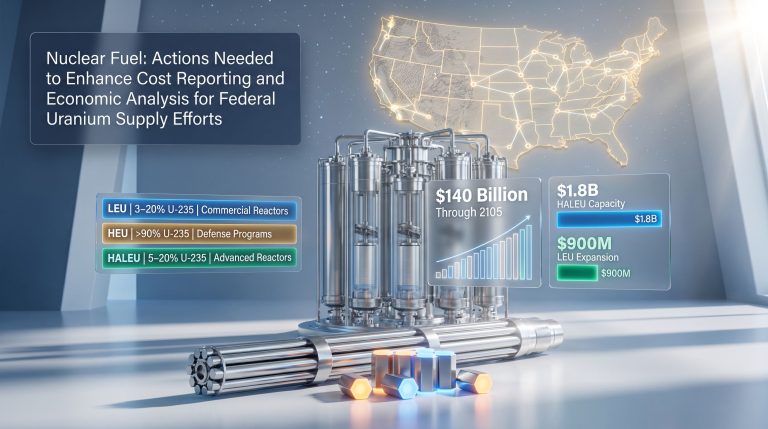
| Uranium Type | Enrichment Level | Primary Application |
|---|---|---|
| LEU (Low-Enriched Uranium) | Below 5% U-235 | Conventional light water reactors, defence programmes |
| HEU (Highly Enriched Uranium) | Above 20% U-235 | Naval propulsion, national security stockpiles |
| HALEU (High-Assay Low-Enriched Uranium) | 5% to 20% U-235 | Advanced reactors, small modular reactors |
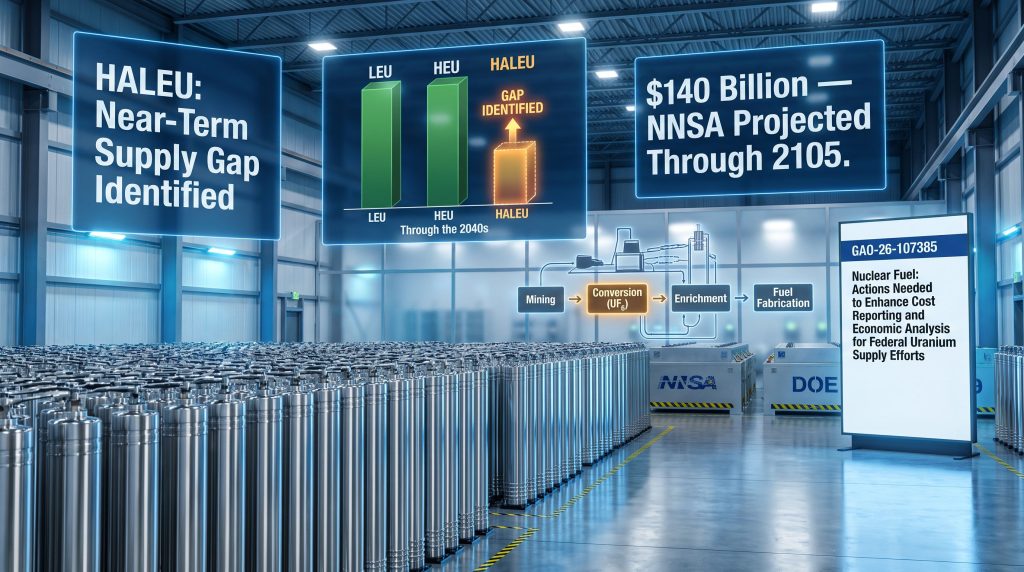
Each category occupies a different risk profile in the current supply picture. LEU and HEU inventories managed by the National Nuclear Security Administration (NNSA) are projected to remain sufficient through the 2040s based on current consumption and production assumptions. HALEU, however, tells a different story entirely.
HALEU is not simply a higher-enrichment version of conventional reactor fuel. Its production requires different centrifuge cascade configurations, more rigorous material handling protocols, and facilities designed to manage the elevated proliferation sensitivity that comes with enrichment levels approaching weapons-relevant thresholds. Practically speaking, a facility licensed to produce LEU cannot simply reconfigure overnight to produce HALEU at commercial scale. The technical and regulatory barriers are substantial.
What the GAO Report Actually Found: Three Dimensions of Federal Oversight
The GAO's review, formally titled Nuclear Fuel: Actions Needed to Enhance Cost Reporting and Economic Analysis for Federal Uranium Supply Efforts, organised its analysis around three interconnected areas. Furthermore, the findings reflect broader uranium market dynamics that have been reshaping investment and policy decisions across the sector.
NNSA Inventory Projections and Long-Term Cost Transparency
The NNSA maintains enriched uranium inventories for national security purposes and periodically updates its long-term cost projections. What the GAO found is that the agency's most recent cost estimate for sustaining defence-grade enriched uranium supply through 2105 reached approximately $140 billion, yet this updated figure had not been incorporated into the biennial congressional report that lawmakers rely on for appropriations oversight.
This is not a trivial omission. When Congress is asked to approve multi-billion-dollar nuclear fuel programmes, the accuracy and completeness of the cost baseline directly shapes those decisions. The GAO characterised this as a structural accountability gap rather than intentional concealment, but the consequence is the same: decision-makers lacked the full financial picture.
DOE Commercial Front-End Support: Investment Scale vs. Analytical Depth
The Department of Energy has committed substantial resources to rebuilding domestic enrichment and conversion capacity. The current federal investment commitments break down as follows:
| Programme Area | Committed Funding | Purpose |
|---|---|---|
| LEU Enrichment Expansion | $900 million | Scale domestic low-enriched uranium capacity |
| HALEU Capacity Development | $1.8 billion | Build commercial HALEU production infrastructure |
| Uranium Conversion Agreement | Established 2025 | Expand upstream conversion capacity |
These are significant figures, representing a combined enrichment commitment of $2.7 billion. Yet the GAO's core criticism is not about the size of the investment but about what is missing around it: a formal, rigorous economic analysis demonstrating that these expenditures will actually deliver financially sustainable domestic supply over the long term.
Without that analytical foundation, congressional appropriations committees are effectively being asked to approve large-scale spending based on strategic rationale alone, without a structured framework for assessing value or viability over time.
The HALEU Supply Gap: The Most Acute Near-Term Vulnerability
The GAO flagged HALEU as the single most pressing near-term supply risk within the entire federal uranium strategy. The reasons for this are layered.
First, demand for HALEU is inherently uncertain. Unlike LEU demand, which can be estimated with reasonable precision based on the existing fleet of light water reactors, HALEU demand depends on how quickly advanced reactor designs progress through licensing, construction, and commissioning. These timelines are notoriously difficult to forecast and have historically slipped.
Second, domestic HALEU production infrastructure is effectively nascent. The $1.8 billion federal investment represents foundational capacity building, not the scaling of a mature industrial base. Centrus Energy's American Centrifuge Plant in Piketon, Ohio, has demonstrated HALEU production capability, but at a demonstration scale that falls well short of what commercial advanced reactor fleets would require.
Third, the specific configuration of HALEU demand varies across reactor designs. Different advanced reactor architectures have different fuel form requirements, burnup targets, and enrichment specifications. This heterogeneity makes it difficult to standardise supply planning and compounds the uncertainty embedded in demand forecasts.
The GAO specifically identified the absence of a standardised HALEU demand forecasting methodology as a structural weakness. Without a common baseline for estimating fuel requirements, federal agencies cannot coordinate effectively, and investment decisions risk being misaligned with actual reactor deployment trajectories.
The Uranium Conversion Bottleneck: An Upstream Risk Often Overlooked
One of the less widely discussed findings in the GAO report on enriched uranium supply efforts concerns uranium conversion — the processing step that transforms uranium ore concentrates into uranium hexafluoride (UF₆), the gaseous form required as a feedstock for centrifuge enrichment cascades. This step sits upstream of enrichment in the fuel cycle, and domestic conversion capacity has historically been underdeveloped relative to enrichment investment.
The DOE's 2025 conversion capacity agreement represents an acknowledgement that enrichment investment alone cannot solve the supply problem if the upstream pipeline feeding those centrifuges remains constrained. Think of it as building a highly efficient manufacturing line without securing the raw material input: the throughput ceiling is set by the weakest link.
For investors and energy analysts tracking the nuclear fuel sector, this upstream dynamic is worth close attention. In addition, companies and facilities operating in the conversion segment of the fuel cycle occupy a structurally important position that is often underappreciated relative to enrichment operators. The uranium supply challenges currently defining the market make this upstream risk all the more consequential.
Six Risk Categories That Could Derail Federal Supply Goals
The GAO's structural analysis identified a set of implementation risks that collectively represent the gap between federal intentions and actual supply outcomes:
- Geopolitical supply disruption – Continued residual dependence on foreign enrichment services leaves the U.S. exposed to sanctions escalation and trade disruption, particularly from state-owned enrichment enterprises in Russia and, increasingly, China.
- Domestic industrial scaling constraints – Building enrichment capacity is capital-intensive, technically complex, and slow. The lead times for new centrifuge cascade deployment are measured in years, not months.
- Conversion infrastructure gaps – Upstream processing bottlenecks can neutralise downstream enrichment investments, making the conversion segment a systemic vulnerability.
- HALEU demand uncertainty – Advanced reactor deployment timelines remain speculative, and overbuilding HALEU capacity based on optimistic projections carries its own financial risk for federal programmes.
- Long-duration cost escalation – Programmes projected to run through 2105 are exposed to compounding inflation, technology shifts, and political cycles that make early cost estimates increasingly unreliable over time.
- Regulatory and licensing timelines – New enrichment and conversion facilities must navigate Nuclear Regulatory Commission licensing processes that can extend for years, creating a structural lag between investment decisions and operational capacity.
The next major ASX story will hit our subscribers first
The Commercial Nuclear Sector's Stake in Federal Uranium Policy
While the GAO report frames its analysis primarily around federal supply obligations, the implications extend directly into the commercial nuclear sector. Advanced reactor developers including companies such as TerraPower, X-energy, and others have built their business models around the assumption that HALEU will be commercially available when their first plants reach operational readiness.
If the federally funded HALEU production infrastructure does not reach commercial scale on schedule, the downstream consequence is not merely a fuel procurement challenge. It becomes an existential timing risk for the advanced reactor industry itself. A reactor that receives regulatory approval but cannot obtain fuel cannot generate revenue, cannot demonstrate its economic case, and cannot attract the private capital needed for the sector to grow.
Scenario analysis suggests that if HALEU commercial supply remains insufficient by 2028 to 2030, reactor operators could face fuel availability constraints that delay initial criticality, effectively stalling the advanced nuclear sector at precisely the moment when investor and policy momentum has reached its highest point in decades.
This is not a remote theoretical risk. It is a scheduling problem embedded in the intersection of enrichment infrastructure timelines, regulatory approval processes, and reactor construction schedules — none of which are currently synchronised. The uranium supply-demand volatility observed in recent years further compounds these pressures, making coordinated planning all the more essential.
Comparing Federal Uranium Strategy Across the Defence and Commercial Divide
| Dimension | National Security (NNSA) | Commercial Sector (DOE) |
|---|---|---|
| Primary Uranium Types | HEU and LEU | LEU and HALEU |
| Inventory Coverage | Through the 2040s | Near-term HALEU gap identified |
| Long-Term Cost Estimate | ~$140B through 2105 | $2.7B committed to enrichment |
| Primary Risk Category | Cost reporting transparency | Supply-demand mismatch for HALEU |
| GAO Oversight Gap | Biennial report not updated | No formal economic sustainability analysis |
The contrast between these two columns is instructive. The national security side has a cost transparency problem: the numbers are large and updated projections have not reached congressional reporting mechanisms. The commercial side has an economic analysis problem: investments are being made without a formal framework for assessing whether they will deliver sustainable supply at a cost that makes commercial nuclear fuel competitive.
What the GAO Is Actually Asking DOE and NNSA to Do
The GAO report on enriched uranium supply efforts recommendations, while framed in bureaucratic language, translate into three practical demands:
- Ensure that the updated $140 billion long-term NNSA cost estimate is incorporated into the next required biennial congressional report, giving lawmakers an accurate financial baseline for oversight decisions.
- Develop a formal economic sustainability analysis for federal uranium supply investments, providing a structured methodology for assessing whether current spending commitments are financially viable over the relevant planning horizon.
- Standardise HALEU demand forecasting methodology across federal agencies to create a common baseline that supports coordinated investment and supply planning.
These are not radical demands. They represent the kind of analytical discipline that any large-scale public investment programme would be expected to demonstrate. The GAO's concern is fundamentally that the scale and duration of these programmes have outpaced the institutional capacity to rigorously evaluate them.
Key Milestones to Monitor as U.S. Nuclear Fuel Policy Evolves
For analysts and observers tracking the trajectory of this sector, several specific indicators will signal whether the structural gaps identified in the report are being addressed:
- Progress on HALEU production facilities funded under the $1.8 billion federal commitment, particularly whether Centrus Energy and BWXT meet their contracted capacity milestones.
- Inclusion of updated NNSA cost estimates in the next biennial congressional report, which would signal that the accountability gap flagged by the GAO is being actively closed.
- Advancement of the 2025 DOE uranium conversion capacity agreement, which represents the critical upstream step in a supply chain that has historically been underinvested.
- Emergence of a standardised federal methodology for HALEU demand forecasting, which would be a prerequisite for coordinated and credible supply planning across agencies.
- The pace of NRC licensing decisions for next-generation reactor designs, which directly sets the demand timeline that HALEU supply infrastructure must meet. Divergences between spot and term pricing in the uranium market will also serve as a useful barometer of broader supply confidence.
Frequently Asked Questions
What is GAO report GAO-26-107385?
It is a federal oversight report released in August 2026, examining whether U.S. agencies have adequate cost reporting systems and economic analysis frameworks to sustain enriched uranium supply for national defence and civilian nuclear power through the coming decades.
Why is HALEU considered the most urgent supply risk?
HALEU demand projections vary significantly depending on advanced reactor deployment rates, and domestic commercial production capacity remains at demonstration scale. The GAO identified a potential gap between projected near-term demand and available supply.
How much has the federal government committed to domestic uranium enrichment?
Current commitments include $900 million for LEU enrichment expansion and $1.8 billion for HALEU capacity development, alongside a 2025 conversion infrastructure agreement totalling $2.7 billion in enrichment-related investment.
What does the GAO want improved?
The two primary recommendations concern ensuring updated long-term cost estimates appear in required congressional reports and developing formal economic analyses that assess whether federal uranium supply investments are financially sustainable over their intended planning horizons.
What role do Russian import restrictions play?
The 2024 Prohibiting Russian Uranium Imports Act created a structural supply gap that domestic enrichment programmes are designed to fill. However, transitioning to fully domestic supply requires capital investment, facility construction, and regulatory approvals that cannot be completed quickly.
Is U.S. defence-grade uranium supply at risk?
Based on current NNSA assessments, LEU and HEU inventories for national security applications are projected to remain adequate through the 2040s. The long-term cost projection of $140 billion through 2105 signals the sustained investment required to maintain that adequacy.
Readers seeking additional context on U.S. nuclear fuel policy and federal oversight of the uranium supply chain may find value in reviewing related coverage from the American Nuclear Society's Nuclear Newswire, which provides ongoing reporting on fuel cycle developments, regulatory updates, and advanced reactor progress. For broader policy context, the U.S. Energy Information Administration also publishes detailed data on nuclear fuel supply, enrichment capacity, and domestic uranium production trends.
Disclaimer: This article contains forward-looking analysis, scenario projections, and interpretations of federal policy reports. These should not be construed as financial advice or investment recommendations. Cost projections, supply timelines, and demand forecasts referenced herein are subject to significant uncertainty and may change as federal programmes evolve.
Want to Position Yourself Ahead of the Next Major Uranium Discovery?
Discovery Alert's proprietary Discovery IQ model delivers real-time alerts on significant ASX mineral discoveries — including uranium — cutting through complex data to surface actionable opportunities the moment they hit the exchange. Explore historic discoveries and their returns to understand the magnitude of what early positioning can mean, then begin your 14-day free trial to ensure you're never caught on the wrong side of a major find.