August 25, 2026

The Enrichment Equation: Why the U.S. Nuclear Fuel Supply Chain Is at a Crossroads
Few industries expose the tension between long-term infrastructure planning and short-term political cycles quite like nuclear fuel supply. Uranium enrichment facilities take decades to build, operate under extraordinary regulatory scrutiny, and must satisfy demand curves that stretch well past any single congressional term. When supply chains function invisibly, policymakers tend to overlook them. When they fracture, the consequences ripple across national security, energy markets, and foreign policy simultaneously.
That is the precise moment the United States finds itself in today. A newly released GAO report on enriched uranium supply and HALEU production has placed the full complexity of America's nuclear fuel challenge in front of Congress, revealing both the depth of existing inventories and the alarming gaps in planning, transparency, and industrial capacity that threaten to undermine long-term energy and defence objectives.
When big ASX news breaks, our subscribers know first
Defining the Fuel Landscape: LEU, HALEU, and HEU Are Not Interchangeable
Understanding the GAO report on U.S. enriched uranium supply and HALEU production requires first grasping that enriched uranium is not a single commodity. It exists across a carefully regulated spectrum, and each category serves fundamentally different applications with distinct supply chain requirements.
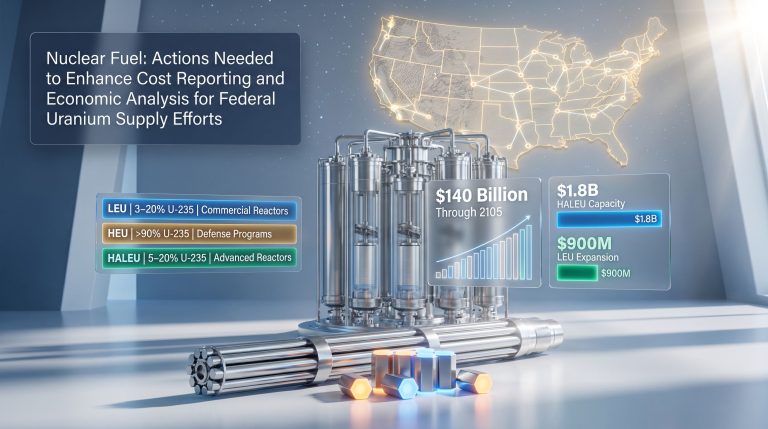
- Low-enriched uranium (LEU): Enriched to below 5% U-235 concentration, LEU fuels the existing fleet of commercial light-water reactors across the United States and allied nations.
- High-assay low-enriched uranium (HALEU): Enriched between 5% and 20% U-235, HALEU is the fuel of choice for most next-generation advanced reactor designs currently in development or licensing review. It offers higher energy density and enables more compact reactor configurations.
- Highly enriched uranium (HEU): Enriched above 20% U-235, HEU serves naval nuclear propulsion systems and supports isotope production and research reactor operations. Its production and handling are governed by the strictest nonproliferation frameworks.
A concept critical to understanding the national security dimension is the idea of unobligated uranium. Uranium used for national security applications cannot carry any foreign obligations, meaning it must have been produced, processed, and handled entirely within domestic supply chains free of international legal encumbrances. This requirement creates a separate, more restrictive supply category that standard commercial enrichment cannot satisfy.
Another essential metric throughout the report is the separative work unit (SWU), which measures the effort required to separate uranium isotopes during the enrichment process. SWU figures provide the standard benchmark for comparing enrichment facility output and determining whether new capacity is sufficient to meet projected demand.
What Current U.S. Inventories Actually Cover and Where They Fall Short
The GAO's assessment of existing enriched uranium stockpiles, drawn from the NNSA's 2023 Enriched Uranium Management Plan, presents a picture that is adequate in the near term but increasingly fragile as timelines extend toward mid-century.
| Fuel Category | Primary Application | Projected Supply Sufficiency |
|---|---|---|
| Unobligated LEU / downblended HEU | Tritium production via TVA reactors | Through early 2040s |
| Naval-grade HEU | Nuclear nuclear propulsion fleet | Through 2050s |
| Allocated HEU | Isotope production and research reactors | Through 2040 |
The tritium production pathway deserves particular attention. The NNSA is currently downblending excess HEU into LEU to fuel two Tennessee Valley Authority reactors responsible for tritium generation, a material essential to the U.S. nuclear weapons stockpile. That downblending programme is expected to conclude by 2027, after which existing unobligated LEU inventory is projected to sustain TVA reactor operations through the early 2040s.
What happens after that point depends entirely on new domestic production coming online in time. The GAO also flags that several demand-side variables could accelerate inventory drawdown beyond current projections. While some of these variables involve classified information, one publicly identified factor is the potential future demand for unobligated HALEU to fuel Department of Defense microreactors currently under development.
If DoD microreactor programmes advance at scale, they could represent an entirely new category of unobligated fuel consumption that existing planning assumptions do not fully account for.
The intersection of classified demand pressures and unclassified projections creates a planning environment where published inventory timelines may understate actual consumption risk, particularly as defence applications for advanced reactor technology expand.
The $140 Billion Commitment Congress Was Never Fully Briefed On
One of the most striking findings in the GAO report concerns fiscal transparency. The NNSA is pursuing three primary enrichment initiatives designed to satisfy long-term national security requirements, and their combined projected cost reaches approximately $140 billion through 2105. This figure spans more than eight decades of federal commitment to domestic enrichment infrastructure.
Despite the scale of this obligation, detailed cost breakdowns for these programmes have not been formally communicated to Congress. The GAO identifies this as a significant accountability gap in one of the longest-duration federal energy programmes ever undertaken. Without transparent cost reporting, congressional oversight bodies cannot meaningfully evaluate whether programme scope, pace, or technology choices remain appropriate as conditions evolve.
GAO Recommendation #1 directly addresses this deficiency, calling on the NNSA to establish formal mechanisms for reporting long-term enrichment programme costs to Congress on a structured basis.
Where Domestic Enrichment Infrastructure Stands Today
The Piketon Facility and the Foreign Parts Problem
The DOE-owned, Centrus Energy-operated American Centrifuge Plant in Piketon, Ohio represents the most visible node in domestic enrichment infrastructure, but it carries a critical limitation. The centrifuge equipment currently installed at Piketon incorporates foreign-manufactured components, which disqualifies its output from national security applications requiring unobligated uranium.
The NNSA's proposed solution involves contracting a commercial operator to deploy one or two entirely new centrifuge cascades at the facility using components that meet unobligated sourcing requirements. This would partially address unobligated LEU demand stretching beyond the early 2040s, but would not on its own satisfy the full scale of projected national security requirements.
BWX Technologies' Pilot Plant in Erwin, Tennessee
A parallel development is underway at a pilot facility being constructed by BWX Technologies in Erwin, Tennessee. This plant is designed to initially produce limited volumes of unobligated LEU using small centrifuge technology. Its longer-term pathway involves transitioning from LEU output to HEU production to support the naval nuclear propulsion mission, using LEU as input feedstock for subsequent enrichment stages.
The 1.5 Million SWU Imperative
Both facilities together must ultimately contribute to a combined national security enrichment target. According to GAO findings, new domestic LEU production infrastructure must be capable of generating approximately 1.5 million separative work units per year beginning in the 2050s to satisfy combined demand from tritium production and naval propulsion programmes.
The NNSA's broader national security enrichment requirement, incorporating all programmes, points toward a figure of approximately 1.7 million SWU per year by the 2050s. These figures underscore just how substantial the industrial buildout challenge actually is, particularly given that the U.S. has not maintained a commercial-scale unobligated enrichment capability since 2013.
The HALEU Production Reality: Milestone Deliveries vs. Commercial Scale
Perhaps no section of the GAO report generates more scrutiny than its treatment of HALEU production capacity. Centrus Energy has achieved a notable milestone by delivering approximately 900 kilograms of HALEU through its cascade operations at Piketon. This represents a meaningful technical demonstration, but the gap between demonstration-scale output and the volumes required to fuel a commercial advanced reactor fleet remains enormous.
The report notes that more than 15 advanced reactor designs are currently at various stages of licensing review with the Nuclear Regulatory Commission. However, the commercial viability of these designs is far from assured. Furthermore, industry participants have expressed substantial scepticism about high-end HALEU demand projections, noting that factors including regulatory approval timelines, construction financing, and actual deployment at commercial scale remain deeply uncertain for many of these concepts.
Projecting HALEU demand based on the number of reactor designs in licensing review conflates regulatory activity with commercial deployment, two milestones separated by years of capital formation, construction execution, and operational validation.
This uncertainty matters enormously for federal investment sizing. Consequently, if HALEU demand materialises at the high end of projections, current investment may prove insufficient. If advanced reactor deployment lags significantly, federal spending could become misaligned with actual market needs, particularly without an economic analysis to guide recalibration. The broader uranium market dynamics at play here underscore why accurate demand forecasting is so critical to programme design.
The next major ASX story will hit our subscribers first
The January 2026 Awards and the Strategy Pivot That Preceded Them
The DOE's approach to stimulating commercial enrichment capacity underwent a meaningful strategic shift between 2024 and 2025. The earlier incentivisation-focused model, designed to attract private capital into enrichment infrastructure, was replaced by a direct task order contracting approach after negotiations with prospective companies demonstrated that direct awards would maximise the volume of capacity actually constructed.
Under the revised framework, enrichment companies can enter supply agreements with end users, including utilities and reactor developers, establishing the commercial relationships necessary to support a self-sustaining domestic fuel market.
The financial commitment behind this strategy is substantial:
| Award Category | Amount | Purpose |
|---|---|---|
| LEU enrichment expansion | $900 million | Supporting the existing commercial reactor fleet |
| HALEU capacity construction | $1.8 billion (two companies) | Fuelling the advanced reactor development pipeline |
| Total committed | $2.7 billion | Combined LEU and HALEU domestic supply chain development |
These awards, announced in January 2026, represent the most significant federal financial commitment to domestic enrichment infrastructure in decades. Milestone-based task orders require recipient companies to demonstrate commercial-scale enrichment capability and satisfy specific licensing, construction, and technical benchmarks. Companies holding these orders are also expected to provide 1 metric ton of uranium to the DOE, which the agency intends to deploy through its HALEU Availability Programme to support early advanced reactor fuel needs.
Five Governance Gaps the GAO Identified
Despite the scale of federal investment, the GAO identified five significant programme management deficiencies that collectively expose a governance deficit running through both the NNSA and DOE fuel programmes.
Gap 1: No economic analysis to validate investment sizing. The DOE has committed $2.7 billion in enrichment funding without documenting any economic analysis to determine whether this level of investment is calibrated to actually stimulate a self-sustaining domestic market.
Gap 2: No written strategic plan. DOE policy establishes clear expectations for programme management documentation, including written plans that articulate a programme's concept, vision, mission, and expected benefits. No such comprehensive strategic plan exists for the commercial fuel support programme.
Gap 3: No integrated cost estimates or deployment schedule. Without consolidated cost baselines and implementation timelines, neither Congress nor external stakeholders can assess whether programmes are progressing as intended.
Gap 4: The Energy Act of 2020 HALEU report remains unfinished. The Energy Act of 2020 requires the DOE to deliver a report to Congress on HALEU activities, including cost and schedule estimates. The agency began drafting this document in 2021. As of July 2026, it had still not been finalised, representing more than five years of drafting without completion.
Gap 5: Absence of required programme management documentation. DOE's own internal policy standards require programmes of this magnitude to maintain formal management documentation. That documentation does not currently exist for the commercial fuel expansion effort.
The pattern across all five gaps is consistent: substantial federal capital has been deployed into nuclear fuel infrastructure without the foundational planning and accountability structures that the DOE's own policies require. This not only complicates congressional oversight but also introduces risk for private investors and reactor developers seeking confidence in the programme's direction.
Challenges That Could Derail Production Goals
The GAO identifies several categories of challenge that could prevent the U.S. from achieving its enriched uranium production targets:
- Domestic fuel cycle infrastructure constraints: Enrichment capacity is only one link in a complex chain. Conversion facilities, fuel fabrication plants, and transportation infrastructure must all scale in parallel. Bottlenecks anywhere in the chain limit the utility of enrichment capacity gains.
- Advanced reactor deployment uncertainty: HALEU market viability depends on advanced reactors actually reaching commercial operation. Licensing timelines, first-of-a-kind construction risks, and capital market conditions all create material uncertainty about when and whether sufficient demand will emerge.
- DoD microreactor demand as an emerging variable: Military microreactor programmes could generate a new unobligated HALEU demand stream not reflected in current planning assumptions, potentially competing with civilian advanced reactor fuel needs.
- Cascading effects of the Russia import ban: The Russian uranium import ban has removed a significant source of LEU supply from the commercial market, tightening availability and increasing pressure on domestic and allied enrichment capacity to fill the gap faster than originally anticipated.
In addition, the uranium supply-demand volatility introduced by these compounding pressures makes it increasingly difficult for programme planners to rely on static demand projections. Furthermore, those monitoring uranium market trends will recognise that the convergence of legislative, geopolitical, and technological factors creates a uniquely complex environment for domestic enrichment investment decisions.
GAO Recommendations at a Glance
The five recommendations delivered by the GAO form a coherent agenda for restoring programme accountability:
- NNSA must report long-term enrichment programme costs to Congress in a structured, transparent format.
- DOE must conduct and document an economic analysis to determine whether commercial fuel support actions are appropriately sized to stimulate a self-sustaining domestic market.
- DOE must develop a formal written strategic plan for its fuel expansion programmes, articulating goals, deliverables, and implementation pathways.
- DOE must produce integrated cost estimates and an implementation schedule for all fuel expansion efforts.
- DOE must finalise the long-overdue Energy Act of 2020 HALEU activity report and deliver it to Congress without further delay.
Frequently Asked Questions on the GAO Uranium Report
What is the GAO's role in reviewing nuclear fuel programmes?
The Government Accountability Office serves as the independent audit and investigative arm of Congress. It reviews federal programmes, evaluates whether agencies are achieving their stated objectives, and issues recommendations to improve accountability. Its nuclear fuel assessment draws on agency documents and interviews with government officials and industry representatives.
How is HALEU different from uranium used in today's reactors?
Conventional commercial reactors use LEU enriched to below 5% U-235. HALEU, enriched between 5% and 20%, offers higher fissile content, enabling smaller and more energy-dense reactor cores. Most advanced reactor designs, including microreactors and many Generation IV concepts, require HALEU rather than conventional LEU.
Why can't the U.S. simply import enriched uranium to meet its needs?
For national security applications, uranium must be unobligated, meaning it cannot involve foreign legal obligations. Importing enriched uranium inherently creates such obligations. Additionally, the Russia import ban has removed a major commercial supply source, and over-reliance on any single foreign enrichment provider creates geopolitical vulnerability.
What is the current status of domestic HALEU production?
Centrus Energy has delivered approximately 900 kilograms of HALEU from its Piketon cascade operations. While technically significant, this volume is far below what commercial advanced reactor deployment would require, and no fully scaled domestic HALEU production capability currently exists.
What happens if HALEU supply falls short of advanced reactor demand timelines?
A supply shortfall would delay reactor commissioning timelines, increase fuel costs, and potentially force reactor developers to seek international sources, reintroducing the foreign dependency risks that domestic enrichment investment is designed to eliminate.
What the Report Means for U.S. Nuclear Competitiveness
The GAO report on U.S. enriched uranium supply and HALEU production ultimately frames enrichment capacity as a national security asset rather than simply a commercial energy input. The structural shift underway, from inventory management to active industrial policy, reflects a recognition that allowing domestic enrichment capability to atrophy creates vulnerabilities that neither the defence establishment nor the commercial nuclear industry can afford.
For investors and reactor developers, the absence of an economic analysis, strategic plan, and integrated schedule introduces genuine uncertainty about programme durability and funding continuity. Those evaluating the broader uranium investment outlook will find the GAO's findings particularly relevant to assessing programme risk and long-term capital commitment. Congressional oversight, activated by the GAO's findings, may serve as the forcing function that compels the documentation and transparency necessary to give private capital sufficient confidence to commit alongside federal investment.
Whether the $2.7 billion already awarded translates into a genuinely self-sustaining domestic enrichment market will depend not only on the companies receiving those funds but on whether the governance frameworks recommended by the GAO are implemented with the urgency the timelines demand.
This article is intended for informational purposes only and does not constitute financial or investment advice. Projections, timelines, and cost figures referenced are drawn from government reports and are subject to revision as programmes evolve. Readers should conduct their own due diligence before making any investment decisions related to nuclear energy or uranium supply chain companies.
For ongoing coverage of nuclear fuel policy and enrichment infrastructure developments, the American Nuclear Society's Nuclear Newswire at ans.org/news provides regularly updated analysis and reporting across all segments of the nuclear fuel cycle.
Want to Stay Ahead of Major Mineral Discoveries Reshaping the Energy Sector?
As uranium enrichment policy and nuclear fuel supply chains command increasing investor attention, Discovery Alert's proprietary Discovery IQ model delivers real-time ASX mineral discovery alerts — instantly translating complex commodity data into actionable opportunities for both traders and long-term investors. Explore historic examples of significant mineral discoveries and their market returns, then begin your 14-day free trial to position yourself ahead of the broader market.