
August 25, 2026
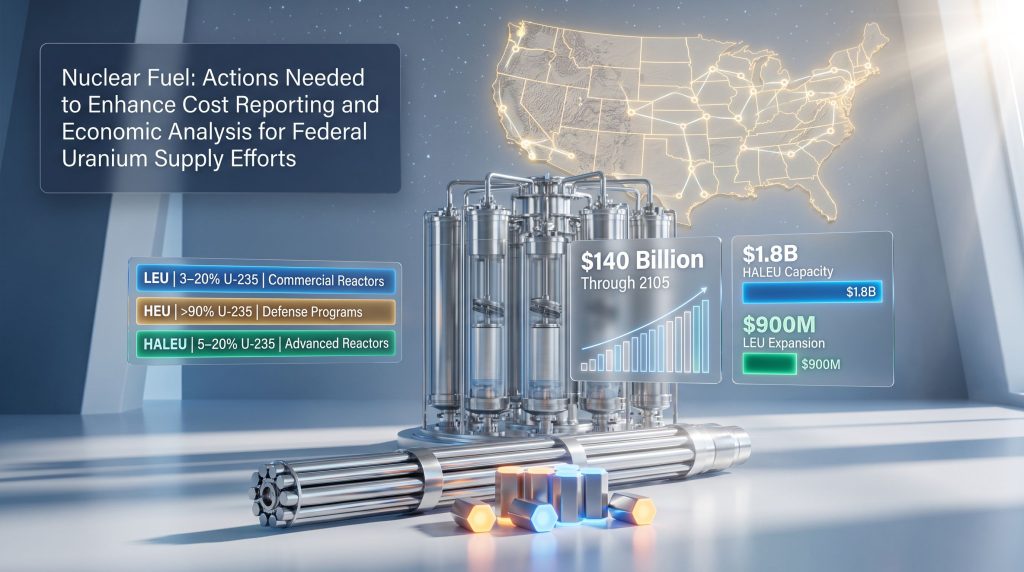
The Nuclear Fuel Cycle as a Strategic Infrastructure Problem
Few infrastructure challenges operate across timescales measured in decades, let alone centuries. Yet the planning frameworks underpinning America's enriched uranium supply do exactly that. The decisions being made today about enrichment capacity, inventory management, and fuel type availability will shape the operational viability of both defence programmes and commercial nuclear power well into the 2100s. This is not a conventional energy policy question. It is a multigenerational infrastructure commitment that intersects national security, industrial capacity, and fiscal governance in ways that few policy domains can match.
The GAO report on nuclear fuel supply efforts, formally titled Nuclear Fuel: Actions Needed to Enhance Cost Reporting and Economic Analysis for Federal Uranium Supply Efforts, brings a critical oversight lens to this challenge. Released in August 2026, the report scrutinises how federal agencies are managing enriched uranium inventories, planning for future enrichment capacity, and communicating the financial scale of these commitments to Congress. What it uncovers is a picture of genuine strategic ambition alongside meaningful gaps in fiscal transparency.
When big ASX news breaks, our subscribers know first
Why Enriched Uranium Has Moved to the Centre of Energy Security Debates
For most of the post-Cold War era, uranium supply was treated primarily as a commercial logistics question. Enrichment services were readily available from international providers, including Russia's state-owned Rosatom, which captured a substantial share of the global enrichment market through competitive pricing. Western utilities, focused on cost optimisation, found little economic incentive to prioritise domestic enrichment capacity.
That calculus has fundamentally changed. The geopolitical rupture triggered by Russia's actions in Ukraine accelerated a policy shift that was already underway. The Russian uranium import ban removed a supplier that had been providing a meaningful share of LEU to American commercial reactors. This single structural shift reframed uranium enrichment from a commodity procurement question into a national resilience problem.
Simultaneously, the domestic advanced reactor pipeline has created an entirely new category of fuel demand. A growing cohort of next-generation reactor designs requires high-assay low-enriched uranium (HALEU), a fuel type enriched to between 5% and 20% U-235 that sits in a category above standard commercial LEU but below the weapons-grade threshold of highly enriched uranium (HEU). HALEU production at commercial scale barely exists in the United States today, creating a potential bottleneck that could stall the deployment of advanced reactors regardless of how much capital flows into their development.
Understanding the Three Tiers of Enriched Uranium
To fully grasp the complexity mapped by the GAO report on nuclear fuel supply efforts, it helps to understand that enriched uranium is not a single material but a spectrum of products with distinct applications, supply chains, and security classifications. Furthermore, the nuclear fuel cycle overview illustrates just how interconnected each of these tiers is across the broader energy system.
| Uranium Type | Enrichment Level | Primary Application | Supply Status |
|---|---|---|---|
| Low-Enriched Uranium (LEU) | 3–20% U-235 | Commercial power reactors | Established but import-dependent |
| Highly Enriched Uranium (HEU) | Above 90% U-235 | Naval propulsion and defence | Inventoried through the 2040s |
| High-Assay LEU (HALEU) | 5–20% U-235 | Advanced and next-gen reactors | Critically uncertain near-term supply |
Each tier presents a different risk profile. HEU for naval and defence applications sits within existing NNSA inventory management systems and is projected to meet national security requirements into the 2040s. The challenge with HEU is not near-term availability but the extraordinary cost of sustaining production and processing infrastructure over the long run.
However, LEU for commercial reactors now faces structural supply chain disruption following the import ban, and HALEU is the most acute pressure point of all, with demand expected to materialise faster than domestic production capacity can realistically scale. Consequently, the uranium supply-demand volatility this creates has become one of the defining challenges for both policymakers and investors.
A key distinction that often goes unappreciated is the difference between stockpile adequacy and production capability. An agency can hold sufficient inventories today while simultaneously lacking the industrial infrastructure to produce replacements. This gap is not theoretical. It is exactly the kind of vulnerability that the GAO report's recommendations are designed to surface before it becomes a crisis.
The $140 Billion Commitment: NNSA's Long-Range Enrichment Planning
The fiscal scale of federal uranium enrichment planning is one of the most striking findings embedded in the GAO report on nuclear fuel supply efforts. NNSA's projections for its long-term enrichment programmes carry an estimated cumulative cost of approximately $140 billion through 2105. This figure should be understood not as a budget line but as a multigenerational commitment, spanning administrations, technology generations, and global geopolitical cycles that cannot be predicted with any confidence today.
NNSA has structured its approach around three parallel enrichment pathways, a form of strategic redundancy designed to avoid single points of failure. The American Centrifuge Plant represents the cornerstone of domestic enrichment infrastructure, though its operational status and long-term role continue to evolve within the broader federal planning framework.
The GAO's core criticism in this area is not that the programmes are misguided. Rather, the report identifies a specific governance failure: NNSA had generated updated long-term cost estimates but failed to incorporate these figures into the congressionally mandated biennial reporting cycle. This omission is more than a procedural oversight. When lawmakers cannot access current cost projections for programmes spanning decades, their ability to conduct meaningful budget oversight is fundamentally compromised.
DOE's Commercial Fuel Investment Architecture
While NNSA handles defence-facing enrichment programmes, the Department of Energy has taken a parallel track to shore up commercial nuclear fuel supply. In addition, the combined federal commitment to civilian fuel infrastructure represents a significant industrial policy intervention.
| Programme | Federal Commitment | Strategic Target |
|---|---|---|
| LEU Enrichment Expansion | $900 million | Domestic commercial supply restoration |
| HALEU Capacity Development | $1.8 billion | Advanced reactor fuel availability |
| Combined Total | $2.7 billion | Broad front-end fuel cycle security |
The HALEU capacity contracts were awarded on a dual-contractor basis, with Centrus Energy and BWXT selected as the primary vehicles for developing domestic production capability. This two-contractor architecture provides some redundancy, though the timeline for scaling meaningful HALEU output remains a subject of significant uncertainty.
It is worth clarifying what the front-end fuel cycle actually encompasses, since this term is frequently used without adequate explanation in policy discussions. The front-end refers to every stage of nuclear fuel production before the fuel enters a reactor core. This includes:
- Uranium mining and milling
- Conversion of uranium ore concentrate into uranium hexafluoride
- Enrichment to the required U-235 concentration
- Fuel fabrication into the specific pellet or assembly format required by the reactor design
Each of these stages requires distinct industrial infrastructure, skilled labour, and supply chain relationships. A gap at any point renders the entire downstream chain inoperative. The GAO's focus on enrichment reflects where the most significant capacity constraints currently reside, but policymakers and investors should understand that enrichment is one node in a longer chain.
The HALEU Timing Problem and Advanced Reactor Deployment Risk
Is the HALEU Supply Gap a Real Threat to Advanced Reactor Projects?
Perhaps the most commercially consequential finding embedded in the GAO report on nuclear fuel supply efforts concerns the mismatch between advanced reactor deployment timelines and HALEU production ramp-up schedules. This is not merely an abstract planning challenge. It has direct implications for the viability of first-of-kind advanced reactor projects.
Several next-generation reactor developers have designed their systems specifically around HALEU fuel. TerraPower's Natrium reactor and X-energy's Xe-100 pebble bed design are among the most prominent examples. Both programmes have received federal support and have published deployment timelines that assume HALEU will be available in meaningful quantities within the current decade.
If HALEU production capacity fails to scale in line with advanced reactor deployment schedules, early-stage reactor operators could encounter fuel availability bottlenecks that delay grid-connected operations by years. For first-of-kind projects already navigating regulatory timelines and capital cost pressures, a fuel supply delay could undermine the economic foundation of the entire project.
This is a risk that the investment community has been slow to price. Furthermore, understanding current uranium market dynamics makes it clear that capital has flowed into advanced reactor development companies on the assumption that fuel supply challenges are a solvable logistics problem. The GAO report suggests that the infrastructure reality is more constrained than this optimistic framing implies.
The next major ASX story will hit our subscribers first
What the GAO Found Wrong With Cost Reporting Practices
Beyond the specific programmes it examined, the GAO report on nuclear fuel supply efforts makes a broader argument about the quality of economic analysis underpinning federal uranium decisions. The specific findings centre on two related failures:
Failure 1: Incomplete biennial reporting. NNSA's congressionally mandated reporting obligations require regular disclosure of enriched uranium management plans and associated costs. The GAO found that updated cost estimates had not been reflected in the most recent biennial submissions, leaving Congress with outdated figures when evaluating multi-decade spending commitments.
Failure 2: Insufficient economic justification frameworks. Before committing significant federal funds to specific enrichment pathways or capacity contracts, the GAO argues that agencies should conduct rigorous comparative economic analysis. The report identifies cases where funding decisions preceded the development of adequate justification frameworks.
The GAO's formal recommendations flow directly from these findings:
- Integrate current long-term cost estimates into mandatory congressional reporting cycles without delay
- Develop structured economic justification frameworks before committing funds to major enrichment programmes
- Strengthen supply-demand modelling for both LEU and HALEU markets to support forward-looking decision-making
Importantly, these recommendations do not question the strategic rationale for the programmes themselves. The GAO is not arguing that the United States should not invest in domestic enrichment capacity. It is arguing that investment decisions of this scale require rigorous analytical foundations and transparent congressional disclosure.
The Geopolitical Dimension: Russia's Enrichment Market Position and Western Decoupling
No analysis of the GAO report on nuclear fuel supply efforts is complete without acknowledging the geopolitical context that makes this report so timely. Russia's Rosatom remains the world's largest provider of enrichment services by capacity, with a market position built over decades of competitive pricing and long-term supply agreements with utilities across Europe, Asia, and North America. Moreover, the uranium supply challenges that have emerged as a result of decoupling from Russia are now central to Western energy security planning.
| Supplier/Bloc | Enrichment Capacity | Strategic Posture |
|---|---|---|
| United States | Domestic and contracted capacity | Rebuilding self-sufficiency |
| European Union (Urenco) | Established commercial capacity | Diversifying away from Russia |
| Russia (Rosatom) | World's largest | Geopolitically constrained access |
| United Kingdom | Urenco partner | Aligned with Western supply strategy |
The U.S. ban on Russian LEU imports does not eliminate Russia's market presence globally, but it does force American utilities to source enrichment services from a narrower pool of Western providers. Urenco, the European enrichment consortium with operations in the U.S., UK, Netherlands, and Germany, is the primary alternative, but its available capacity for additional American contracts is not unlimited.
A less commonly appreciated dimension of this dynamic is the conversion stage that precedes enrichment. Uranium hexafluoride conversion capacity in the Western world is relatively concentrated, with a small number of facilities handling most of the throughput. Any disruption to conversion capacity would cascade into enrichment and ultimately fuel fabrication, regardless of how much investment flows into enrichment specifically. This systemic interdependency is one reason why the GAO's broader call for stronger supply-demand modelling is so important.
Frequently Asked Questions: GAO Report on Nuclear Fuel Supply Efforts
What is the main purpose of the GAO nuclear fuel report?
The report evaluates how NNSA and DOE are managing enriched uranium supply for both defence and commercial purposes, identifies gaps in cost reporting and economic analysis, and recommends specific improvements to congressional oversight mechanisms.
How much has the federal government committed to uranium enrichment programmes?
Federal commitments include approximately $900 million for LEU enrichment expansion, $1.8 billion for HALEU capacity contracts, and an NNSA enrichment programme with costs projected at approximately $140 billion through 2105.
What is HALEU and why is its supply considered uncertain?
HALEU is uranium enriched to between 5% and 20% U-235, required by most advanced reactor designs. Domestic production capacity is extremely limited, with only small-scale demonstration production currently operational in the United States.
What is the difference between LEU and HEU in a defence context?
LEU powers commercial reactors at enrichment levels below 20%, while HEU enriched above 90% powers naval propulsion systems and supports other defence applications. They require entirely separate production and custody frameworks.
Does the GAO have authority to force DOE or NNSA to change their practices?
The GAO operates as an advisory body to Congress and cannot compel agency action. However, its recommendations carry significant weight because they inform congressional appropriations decisions and create accountability pressure on agencies to respond formally.
Nuclear Fuel as a 100-Year Infrastructure Commitment
The deepest insight offered by the GAO report on nuclear fuel supply efforts is one that extends well beyond its specific findings and recommendations. Nuclear fuel infrastructure is not a policy lever that can be adjusted on election cycles or budget timelines. The decisions made today about enrichment capacity, fuel type development, and inventory management will constrain or enable energy and defence options for generations.
This temporal reality demands a quality of long-range economic analysis and transparent congressional reporting that the GAO found to be currently lacking. The stakes of this gap are not abstract. Insufficient HALEU production capacity could delay the commercial deployment of advanced reactors that represent the United States' best option for low-carbon baseload power at scale. In addition, staying abreast of evolving uranium market trends will be essential for investors and policymakers navigating these challenges.
Key Takeaways: What the GAO Report Tells Us About U.S. Nuclear Fuel Readiness
- Defence inventories of LEU and HEU are projected to meet national security requirements into the 2040s, but sustaining and replacing these inventories carries an estimated cost of approximately $140 billion through 2105
- Combined federal commercial fuel investment totals at least $2.7 billion, spanning $900 million for LEU enrichment expansion and $1.8 billion in HALEU capacity contracts
- HALEU supply risk is the most acute near-term vulnerability, with advanced reactor deployment timelines potentially outpacing production ramp-up by several years
- The Russian LEU import ban has introduced structural tightness into Western commercial enrichment markets previously supported by Rosatom's competitive pricing
- The GAO's central critique targets the transparency and rigour of cost reporting, not the strategic direction of the programmes, indicating a governance gap rather than a fundamental policy failure
- Front-end fuel cycle security requires attention across multiple interdependent stages, including conversion and fabrication, not just enrichment alone
- Congressional oversight of multigenerational nuclear fuel commitments requires materially stronger economic modelling frameworks to be meaningful or effective
Disclaimer: This article contains forward-looking analysis and scenario projections based on publicly available government reports and industry data. Projections regarding programme costs, fuel availability timelines, and advanced reactor deployment schedules involve inherent uncertainty and should not be construed as guarantees of future outcomes. Readers should consult primary source documentation, including the GAO report itself, for authoritative findings.
For ongoing coverage of federal nuclear fuel policy and advanced reactor developments, the American Nuclear Society's Nuclear Newswire at ans.org/news provides detailed tracking of enrichment programmes, fuel cycle developments, and regulatory proceedings across the nuclear sector.
Want to Stay Ahead of the Next Major Uranium Discovery on the ASX?
Discovery Alert's proprietary Discovery IQ model delivers real-time alerts on significant ASX uranium and mineral discoveries, transforming complex market data into actionable insights for investors at every level — explore historic discoveries and their returns, then begin your 14-day free trial to position yourself ahead of the market.