
June 23, 2026
The Hidden Cost Centre That Mining Boardrooms Can No Longer Ignore
Every decade or so, the mining industry confronts a structural reckoning. Capital investment cycles run long, commodity prices swing unpredictably, and the physical infrastructure holding it all together quietly ages beyond its original design parameters. What rarely makes headlines, but consistently erodes margins, is the widening gap between what mine site assets were built to deliver and what they are actually capable of producing today.
This is not a peripheral concern. It sits at the operational heart of every producing mine on earth, and it is precisely why enterprise asset management in mining has evolved from a back-office maintenance function into a boardroom-level strategic priority.
When big ASX news breaks, our subscribers know first
Understanding Enterprise Asset Management in Mining: Scope, Depth, and Strategic Function
Most mining professionals are familiar with a Computerised Maintenance Management System, or CMMS. These platforms schedule work orders, log service histories, and track spare parts inventory. They are functional tools, but they operate at a tactical level.
Enterprise asset management operates at an entirely different altitude. Where a CMMS addresses the mechanics of individual maintenance tasks, EAM governs the complete lifecycle of every physical and digital asset on site — from procurement and commissioning through to end-of-life decommissioning. It connects maintenance workflows to production scheduling, procurement pipelines, financial reporting, and regulatory compliance in a single integrated operational framework.
The distinction matters enormously in a mining context, where asset complexity is unlike almost any other industrial environment:
- Geographically dispersed assets spanning hundreds of square kilometres, often in remote or environmentally hostile locations
- Infrastructure designed for operational lifespans measured in decades, not years
- High-criticality fixed plant where a single unplanned failure can halt entire processing circuits
- Regulatory obligations that require documented asset condition records and proactive risk mitigation
Industry Reality: A significant proportion of mine site infrastructure globally has been operational for multiple decades. In many cases, production priorities historically took precedence over disciplined asset management, leaving today's operators to manage a growing mismatch between output expectations and underlying asset capability.
The Three Forces Compressing Mining Asset Management Timelines
The urgency surrounding enterprise asset management in mining today is not the product of a single trend. It reflects the simultaneous convergence of three compounding pressures that individually would be manageable, but together create a structural challenge.
1. Aging capital infrastructure. Mining assets commissioned during previous commodity booms are now operating well beyond their original design horizons. Replacement costs are substantial, making the financial case for extending asset life through intelligent management compelling, provided it can be done safely and reliably.
2. Tightening commodity margins. With cost structures under sustained pressure, operational efficiency has become a primary competitive lever. Unplanned equipment failures in mining can generate downtime losses measured in thousands of dollars per hour depending on commodity type and operation scale, making reliability a direct financial variable.
3. Escalating regulatory and ESG obligations. Occupational health and safety frameworks increasingly require documented evidence of proactive asset condition monitoring. Environmental compliance, particularly around tailings infrastructure and water treatment systems, demands real-time visibility into equipment performance. Furthermore, mining sustainability transformation is now a core expectation from both regulators and investors alike.
From Break-Fix to Prescriptive: The Maintenance Maturity Spectrum
One of the most practically useful frameworks for understanding enterprise asset management in mining is the maintenance maturity spectrum. Where an operation sits on this spectrum largely determines its cost structure, safety performance, and production reliability.
| Maintenance Model | Core Mechanism | Typical Outcome |
|---|---|---|
| Reactive (Break-Fix) | Repair after failure | High unplanned downtime, elevated safety risk |
| Preventive (Time-Based) | Fixed interval servicing | Reduced failures but risk of over-maintenance |
| Condition-Based | Real-time asset health data triggers intervention | Optimised service intervals, reduced waste |
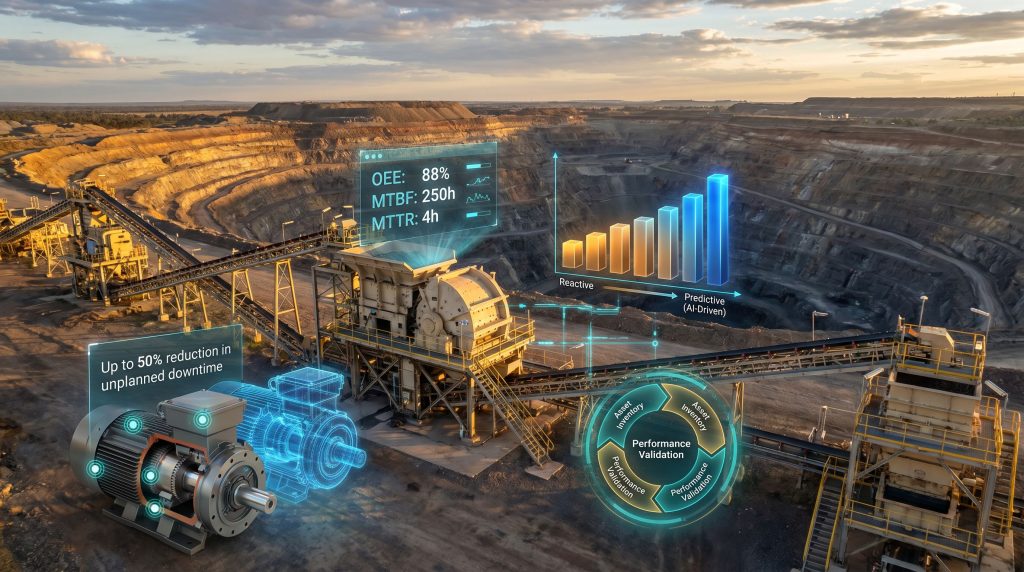
| Predictive (AI-Driven) | Machine learning forecasts degradation trajectories | Up to 50% reduction in unplanned downtime |
| Prescriptive | System recommends specific corrective actions pre-failure | Maximum asset availability and cost efficiency |
The progression from reactive to prescriptive maintenance is not merely a technology upgrade. It represents a fundamental cultural and operational shift in how mining organisations understand the relationship between maintenance and production value. In addition, predictive maintenance in mining has proven to be one of the most impactful levers for reducing unplanned downtime across complex operations.
The Technology Stack Enabling This Transition
Modern EAM platforms draw on a converging set of technologies that, together, create unprecedented visibility into asset health:
- IoT sensor networks continuously monitor vibration signatures, thermal profiles, pressure fluctuations, and electrical load data across critical equipment
- AI and machine learning models identify degradation patterns in historical and real-time datasets, projecting remaining useful life (RUL) for high-criticality assets
- Integrated condition monitoring systems such as ABB Ability Genix APM Predict detect early-stage deterioration across drives, protection systems, and electrical infrastructure
- ERP-integrated EAM platforms such as SAP EAM synchronise maintenance workflows with procurement, finance, and production scheduling
- Digital twin technology creates virtual asset replicas that enable operators to simulate maintenance scenarios before committing to physical interventions
Practitioner Insight: According to Cecil Maartens, Account Manager for the MMM Segment at Schneider Electric SSA, intelligent monitoring and digitalisation technologies can frequently be retrofitted onto existing infrastructure, allowing operators to optimise and safely extend the life of current assets while deferring large-scale capital expenditure programs. This CapEx-to-OpEx conversion is one of the most financially significant advantages of a retrofit-first EAM strategy. (Source: African Mining Market, June 2026)
Asset Sweating: What It Actually Means and Why It Requires Data
The term sweating assets is used loosely across the industry, but its operational meaning is precise. It refers to the disciplined extraction of maximum productive value from existing assets without compromising safety margins, regulatory compliance, or long-term reliability. It is emphatically not the same as simply running equipment until it breaks.
Genuine asset sweating requires a clearly defined operational roadmap underpinned by data, not assumption. Modern EAM platforms make this possible by identifying degradation trends in critical systems including variable speed drives, protection relays, switchgear, and high-voltage electrical infrastructure, enabling operators to assess whether a given asset can continue delivering safe, reliable performance for several more years or whether replacement planning should begin immediately.
The Six-Step Lifecycle Management Process in Practice
-
Asset inventory and criticality classification — Centralised cataloguing of all machinery, instrumentation, vehicles, and digital systems with criticality ratings assigned to prioritise EAM investment toward highest-impact assets
-
Baseline condition assessment — Establish current health benchmarks using diagnostic tools and comprehensive historical maintenance records
-
Degradation trend modelling — Apply predictive analytics to project remaining useful life for each asset class, with particular focus on high-criticality fixed plant and electrical infrastructure
-
End-of-life threshold definition — Determine both operational and commercial end-of-life parameters, distinguishing between when an asset ceases to perform adequately and when it ceases to be financially viable to maintain
-
Data-driven intervention planning — Schedule maintenance, refurbishment, or replacement decisions based on projected end-of-life data rather than calendar-based assumptions that frequently result in either premature replacement or dangerous over-extension
-
Post-intervention performance validation — Monitor restored asset health following each intervention and use the data to recalibrate predictive models, continuously improving forecast accuracy
Key Performance Metrics That Define Asset Management Maturity
| KPI | Definition | Strategic Relevance |
|---|---|---|
| Overall Equipment Effectiveness (OEE) | Availability × Performance × Quality | Composite measure of productive asset utilisation |
| Mean Time Between Failures (MTBF) | Average operational time between unplanned failures | Indicates reliability and maintenance program effectiveness |
| Mean Time to Repair (MTTR) | Average duration to restore failed equipment | Measures maintenance response efficiency |
| Total Cost of Ownership (TCO) | Full lifetime cost from acquisition to disposal | Informs replace vs. retain decisions with financial rigour |
| Asset Utilisation Rate | Percentage of time an asset is actively productive | Identifies underperforming or over-committed equipment |
The next major ASX story will hit our subscribers first
EAM as the Integration Layer for Digital Transformation
One dimension of enterprise asset management in mining that is frequently underestimated is its role as the connective tissue between previously siloed operational systems. An integrated EAM platform does not merely manage maintenance schedules — it connects energy management systems, production planning tools, safety compliance workflows, and operational technology data into a unified ecosystem.
This has profound implications for broader Industry 4.0 adoption. Consequently, as data-driven mining operations become the operational standard, EAM provides the data infrastructure that enables these technologies to function cohesively rather than in isolation.
The interoperability challenge between operational technology (OT) and information technology (IT) environments is a persistent obstacle in mining digitalisation. Well-architected EAM frameworks address this directly by establishing governed data flows that ensure asset performance data is accessible across the enterprise without creating security vulnerabilities or data integrity risks.
Environmental Compliance and ESG Through Asset Intelligence
The connection between enterprise asset management and ESG performance is more direct than many mining executives recognise. Equipment failures in critical environmental systems — including tailings storage facilities, water treatment infrastructure, and mine ventilation — represent some of the highest-consequence risk scenarios in the industry. Real-time condition monitoring substantially reduces the probability of these failure events.
Beyond risk mitigation, EAM platforms generate the operational data that increasingly underpins ESG reporting obligations. Energy consumption monitoring supports Scope 1 and Scope 2 emissions tracking. Asset lifecycle extension reduces the raw material and embodied energy demands associated with premature equipment replacement. Documented condition records provide auditable evidence for regulatory compliance submissions.
Strategic Perspective: A well-executed EAM program does not merely maintain assets. It directly extends the productive life of a mine by sustaining reliable throughput, reducing costly production interruptions, and enabling operators to defer or optimise major capital reinvestment cycles — each of which strengthens the financial and sustainability case for mine life extensions.
Building a Practical EAM Roadmap: Six Pillars, No Shortcuts
Translating EAM strategy into operational reality requires a structured implementation framework. The following pillars reflect best practice across mining operation types and scales.
1. Operational reality assessment before technology selection
Understanding site-specific bottlenecks, production priorities, and long-term strategic goals must precede any platform selection decision. Technology-first approaches that ignore workforce capability, data infrastructure maturity, and operational context consistently underdeliver.
2. Comprehensive asset base audit
Every asset — from heavy mobile equipment and fixed processing plant to instrumentation, control systems, and digital infrastructure — must be inventoried and classified. Criticality ratings should be assigned to direct EAM investment toward assets where failure has the greatest production and safety impact.
3. Current-state maintenance practice evaluation
Audit existing workflows, identify systemic risks, analyse historical failure data, and assess current data utilisation maturity. The gap between where an operation is and where it needs to be is the baseline from which roadmap priorities are set.
4. Phased implementation aligned to business strategy
Phase 1 should target highest-criticality assets. Coverage expands progressively as capability and confidence develop. Furthermore, mining automation trends increasingly influence EAM platform selection, and technology investment timelines should align with capital planning cycles to avoid budget conflicts that derail implementation momentum.
5. Site-specific customisation over generic templates
No two mining operations share identical asset profiles, production pressures, or regulatory environments. An EAM roadmap built on generic templates will systematically miss the site-specific conditions that determine whether the strategy succeeds or stalls.
6. Continuous performance measurement and iteration
KPI baselines established at implementation enable ongoing performance review. Operational data refines predictive models, updates maintenance strategies, and builds the ROI evidence that sustains leadership commitment to the program over time.
Common Implementation Failures to Avoid
- Change management underestimation: Technology without cultural alignment and workforce training fails at the adoption stage regardless of platform quality
- Data quality neglect: Predictive models are only as reliable as the data feeding them — poor sensor calibration or incomplete maintenance records directly undermine forecast accuracy
- Siloed deployment: Implementing EAM within maintenance alone, disconnected from production, finance, and safety systems, limits its strategic value to tactical scheduling
- Over-engineering early phases: Starting with excessive complexity before foundational data infrastructure is in place creates implementation risk and erodes stakeholder confidence
The Competitive Divide Is Already Forming
As commodity markets tighten further and investor scrutiny of operational efficiency intensifies, the performance gap between mines with mature enterprise asset management capabilities and those still relying on predominantly reactive maintenance practices will widen materially.
Operations with integrated asset intelligence frameworks demonstrate measurably superior cost structures, lower operational risk profiles, stronger ESG credentials, and more defensible production guidance — all of which influence financing access, insurance premiums, and investor confidence. Moreover, AI-powered mining efficiency tools are accelerating this competitive divide by enabling faster, more accurate asset decision-making.
| EAM Capability | Operational Benefit | Strategic Outcome |
|---|---|---|
| Predictive maintenance | Up to 50% reduction in unplanned downtime | Higher production availability |
| Lifecycle management | Optimised asset replacement timing | Reduced CapEx pressure |
| Condition monitoring | Early failure detection | Improved safety outcomes |
| Integrated data ecosystem | Cross-functional operational visibility | Stronger decision-making |
| ESG performance tracking | Documented compliance evidence | Enhanced investor confidence |
| Retrofit-first approach | CapEx-to-OpEx conversion | Preserved capital flexibility |
The mines investing in intelligent asset management frameworks today are building the operational resilience to sustain production through the next commodity cycle downturn. Those that continue deferring this investment are not saving capital. They are accumulating a liability that compounds with every year of deferred action.
Disclaimer: This article is intended for informational purposes only and does not constitute financial, investment, or operational advice. Projections regarding downtime reduction and cost savings reflect industry estimates and publicly available data. Actual outcomes will vary based on site-specific conditions, technology selection, and implementation quality.
Want to Identify ASX Mining Companies With Strong Operational Foundations Before the Market Does?
Discovery Alert's proprietary Discovery IQ model delivers real-time alerts on significant ASX mineral discoveries, instantly empowering subscribers to identify actionable opportunities in the mining sector ahead of the broader market — explore the historic returns major discoveries have generated and begin your 14-day free trial to position yourself at the forefront of the next major find.