June 23, 2026
The Hidden Cost of Doing Nothing: Why Western Australia's Resource Economy Faces a Structural Inflection Point
Imagine an economy that generates extraordinary wealth from the ground beneath its feet, yet remains structurally exposed to a single commodity cycle. That is not a hypothetical scenario reserved for developing nations with limited institutional capacity. It describes, with uncomfortable precision, the current position of one of the world's most sophisticated resource economies. Western Australia's geological endowment is genuinely world-class, but the economic architecture built around it is showing signs of age in a world that is rapidly rewiring its industrial base around Western Australia mining reform.
The global energy transition is not merely a policy narrative. It is reshaping which minerals matter, which countries lead, and which economic models survive the shift. For Western Australia, the transition represents both the greatest risk and the most significant commercial opportunity in a generation. How the state responds to that duality will determine whether its resource wealth translates into durable prosperity or a cautionary tale about complacency.
When big ASX news breaks, our subscribers know first
A $200-Billion Economy with a Single Point of Failure
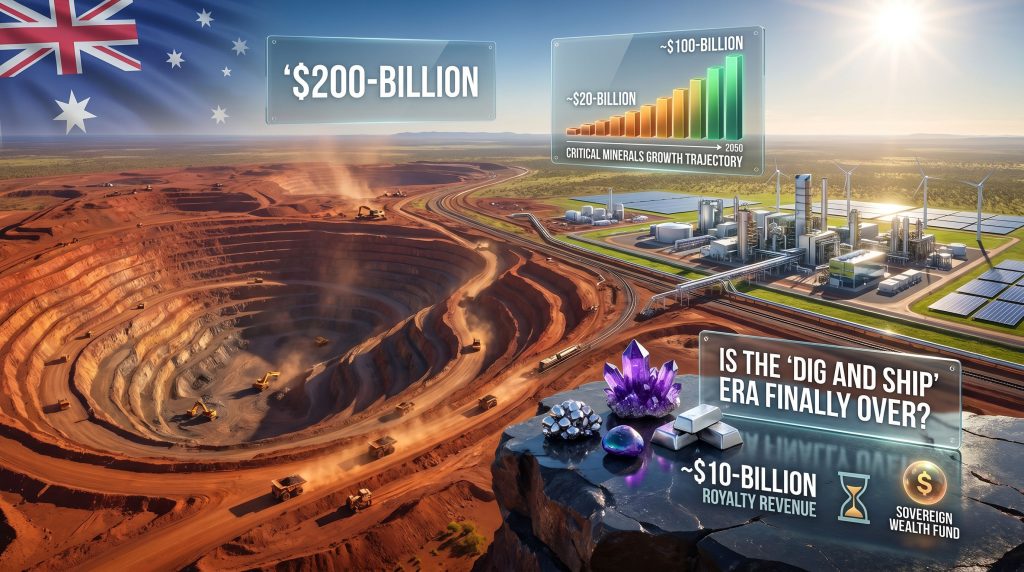
Western Australia's WA resources sector impact contributes approximately $200-billion annually to national economic output, underpinning employment, government revenues, and export earnings at a scale few comparable regions can match. On the surface, these figures project strength and stability.
Dig deeper, however, and a more fragile picture emerges. Iron ore alone accounts for more than 80% of Western Australia's royalty revenue and generates approximately $126-billion in annual economic output. That degree of concentration in a single commodity is not a sign of comparative advantage being well-managed. It is a structural vulnerability dressed in the language of success.
The Bankwest Curtin Economics Centre's Western Australia's Resources Sector in Transition report frames this clearly: the conditions that delivered decades of prosperity are shifting at an accelerating pace. Three converging pressures are driving that shift simultaneously.
The three forces reshaping Western Australia's resource landscape:
- Decarbonisation is reducing global appetite for fossil fuel-intensive supply chains, directly affecting the long-term trajectory of iron ore and LNG demand
- Technological disruption is altering which commodities global industries need and, critically, in what processed form they need them
- International competition is intensifying, with resource-rich nations from Canada to Indonesia investing heavily in domestic processing and value-added manufacturing to capture a greater share of battery supply chain economics
The report's modelling paints a stark directional picture. Under an accelerated transition scenario, fossil fuel exports decline from roughly $39-billion in 2025 to approximately $11-billion by 2050, a compression of more than 70% within a single generation. That is not a gradual drift. It is a structural reorientation that demands policy responses measured in years, not decades.
The Critical Minerals Opportunity: From $20-Billion to $100-Billion
The same transition that threatens Western Australia's iron ore revenue concentration simultaneously opens a significant new frontier. The state's geological endowment extends well beyond iron ore into a suite of minerals that sit at the heart of the clean energy economy.
Western Australia is already a globally significant producer of lithium, nickel, cobalt, rare earth elements, and mineral sands, all of which are critical inputs for battery manufacturing, electric vehicles, and grid-scale energy storage infrastructure. Furthermore, the role of critical minerals in energy transition strategies globally means the question is not whether demand for these materials will grow. The question is whether Western Australia captures the processing margin, or simply supplies the raw feedstock for other countries to convert into higher-value products.
Economic modelling from the Bankwest Curtin Economics Centre projects that critical minerals, processing, and other value-added industries could generate more than $100-billion per year by 2050, representing a fivefold increase from approximately $20-billion today. That trajectory is achievable, but it is not automatic.
As Dr Silvia Salazar of the Bankwest Curtin Economics Centre has noted, Western Australia holds the minerals, expertise, and global reputation needed to lead the industries emerging from the energy transition, but that leadership position must be actively secured through the right energy, infrastructure, skills, and investment settings. Success is not a given.
The distinction between supplying raw ore and supplying processed battery-grade material is not trivial. It represents the difference between capturing commodity pricing and capturing industrial value. Countries that invest in midstream and downstream processing infrastructure retain the margin that otherwise flows offshore. Western Australia's "dig and ship" heritage has served it well in volume terms, but volume without value is a diminishing proposition in a world that increasingly prices materials by their purity and processability.
Fiscal Architecture: The Billions Hiding in Policy Design
Mining and petroleum royalties contributed approximately $10-billion to the Western Australian government in the most recent fiscal year, representing roughly one-fifth of total state revenue. Consequently, the WA economic contribution from these royalties raises a more uncomfortable question about intergenerational equity.
Finite resources generate one-time wealth. Without deliberate reinvestment mechanisms, today's royalty revenues do not automatically translate into tomorrow's industries, employment, or fiscal capacity. Professor Alan Duncan of the Bankwest Curtin Economics Centre has made this point directly: when a jurisdiction earns nearly $10-billion annually from resources that are physically exhaustible, the central policy question is what is being left behind for future generations.
The Bankwest report examines this question through several fiscal lenses, modelling alternative royalty structures, resource taxation arrangements, and hypothetical public equity participation in major developments.
Comparison of sovereign wealth approaches among resource-dependent economies:
| Economy | Primary Resource Revenue Share | Future Fund Mechanism |
|---|---|---|
| Western Australia | ~20% of state revenue | Limited current model |
| Norway | ~15-20% of government revenue | Government Pension Fund Global (~$1.7 trillion) |
| Alberta, Canada | ~20-25% of provincial revenue | Heritage Savings Trust Fund |
| Abu Dhabi | ~50%+ of government revenue | Abu Dhabi Investment Authority |
Note: Figures are approximate and provided for comparative context only.
The Norwegian model is instructive. Norway's Government Pension Fund Global, built on petroleum revenues, now holds assets exceeding $1.7 trillion, providing a structural buffer that insulates the Norwegian economy from commodity cycles while generating returns that fund public services indefinitely. Western Australia's current fiscal architecture captures revenue but lacks an equivalent compounding mechanism.
The Bankwest modelling illustrates how consequential policy design can be. A hypothetical 30% public equity stake in a new $50-billion LNG development, with returns invested through a future fund model, could generate a revenue stream extending well beyond the productive life of the underlying resource. Separately, the potential approval of the Browse LNG project could generate tens of billions of dollars in combined state and Commonwealth revenues between now and 2050, with the final quantum highly sensitive to which royalty and taxation framework is applied. In addition, establishing a critical minerals strategic reserve could further bolster long-term fiscal resilience.
Professor Alan Duncan has articulated the core challenge concisely: the difference between one fiscal arrangement and another can amount to billions of dollars over the life of a project, making policy design one of the highest-leverage decisions available to government.
Regulatory Modernisation: Reform With Real-World Costs
Western Australia mining reform is not occurring in a vacuum. The regulatory landscape is simultaneously being restructured at both state and federal levels, creating genuine uncertainty for investors navigating approval timelines.
How Has the Regulatory Structure Changed?
The WA resources department restructuring in March 2025 replaced the former DEMIRS structure with the new Department of Mines, Petroleum and Exploration (DMPE), creating a more focused mandate around exploration facilitation and compliance oversight. Concurrently, the Environmental Protection Authority (EPA) is transitioning from prescriptive, plan-based assessment frameworks toward an outcomes-based model.
How the two assessment models compare:
| Dimension | Previous Approach | Outcomes-Based Model |
|---|---|---|
| Primary focus | Mitigation planning | Demonstrable environmental results |
| Proponent obligation | Submit documentation | Prove tangible outcomes |
| Regulatory flexibility | Lower | Higher, with greater accountability |
| Investor certainty | Moderate | Currently elevated uncertainty |
Layered on top of this state-level transition is the federal Nature Positive Plan, which introduces National Environmental Standards and two new federal bodies: Environment Protection Australia and Environment Information Australia. The interaction between state EPA reforms and federal requirements is currently generating material approval timeline uncertainty, a factor that weighs most heavily on junior explorers and project developers managing constrained capital timelines.
What Do the Latest Legislative Changes Mean?
On the legislative front, the Mining Amendment Bill 2024 lapsed due to parliamentary prorogation without passing. A subsequent Mining Amendment Bill 2025 was introduced in June 2025 carrying forward efficiency reforms including streamlined exploration licence applications, simplified Section 58 and Section 19 frameworks, and clearer native title negotiation timelines.
The native title dimension deserves particular attention. Mining leases active for more than 40 years currently cannot be renewed without a formal agreement with relevant Indigenous groups. Proposed amendments would extend available timeframes and provide secondary renewal options before lease expiration. The policy intent is to reduce investment uncertainty while preserving the integrity of Indigenous consultation processes, but the balance between those objectives requires genuine multi-stakeholder engagement rather than expedited legislative change.
Enabling Conditions: Infrastructure, Skills, and Innovation
Economic modelling can project a $100-billion critical minerals future, but projections do not build processing facilities, train metallurgists, or develop the energy infrastructure needed to power energy-intensive refining operations at globally competitive cost. The enabling conditions for Western Australia's transition are as important as the policy architecture surrounding them.
The three infrastructure pillars underpinning value-chain advancement:
- Energy infrastructure capable of supplying cost-competitive power to processing operations, given that refining and manufacturing are significantly more energy-intensive than raw extraction
- Transport and logistics networks connecting geographically dispersed inland deposits to processing hubs and export terminals
- Digital and data infrastructure supporting productivity gains, operational efficiency, and the integration of automation across exploration and production
The workforce dimension is equally consequential. A transition from volume-based extraction to value-added processing requires a fundamentally different skills profile, encompassing engineering and metallurgical expertise, data science capabilities, and cross-disciplinary knowledge linking resources, energy, and manufacturing sectors. Building that workforce takes time, which is precisely why the transition window being open today matters.
Innovation and productivity also carry competitive weight. Western Australia will not outcompete lower-cost processing jurisdictions purely on labour economics. Its competitive advantage must be built on technology adoption, research and development investment in minerals processing, and industry-academia collaboration to convert productivity improvements into commercial outcomes.
The next major ASX story will hit our subscribers first
The Intergenerational Imperative
The case for Western Australia mining reform ultimately rests on a simple but profound observation. Finite resources, once extracted, are gone. The wealth they generate is not inherently self-perpetuating. Without deliberate structural choices about how that wealth is captured, invested, and diversified, there is no automatic mechanism that converts today's royalty revenues into the industries, skills, and fiscal capacity that future generations will need.
The comparison with Norway is not just instructive. It is a mirror that Western Australian policymakers should hold up honestly. The difference in long-term outcomes between jurisdictions that built sovereign wealth mechanisms and those that did not is now measurable in trillions of dollars.
The defining variable for the next 25 years is not the quantity of minerals in the ground. Western Australia's geological endowment is established and internationally recognised. The defining variable is the quality of the decisions made in the next five to ten years regarding policy design, infrastructure investment, regulatory architecture, and fiscal settings.
Those decisions compound over time. Made well, they transform a mining economy into a diversified industrial powerhouse. Made poorly, or deferred indefinitely, they leave future generations inheriting a smaller pie from a depleted ground.
The Bankwest Curtin Economics Centre's central argument is both an economic analysis and a governance challenge: every tonne extracted should contribute to building a stronger long-term future, not merely servicing the fiscal needs of the present.
Disclaimer: This article contains economic projections and modelling scenarios sourced from the Bankwest Curtin Economics Centre's published research. All forward-looking figures represent modelled scenarios under specific assumptions and should not be interpreted as guaranteed outcomes. Readers should conduct independent research before making investment or policy decisions based on the information presented here.
Want to Know Which ASX Resource Companies Are Making Significant Mineral Discoveries Right Now?
As Western Australia's resource economy undergoes structural reform and critical minerals demand accelerates, Discovery Alert's proprietary Discovery IQ model instantly identifies significant ASX mineral discoveries across more than 30 commodities, delivering real-time alerts that turn complex geological data into actionable investment insights — explore Discovery Alert's discoveries page to understand the historic returns major mineral discoveries have generated, and begin your 14-day free trial to position yourself ahead of the broader market.