June 23, 2026
The Structural Scarcity of Primary Silver and Why It Commands a Premium
Most investors thinking about silver picture coins, jewellery, or exchange-traded funds. Far fewer pause to consider where the metal actually originates in the ground, and why the answer to that question has profound implications for how silver assets are valued on public markets.
The overwhelming majority of the world's silver, roughly 74% of global mined supply in 2025, does not come from mines built specifically to extract silver. It arrives as a residual output of copper, lead, and zinc operations, where silver's economics are entirely subordinate to base metal price cycles. The mine runs when copper or zinc is profitable; silver follows along for the ride.
This structural reality means that genuinely large, standalone primary silver deposits, assets where silver is the dominant economic driver, are among the rarest and most strategically concentrated resources in the global mining landscape. Understanding silver's dual role as both a precious metal and an industrial input is essential context for evaluating any primary silver asset on its merits.
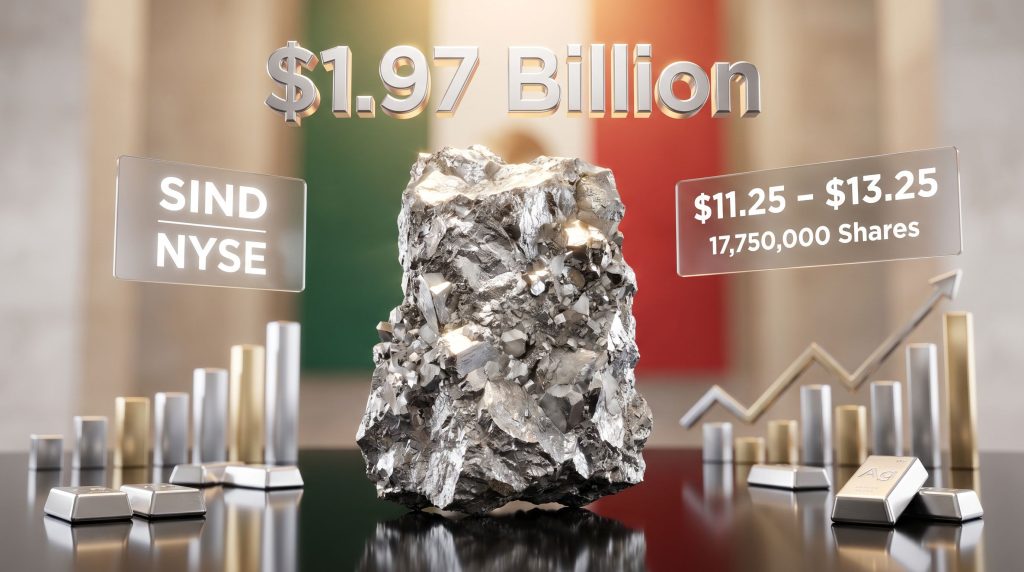
Furthermore, this dynamic is essential context for evaluating the Sinda US IPO roadshow, which launched in June 2026 and is targeting a valuation of up to $1.97 billion on the New York Stock Exchange under ticker symbol SIND.
When big ASX news breaks, our subscribers know first
Sinda's Core Asset: The Guanajuato Silver Property
Why Guanajuato Has Geological and Historical Credibility
The state of Guanajuato in central Mexico is not a speculative frontier. It is one of the most historically documented silver-producing regions on earth, with mining activity stretching back centuries to the colonial era. The district's geology is characterised by epithermal vein systems, a geological formation type associated with high-grade precious metal mineralisation deposited by hydrothermal fluids at relatively shallow crustal depths.
Epithermal deposits in historically proven districts carry a particular advantage for exploration-stage companies. The geological models are well understood, drill targeting is informed by extensive prior work, and metallurgical behaviour is often predictable based on analogous operations in the same district. This reduces certain categories of technical risk that plague greenfield exploration in less-documented terrains.
Sinda's prospectus describes the Guanajuato property as a large primary silver deposit with the potential to become a globally significant mining operation. For context, the company's IPO filing noted that only approximately 26% of global mined silver supply was sourced from primary silver mines in 2025, reinforcing how scarce such assets genuinely are within the broader commodity supply chain.
Primary vs. By-Product Silver: Why the Distinction Matters
The difference between a primary silver mine and a by-product silver producer is not merely geological. It fundamentally shapes how investors gain exposure to the silver price and how mine management decisions are made.
| Metric | Primary Silver Mines | By-Product Silver Production |
|---|---|---|
| Share of Global Supply (2025) | ~26% | ~74% |
| Price Sensitivity | High, directly exposed to silver price movements | Lower, economics driven by base metal pricing |
| Strategic Value | Concentrated, controllable pure-play asset | Dependent on base metal production decisions |
| Management Alignment | Silver price is the primary revenue driver | Silver is incidental to operational planning |
| Investor Appeal | Direct silver exposure with leverage to price upside | Indirect and diluted silver exposure |
When silver prices rise, a primary silver mine captures the full economic benefit. A by-product producer may not meaningfully alter its production plans at all, since those decisions are governed by copper or zinc economics. This asymmetry is precisely why institutional investors seeking concentrated silver exposure are structurally limited in their choices. In addition, the growing silver supply deficits observed in recent years have further intensified demand for primary silver assets with genuine scale.
The Institutional Architecture Behind the Offering
The Electrum Group and Precious Metals Conviction
Sinda operates as a portfolio company of The Electrum Group, a natural resources investment platform with a concentrated focus on precious metals assets. Thomas Kaplan, the firm's founder and chairperson, is widely regarded within institutional investment circles as one of the most committed long-term advocates for silver and gold as strategic wealth preservation instruments.
This is not incidental to how the Sinda story is being told in capital markets. The institutional parent's philosophical orientation toward precious metals shapes the narrative presented to investors during the roadshow. Electrum-backed companies tend to be positioned within a macro framework that emphasises long-duration value in hard assets, a framing that resonates with sovereign wealth funds, family offices, and commodity-specialist fund managers.
The involvement of a prestigious institutional sponsor does not eliminate the risks inherent in an exploration-stage company, but it does signal that the asset has passed through a disciplined evaluation process before reaching public markets.
IPO Structure: Understanding the Deal Mechanics
Key Terms at a Glance
| Feature | Detail |
|---|---|
| Exchange | New York Stock Exchange (NYSE) |
| Ticker Symbol | SIND |
| Shares Offered | 17,750,000 shares of common stock |
| Price Range | $11.25 to $13.25 per share |
| Maximum Raise | ~$235.2 million |
| Implied Valuation | Up to $1.97 billion |
| Underwriter Option | 2,662,500 additional shares (30-day greenshoe) |
| SEC Filing Date | June 5, 2026 |
What a $1.97 Billion Valuation Means for a Pre-Revenue Miner
Exploration-stage mining companies are valued on the basis of resource potential, geological credibility, commodity price outlook, and the quality of their institutional backing, not on earnings or cash flow, because none yet exist. A valuation approaching $2 billion for a company that has not yet commenced commercial production is therefore a direct reflection of how the market is pricing silver's scarcity and future demand trajectory.
This approach to valuation carries inherent uncertainty. The gap between a resource estimate and a producing mine is bridged by permitting approvals, definitive feasibility studies, capital expenditure programmes, and execution risk that can span a decade or more. Investors must weigh the premium they are paying for optionality against the timeline and capital intensity of the path to production.
The Greenshoe Option Explained
The underwriter option, commonly called the greenshoe, allows bookrunners to purchase up to an additional 2,662,500 shares within 30 days of listing. This mechanism serves two purposes. First, it allows underwriters to stabilise the share price in early trading by covering short positions opened during the allocation process. Second, it provides the issuer with additional capital if demand is strong enough to justify the full exercise of the option. The greenshoe is a standard feature of major IPOs and its inclusion here reflects conventional deal structuring rather than a unique characteristic of this offering.
The Banking Syndicate and What It Signals
Lead and Joint Bookrunners
The composition of an IPO syndicate communicates important information about how the deal is being positioned across different investor segments.
- Morgan Stanley brings access to the broadest institutional equity investor base globally
- Scotiabank contributes deep expertise in Canadian mining capital markets and precious metals investment flows
- BMO Capital Markets adds specialist resource-sector credibility, with one of North America's most established mining research and distribution franchises
- Canaccord Genuity provides direct access to dedicated mining and metals investors, particularly in the exploration and development space
- Citigroup extends reach into global institutional and sovereign wealth fund networks
- RBC Capital Markets reinforces the Canadian and resource-sector institutional coverage
The simultaneous presence of bulge-bracket generalists and specialist resource-sector advisors suggests the deal is being marketed to two distinct audiences at once: mainstream institutional equity allocators and dedicated precious metals and mining fund managers. This dual-channel approach is deliberate, and it maximises the breadth of the order book.
How the Sinda US IPO Roadshow Actually Works
The Step-by-Step Process from Launch to NYSE Debut
-
Prospectus Filing The SEC registration statement was filed on June 5, 2026, establishing the legal foundation for the offering and providing investors with mandatory disclosures.
-
Roadshow Launch Management commences a structured series of investor presentations, typically spanning seven to ten trading days, delivered across major financial centres.
-
Institutional Investor Meetings One-on-one and group sessions are held with fund managers, family offices, sovereign wealth funds, and commodity-specialist allocators.
-
Order Book Construction Bookrunners aggregate demand indications at various price points within the stated range, building a picture of where genuine buying interest is concentrated.
-
Price Setting The final offer price is determined based on the quality and depth of demand, with preference given to long-duration institutional holders over short-term speculative accounts.
-
SEC Effectiveness Shares cannot legally be distributed or sold until the SEC declares the registration statement effective, a milestone investors should monitor closely.
-
Allocation and Settlement Shares are distributed to investors and trading commences on NYSE under the SIND ticker.
The next major ASX story will hit our subscribers first
Silver's Demand Profile in 2026: Why the Timing Is Deliberate
Industrial Consumption Meets Safe-Haven Allocation
Silver occupies a structurally unusual position among commodities. It serves simultaneously as a precious metal, attracting capital during periods of monetary uncertainty, and as an industrial input with irreplaceable applications in electronics, medical devices, and solar photovoltaic manufacturing.
Solar panel production alone has become a dominant driver of silver demand growth. Each photovoltaic cell requires a small but non-substitutable quantity of silver paste to conduct electricity efficiently. As global solar installation capacity has expanded dramatically in recent years, the cumulative industrial pull on silver supply has intensified in a way that has no historical precedent.
This dual-engine demand structure, safe-haven buying coinciding with structural industrial consumption growth, has contributed to a meaningful appreciation in silver prices over the preceding year. Consequently, the broader precious metals outlook has shifted in a direction that supports higher valuations for primary silver assets. Mining companies with primary silver assets have benefited directly from this price environment, and the timing of the Sinda US IPO roadshow reflects management's and the underwriting syndicate's judgment that the current window is favourable for accessing public capital at an attractive valuation.
Risk Factors Every Investor Should Assess
Exploration-Stage Classification Is Not a Minor Caveat
Sinda's classification as an exploration-stage company is not a technical formality. It means the company has not yet demonstrated a pathway to commercial production, has no revenue, and has no certainty of achieving it within any specific timeframe. Exploration-stage mining IPOs carry risk profiles that differ substantially from producing mine offerings.
| IPO Type | Revenue Profile | Valuation Basis | Risk Level |
|---|---|---|---|
| Exploration-Stage (e.g., Sinda) | None | Resource potential and commodity outlook | High |
| Development-Stage | None, construction phase | Net present value of projected cash flows | Medium-High |
| Producing Mine IPO | Revenue-generating | Cash flow multiples and earnings | Medium |
Additional Risk Dimensions
-
Permitting and Regulatory Exposure Mexico's mining regulatory environment requires navigation of federal and state-level permitting processes. Changes to mining law, water rights, or environmental regulations can materially alter project timelines and economics.
-
Silver Price Volatility Because Sinda is a primary silver asset with no commodity diversification, its economic viability is entirely dependent on the silver price maintaining levels sufficient to support the capital expenditure required to bring the deposit into production.
-
Dilution Risk Future capital raises, which are virtually certain for an exploration-stage company, will dilute existing shareholders. The greenshoe option itself adds incremental dilution beyond the base offering.
-
SEC Registration Timing Because the registration statement had not yet been declared effective at the time of the roadshow launch, no shares could be legally sold prior to that milestone being reached.
Five Strategic Signals the Sinda Offering Sends to Resource Investors
The Sinda US IPO roadshow is not simply a single company event. It functions as a signal flare for broader conditions in the precious metals capital markets. Five observations stand out for investors tracking the sector.
-
Scarcity premiums for primary silver are real and quantifiable when only roughly one quarter of global silver supply originates from dedicated silver mines, genuinely large primary assets command structural pricing power that smaller or by-product silver positions cannot replicate.
-
The 2026 IPO window for resource companies is open — buoyant equity markets and improving investor sentiment have created conditions where exploration-stage miners can access public capital at valuations that would have been unachievable in tighter market environments.
-
Institutional confidence in silver's dual-demand profile is sufficient to support near-$2 billion pre-revenue valuations — demonstrating that sophisticated capital allocators are pricing in long-duration commodity conviction, not short-term speculation.
-
Syndicate formation involving both generalist and specialist banks signals serious institutional intent — this is not a retail-driven speculative offering but a structured transaction designed to attract durable, informed capital.
-
Guanajuato retains its standing as a globally credible silver jurisdiction — despite broader considerations around operating in emerging market environments, the district's geological track record and historical production history continue to provide credibility to new exploration programmes within its boundaries.
However, investors should also weigh the gold-silver ratio analysis for 2025 and beyond when assessing how silver's relative valuation may shift as macro conditions evolve.
Frequently Asked Questions: Sinda IPO
What exchange will Sinda list on?
Sinda is expected to trade on the New York Stock Exchange under the ticker symbol SIND.
How many shares is Sinda offering?
The company is offering 17,750,000 shares, with underwriters holding a 30-day option to purchase up to an additional 2,662,500 shares via the greenshoe mechanism.
What is Sinda's target valuation?
Sinda is targeting a valuation of up to $1.97 billion, with shares priced between $11.25 and $13.25 per share.
Where is Sinda's primary asset located?
The Sinda property is situated in Guanajuato, Mexico, a district with deep geological and historical significance as a silver-producing region.
Who are the lead underwriters?
Morgan Stanley, Scotiabank, and BMO Capital Markets serve as lead bookrunners, with Canaccord Genuity, Citigroup, and RBC Capital Markets acting as joint bookrunners.
Is Sinda currently producing silver?
No. Sinda is classified as an exploration-stage company with no current commercial production and no revenue.
When did Sinda file its SEC registration?
The registration statement was filed on June 5, 2026. For further detail on the deal mechanics and valuation target, Bloomberg's coverage provides additional context on the placement structure.
This article contains forward-looking analysis and should not be construed as financial advice. Exploration-stage mining investments carry significant risk and investors should consult independent financial advice before making any investment decisions.
Want to Track the Next Major Silver Discovery Before the Market Moves?
Discovery Alert's proprietary Discovery IQ model scans ASX announcements in real time, instantly identifying significant mineral discoveries — including primary silver assets — and delivering actionable alerts directly to subscribers ahead of the broader market. Explore historic examples of major mineral discoveries and their returns on Discovery Alert's dedicated discoveries page, and begin your 14-day free trial at discoveryalert.com.au to position yourself at the forefront of the next significant find.