
May 13, 2026
Environmental compliance frameworks in mining operations have evolved dramatically over the past decade, driven by increasing recognition of biodiversity conservation imperatives and strengthened regulatory enforcement mechanisms. The recent US$39M fine for Alcoa illegal land clearing exemplifies this regulatory transformation, furthermore highlighting how mining permitting basics have become increasingly complex. Australia's Environment Protection and Biodiversity Conservation Act represents one of the world's most comprehensive federal environmental protection regimes, establishing dual-jurisdiction oversight that requires mining companies to navigate both state and national approval processes for projects affecting matters of national environmental significance.
Understanding Australia's Environmental Protection Framework
The Environment Protection and Biodiversity Conservation Act operates as Australia's primary federal environmental legislation, enacted in 1999 to replace the Environmental Protection Act of 1974. This comprehensive framework creates a multi-layered approval system where resource extraction projects must obtain federal authorization when operations potentially impact protected species, world heritage areas, or nationally significant ecological communities.
Mining operations in Western Australia face particularly complex regulatory requirements due to the intersection of state-level Environmental Protection Act obligations with federal EPBC oversight. This dual-approval framework means companies must satisfy both jurisdictions simultaneously, often extending project timelines and increasing compliance costs significantly.
The EPBC Act defines nine specific categories of matters requiring national environmental significance assessment, including listed threatened species habitat and nationally protected wetlands. For bauxite mining operations in jarrah forest ecosystems, the primary trigger mechanisms involve clearing native vegetation that constitutes critical habitat for protected fauna species.
Federal environmental oversight operates through a referral system where mining companies must demonstrate that proposed activities will not have unacceptable impacts on protected environmental values. The Department of Climate Change, Energy, Environment and Water conducts comprehensive assessments considering cumulative landscape impacts, species population dynamics, and long-term ecosystem integrity.
National interest exemptions represent a critical component of the EPBC framework, allowing continued operations under specific circumstances while comprehensive strategic assessments proceed. These exemptions balance immediate resource extraction needs with longer-term conservation planning requirements, typically involving enhanced monitoring and interim environmental management conditions.
When big ASX news breaks, our subscribers know first
The Scale of Environmental Penalties in Australian Mining
The US$39 million fine for Alcoa illegal land clearing represents a watershed moment in Australian environmental enforcement, establishing new precedent for penalty calculations under federal environmental legislation. This settlement, announced by Environment Minister Murray Watt in February 2026, addresses unauthorized clearing activities conducted between 2019 and 2025 in the Northern Jarrah Forest ecosystem.
Historical analysis of EPBC Act enforcement reveals a significant escalation in penalty amounts over the past five years, reflecting both legislative amendments strengthening enforcement mechanisms and increased government commitment to environmental protection. This trend aligns with the environmental fine precedent set by other major mining enforcement actions. Prior to 2020, environmental penalties in the mining sector typically ranged from AUD $100,000 to AUD $2 million for comparable violations.
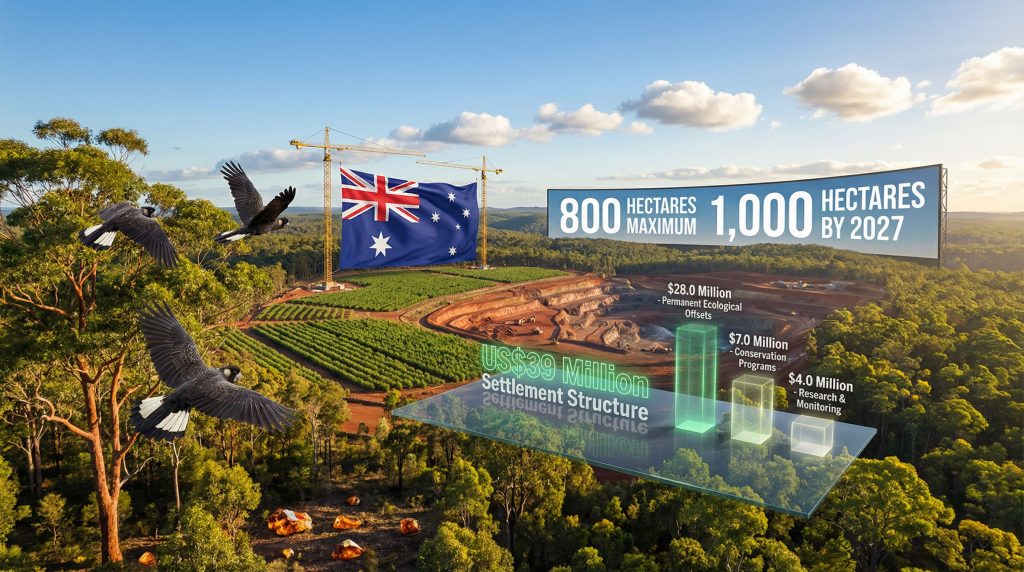
The Alcoa settlement structure demonstrates sophisticated penalty calculation methodology that extends beyond simple financial punishment to encompass comprehensive environmental remediation:
| Settlement Component | Amount (US$ Million) | Percentage of Total | Primary Objective |
|---|---|---|---|
| Permanent Ecological Offsets | $28.0 | 71.8% | Habitat compensation and long-term protection |
| Species Conservation Programs | $7.0 | 17.9% | Threatened fauna recovery initiatives |
| Research & Monitoring Systems | $4.0 | 10.3% | Invasive species control and ecosystem studies |
| Total Settlement Value | $39.0 | 100.0% | Comprehensive environmental remediation |
This penalty structure reflects evolving regulatory philosophy that prioritises ecological restoration over purely punitive measures. The $28 million allocation for permanent ecological offsets represents the largest single environmental offset requirement imposed on an Australian mining operation, establishing new benchmarks for habitat compensation calculations.
Comparative analysis with international mining environmental penalties reveals Australia's enforcement approach increasingly aligns with stringent regulatory frameworks in Canada and the European Union. The US$39 million settlement exceeds many comparable violations in North American jurisdictions, including recent bauxite mining penalties that demonstrate growing global enforcement trends, indicating Australia's commitment to positioning itself as a leader in mining environmental accountability.
The enforcement action's timing coincides with broader policy initiatives strengthening Australia's environmental protection capabilities, including enhanced monitoring technologies and increased staffing within federal environmental departments. This administrative capacity expansion enables more comprehensive compliance oversight and faster detection of unauthorized activities.
Mining Companies Navigate Environmental Compliance Challenges
Pre-approval requirements for land clearing operations in areas containing protected species habitat involve multi-stage assessment processes that can extend over 12 to 24 months for complex mining projects. Companies must submit comprehensive referrals documenting baseline environmental conditions, proposed impact mitigation measures, and long-term rehabilitation strategies.
The EPBC referral process requires detailed species impact assessments incorporating:
- Baseline ecological surveys conducted across multiple seasons to capture species breeding and migration patterns
- Quantitative habitat mapping using Geographic Information Systems technology
- Population-level analysis demonstrating project impacts on species recovery objectives
- Cumulative impact evaluation considering existing disturbances in surrounding landscapes
- Comprehensive mitigation hierarchy implementation following avoid-minimize-offset principles
State versus federal jurisdiction overlaps create particular complexity in Western Australia, where mining operations must satisfy both the state Environmental Protection Authority and federal Department of Climate Change, Energy, Environment and Water. These parallel processes often require duplicate documentation and can result in conflicting approval conditions requiring negotiated resolution.
Documentation requirements for protected species assessments have become increasingly sophisticated, incorporating advanced ecological modelling techniques and long-term monitoring protocols. Companies must demonstrate understanding of species life cycle requirements, habitat connectivity needs, and landscape-scale conservation objectives.
Processing timelines for EPBC referrals vary significantly based on project complexity and environmental significance. Routine referrals with minimal environmental impact may receive approval within 30 days, while comprehensive assessments involving threatened species habitat can require 12 months or longer for detailed evaluation.
The Alcoa violation occurred despite the company's extensive experience navigating Australian environmental approval processes, highlighting the compliance challenges even experienced operators face when managing operations across large landscapes over extended timeframes. The unauthorised clearing affected known habitats for nationally protected species, indicating either inadequate pre-clearing surveys or procedural failures in approval verification processes.
Northern Jarrah Forest Ecosystem Environmental Significance
Western Australia's jarrah forest ecosystems represent globally significant biodiversity repositories, supporting high levels of endemic plant and animal species within the Southwest Australian Floristic Region. This temperate forest biome extends across approximately 1.5 million hectares of southwestern Western Australia, characterised by distinctive eucalyptus jarrah trees and diverse understory vegetation communities.
The Northern Jarrah Forest ecosystem hosts critical habitat for Carnaby's black cockatoo (Calyptorhynchus latirostris) and Baudin's black cockatoo (Calyptorhynchus baudinii), both listed as endangered under federal environmental legislation. These species depend on mature jarrah trees for nesting hollows and diverse plant communities for seasonal foraging resources.
Current population estimates indicate Carnaby's black cockatoo populations have declined by approximately 50% over the past three generations, primarily due to habitat loss from agricultural clearing, urban development, and resource extraction activities. The species requires large territory ranges and specific nesting site characteristics, making habitat fragmentation particularly problematic for population maintenance.
Baudin's black cockatoo populations face similar conservation challenges, with breeding success rates directly correlated to availability of suitable nesting hollows in mature eucalyptus trees. The species exhibits strong site fidelity, returning to traditional nesting areas across generations, which increases vulnerability to habitat modification.
Jarrah forest biodiversity extends beyond flagship species to encompass:
- Over 1,500 native plant species, with endemism rates exceeding 60% in some vegetation communities
- Diverse reptile assemblages including several species found nowhere else globally
- Complex invertebrate communities supporting ecosystem processes and food web stability
- Unique soil microorganism communities adapted to specific jarrah forest soil chemistry
Historical clearing patterns in jarrah forests reveal extensive modification since European settlement, with original forest extent reduced by approximately 30% through agricultural conversion, timber harvesting, and urban development. Remaining forest areas face ongoing pressure from multiple land uses, making conservation of intact habitat patches increasingly critical for species survival.
Bauxite mining environmental impact assessment in jarrah forests requires understanding of ecosystem recovery dynamics following disturbance. Research indicates successful rehabilitation is possible but requires extended timeframes, with full ecosystem function restoration typically requiring 15 to 25 years following mine closure and rehabilitation implementation.
What Are the Long-term Rehabilitation Requirements?
Long-term rehabilitation in jarrah forest ecosystems involves comprehensive mine reclamation innovation approaches that integrate ecological restoration principles with advanced monitoring systems. These programs must demonstrate measurable progress toward re-establishing native biodiversity and ecosystem functionality across extended timeframes.
Financial and Operational Implications for Mining Operations
The US$39M fine for Alcoa illegal land clearing establishes new cost parameters for environmental compliance failures in Australian mining operations, representing approximately 2.1% of Alcoa's global annual revenue based on 2025 financial reporting. This proportional impact creates material financial consequences that influence corporate environmental risk management strategies.
Ongoing operational constraints under Alcoa's national interest exemption include:
- Annual land clearing limits capped at 800 hectares maximum across all Northern Jarrah Forest operations
- Enhanced rehabilitation targets requiring completion of 1,000 hectares restoration by 2027
- Strategic assessment timeline extending through 2045 with interim review milestones
- Mandatory monitoring programs for protected species populations and habitat condition
Cost-benefit analysis for mining operations increasingly incorporates environmental compliance expenses as standard operational considerations rather than exceptional costs. Industry analysis suggests comprehensive environmental management systems, including pre-approval surveys and ongoing monitoring, typically represent 3-7% of total mining operational expenses for projects in sensitive ecological areas.
Insurance and bonding requirements for future mining approvals have evolved to reflect increased environmental liability exposure. Mining companies operating in areas with protected species habitat now face significantly higher environmental insurance premiums and must provide larger financial assurance bonds to guarantee rehabilitation completion.
The settlement's impact on shareholder returns demonstrates market recognition of environmental compliance as material business risk. Following the penalty announcement, Alcoa's share price experienced temporary volatility, with environmental analysts noting increased scrutiny of the company's global environmental management practices and potential implications for operations in other jurisdictions.
Capital allocation priorities within mining companies have shifted to emphasise proactive environmental management infrastructure, including advanced monitoring systems, enhanced staff training programs, and improved communication protocols between operational and environmental management teams.
Industry-Wide Compliance and Regulatory Evolution
Regulatory enforcement evolution in Australian mining reflects broader international trends toward proactive environmental oversight and integration of biodiversity conservation objectives with resource extraction activities. The US$39M fine for Alcoa illegal land clearing represents a transition from reactive penalty-focused enforcement to comprehensive ecosystem restoration and long-term conservation outcomes.
Strategic assessment processes for major mining operations now incorporate landscape-scale planning approaches that consider cumulative impacts across multiple projects and extended timeframes. This methodology requires companies to demonstrate understanding of ecosystem connectivity, species population dynamics, and regional conservation priorities.
The enforcement action generated unprecedented public engagement, with over 59,000 public submissions received during the strategic assessment consultation process. This participation level exceeds previous environmental assessment processes by significant margins, indicating increased community awareness and concern about mining impacts on biodiversity conservation.
Enhanced due diligence requirements for mining companies include:
- Comprehensive baseline ecological surveys covering full annual cycles and capturing species behavioural patterns
- Advanced habitat mapping using satellite imagery and ground-truthing protocols
- Population monitoring systems for affected species extending beyond immediate impact areas
- Adaptive management frameworks enabling operational modifications based on environmental monitoring outcomes
Federal environmental enforcement capabilities have expanded through increased staffing, improved surveillance technology, and enhanced inter-agency coordination mechanisms. Remote sensing technology now enables real-time monitoring of land clearing activities, significantly reducing the time between unauthorised activities and regulatory detection.
How Do Companies Manage Environmental Waste Streams?
Modern mining operations implement comprehensive waste management solutions that address both regulatory compliance requirements and environmental stewardship objectives. These systems integrate advanced monitoring technologies with proven remediation techniques to minimise ecological impact across operational lifecycles.
Industry-wide compliance implications extend beyond individual company operations to encompass supply chain environmental responsibility, with downstream processors and international customers increasingly requiring evidence of responsible environmental management practices from mining suppliers.
The next major ASX story will hit our subscribers first
Future Mining Approvals and Investment Considerations
Enhanced environmental assessment standards emerging from the Alcoa settlement establish new benchmarks for habitat protection requirements and improved offset calculation methodologies. Future mining approvals will likely require demonstration of net positive biodiversity outcomes through comprehensive offset programs and innovative conservation technologies.
Investment and operational planning considerations for mining companies operating in sensitive ecological areas now include:
- Environmental risk assessment integration throughout project development phases, from exploration through closure
- Capital allocation strategies incorporating comprehensive environmental management infrastructure
- Long-term sustainability planning aligned with evolving regulatory expectations and community standards
- Stakeholder engagement programs designed to build social licence for operations in sensitive environments
Public engagement and transparency requirements reflect increased community expectations for meaningful participation in environmental decision-making processes. The record-breaking submission numbers for Alcoa's strategic assessment demonstrate community capacity for detailed technical engagement and sustained advocacy throughout extended regulatory processes.
Technology integration opportunities in environmental compliance include:
- Artificial intelligence applications for species monitoring and habitat condition assessment
- Drone technology for regular surveillance and compliance verification
- Blockchain systems for transparent environmental data reporting and verification
- Predictive modelling platforms for ecosystem response simulation and adaptive management
What Does This Mean for Mining Industry Evolution?
The settlement establishes precedent for comprehensive environmental accountability extending beyond immediate mining operations to encompass broader landscape conservation outcomes and long-term species recovery objectives. This transformation aligns with broader industry evolution trends toward sustainable resource extraction practices. This approach requires mining companies to function as active participants in ecosystem stewardship rather than simply minimising negative impacts.
For investors, environmental compliance costs represent increasingly material operational considerations requiring incorporation into financial modelling and risk assessment frameworks. Companies demonstrating proactive environmental management capabilities may achieve competitive advantages through faster approval processes, reduced regulatory scrutiny, and enhanced social licence for operations.
The transformation of Australia's mining environmental enforcement framework signals a fundamental shift toward integrated ecosystem management, requiring companies to demonstrate positive conservation contributions rather than simply avoiding prohibited activities.
Critical investment implications include recognition that environmental compliance excellence creates competitive differentiation in capital markets, regulatory approval processes, and community relationship management. Mining companies that develop sophisticated environmental management capabilities position themselves advantageously for long-term operational sustainability in an increasingly regulated sector.
This enforcement precedent indicates Australian environmental regulation will continue evolving toward comprehensive ecosystem stewardship requirements, creating both challenges and opportunities for mining companies capable of integrating biodiversity conservation objectives with efficient resource extraction operations. Furthermore, the comprehensive regulatory framework established through this settlement demonstrates how environmental accountability mechanisms continue to strengthen across global mining jurisdictions.
Environmental compliance in mining operations involves complex regulatory requirements and evolving enforcement standards. This analysis is provided for informational purposes and should not be considered as legal or investment advice. Stakeholders should consult qualified professionals for specific guidance regarding environmental compliance obligations and investment decisions.
Looking to Invest in Resource Companies Before Regulatory Changes Impact Market Valuations?
Discovery Alert's proprietary Discovery IQ model delivers instant notifications on significant ASX mineral discoveries, helping subscribers identify actionable opportunities before market-moving environmental compliance costs affect share prices. With environmental regulations increasingly impacting mining operations and investor sentiment, explore how major mineral discoveries can generate substantial returns and begin your 14-day free trial today to position yourself ahead of regulatory-driven market shifts.