May 15, 2026
Canada's critical mineral supply chain faces unprecedented pressures as global energy transition accelerates and geopolitical tensions reshape resource dependencies. The uranium sector, positioned at the intersection of nuclear power expansion and energy security concerns, operates within complex regulatory frameworks that must balance resource development imperatives with environmental stewardship obligations. Recent developments in Saskatchewan's uranium project pipeline demonstrate how provincial regulatory architecture functions as both developmental catalyst and quality assurance mechanism for strategic mineral assets, particularly as seen in the environmental impact statement Patterson Lake South approval process.
How Provincial Environmental Assessment Shapes Critical Mineral Project Viability
Saskatchewan's environmental assessment framework represents decades of institutional refinement within Canada's leading uranium jurisdiction. The Patterson Lake South project's recent environmental approval milestone illustrates how this regulatory architecture transforms project risk profiles while maintaining rigorous environmental standards.
The environmental impact statement Patterson Lake South approval process demonstrates sophisticated regulatory coordination between provincial and federal authorities. Following technical acceptance in June 2025, the three-month public review period between July and September 2025 provided comprehensive stakeholder engagement opportunities before ministerial authorization under Saskatchewan's Environmental Assessment Act.
This sequential regulatory structure creates predictable pathways for project advancement while ensuring thorough environmental evaluation. Furthermore, the provincial approval serves as a mandatory prerequisite for federal Canadian Nuclear Safety Commission licensing, establishing environmental compliance foundations that federal reviewers subsequently reference during construction license evaluation.
Regulatory Timeline Optimization and Investment Certainty
The structured approach to environmental assessment delivers tangible economic benefits through regulatory predictability. Projects completing provincial environmental assessment gain access to federal licensing processes with established environmental compliance credentials, reducing overall development timelines and regulatory uncertainty.
Saskatchewan's institutional expertise in uranium regulation, developed through decades of operational experience, translates into regulatory efficiency advantages. In addition, the province's review panel of subject matter experts provides technical evaluation capabilities specifically calibrated to uranium project requirements, ensuring assessments address industry-specific environmental and safety considerations.
Consequently, the Canada energy transition has benefited from these streamlined regulatory processes, enabling faster project development whilst maintaining environmental standards.
Table: Saskatchewan Environmental Assessment Timeline Components
| Phase | Duration | Key Activities |
|---|---|---|
| Technical Review | Initial Assessment | Subject matter expert evaluation |
| Public Consultation | 3 months (July-September 2025) | Stakeholder and Indigenous engagement |
| Ministerial Decision | Post-consultation | Final approval determination |
| Federal Integration | Ongoing | CNSC construction license progression |
When big ASX news breaks, our subscribers know first
Patterson Lake South: Technical Characteristics and Strategic Positioning
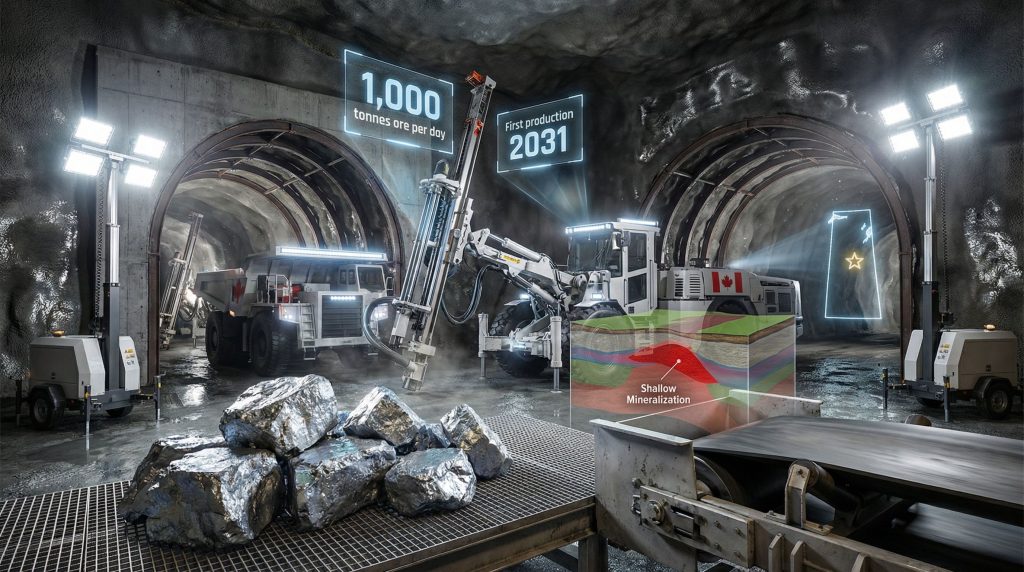
The Patterson Lake South deposit exemplifies the geological advantages characterising Saskatchewan's Athabasca Basin uranium resources. Shallow mineralisation depths reduce extraction complexity while high-grade ore concentrations enhance processing economics, positioning the project among Canada's most commercially viable uranium development opportunities.
Located 155 kilometres from established transportation infrastructure, the project benefits from proximity to existing mining support networks developed through decades of basin operations. This infrastructure connectivity reduces capital requirements and logistical complexity compared to greenfield developments requiring comprehensive infrastructure investment.
The approved development plan encompasses integrated mining and processing facilities designed for sustained production. Moreover, underground mining operations targeting 1,000 tonnes of ore per day processing capacity represent substantial production infrastructure supporting long-term operational sustainability.
Processing Infrastructure and Environmental Management Systems
Onsite milling capabilities eliminate requirements for ore transportation to external processing facilities, reducing logistical costs and environmental impact through integrated operations. The comprehensive facility design includes:
• Underground mining systems utilising multi-level extraction methodologies optimised for shallow, high-grade mineralisation
• Integrated processing facilities with 1,000-tonne daily ore processing capacity for uranium concentrate production
• Underground tailings management replacing surface storage with contained waste management systems
• Comprehensive water treatment infrastructure supporting environmental compliance and operational water recycling
• Waste rock containment systems managing non-ore materials through engineered storage solutions
The underground tailings storage approach represents advanced environmental management, addressing containment concerns through engineered systems that prevent surface environmental impact. Furthermore, water treatment systems incorporate effluent processing and recycling capabilities, supporting both regulatory compliance and operational sustainability objectives.
Technical specifications indicate production targeting 2031 based on current regulatory progression and development schedules. This timeline encompasses federal licensing completion, detailed engineering, construction phases, and pre-operational commissioning requirements.
Economic Impact of Environmental Assessment Approval on Project Development
Environmental assessment approval fundamentally transforms project investment profiles by eliminating regulatory uncertainty that constrains capital allocation decisions. The milestone provides institutional validation of environmental compliance capability while establishing clear pathways for federal licensing progression.
Investment confidence increases substantially following environmental approval as projects demonstrate ability to navigate complex regulatory requirements successfully. However, this regulatory validation reduces perceived investment risk, facilitating access to development capital at improved terms compared to projects facing regulatory uncertainty.
Risk Mitigation and Capital Access Optimisation
The approval creates positive momentum for broader Canadian uranium sector investment by demonstrating regulatory pathway effectiveness. Projects successfully completing environmental assessment provide proof-of-concept for regulatory framework navigation, encouraging investment in similar developments within Saskatchewan's uranium pipeline.
Provincial environmental approval establishes environmental compliance baselines that federal reviewers reference during construction licence evaluation. Consequently, this regulatory integration reduces duplicate environmental analysis while maintaining distinct provincial and federal regulatory authorities and requirements.
Given the current market conditions and uranium volatility insights, regulatory approval becomes even more critical for investor confidence.
Investment Insight: Environmental assessment approval serves as a catalyst for project advancement rather than a regulatory barrier, transforming project risk profiles and enabling access to development capital at competitive terms.
Federal licensing requirements build upon provincial environmental foundations whilst addressing nuclear safety and security considerations specific to uranium operations. The Canadian Nuclear Safety Commission construction licence application progresses concurrently with ongoing technical documentation development supporting safe construction and operational authorisation.
Table: Regulatory Milestone Economic Impact Assessment
| Impact Category | Immediate Benefits | Medium-term Advantages |
|---|---|---|
| Investment Access | Reduced regulatory risk premiums | Enhanced institutional investor interest |
| Development Timeline | Federal licensing pathway clarity | Construction commencement authorisation |
| Market Confidence | Demonstrated regulatory competence | Strengthened sector investment appeal |
| Operational Planning | Environmental compliance certainty | Infrastructure development authorisation |
Saskatchewan's Strategic Positioning in Critical Mineral Development
Saskatchewan's uranium sector leadership stems from decades of operational experience creating institutional knowledge and regulatory expertise benefiting new project development. The province's competitive advantages extend beyond geological endowments to encompass regulatory frameworks, workforce capabilities, and infrastructure connectivity supporting efficient project development.
Government policy alignment with responsible resource development creates supportive regulatory environments encouraging investment whilst maintaining environmental protection standards. Official statements connecting Patterson Lake South approval to provincial growth plans and energy supplier positioning indicate strategic government support for uranium sector expansion.
Institutional Expertise and Workforce Advantages
Established mining operations provide skilled workforce availability supporting new project development without requiring extensive training programmes or workforce importation. This human capital advantage reduces development costs and operational risk compared to jurisdictions lacking established mining expertise.
Regulatory frameworks refined through accumulated operational experience provide predictable approval pathways based on proven assessment methodologies. Furthermore, Saskatchewan's institutional knowledge regarding uranium project requirements translates into efficient regulatory processing compared to jurisdictions developing regulatory capacity concurrently with project evaluation.
Transportation infrastructure connecting basin deposits to processing facilities and export outlets reduces development costs through existing connectivity rather than requiring comprehensive infrastructure investment. Rail and highway networks developed for existing operations provide access for new projects at marginal additional cost.
In addition, modern reclamation innovations have been integrated into Saskatchewan's regulatory framework, ensuring environmental stewardship throughout project lifecycles.
Key Competitive Advantages:
• Proven regulatory frameworks refined through decades of operational experience
• Skilled workforce availability from established mining operations
• Infrastructure connectivity reducing capital requirements
• Government policy support for responsible resource development
• Geological expertise in Athabasca Basin mineralisation characteristics
Federal Licensing Integration and Production Timeline Expectations
Canadian Nuclear Safety Commission construction licence requirements operate independently from provincial environmental assessment whilst building upon environmental compliance foundations established through Saskatchewan's approval process. This regulatory architecture creates sequential but coordinated approval pathways maximising regulatory efficiency.
Federal licensing encompasses construction authorisation, operational licensing, and ongoing regulatory oversight throughout project lifecycle. The construction licence application submitted to CNSC advances through technical review addressing safety case development, environmental monitoring plans, and Indigenous consultation requirements meeting federal standards.
Regulatory Coordination and Timeline Optimisation
The integrated provincial-federal approach reduces overall regulatory timelines through coordinated rather than duplicative review processes. Provincial environmental assessment establishes compliance baselines referenced during federal safety and security evaluation, avoiding redundant environmental analysis whilst maintaining regulatory independence.
Construction licence approval enables project advancement to development phases including detailed engineering, procurement, and construction commencement. The anticipated 2031 production timeline reflects coordination between regulatory approval completion and technical development requirements supporting operational readiness.
Technical documentation supporting federal licensing includes safety case development demonstrating regulatory compliance capability, environmental monitoring plans aligned with federal environmental standards, and Indigenous consultation meeting federal engagement requirements potentially extending beyond provincial consultation scope.
Federal Licensing Timeline Components:
• Construction licence review currently under CNSC evaluation
• Technical documentation completion supporting safety and environmental compliance
• Indigenous consultation fulfilment meeting federal engagement standards
• Safety case validation demonstrating operational safety capability
• Environmental monitoring establishment ensuring ongoing compliance oversight
Global Uranium Market Context and Supply Chain Implications
Patterson Lake South development occurs within global uranium market dynamics experiencing supply-demand rebalancing driven by nuclear power expansion programmes and energy security considerations. Canadian uranium production becomes strategically important for supply chain diversification away from geopolitically sensitive uranium sources.
Nuclear power expansion supporting clean energy transition objectives creates sustained uranium demand growth expectations. Furthermore, small modular reactor deployment initiatives and utility strategic reserve building contribute to market demand fundamentals supporting new production development.
Supply Chain Resilience and Energy Security Positioning
The project's advancement demonstrates Canada's uranium sector capability to respond to growing global demand whilst maintaining world-class safety and environmental standards. This positioning becomes increasingly valuable as energy security considerations drive preference for uranium sourced from politically stable jurisdictions.
Canadian uranium assets benefit from favourable geopolitical positioning compared to production concentrated in countries facing international sanctions or political instability. Consequently, this advantage translates into premium pricing potential and preferential purchasing arrangements with utilities prioritising supply chain security.
Investment momentum created by successful environmental impact statement Patterson Lake South approval extends beyond individual project benefits to strengthen Canada's broader uranium development pipeline credibility. International investors gain confidence in Canadian regulatory frameworks through demonstrated approval process effectiveness.
However, the rising critical minerals demand has created additional competition for investment capital across multiple commodity sectors.
Table: Market Positioning Impact Assessment
| Market Factor | Short-term Effect | Long-term Strategic Advantage |
|---|---|---|
| Supply Chain Security | Enhanced Canadian uranium credibility | Preferred supplier status development |
| Investment Confidence | Increased sector capital allocation | Global investor interest expansion |
| Regulatory Credibility | Demonstrated framework effectiveness | Competitive advantage in project development |
| Technology Innovation | Advanced mining technology deployment | Innovation leadership in critical mineral extraction |
The next major ASX story will hit our subscribers first
Regulatory Best Practices and Industry Development Implications
The Patterson Lake South environmental assessment approval demonstrates effective strategies for navigating complex regulatory requirements through comprehensive stakeholder engagement and technical documentation excellence. These approaches provide templates for other critical mineral projects seeking regulatory approval efficiency.
Early stakeholder engagement building community and Indigenous support creates regulatory pathway advantages through proactive relationship development rather than reactive consultation responses. Furthermore, comprehensive technical documentation addressing environmental concerns before regulatory review reduces approval timelines and post-approval compliance costs.
Strategic Lessons for Critical Mineral Project Development
Integrated planning approaches coordinating provincial and federal requirements optimise regulatory efficiency by avoiding sequential bottlenecks and ensuring documentation compatibility across regulatory levels. Transparent communication maintaining public confidence throughout approval processes reduces stakeholder opposition and regulatory complexity.
The approval establishes precedents for future critical mineral developments whilst maintaining Saskatchewan's leadership in responsible uranium production. These precedents benefit subsequent projects through proven regulatory pathway effectiveness and stakeholder engagement methodologies.
Consequently, projects following uranium investment strategies that incorporate comprehensive regulatory planning typically achieve better outcomes.
Strategic Framework: Projects investing in comprehensive environmental assessment preparation and proactive stakeholder consultation typically experience accelerated regulatory approval timelines and reduced post-approval compliance costs compared to projects with reactive regulatory strategies.
Regulatory strategy optimisation requires understanding that environmental assessment serves as project development catalyst rather than barrier when approached with adequate preparation and stakeholder engagement. This perspective shift enables projects to leverage regulatory processes for competitive advantage rather than viewing them as obstacles.
Technical Innovation and Environmental Management Excellence
Underground tailings storage systems employed at Patterson Lake South represent advanced environmental management addressing surface containment concerns through engineered solutions. This technical approach demonstrates innovation in waste management whilst maintaining operational efficiency and environmental protection standards.
Water treatment systems incorporating comprehensive effluent processing and recycling capabilities support both regulatory compliance and operational sustainability. Moreover, these integrated environmental management systems demonstrate compatibility between resource development and environmental stewardship objectives.
Mining Technology Advancement and Operational Efficiency
Multi-level underground extraction systems optimised for shallow, high-grade mineralisation characteristics demonstrate technical adaptation to specific geological conditions. These methodologies maximise resource recovery whilst minimising environmental impact through targeted extraction approaches.
Onsite processing capabilities eliminating external transportation requirements reduce environmental impact through integrated operations whilst improving operational economics through reduced logistical complexity and transportation costs.
In addition, the integration of advanced mining technologies with comprehensive environmental management systems positions the project at the forefront of responsible resource development practices, establishing benchmarks for future uranium project development.
Investment Strategy Implications and Market Psychology
Environmental assessment approval creates positive investment psychology by demonstrating project viability through regulatory validation. Institutional investors gain confidence in project development capability through successful navigation of complex regulatory requirements, reducing perceived investment risk.
The milestone triggers increased analyst attention and institutional investor evaluation as projects advance through development phases with reduced regulatory uncertainty. Furthermore, this attention translates into improved access to development capital at competitive terms compared to projects facing regulatory obstacles.
Market Sentiment and Capital Allocation Dynamics
Successful regulatory milestone achievement creates momentum effects encouraging additional investment in Canadian uranium sector opportunities. Investment confidence generated by proven regulatory pathway effectiveness benefits broader sector capital allocation and valuation metrics.
The approval demonstrates management execution capability in navigating complex regulatory environments, providing investors confidence in project delivery capability extending beyond regulatory compliance to operational execution.
Long-term uranium market fundamentals supporting price appreciation expectations enhance project investment attractiveness as production timelines align with anticipated market demand growth from nuclear power expansion and energy security considerations.
Future Outlook and Strategic Implications
Patterson Lake South's progression through environmental assessment establishes important precedents for Canada's critical mineral development strategy. The project's successful regulatory navigation demonstrates frameworks capable of balancing resource development with environmental protection whilst maintaining international competitiveness.
The 2031 production timeline positions the project to capture anticipated uranium market demand growth driven by global nuclear power expansion programmes and small modular reactor deployment initiatives. This timing alignment creates favourable market entry conditions supporting project economics and investment returns.
Regulatory pathway effectiveness demonstrated through the environmental impact statement Patterson Lake South approval process strengthens Canada's positioning in global critical mineral supply chains by validating development capability within established frameworks. This positioning becomes increasingly valuable as energy security considerations drive preference for minerals sourced from politically stable jurisdictions.
However, companies must monitor developments through sources like the Mining Weekly and Canadian Nuclear Safety Commission to stay current on regulatory progress.
The integration of provincial environmental assessment with federal nuclear licensing creates regulatory architecture supporting efficient project development whilst maintaining rigorous safety and environmental standards. This framework provides competitive advantages attracting international investment to Canadian uranium opportunities.
Disclaimer: This analysis contains forward-looking statements regarding uranium market conditions, regulatory timelines, and project development schedules. Actual outcomes may differ materially from projections due to market volatility, regulatory changes, technical challenges, or other factors beyond current analysis scope. Investment decisions should consider comprehensive due diligence and professional financial advice.
Ready to Capitalise on Critical Mineral Discoveries?
Discovery Alert's proprietary Discovery IQ model delivers real-time alerts on significant ASX mineral discoveries, instantly empowering subscribers to identify actionable opportunities ahead of the broader market. Understand why major mineral discoveries can lead to substantial market returns by exploring Discovery Alert's dedicated discoveries page, showcasing historic examples of exceptional outcomes, and begin your 14-day free trial today to position yourself ahead of the market.