May 17, 2026
Understanding Environmental Mining Research Infrastructure
The global mining industry stands at a critical juncture where environmental stewardship has evolved from regulatory compliance to operational necessity. Advanced research facilities now integrate complex environmental systems with mining engineering to address unprecedented sustainability challenges. The Centre for Environmental Responsibility in Mining stands at the forefront of these developments, pioneering innovative approaches to environmental mining research. Within Australia's mining research ecosystem, specialised centres are developing technologies that fundamentally reshape how mineral extraction interacts with ecological systems.
Modern environmental mining research encompasses water resource management, ecosystem restoration, carbon sequestration, and contaminated land remediation. These technical domains require sophisticated monitoring systems, predictive modelling capabilities, and interdisciplinary expertise spanning geochemistry, ecology, hydrology, and engineering disciplines.
When big ASX news breaks, our subscribers know first
What is the Centre for Environmental Responsibility in Mining (CERM)?
Understanding CERM's Core Mission
The Centre for Environmental Responsibility in Mining represents a pioneering approach to environmental challenges within mineral extraction operations. Established within the University of Queensland's Sustainable Minerals Institute, CERM integrates environmental science methodologies with mining engineering principles to develop practical solutions for industry-wide sustainability challenges.
Dr Doug Aitken commenced his role as the inaugural director of CERM on January 21, 2026, marking the formal establishment of this specialised research facility. The centre's operational framework emphasises the integration of production expertise, environmental management systems, social science research, and health and safety protocols to deliver comprehensive sustainable resource development strategies.
CERM's research philosophy differs from traditional mining research approaches by prioritising environmental outcomes as fundamental design criteria rather than secondary considerations. This methodology requires simultaneous optimisation of mineral extraction efficiency and ecological protection protocols, creating technical challenges that demand innovative engineering solutions.
CERM's Position Within Australia's Mining Research Landscape
Australia's mining research infrastructure encompasses multiple specialised institutions including CSIRO, Geoscience Australia, and university-based research centres. CERM occupies a unique position within this ecosystem by focusing specifically on environmental responsibility integration rather than broader mining technology development.
The Sustainable Minerals Institute provides CERM with access to multidisciplinary research capabilities spanning:
- Advanced geochemical analysis facilities
- Environmental monitoring technology platforms
- Ecological restoration research programmes
- Water resource management systems
- Social science research methodologies
This institutional framework enables CERM to address complex environmental challenges that require expertise across multiple technical domains. The centre's positioning within SMI facilitates collaboration with production specialists, environmental management experts, and health and safety professionals.
Australia's broader mining sustainability framework increasingly emphasises environmental responsibility as a competitive advantage rather than regulatory burden. CERM contributes to this strategic shift by developing technologies that improve both environmental outcomes and operational efficiency simultaneously.
How Does CERM Address Critical Environmental Challenges in Mining?
Water Management and Hydrology Solutions
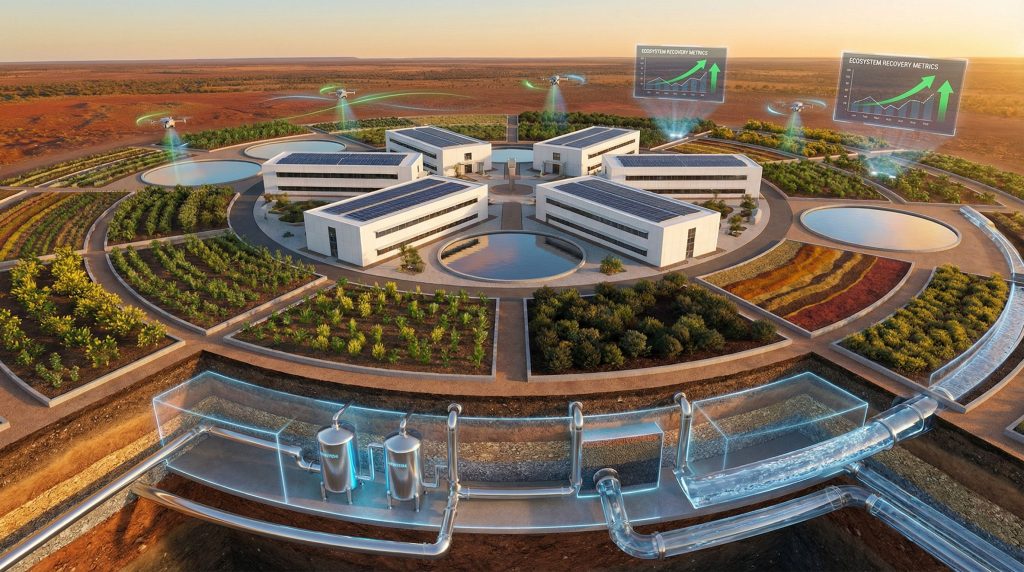
Water resource management represents one of mining's most complex environmental challenges. CERM develops advanced treatment technologies that address contaminated water from multiple sources including acid mine drainage, process water discharge, and groundwater contamination.
Advanced water treatment methodologies employ:
- Biological treatment systems for sulfate reduction and metal precipitation
- Membrane filtration technologies for selective contaminant removal
- Constructed wetland systems for natural treatment processes
- Ion exchange systems for specific metal recovery and water purification
Groundwater protection strategies require comprehensive hydrogeological modelling to predict contaminant transport pathways and develop preventive measures. CERM's research addresses both active mining operations and legacy contamination sites requiring long-term remediation strategies.
Post-mining water quality restoration involves complex geochemical processes that continue for decades after mining cessation. Understanding these long-term processes enables development of closure strategies that minimise environmental liability and maximise ecosystem recovery potential.
Mine Waste Ecological Engineering
Mine waste management has evolved from containment strategies to resource recovery and ecosystem restoration approaches. CERM's research focuses on transforming waste materials into productive ecological systems through innovative mine reclamation innovation techniques.
Bioremediation technologies utilise naturally occurring microorganisms to:
- Neutralise acid-generating materials
- Precipitate dissolved metals from solution
- Establish biogeochemical cycles supporting plant growth
- Create stable soil matrices for vegetation establishment
Phytomining applications represent an innovative approach where specialised plant species extract metals from contaminated soils whilst simultaneously improving soil chemistry and establishing vegetation cover. This dual-purpose technology addresses both environmental restoration and resource recovery objectives.
Tailings management innovations focus on creating geochemically stable materials that support ecosystem development rather than requiring perpetual containment. These approaches transform liability into ecological assets through careful material characterisation and strategic placement protocols.
Climate Adaptation and Carbon Sequestration Research
Climate change impacts mining operations through altered precipitation patterns, extreme weather events, and shifting regulatory frameworks. Furthermore, the mining decarbonisation benefits are becoming increasingly apparent across the sector. CERM's research addresses these challenges through adaptive infrastructure design and carbon sequestration opportunities.
Rehabilitated mining landscapes offer significant carbon sequestration potential through:
- Soil carbon accumulation in reconstructed profiles
- Vegetation carbon storage in established ecosystems
- Geological carbon storage in reactive mineral phases
- Wetland carbon sequestration in constructed treatment systems
Climate resilience strategies for mining infrastructure must account for changing environmental conditions over decades-long operational periods. This requires probabilistic risk assessment methodologies and adaptive management frameworks that accommodate uncertainty.
In addition, renewable energy solutions in mining operations present technical challenges related to intermittent power supply and high energy demand mining processes. CERM's research addresses energy storage solutions, hybrid power systems, and process optimisation strategies that maximise renewable energy utilisation.
What Research Methodologies Does CERM Employ?
Remote Sensing and Ecosystem Assessment Technologies
Environmental monitoring across large mining landscapes requires sophisticated remote sensing capabilities that provide comprehensive data collection at multiple temporal and spatial scales. CERM employs satellite-based monitoring systems for tracking environmental changes over time.
Satellite monitoring technologies provide:
- Multispectral imaging for vegetation health assessment
- Thermal infrared sensing for water temperature monitoring
- Radar interferometry for ground movement detection
- Hyperspectral analysis for mineral identification and mapping
Drone-based ecological surveys enable high-resolution data collection for specific research sites and provide validation data for satellite observations. These systems carry specialised sensors including LiDAR, multispectral cameras, and water quality measurement devices.
Artificial intelligence applications in ecosystem recovery pattern recognition analyse large datasets to identify trends and predict restoration success probabilities. Machine learning algorithms process environmental monitoring data to optimise management strategies and predict long-term outcomes.
High Reliability Organisational Principles in Environmental Management
High Reliability Organisational (HRO) principles provide frameworks for managing complex environmental systems where failures can have severe consequences. CERM applies these principles to environmental management through systematic risk assessment and continuous improvement protocols.
Environmental risk assessment frameworks must account for:
- Uncertainty in environmental processes and long-term outcomes
- Complex interactions between multiple environmental systems
- Cumulative impacts from multiple stressors over time
- Adaptive capacity of ecological systems under changing conditions
Continuous improvement protocols integrate environmental performance monitoring with operational decision-making processes. This approach enables real-time adjustments to management strategies based on environmental feedback.
Safety culture integration with environmental stewardship creates organisational frameworks where environmental protection receives equal priority with worker safety and operational efficiency. This cultural transformation requires systematic training, performance measurement, and incentive alignment.
Landform Design for Functional Resilience
Sustainable mine closure requires landform designs that provide long-term stability without perpetual maintenance. CERM's research addresses geomorphological processes that control landform evolution over centuries-long timeframes.
Geomorphological modelling approaches include:
- Erosion prediction models for surface water flow patterns
- Slope stability analysis for long-term structural integrity
- Sediment transport modelling for downstream impact assessment
- Climate impact scenarios for changing precipitation patterns
Soil reconstruction techniques must recreate functional soil profiles that support plant growth whilst providing appropriate chemical and physical properties. This requires understanding soil formation processes and accelerating natural development through strategic material placement and treatment.
Native vegetation establishment strategies account for local ecological conditions, seed availability, and establishment success probabilities under varying climatic conditions. Success depends on matching plant species requirements with reconstructed soil conditions and long-term climate projections.
Who Leads CERM's Research Initiatives?
Leadership Structure and Expertise Areas
Dr Doug Aitken's appointment as inaugural director positions CERM within the broader landscape of environmental mining research leadership. His role encompasses strategic research direction, industry partnership development, and institutional collaboration coordination.
CERM's leadership structure integrates with the Sustainable Minerals Institute's multidisciplinary approach, providing access to expertise across environmental management, social science research, and health and safety specialisations. This institutional integration enables comprehensive approaches to complex environmental challenges.
Research leadership requires balancing academic research objectives with industry application requirements. This involves translating fundamental research findings into practical technologies that address real-world environmental challenges whilst maintaining scientific rigour.
Research Team Composition and Capabilities
Environmental mining research requires diverse expertise spanning multiple scientific and engineering disciplines. CERM's research capabilities encompass environmental geochemistry, ecological engineering, water resource management, and contamination assessment specialisations.
Core research expertise areas include:
- Environmental geochemistry specialists focusing on metal mobility and bioavailability
- Ecological engineering researchers developing restoration technologies
- Water resource management experts addressing treatment and protection strategies
- Contamination assessment scientists evaluating environmental impacts and remediation options
Research team development requires continuous capability building through postgraduate training programmes, international collaboration, and industry partnership projects. This ensures research capabilities evolve with changing environmental challenges and technological opportunities.
How Does CERM Collaborate With Industry Partners?
Industry Partnership Models
CERM's industry collaboration model builds upon existing partnerships within the Sustainable Minerals Institute framework. The $1.25 million Evolution Mining partnership established in October 2025 provides a significant example of industry-academia collaboration focused on sustainability outcomes.
The Jim Askew Evolution Mining Fellowship represents a five-year initiative targeting unrealised potential in orebody development with specific emphasis on safety, efficiency, and sustainability improvements. This partnership model demonstrates industry commitment to environmental responsibility research.
Partnership funding and research outcomes represent collaborative investments with inherent uncertainties regarding technological development timelines and commercial application success rates.
Joint research project governance structures require balancing academic research freedom with industry application requirements. This involves developing intellectual property protocols that protect both institutional research interests and commercial application opportunities.
Technology transfer mechanisms enable research findings to transition from laboratory development to operational implementation. Success depends on developing robust validation protocols and scaling strategies that address real-world operational constraints.
Government and Regulatory Engagement
Environmental mining research increasingly requires engagement with regulatory frameworks and policy development processes. However, the Centre for Environmental Responsibility in Mining contributes to evidence-based policy development for sustainable mining practices.
Technical advisory services for government agencies provide scientific expertise for regulatory decision-making processes. This involves translating complex research findings into policy-relevant information that supports effective environmental protection frameworks.
Compliance framework development requires understanding both environmental science principles and regulatory implementation challenges. CERM's research addresses practical compliance strategies that achieve environmental objectives whilst maintaining operational feasibility.
Community and Indigenous Engagement Strategies
Community engagement in environmental mining research requires culturally sensitive approaches that respect traditional knowledge systems whilst advancing scientific understanding. This involves developing collaborative research methodologies that integrate multiple knowledge frameworks.
Indigenous engagement protocols emphasise:
- Traditional ecological knowledge integration in research design
- Cultural sensitivity in research methodology development
- Community benefit sharing from research outcomes
- Long-term relationship building beyond individual projects
Community-based monitoring programmes enable local stakeholders to participate directly in environmental data collection and management decision-making processes. These programmes build technical capacity whilst improving research data quality and community acceptance.
The next major ASX story will hit our subscribers first
What Are CERM's Key Research Outcomes and Applications?
Breakthrough Technologies and Innovations
Environmental mining research produces innovations across multiple technology domains including water treatment, waste management, ecological restoration, and environmental monitoring systems. Consequently, these technologies address both current operational challenges and emerging sustainability requirements.
Technological innovation areas include:
- Advanced water treatment systems with improved efficiency and reduced operating costs
- Novel ecological restoration techniques that accelerate ecosystem recovery timelines
- Innovative waste management approaches that transform liabilities into resources
- Enhanced environmental monitoring technologies providing real-time operational feedback
Patent development and intellectual property protection ensure research investments translate into commercial applications whilst maintaining competitive advantages for partner organisations.
Measurable Environmental Impact Improvements
Environmental research success requires quantifiable improvements in ecological outcomes, regulatory compliance performance, and operational efficiency metrics. CERM's research addresses measurable environmental indicators including:
| Environmental Indicator | Measurement Approach | Success Criteria |
|---|---|---|
| Water quality improvement | Chemical analysis protocols | Regulatory standard compliance |
| Ecosystem recovery rates | Biodiversity monitoring | Native species establishment |
| Carbon sequestration potential | Soil and vegetation carbon measurement | Net carbon storage increase |
| Contamination reduction | Geochemical assessment | Contaminant concentration decrease |
Cost-benefit analyses of environmental interventions demonstrate economic value of environmental responsibility investments. These analyses account for both direct costs and long-term liability reduction benefits.
Environmental restoration timelines and success rates involve significant uncertainty due to complex ecological processes and changing environmental conditions.
How Does CERM Compare to Global Environmental Mining Research Centers?
International Research Collaboration Networks
Global environmental mining research requires international collaboration to address common challenges across different geological, climatic, and regulatory contexts. For instance, professional certificate programmes in ESG and social responsibility demonstrate the growing international focus on sustainable mining practices.
International collaboration benefits include:
- Technology transfer of proven methodologies across different operational contexts
- Comparative studies evaluating technique effectiveness under varying conditions
- Knowledge sharing regarding regulatory frameworks and policy development
- Joint funding opportunities for large-scale research initiatives
Research collaboration networks enable rapid dissemination of innovative technologies and best practices across the global mining industry. This accelerates environmental performance improvements industry-wide.
Unique Australian Contributions to Global Mining Sustainability
Australia's diverse geological conditions, extreme climate variations, and complex regulatory frameworks create unique research opportunities that benefit global mining sustainability development. CERM's research addresses challenges specific to Australian conditions whilst developing broadly applicable solutions.
Australian research advantages include:
- Diverse mining environments spanning tropical, arid, and temperate climate zones
- Complex geological conditions requiring innovative technical solutions
- Strong industry-academia collaboration culture facilitating technology transfer
- Indigenous knowledge systems providing alternative perspectives on environmental management
Tropical and arid climate mining solutions address water scarcity, extreme weather resilience, and accelerated biogeochemical processes that affect environmental management strategies globally.
What Future Directions Is CERM Pursuing?
Emerging Research Priorities
Critical minerals environmental impact assessment represents an emerging research priority as global supply chains transition toward renewable energy technologies. The Centre for Environmental Responsibility in Mining addresses environmental challenges specific to lithium, cobalt, rare earth elements, and other materials essential for clean energy infrastructure.
Deep mining environmental challenges require innovative solutions for managing environmental impacts at greater depths where traditional approaches may prove inadequate. This includes understanding groundwater impacts, rock mechanics effects, and waste management challenges at depth.
Circular economy applications in mining waste management transform traditional waste streams into input materials for other industries, reducing environmental impacts whilst creating economic value. This requires developing quality control protocols and market development strategies.
Technology Development Roadmap
Next-generation environmental monitoring systems integrate Internet of Things sensors, artificial intelligence analytics, and automated response systems to provide real-time environmental management capabilities. These systems enable predictive environmental management rather than reactive responses.
Artificial intelligence applications in environmental prediction include:
- Predictive modelling for environmental impact forecasting
- Pattern recognition in large environmental datasets
- Optimisation algorithms for environmental management strategies
- Automated monitoring systems for continuous data collection
Biotechnology innovations for mining sustainability encompass engineered microorganisms for metal extraction, bioremediation enhancement, and waste treatment optimisation. These biological approaches offer sustainable alternatives to traditional chemical processing methods.
Strategic Partnerships and Expansion Plans
International collaboration expansion focuses on developing research partnerships with institutions addressing similar environmental challenges in different geological and climatic contexts. This enables comparative research and technology validation across diverse operational conditions.
Moreover, industry evolution trends indicate increasing emphasis on environmental responsibility and sustainability across the mining sector. Industry partnership diversification involves engaging with companies across the mining value chain including exploration companies, equipment manufacturers, and environmental service providers.
Research infrastructure development priorities include advanced analytical facilities, field research stations, and technology demonstration sites that enable comprehensive environmental research capabilities.
Future research directions and partnership development involve inherent uncertainties regarding funding availability, technological feasibility, and market demand for environmental technologies.
How Can Organizations Engage With CERM's Research?
Academic Collaboration Opportunities
Research collaboration with CERM provides access to specialised environmental mining expertise and advanced research facilities. Academic partnerships enable joint research projects, student exchange programmes, and collaborative publication opportunities.
Postgraduate research programmes offer:
- PhD research opportunities in environmental mining specialisations
- Master's degree programmes with industry-focused research projects
- Research training programmes for practising professionals
- International student exchange arrangements with partner institutions
Visiting researcher arrangements provide opportunities for international academics to access CERM's research facilities and collaborate on specific projects. These arrangements facilitate knowledge transfer and international research network development.
Industry Partnership Pathways
Contract research services enable companies to access CERM's specialised expertise for addressing specific environmental challenges. These services range from technical consulting to comprehensive research programmes addressing complex environmental problems.
Technology licensing opportunities include:
- Patent licensing for innovative environmental technologies
- Technical expertise transfer through consulting arrangements
- Joint development agreements for commercial technology applications
- Pilot project collaboration for technology validation and refinement
Professional development programmes provide training opportunities for industry professionals seeking to enhance their environmental mining expertise. These programmes combine academic knowledge with practical application experience.
Funding and Grant Application Support
Research proposal development requires understanding both scientific merit criteria and practical application potential. The Centre for Environmental Responsibility in Mining provides expertise in developing competitive grant applications that address both academic research standards and industry relevance requirements.
Grant application support includes:
- Proposal writing assistance for government and industry funding opportunities
- Technical review of research methodology and feasibility assessment
- Partnership development with complementary research institutions and industry partners
- Budget development for comprehensive research programme implementation
Intellectual property protection strategies ensure research investments result in protected competitive advantages whilst maintaining opportunities for collaborative development and commercialisation.
The integration of natural capital operations into mining practices represents another critical area where organisations can benefit from CERM's expertise and collaborative research opportunities.
Organisations interested in environmental responsibility in mining research can explore collaborative opportunities through the University of Queensland's Sustainable Minerals Institute, which provides comprehensive information about current research projects, industry partnerships, and engagement opportunities in mining sustainability research.
Looking to Stay Ahead of Australia's Environmental Mining Innovation?
Discovery Alert's proprietary Discovery IQ model delivers instant notifications on significant ASX mineral discoveries, including companies developing breakthrough environmental mining technologies and sustainable extraction methods. Position yourself to identify actionable investment opportunities in Australia's evolving mining sustainability sector by exploring Discovery Alert's dedicated discoveries page, showcasing historic examples of exceptional returns from major mineral discoveries.