July 17, 2026
Reading Mining OEM Results Requires a Different Lens
Most industries report quarterly results in a single currency, making peer-to-peer comparisons relatively straightforward. The global mining equipment sector is not that industry. When two of the world's largest original equipment manufacturers report from Stockholm in Swedish kronor, yet generate the vast majority of their revenues in US dollars, Australian dollars, and Brazilian reals, headline figures can tell a story that is almost the inverse of operational reality. Understanding this dynamic is the starting point for any serious assessment of the Epiroc and Sandvik June quarter results.
The June 2026 quarter delivered a broadly positive underlying picture for both Epiroc and Sandvik Mining and Rock Excavation Technology (SMR), with order intake climbing, revenues rising, and profitability expanding in organic terms. Yet both companies saw share price pressure following the releases, a reaction that reflects not operational failure but rather the persistent expectations gap that defines how financial markets process currency-distorted industrial results.
When big ASX news breaks, our subscribers know first
Why Currency Translation Is the First Variable to Isolate
Before any performance metric from a Swedish OEM can be meaningfully interpreted, the Swedish krona's behaviour must be accounted for. The krona has experienced sustained weakness against the US dollar, euro, and Australian dollar over recent years, and this creates a mechanical headwind when foreign-currency revenues are translated back into SEK for reporting purposes.
For Epiroc, this effect was substantial during the June quarter. A business generating genuine organic revenue growth in the mid-single digits simultaneously reported a headline revenue decline when measured in krona terms. The gap between organic performance and reported performance ran to approximately nine percentage points, a distortion significant enough to invert the directional signal for investors not applying a currency-adjusted framework.
Analytical note for investors: A headline revenue decline of several percentage points and organic revenue growth of five percent or more are not contradictory. They can coexist when the reporting currency has depreciated materially against the currencies in which revenues are earned. Fixed-currency metrics are the operationally meaningful benchmark.
This is not a nuance unique to one quarter. Swedish industrial manufacturers have faced this structural reporting challenge persistently, and it represents one reason why sell-side analysts covering Epiroc and Sandvik consistently weight organic growth rates, adjusted operating margins, and fixed-currency order intake above headline SEK figures. Furthermore, understanding the relationship between commodity prices and mining performance adds critical context when interpreting these currency-distorted results.
Epiroc June Quarter: Organic Momentum Behind a Misleading Headline
Unpacking the Financial Scorecard
Epiroc's June quarter results, when stripped of currency effects, revealed a business sustaining genuine demand momentum. Order intake reached SEK 17.3 billion (approximately US$1.8 billion), rising 13% on a reported basis, a figure that itself overstates simplicity since currency movements affect the year-on-year comparable differently depending on the direction of FX movement across periods.
Revenue reached SEK 15.13 billion, up 10% from the prior comparable period. Operating profit rose meaningfully, and the company demonstrated resilience in its core mining-facing divisions despite pressure from a weaker construction market. For additional context on Epiroc's broader financial performance, the Epiroc Q2 2024 interim report provides useful historical benchmarking.
| Metric | Reported Result | Organic Growth | Year-on-Year Direction |
|---|---|---|---|
| Order Intake | SEK 17.3B (~US$1.8B) | Strong mid-single digit | +13% reported |
| Revenue | SEK 15.13B | Positive on fixed-FX basis | +10% reported |
| Operating Margin | Reported under pressure | Adjusted view more favourable | Compressed vs. prior year |
| Earnings Per Share | Declined on reported basis | Organic picture stronger | Impacted by FX translation |
The margin story is where the complexity deepens. On a headline basis, operating margin compression was evident, reflecting the combination of FX translation effects, input cost pressures, and geographic revenue mix. On an adjusted basis, however, Epiroc maintained margins closer to 20%, indicating that the underlying cost structure and pricing power of the business remained broadly intact.
The Divisional Picture: Service Stability and Aftermarket Resilience
Epiroc operates across two primary divisions, and their June quarter dynamics diverged in instructive ways.
The Equipment and Service division generated order intake growth organically in the mid-single digits despite a headline decline in reported terms. The aftermarket service component of this division played a stabilising role, with long-term service agreements providing a revenue floor that pure equipment sales cannot replicate. Aftermarket income is structurally more predictable, carries higher margins, and is less sensitive to mining company capital expenditure cycles than new machine orders.
The Tools and Attachments division produced a counterintuitive result: revenue declined modestly in headline terms, yet operating profit increased. This outcome reflects a deliberate shift in product mix toward higher-margin consumables and specialised attachments, combined with pricing discipline. It is an outcome that sophisticated operators target precisely but rarely achieve consistently, and its appearance in a period of revenue headwinds suggests meaningful underlying operational quality.
Mining vs. Construction: A Structural Demand Divergence
One of the less-discussed dynamics within Epiroc's June quarter results was the extent to which its mining-sector exposure buffered against pronounced construction market weakness. Global construction activity contracted in key markets during the period, weighing on equipment demand across the sector.
Epiroc's portfolio weighting toward mining, which skews toward longer replacement cycles, higher asset values, and more contractual aftermarket relationships, insulated the overall business from the full force of this downturn. This divergence reinforces a broader investment thesis: in a late-cycle environment where discretionary construction activity slows ahead of monetary easing, mining OEMs with high mining-sector revenue concentration outperform peers exposed to construction on a relative basis.
Sandvik Mining and Rock Excavation Technology: Record Revenue and the Aftermarket Advantage
Clearing Up the Entity Confusion
Important distinction: Sandvik Mining and Rock Excavation Technology (SMR) is a business division focused specifically on mining equipment and services. It operates within, but is distinct from, Sandvik AB (SAND.ST), the broader Swedish industrial conglomerate. When mining-sector analysts reference Sandvik's record June quarter performance, they are describing SMR's results, not the consolidated Sandvik AB group figures. Conflating the two leads to misinterpretation of both entities.
SMR's Record Quarter: The Numbers and the Drivers
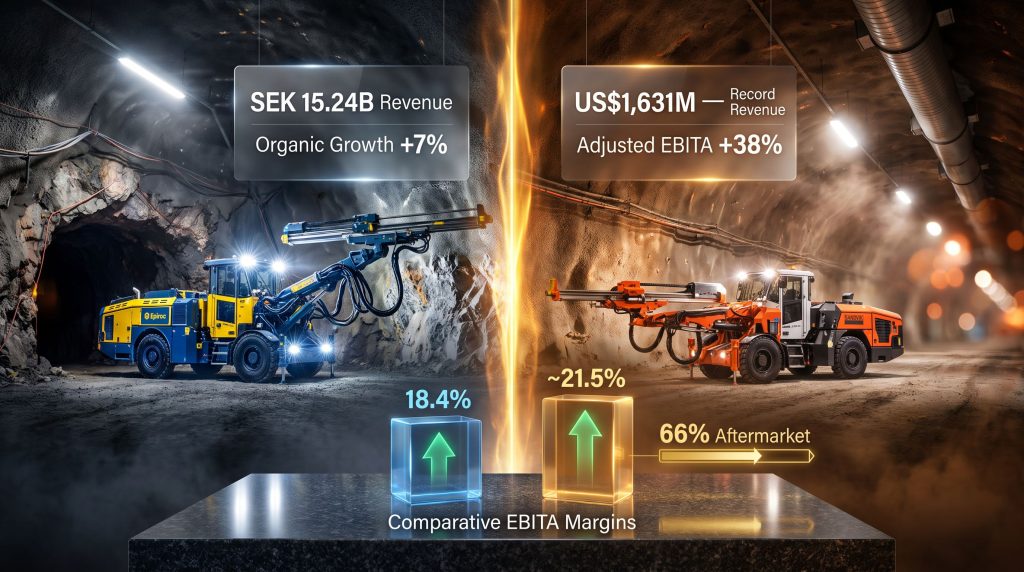
SMR delivered a standout June quarter, achieving record revenue of US$1.631 billion and recording its second-highest order intake on record at US$1.621 billion. Adjusted EBITA surged 38% to US$352 million, with EBITA margin expanding from approximately 17.5% to around 21.5%, a gain of roughly 400 basis points. Morningstar's analysis of both businesses, which recently upgraded its moat rating to wide for both Sandvik and Epiroc, underscores the structural competitive positioning these results reflect.
| SMR Metric | June Quarter Result | Year-on-Year Change |
|---|---|---|
| Revenue | US$1,631M | Record high |
| Order Intake | US$1,621M | 2nd highest on record |
| Adjusted EBITA | US$352M | +38% |
| EBITA Margin | ~21.5% | Up ~400 basis points |
| H1 Order Intake Growth | +9% |
The 38% EBITA growth against revenue growth of a lower magnitude signals significant operating leverage, a phenomenon that occurs when fixed costs are absorbed across a higher revenue base while variable costs are managed tightly. In capital-intensive manufacturing, this kind of leverage is a hallmark of structural competitiveness rather than cyclical luck.
A critical advantage for SMR compared to Epiroc in period-to-period reporting is currency denomination. SMR reports primarily in US dollars, which eliminates the SEK translation drag that obscures Epiroc's organic performance. This structural difference makes SMR results easier for global investors to interpret at face value, and may partially explain differential investor sentiment between the two businesses despite broadly comparable underlying demand conditions.
The 66/34 Aftermarket Split: Why This Number Matters More Than Any Other
Perhaps the single most strategically significant data point from SMR's June quarter results was the revenue composition: 66% of quarterly revenue derived from aftermarket services, with only 34% from new equipment sales. This is not a marginal shift in revenue mix; it represents a fundamental characteristic of a mature, installed-base-driven business model.
Consider what a 66% aftermarket revenue share actually signals:
- A large and active global installed base generating recurring demand for parts, consumables, and service contracts
- Revenue streams that are structurally insulated from new equipment order cyclicality
- Customer relationships that are deeply embedded through proprietary parts ecosystems and monitoring platforms
- Margin profiles that are structurally superior to equipment-sale margins, since aftermarket services carry lower capital intensity
For operators evaluating OEM partnerships, a high aftermarket share also functions as a proxy for equipment reliability and support network quality. Mining companies do not sign long-term service agreements with OEMs whose equipment underperforms. The 66% figure is therefore simultaneously a financial metric and a customer satisfaction signal.
Geographic Demand: Australia, South America, and the Next Frontier
SMR's record quarter was not uniformly distributed across geographies. Australia emerged as the standout growth market, driven by sustained capital investment in iron ore, copper, and gold operations. The country's long-cycle mine development projects, combined with a well-established aftermarket service infrastructure, created conditions for both equipment sales and service revenue growth.
South America and Europe also contributed positively, reflecting commodity-specific investment cycles in copper and lithium in South America and a degree of infrastructure investment recovery in European markets. The geographies that remain underpenetrated relative to their resource endowment, parts of Sub-Saharan Africa and Central Asia in particular, represent a meaningful next-phase growth opportunity for OEMs capable of deploying service infrastructure ahead of equipment order cycles.
Head-to-Head: Epiroc vs. Sandvik SMR on the Metrics That Matter
| Performance Dimension | Epiroc | Sandvik SMR |
|---|---|---|
| Revenue Scale | SEK 15.13B (~US$1.6B reported) | US$1.631B (Record) |
| Order Intake Growth | +13% reported | 2nd highest on record |
| Operating Margin | Under pressure on headline basis | ~21.5% EBITA (record vicinity) |
| Profit Growth | Positive on adjusted basis | +38% adjusted EBITA |
| Aftermarket Revenue Share | Significant; not separately disclosed | 66% of total revenue |
| Currency Reporting | SEK (FX drag significant) | USD (minimal translation distortion) |
The margin divergence between the two OEMs in this period warrants careful interpretation. SMR's margin expansion to approximately 21.5% against Epiroc's adjusted margin of around 20% represents a gap, but not necessarily a structural competitive disadvantage for Epiroc. SMR's USD reporting and higher disclosed aftermarket concentration contributed mechanically to its margin outcome in ways that are not directly replicable by Epiroc without a change in reporting currency or further aftermarket revenue disclosure.
What is unambiguous is that both businesses demonstrated positive organic order growth, confirming that mining sector demand for equipment and services remained constructive through the June 2026 quarter despite macro uncertainty.
Why Shares Declined Despite Broadly Positive Results
The share price responses to both companies' results illustrated a dynamic that repeats itself regularly in mining OEM reporting seasons: the expectations gap. When analyst consensus models are built on a specific revenue, margin, or order intake number, and reported figures come in slightly below that number even if they are operationally positive in absolute terms, algorithmic and institutional selling pressure follows.
Several specific factors amplified this dynamic:
- Margin trajectory concerns were more influential than absolute margin levels. Investors tracking Epiroc's margin compression from prior-year peaks focused on the directional signal rather than the adjusted level.
- Forward guidance language was interpreted cautiously, with references to ongoing FX headwinds and uncertain macro conditions weighing on sentiment.
- Currency-adjusted vs. reported divergence created confusion for less sophisticated market participants, with headline figures initially dominating newswire coverage before organic metrics received attention.
- Swedish industrial sector sentiment more broadly influenced trading, with the krona's weakness creating a persistent discount to Swedish-listed industrials among foreign currency investors.
The next major ASX story will hit our subscribers first
Strategic Implications: The Three Competitive Battlegrounds for H2 2026 and Beyond
Aftermarket Expansion as the Primary Value Driver
Both Epiroc and Sandvik SMR are investing heavily in aftermarket service capability, and for rational reasons. Aftermarket revenue provides a counter-cyclical buffer when new equipment orders soften, carries higher margins than hardware sales, and generates the customer intimacy necessary to secure the next equipment purchase cycle. The OEM that most effectively converts its installed base into long-term service agreement coverage will hold a durable earnings advantage regardless of short-term commodity price fluctuations.
The emerging battleground within aftermarket services is digital monitoring and predictive maintenance in mining. OEMs deploying telematics systems that continuously collect equipment health data can offer condition-based maintenance contracts, reducing unplanned downtime for operators while generating high-frequency service revenue for themselves. This technology layer is becoming a meaningful source of competitive differentiation.
Automation and Electrification: The Technology Premium
Autonomous and battery-electric mining equipment commands a meaningful price premium over conventional diesel equivalents, and both Epiroc and Sandvik SMR have invested substantially in this technology layer. Epiroc's AutoMine platform and Sandvik SMR's automation and optimisation systems represent not merely product features but ecosystem plays, where the hardware, software, and service contract are bundled into integrated offerings that raise switching costs substantially.
The financial significance of this premium is underappreciated by investors focused on headline revenue. An autonomous haulage or drilling system sold at a 20–30% premium to its conventional equivalent, with a higher-margin software subscription and enhanced service agreement attached, can generate meaningfully more lifetime value per unit than the capital equipment revenue line alone suggests. In addition, mining automation trends indicate that adoption rates are accelerating across multiple commodity sectors, further expanding the addressable market for premium autonomous systems.
Battery-electric mining equipment is gaining particular traction, driven by ventilation cost reductions, zero-emission regulatory pressure in multiple jurisdictions, and total cost of ownership calculations that increasingly favour electrification over diesel at depth. This transition creates a multi-year replacement cycle opportunity for OEMs positioned with credible electric product lines.
Currency Risk: A Structural Challenge Without a Simple Solution
For Epiroc specifically, the SEK reporting currency will continue to create periodic headline volatility that obscures organic performance. Natural hedging through cost structures in local currencies, financial hedging programmes, and investor education around fixed-currency metrics are the available levers. None eliminates the distortion entirely.
Investors benchmarking Swedish OEM performance against US-dollar-reporting peers should routinely apply currency adjustments before drawing conclusions about relative competitive positioning. The risk of misallocating capital based on currency-distorted comparisons is non-trivial, particularly for generalist fund managers without deep sector expertise.
What the Epiroc and Sandvik June Quarter Results Signal for the Mining Equipment Cycle
The broader takeaway from the Epiroc and Sandvik June quarter results extends beyond the specific financials of two Swedish companies. The quarter confirmed that mining sector capital expenditure remained constructive, with order intake at both OEMs pointing to continued operator investment in productivity, safety, and fleet renewal.
Copper, gold, and iron ore all supported healthy equipment demand in their respective geographies. Battery metals, while experiencing price volatility, continued to drive long-cycle project investment in lithium and nickel mining regions. The construction sector provided a genuine offset, with weakness in that market dragging on Epiroc's blended results in a way that will ease if interest rate reductions stimulate infrastructure activity in H2 2026.
Furthermore, AI-driven mining efficiency initiatives are increasingly embedded within both companies' product roadmaps, adding another layer of value creation that headline financial metrics do not yet fully capture. The most durable insight from the quarter is this: the mining OEM sector is not a simple cyclical play on commodity prices.
It is a structural growth story driven by the intersection of resource depletion requiring deeper and more complex mines, electrification mandates requiring fleet replacement, and automation adoption requiring technology-embedded equipment ecosystems. Companies positioned at the convergence of these forces, as both Epiroc and Sandvik SMR demonstrably are, occupy a defensible position in the global industrial landscape regardless of short-term currency noise.
This article is intended for informational and analytical purposes only. It does not constitute financial advice. Past performance of the companies discussed is not indicative of future results. Investors should conduct their own due diligence and consult qualified financial advisers before making investment decisions. All financial figures referenced are drawn from publicly available company reporting and independent industry sources.
Want to Know Which ASX Mining Companies Could Benefit From the Next Major Discovery?
Discovery Alert's proprietary Discovery IQ model scans ASX announcements in real time, instantly identifying significant mineral discoveries across gold, copper, iron ore, and more than 30 other commodities — turning complex data into actionable investment insights before the broader market reacts. Explore Discovery Alert's discoveries page to see how historic mineral discoveries have generated substantial returns, and begin a 14-day free trial to position yourself ahead of the next major find.