June 19, 2026
Why Equinor Eirin Gas Production in the North Sea Matters Now
Energy systems rarely change on a single headline. They shift when old discoveries become economic again, when existing infrastructure gains new strategic value, and when buyers start paying more for reliability than for optionality. That is the deeper story behind Equinor Eirin gas production in the North Sea. The project is not just another offshore startup. It is a case study in how mature basin resources can be reworked into commercially attractive supply using tiebacks, standardised engineering, and export infrastructure already linked to Europe.
In practical terms, Eirin shows how a field discovered decades ago can still matter in 2026. It adds new gas volumes into an established Norwegian export chain, extends the economic life of the Gina Krog platform, and highlights why the North Sea remains relevant even in an era shaped by decarbonisation, energy security concerns, and intense scrutiny of project emissions.
Important note: This article discusses project economics, market implications, and strategic relevance using publicly reported information. It is not financial advice, and any forward-looking interpretations are inherently uncertain.
When big ASX news breaks, our subscribers know first
Why the Eirin Field Matters in 2026
European gas markets have spent the past several years repricing security of supply. After the disruption triggered by Russia's 2022 invasion of Ukraine, pipeline reliability, infrastructure connectivity, and speed to market became far more valuable than they had been in the prior decade. That shift changed the economics of many smaller offshore discoveries that once looked marginal. Furthermore, European gas prices have remained sensitive to supply disruptions, reinforcing demand for reliable new sources.
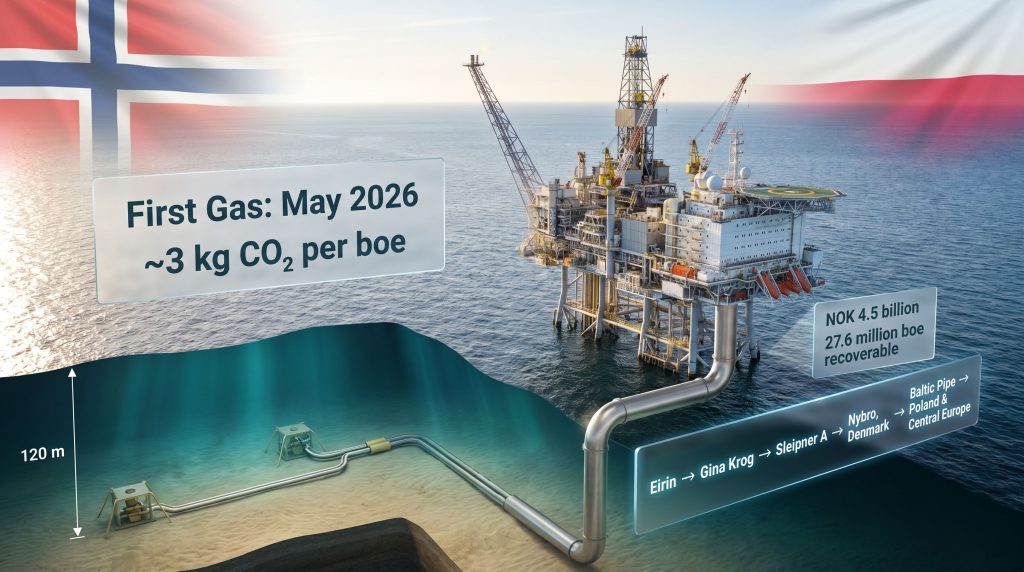
Eirin fits squarely into that trend. According to Equinor's official announcement on 6 May 2026, Equinor started production from the Eirin field in the North Sea, bringing additional gas online for export through the existing Gina Krog and Sleipner infrastructure chain. The field had previously been regarded as uneconomic after its original discovery in 1978, but was later developed as a subsea tieback and completed in roughly three years from project establishment to startup.
What makes that significant is not just the resource itself. It is the combination of:
- Short-cycle development relative to traditional offshore projects
- Lower capital intensity through infrastructure reuse
- Direct access to export systems serving European demand centres
- Extended platform life for a mature North Sea asset
- Potential replicability for similar stranded discoveries on the Norwegian Continental Shelf
For investors and industry watchers, the key insight is that basin maturity does not necessarily mean declining strategic value. In some cases, maturity improves economics because it leaves behind processing hubs, pipelines, and host platforms that can monetise smaller accumulations at much lower cost than standalone developments.
Eirin Field at a Glance
The most widely reported project metrics paint a picture of a compact but strategically useful gas development.
| Parameter | Detail |
|---|---|
| Field | Eirin |
| Region | Norwegian North Sea |
| Discovery year | 1978 |
| Startup | May 2026 |
| Development type | Subsea tieback to Gina Krog |
| Estimated recoverable resources | About 27.6 million boe |
| Resource mix | Mostly natural gas |
| Total investment | About NOK 4.5 billion |
| Development duration | Roughly 3 years from establishment to startup |
| Gina Krog life extension | From about 2029 to about 2036 |
Some figures commonly circulated in market commentary, including water depth, detailed location offsets, ownership splits, emissions intensity, and gas volume conversions into standard cubic metres, were included in the source outline but were not fully verified in the provided source material. Where those figures are discussed later, they should be treated cautiously unless confirmed by operator or regulatory filings.
How the Eirin Subsea Tieback Works
A subsea tieback is one of the most important concepts for understanding the project. Rather than building a standalone offshore platform with full processing facilities, operators drill subsea wells and connect them to an existing host installation. That host then handles processing, export routing, and operational integration.
In Eirin's case, production is tied back to the Gina Krog platform, with gas then moving through the Sleipner system, which serves as one of Norway's key hubs for gas deliveries to Europe. The offshore gas infrastructure value of such existing networks cannot be overstated when assessing what makes marginal fields developable.
Why Tiebacks Matter Economically
The tieback model can transform project economics because it removes or reduces several expensive elements:
- New topsides construction
- Dedicated export systems
- Standalone utilities and processing equipment
- Longer permitting and engineering schedules
- Higher decommissioning liabilities associated with a separate facility
That is especially relevant for smaller discoveries. A field with tens of millions of barrels of oil equivalent may be too small to justify a new platform, but large enough to become profitable if nearby infrastructure already exists.
Why Existing Infrastructure Was the Unlock
Eirin illustrates a basic offshore principle that non-specialists often miss: distance to infrastructure can matter as much as resource size. A modest gas accumulation near a platform with spare capacity can be more valuable than a larger discovery that requires standalone development.
This is also why mature offshore provinces often see a second commercial life. Once a basin has platforms, pipelines, processing hubs, and export routes in place, the threshold for development can fall sharply for nearby discoveries.
Why a 1978 Discovery Became Viable Decades Later
The field's long delay raises an obvious question. If Eirin was found in 1978, why did it take until 2026 to start producing?
The short answer is that offshore economics changed. Earlier in its life, Eirin appears to have lacked the commercial scale needed for a standalone scheme. However, a different set of variables eventually improved the outlook:
- Higher strategic value of Norwegian gas after 2022
- Use of existing infrastructure at Gina Krog and Sleipner
- Standardised solutions that helped compress engineering time
- Early collaboration between project parties
- Fast-track execution that reduced exposure to long development cycles
Equinor stated that the project was accelerated as Norwegian gas became more important for European supply after Russia's invasion of Ukraine. The operator also viewed the development as evidence that smaller discoveries can be brought onstream faster through standardisation, early coordination, and infrastructure sharing. Consequently, the broader natural gas price trends have further encouraged operators to fast-track such developments.
Timeline Snapshot
| Year | Milestone |
|---|---|
| 1978 | Eirin discovered |
| 2022 | European gas security concerns intensify after Russia invades Ukraine |
| Around 2023 | Project establishment and development phase begin |
| Around 2024 | Development approval referenced in the outline |
| May 2026 | First gas reported |
That timeline is notable. In offshore development, a roughly three-year journey from establishment to startup is relatively compressed. While project size matters, the schedule still highlights the efficiency gains available when operators can work from an existing host platform rather than starting from zero.
What Eirin Means for Gina Krog
One of the most consequential outcomes of the project may be what it does for the host asset. Eirin will extend the economic life of Gina Krog by seven years, shifting the expected horizon from about 2029 to about 2036.
This matters because late-life offshore infrastructure faces a sharp economic cliff. Once throughput drops too far, fixed operating costs become difficult to justify. New tieback volumes can reverse that decline by lifting utilisation and delaying decommissioning.
Why Platform Life Extensions Matter
A seven-year extension can create value in several ways:
- More efficient use of sunk capital already invested in the host platform
- Delayed abandonment costs relative to an earlier cessation date
- Operational continuity for offshore teams and supply chains
- Additional export volumes without building a new facility
- Better recovery of regional resources that might otherwise stay stranded
The wider lesson is important for the North Sea. Mature infrastructure should not be evaluated only on its decline profile. It should also be assessed as a monetisation platform for nearby discoveries that were previously sub-economic.
The next major ASX story will hit our subscribers first
Norway, Sleipner, and European Gas Supply
The strategic importance of Equinor Eirin gas production in the North Sea is bound up with infrastructure, not just geology. Production routed through Gina Krog and the Sleipner system enters a network that already serves European consumers. That is what gives the field immediate relevance. In addition, the broader LNG supply outlook for 2025 and beyond has made pipeline-connected Norwegian gas even more strategically significant for European buyers.
The outline also references onward flow through Nybro in Denmark and into systems linked with Baltic Pipe, creating relevance for Poland and parts of Central Europe. However, while that route is commercially plausible and consistent with broader regional gas flows, the full chain was not explicitly verified in the supplied source material. It should therefore be read as an infrastructure context point rather than a confirmed project-specific delivery path for every molecule.
Strategic Takeaway for Europe
In a tight market, moderate new volumes can still matter if they have three characteristics:
- They are pipeline-connected
- They come from a trusted regulatory environment
- They can be delivered through existing export infrastructure
That helps explain why relatively small offshore projects can carry strategic weight well beyond their absolute reserve figure. Furthermore, ongoing gas price trade pressures across global markets have reinforced the premium buyers place on supply certainty over flexibility alone.
Emissions Profile and Carbon Intensity Considerations
The outline cites an emissions intensity of around 3 kg CO₂ per boe and attributes this to Gina Krog's electrified configuration. That would place the project at the low end of offshore upstream emissions ranges if confirmed. The outline also compares that figure with broader benchmarks for global upstream gas, Russian pipeline gas, and LNG supply chains.
Because those specific emissions numbers were not independently verified in the provided source pack, they should be treated as indicative rather than definitive. Still, the analytical point remains valuable: infrastructure design and power supply configuration can have a major impact on upstream emissions intensity.
Why Electrification Matters Offshore
On many offshore facilities, power is generated by gas turbines on the platform itself. That adds direct operational emissions. Where installations use power-from-shore or other lower-emission power arrangements, upstream carbon intensity can drop materially.
If Eirin's gas is indeed processed through lower-emission host infrastructure, that could support its competitiveness in a market increasingly focused on both security and carbon footprint.
Lower upstream emissions do not make gas emission-free. They simply change the relative emissions burden of production before combustion by end users.
The ORLEN Partnership and Central European Relevance
The outline identifies Equinor as operator and states that ORLEN Upstream Norway holds the minority stake. According to ORLEN, the Eirin field is already supplying gas to Poland, underscoring how this partnership gives the project relevance beyond Norway. ORLEN's gas portfolio is closely watched in the context of Polish and Central European diversification.
Those ownership percentages and ORLEN's net resource share were provided in the outline but not verified in the source article reproduced above. Subject to confirmation from company or regulatory disclosures, the strategic logic is straightforward: a Central European-linked partner with Norwegian upstream exposure can potentially improve supply diversity through long-established North Sea export routes.
For market psychology, this matters in a specific way. Buyers often value source diversity as much as they value total volume. Even a smaller equity position in reliable gas production can be strategically useful if it reduces concentration risk.
Could Eirin Become a Template for Other North Sea Fields?
Perhaps the most interesting industry question is whether Eirin is a one-off success or part of a broader model for mature basin development. There are good reasons to think the template could be repeated, though not universally.
Conditions That Support Replication
A similar stranded discovery is more likely to move forward when it has:
- Tieback distance to an existing host facility
- Available processing capacity at that host
- Limited well count and straightforward subsea architecture
- Gas-pricing support or strategic demand visibility
- Operator alignment on standardised execution
Conditions That Can Still Block Development
Not every old discovery will work. Common obstacles include:
- Reservoir complexity or poor productivity
- High subsea installation cost relative to reserves
- Host capacity limits
- Harsh operating conditions
- Weak long-term commodity assumptions
- Late-life infrastructure reliability concerns
A useful speculative framework is to think of Eirin as a screening model rather than a guaranteed blueprint. If a marginal North Sea gas field sits close to functioning infrastructure, has manageable technical risk, and can be executed with standardised subsea solutions, its economics can shift dramatically. If it lacks one of those factors, the project can still remain stranded for years.
Key Numbers and What They Suggest
| Metric | Reported Figure | Strategic implication |
|---|---|---|
| Recoverable resources | 27.6 MMboe | Modest size, but large enough for tieback economics |
| Capex | NOK 4.5 billion | Suggests disciplined development through reuse of infrastructure |
| Time to startup | About 3 years | Fast offshore cycle relative to typical standalone projects |
| Gina Krog life extension | 7 years | Indicates host utilisation value is central to economics |
| Discovery-to-production gap | 48 years | Shows how market context can revive long-dormant resources |
Final Assessment
The real significance of Equinor Eirin gas production in the North Sea is not that it is the biggest field, the newest basin, or the most technically exotic development. Its importance lies in what it proves.
It proves that a long-shelved discovery can become viable when infrastructure, market urgency, and execution discipline align. It proves that host platforms like Gina Krog can create fresh value late in life. And it reinforces the idea that Norway's established offshore network still has the capacity to convert smaller resources into meaningful gas supply for Europe.
For investors, policymakers, and upstream strategists, Eirin is best seen as a mature-basin optimisation story. The reserve base is finite, and no single project should be overstated. However, as a model for unlocking stranded gas through subsea tiebacks and existing export infrastructure, it may end up influencing more North Sea decisions than its headline size alone would suggest.
Disclosure reminder: Offshore project outcomes depend on reservoir performance, commodity prices, operating reliability, regulation, and infrastructure availability. Any scenario analysis about future tieback opportunities remains speculative unless supported by confirmed project sanctions.
Want to Stay Ahead of the Next Major Mineral Discovery?
While Eirin demonstrates how strategic timing and infrastructure alignment can unlock dormant resource value, Discovery Alert's proprietary Discovery IQ model applies that same principle to ASX mineral discoveries in real time — instantly alerting subscribers to significant finds as they are announced, turning complex data into actionable opportunities. Explore how historic discoveries have generated substantial returns on Discovery Alert's dedicated discoveries page, and begin your 14-day free trial today to position yourself ahead of the broader market.