June 4, 2026
What Does Equinor's Latest Norwegian Sea Discovery Mean for Regional Energy Security?
Equinor discovers hydrocarbons southwest of Brønnøysund in a significant development that highlights the continuing potential of Norwegian Continental Shelf exploration. The global energy infrastructure landscape faces unprecedented transformation as traditional hydrocarbon resources intersect with evolving market demands for supply security and technological innovation. Against this backdrop, recent exploration activities in the Norwegian Sea demonstrate how established operators continue to pursue strategic resource development within existing operational frameworks. Understanding the technical and commercial implications of new discoveries requires analysis of geological characteristics, infrastructure synergies, and regional development strategies that extend beyond immediate resource assessment.
Geological Context of the Tyrihans Øst Prospect
The Tyrihans Øst prospect represents a significant exploration target within the broader Norwegian Continental Shelf development framework. Located approximately 250 kilometers southwest of Brønnøysund, this discovery adds to the growing portfolio of Norwegian Sea hydrocarbon resources identified through systematic exploration programs.
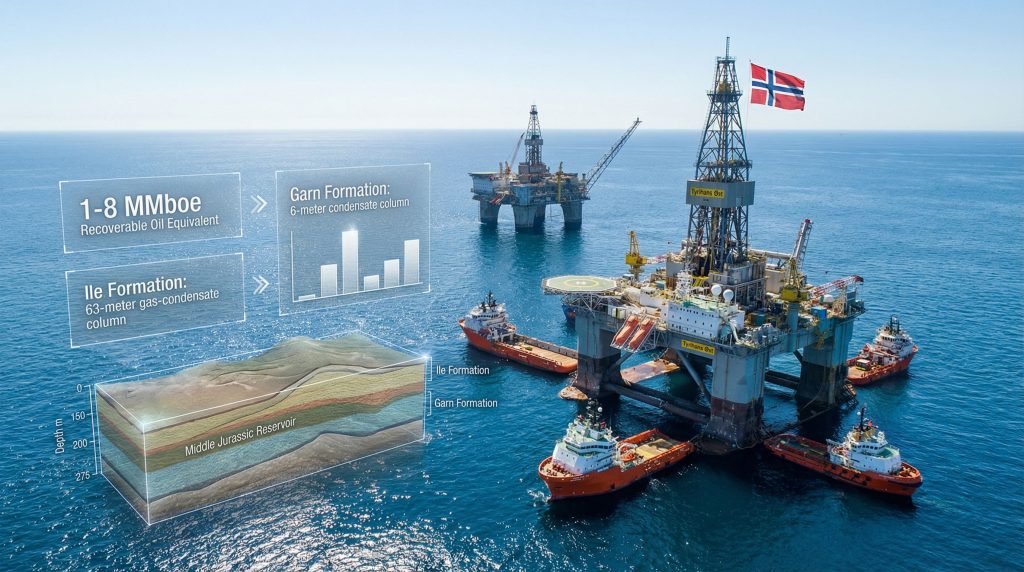
The geological setting encompasses Middle Jurassic reservoir formations within established structural trends. Exploration well 6407/1-B-2 H reached a measured depth of 4,590 meters with a true vertical depth of 4,045 meters below sea level. Drilling operations, conducted by the Transocean Encourage rig in 275 meters of water, targeted multiple formation intervals within the Fangst Group geological sequence.
Formation analysis reveals distinct hydrocarbon accumulations across different stratigraphic intervals:
- Garn Formation (Primary Target): Approximately 6-meter condensate-light oil column in sandstone with poor to moderate reservoir properties
- Île Formation (Secondary Target): Approximately 63-meter gas-condensate column in sandstone demonstrating poor to good reservoir quality variation
- Rør Formation: Well termination point providing structural context for trap integrity assessment
The discovery's proximity to existing Norwegian Sea infrastructure creates immediate strategic value through potential development synergies. Furthermore, the technical specifications place this prospect within established operational parameters for subsea development concepts utilizing proven Norwegian Sea technology applications.
Strategic Significance of Production License PL 1121
Production License PL 1121 was awarded during the 23rd Licensing Round in February 2021, representing strategic positioning by the licensee group within the Norwegian Sea exploration portfolio. The partnership structure demonstrates balanced risk allocation among established Norwegian Continental Shelf operators:
- Equinor ASA: 40% (operator)
- Vår Energi ASA: 30%
- DNO Norge AS: 30%
This ownership configuration reflects each partner's strategic objectives and technical capabilities within Norwegian Sea operations. Equinor's operator role leverages extensive regional experience and infrastructure access, while Vår Energi and DNO Norge contribute specialized technical expertise and financial capacity for exploration risk management.
The first-well drilling strategy employed advanced horizontal drilling techniques to maximize reservoir exposure across multiple formation targets. However, the decision to temporarily plug and abandon the exploration well while considering production well drilling from the same location indicates operator confidence in commercial development potential despite challenging reservoir characteristics.
When big ASX news breaks, our subscribers know first
How Do Reserve Estimates Impact Norwegian Continental Shelf Development Strategy?
Resource Volume Assessment Framework
Preliminary resource calculations indicate 0.2 to 1.3 million standard cubic meters of recoverable oil equivalent, corresponding to 1-8 million barrels of oil equivalent (MMboe). This range reflects geological uncertainty typical of single-well discoveries requiring additional characterization for development planning.
| Parameter | Lower Estimate | Upper Estimate | Industry Context |
|---|---|---|---|
| Recoverable Oil Equivalent | 1 MMboe | 8 MMboe | Tier 3 Discovery Classification |
| Standard Cubic Meters | 0.2 million | 1.3 million | Development Threshold Range |
| Development Concept | Subsea Tie-back | Subsea Tie-back | Infrastructure Integration Required |
| Water Depth | 275 meters | 275 meters | Proven Technology Application |
The wide estimation range necessitates detailed reservoir characterization to support commercial development decisions. Norwegian Petroleum Directorate guidelines for development plan submissions typically require minimum economic viability assessments demonstrating acceptable returns across multiple economic scenarios.
Reservoir Quality Analysis
The heterogeneous nature of reservoir properties across different formations presents both opportunities and challenges for development optimization. Additionally, these characteristics reflect broader natural gas price trends that influence commercial viability assessments:
Garn Formation Characteristics:
- Column Height: 6 meters (condensate-light oil)
- Lithology: Middle Jurassic sandstone
- Reservoir Quality: Poor to moderate permeability and porosity
- Recovery Implications: Enhanced recovery techniques may be required to achieve optimal production rates
Île Formation Assessment:
- Column Height: 63 meters (gas-condensate)
- Reservoir Quality: Poor to good variability indicating lateral heterogeneity
- Development Impact: Production well placement and completion design critical for accessing higher-quality intervals
- Resource Potential: Primary value driver for commercial development
The reservoir quality variations require advanced reservoir management strategies rather than conventional primary depletion approaches. Industry experience with similar Norwegian Sea discoveries suggests recovery factors of 15-25% for challenging reservoir properties compared to 30%+ achievable in high-quality reservoirs.
Economic Viability Scenarios
Development economics depend heavily on infrastructure integration opportunities and market timing considerations. The proposed Kristin platform tie-back concept offers significant capital efficiency advantages over standalone development approaches.
Key Economic Factors:
- Development Cost Range: USD 200-400 million typical for Norwegian Sea subsea tie-back projects
- Breakeven Analysis: Mid-range reserve estimates (3-5 MMboe) generally required for acceptable commercial returns
- Market Timing: Current European gas pricing dynamics support development authorization for appropriately sized discoveries
- Infrastructure Synergies: Existing facility capacity utilization reduces operational complexity and ongoing costs
Consequently, the oil price movement analysis suggests favourable conditions for development authorization. Current European energy security considerations, combined with established Norwegian Sea infrastructure capacity, create favorable conditions for accelerated development of appropriately sized discoveries that can utilize existing processing and export systems.
What Are the Infrastructure Integration Opportunities?
Kristin Platform Tie-Back Analysis
The Kristin installation represents an established production hub with proven operational performance since commissioning in 2005. Technical specifications support additional subsea development integration within current operational parameters:
Platform Specifications:
- Installation Type: Semi-submersible production facility
- Water Depth: Approximately 268 meters (comparable to Tyrihans Øst location)
- Export Connection: Integrated with Åsgard transport system to Mongstad terminal
- Processing Capacity: Designed for multi-field tie-in operations
Tie-Back Technical Requirements:
- Pipeline Distance: Estimated 10-30 kilometers (pending detailed route engineering)
- Water Depth Compatibility: 275-meter location within established subsea technology parameters
- Processing Integration: Additional separation and compression duties accommodated within existing facility framework
- Export Coordination: Integration with established Åsgard transport system scheduling and capacity allocation
The subsea development architecture would utilize proven Norwegian Sea technology applications including subsea wellhead systems, manifold consolidation, and pipeline routing designed for local seabed conditions and obstacle avoidance requirements.
Regional Hub Strategy Implications
Norwegian Sea infrastructure optimization continues through strategic hub-and-spoke development concepts that maximize existing facility utilization while reducing capital requirements for individual discoveries. Moreover, the Tyrihans Øst prospect fits within this established framework through:
Operational Synergies:
- Shared Infrastructure: Processing, compression, and export system utilization
- Operational Expertise: Leveraging established maintenance and operational protocols
- Regulatory Framework: Proven compliance systems and environmental management procedures
- Technology Integration: Digital monitoring and control system connectivity
Strategic Value Creation:
- Portfolio Optimization: Enhanced overall field life and production profile management
- Cost Efficiency: Reduced unit development costs through infrastructure sharing
- Risk Mitigation: Proven technology and operational procedures reduce execution risk
- Market Access: Established export routes and commercial agreements
Transportation and Processing Considerations
Integration with existing transportation infrastructure requires coordination across multiple operational and commercial frameworks. This integration aligns with broader US oil production trends affecting global market dynamics:
Processing Facility Requirements:
- Separation Duties: Oil, water, and gas phase separation capacity evaluation
- Compression Requirements: Additional gas flow accommodation from gas-condensate accumulation
- Capacity Assessment: Potential debottlenecking if existing equipment utilization approaches design limits
- Maintenance Coordination: Scheduling integration for operational flexibility
Export System Integration:
- Pipeline Capacity: Åsgard transport system accommodation for additional throughput
- Pressure Compatibility: Flow rate and pressure specifications for tie-in point design
- Commercial Framework: Transportation tariff and capacity allocation agreements
- Terminal Coordination: Mongstad terminal processing and storage capacity planning
How Does This Discovery Fit Into Norway's Energy Transition Strategy?
Natural Gas Role in Energy Security
European energy markets continue prioritising supply diversification and security following geopolitical disruptions that reshaped global energy flows. Norwegian natural gas resources play an increasingly strategic role in European energy security frameworks, with discoveries like Tyrihans Øst contributing to long-term supply reliability.
Energy Security Contributions:
- Supply Diversification: Reduced dependency on unstable supply sources
- Infrastructure Utilisation: Maximising existing pipeline and processing capacity
- Market Stability: Predictable supply from established regulatory and operational frameworks
- Strategic Reserves: Contributing to European strategic energy storage and supply planning
The gas-condensate nature of the Île formation accumulation aligns with European demand for cleaner-burning natural gas during the energy transition period. In addition, this resource type supports both immediate energy security requirements and longer-term transition strategies toward renewable energy integration.
Carbon Management Integration
Norwegian Continental Shelf developments increasingly incorporate carbon management strategies that address environmental objectives while maintaining commercial viability. Furthermore, OPEC production impact considerations influence regional energy policy decisions:
Environmental Integration Opportunities:
- CO2 Storage Potential: Depleted reservoir utilisation for carbon storage applications
- Emission Reduction: Advanced production techniques minimising operational emissions
- Regulatory Compliance: Meeting evolving environmental standards and reporting requirements
- Technology Development: Deploying innovative emission reduction and monitoring technologies
The Kristin platform tie-back concept supports environmental objectives through infrastructure sharing that reduces overall development footprint compared to standalone facilities. This approach aligns with Norwegian petroleum policy emphasising efficient resource development within environmental stewardship frameworks.
Technology Deployment Opportunities
Modern Norwegian Sea developments serve as testing grounds for advanced technologies that enhance operational efficiency while reducing environmental impact:
Innovation Applications:
- Digital Twin Technology: Reservoir management optimisation through real-time modelling
- Enhanced Recovery: Advanced techniques for challenging reservoir properties
- Subsea Automation: Remote monitoring and control system integration
- Predictive Maintenance: AI-powered equipment monitoring and optimisation
These technology deployments create value through improved production efficiency, reduced operational costs, and enhanced safety performance. Additionally, the Tyrihans Øst development provides opportunities to implement proven technologies within established operational frameworks while testing innovative approaches for future applications.
What Are the Investment and Market Implications?
Partnership Structure Analysis
The three-party partnership structure distributes both financial and technical risks while leveraging each partner's competitive advantages within Norwegian Sea operations:
Risk-Sharing Mechanisms:
- Capital Allocation: 40/30/30 split distributes development costs proportionally
- Technical Expertise: Combined capabilities across exploration, development, and operations
- Operational Experience: Shared knowledge base for Norwegian Sea project execution
- Commercial Framework: Balanced revenue and cost sharing for long-term value creation
Partner Strategic Objectives:
- Equinor (40% Operator): Regional hub strategy execution and infrastructure optimisation
- Vår Energi (30%): Norwegian Continental Shelf portfolio development and production growth
- DNO Norge (30%): Strategic positioning within established Norwegian operations framework
This partnership configuration enables efficient decision-making while maintaining balanced representation across development planning, operational execution, and commercial optimisation phases.
Market Timing Considerations
Current market conditions present both opportunities and challenges for Norwegian Sea development authorisation. For instance, oil price rally insights demonstrate how market volatility affects investment decisions:
Favorable Market Factors:
- European Gas Demand: Continued strong demand for Norwegian natural gas exports
- Infrastructure Availability: Existing facility capacity supporting additional tie-in developments
- Regulatory Environment: Established approval processes and environmental frameworks
- Technology Readiness: Proven subsea development technologies reducing execution risk
European energy security priorities, combined with established Norwegian Sea infrastructure capacity and proven development technologies, create supportive conditions for commercial development of appropriately sized discoveries that can effectively utilise existing processing and export systems.
Market Challenges:
- Price Volatility: Energy market fluctuations affecting long-term commercial projections
- Capital Competition: Limited development capital competing across multiple project opportunities
- Environmental Standards: Evolving regulatory requirements affecting project design and costs
- Technology Costs: Advanced completion and recovery techniques required for challenging reservoir properties
Competitive Landscape Assessment
Norwegian Sea exploration and development activity remains active within established licensing and development frameworks:
Regional Competition Factors:
- License Competition: Multiple operators pursuing similar exploration and development opportunities
- Infrastructure Access: Competition for existing facility capacity and transportation systems
- Resource Competition: Capital allocation across multiple Norwegian Continental Shelf opportunities
- Technology Competition: Access to specialised equipment and technical expertise
The Tyrihans Øst discovery's strategic positioning within established infrastructure networks provides competitive advantages through reduced development complexity and accelerated project timelines compared to greenfield developments requiring new infrastructure investment.
What Are the Technical Development Challenges and Solutions?
Reservoir Management Strategy
The heterogeneous reservoir properties across multiple formations require sophisticated development approaches that optimise production while managing technical and commercial risks:
Poor Reservoir Quality Mitigation:
- Advanced Completion Techniques: Multi-zone completion systems maximising reservoir contact
- Enhanced Recovery Methods: Water injection or pressure support systems improving recovery factors
- Production Optimisation: Real-time monitoring and control systems adapting to changing reservoir conditions
- Well Placement Strategy: Precision drilling targeting higher-quality reservoir intervals
Technology Selection Framework:
- Formation Evaluation: Advanced logging and testing programmes characterising reservoir heterogeneity
- Completion Design: Customised completion systems addressing specific formation challenges
- Production Management: Intelligent well systems enabling remote optimisation and intervention
- Recovery Enhancement: Proven enhanced recovery technologies adapted for specific reservoir conditions
Industry experience with similar Norwegian Sea reservoirs demonstrates that advanced completion and production management techniques can achieve recovery factors approaching conventional reservoir performance despite challenging initial properties.
Subsea Development Framework
The 275-meter water depth location requires proven subsea technology applications within established Norwegian Sea operational parameters. Equinor has made significant offshore discoveries that demonstrate the viability of such developments:
Technical Specifications:
- Subsea Wellhead Systems: Proven designs for 275-meter water depth applications
- Pipeline Engineering: Subsea pipeline routing accounting for seabed conditions and obstacle avoidance
- Manifold Systems: Consolidation of multiple wellstream outputs for efficient transportation
- Control Systems: Integration with Kristin platform monitoring and control infrastructure
Installation Logistics:
- Equipment Specifications: Subsea equipment rated for Norwegian Sea environmental conditions
- Installation Timing: Coordination with existing facility maintenance schedules and weather windows
- Construction Management: Utilising established Norwegian Sea construction and installation capabilities
- Commissioning Strategy: Systematic startup and testing procedures ensuring safe and efficient operations
Operational Excellence Implementation
Modern Norwegian Sea developments emphasise operational excellence through integrated technology systems and proven management procedures:
Key Operational Questions and Solutions:
What makes this discovery technically challenging?
The combination of poor to moderate reservoir properties requires advanced completion techniques and potentially enhanced recovery methods to optimise production rates. However, Norwegian Sea operators have successfully addressed similar challenges through proven technology applications and operational procedures.
How does water depth affect development costs?
At 275 meters, the discovery falls within established Norwegian Sea development parameters, allowing for proven subsea technology deployment. This water depth is well within the operational envelope for existing Norwegian Sea infrastructure and technology systems.
What are the key success factors for development optimisation?
Success depends on precise reservoir characterisation, appropriate completion design, efficient infrastructure integration, and systematic operational management utilising proven Norwegian Sea procedures and technology systems.
Digital Integration Framework:
- Real-Time Monitoring: Continuous reservoir and production system monitoring
- Predictive Analytics: Data-driven optimisation of production and maintenance schedules
- Remote Operations: Centralised control and optimisation from established operational centres
- Performance Optimisation: Continuous improvement through systematic data analysis and operational adjustment
The next major ASX story will hit our subscribers first
Future Exploration and Development Outlook
Regional Exploration Potential
The Tyrihans Øst discovery validates geological concepts and exploration strategies within the broader Norwegian Sea framework, creating opportunities for additional prospect development. Similarly, fresh discoveries offshore Norway continue to demonstrate regional potential:
Adjacent Prospect Evaluation:
- Geological Trend Analysis: Extending successful exploration concepts to nearby structural trends
- Seismic Interpretation: Utilising discovery data to enhance regional prospect evaluation
- Risk Assessment: Reducing exploration risk through improved geological understanding
- Portfolio Development: Strategic prospect prioritisation within established licensing frameworks
Future Licensing Opportunities:
- License Extension: Potential expansion of current license areas for additional exploration
- Strategic Positioning: Advantageous positioning for future Norwegian Sea licensing rounds
- Partnership Development: Enhanced partnership opportunities through proven exploration success
- Technology Application: Leveraging advanced exploration technologies for improved prospect evaluation
Technology Innovation Applications
Norwegian Sea developments continue serving as testing grounds for advanced technologies that enhance operational efficiency and environmental performance:
Innovation Deployment:
- Advanced Seismic: Next-generation seismic interpretation techniques improving prospect evaluation
- Reservoir Characterisation: Enhanced formation evaluation and reservoir modelling capabilities
- Production Optimisation: AI-powered production optimisation and predictive maintenance systems
- Environmental Management: Advanced monitoring and emission reduction technologies
Strategic Technology Development:
- Digital Transformation: Comprehensive digitalisation of exploration, development, and operations
- Automation Enhancement: Increased automation reducing operational costs and improving safety
- Data Analytics: Advanced analytics improving decision-making across all project phases
- Sustainability Integration: Technologies supporting environmental objectives and regulatory compliance
Long-term Strategic Value
The discovery represents more than immediate commercial opportunity, contributing to long-term strategic positioning within Norwegian Continental Shelf development:
Portfolio Integration Value:
- Asset Synergies: Enhanced overall portfolio performance through infrastructure sharing
- Operational Efficiency: Improved cost structure through integrated operational management
- Technology Development: Platform for testing and deploying innovative technologies
- Strategic Positioning: Enhanced competitive positioning for future development opportunities
Regional Hub Expansion:
- Infrastructure Optimisation: Maximum utilisation of existing facility investments
- Development Sequencing: Strategic timing of additional discoveries within regional framework
- Commercial Integration: Enhanced commercial terms through integrated development planning
- Operational Excellence: Systematic improvement in operational performance and cost management
Regulatory and Environmental Considerations
Norwegian Petroleum Directorate Oversight
Norwegian Continental Shelf development operates within established regulatory frameworks that balance commercial objectives with environmental stewardship and safety requirements:
Regulatory Compliance Requirements:
- Exploration Compliance: Adherence to established exploration drilling and reporting requirements
- Development Authorisation: Systematic development plan review and approval processes
- Environmental Assessment: Comprehensive environmental impact evaluation and mitigation planning
- Safety Management: Implementation of proven safety management systems and operational procedures
Development Plan Framework:
- Technical Documentation: Detailed technical and commercial justification for development authorisation
- Environmental Integration: Environmental impact assessment and mitigation strategy development
- Stakeholder Consultation: Systematic engagement with relevant stakeholder groups and communities
- Regulatory Coordination: Integration with broader Norwegian petroleum policy and regulatory objectives
Stakeholder Engagement Framework
Modern Norwegian Sea developments emphasise comprehensive stakeholder engagement that addresses commercial, environmental, and community considerations:
Community Consultation:
- Local Engagement: Consultation with local communities and stakeholder groups
- Environmental Monitoring: Systematic environmental monitoring and reporting procedures
- Economic Impact: Assessment of local and regional economic benefits from development activities
- Social Responsibility: Implementation of corporate social responsibility programmes and community investment
Industry Collaboration:
- Technology Sharing: Collaboration on technology development and operational best practices
- Infrastructure Coordination: Coordinated development planning maximising regional infrastructure utilisation
- Environmental Standards: Industry-wide commitment to environmental performance improvement
- Safety Excellence: Shared commitment to safety performance and risk management excellence
The Tyrihans Øst discovery demonstrates how systematic exploration within established regulatory and operational frameworks can identify commercial opportunities while maintaining high standards for environmental protection and community engagement. This balanced approach supports sustainable development of Norwegian Continental Shelf resources within broader energy security and environmental objectives. Furthermore, Equinor discovers hydrocarbons southwest of Brønnøysund represents a significant contribution to regional energy security and technological advancement within the Norwegian Sea.
Disclaimer: This analysis is based on publicly available information and industry standard practices. Actual development decisions depend on detailed technical and commercial evaluation by the operator and partners. Resource estimates and development timelines are preliminary and subject to revision based on additional data and analysis. Investment decisions should consider multiple risk factors and market conditions not fully addressed in this overview.
Looking to Stay Ahead of the Next Major Resource Discovery?
While Norway's Tyrihans Øst discovery demonstrates the ongoing potential of established oil and gas regions, Australia's mining sector continues to produce significant mineral discoveries that can create substantial market opportunities. Discovery Alert's proprietary Discovery IQ model delivers real-time alerts on significant ASX mineral discoveries, instantly empowering subscribers to identify actionable opportunities ahead of the broader market. Begin your 30-day free trial today and secure your market-leading advantage.