June 25, 2026
The Hidden Cost of Growth: How Decarbonisation Works Inside an Expanding Gold Portfolio
Across the global mining industry, the relationship between production growth and emissions management has never been more complex. As gold producers pursue consolidation strategies to capture operational scale, each new asset acquired brings with it a distinct energy profile, a different grid dependency, and a fresh set of community expectations. For mid-tier producers navigating this terrain, the challenge is not simply reducing emissions in absolute terms, but doing so while simultaneously absorbing new operations with divergent carbon footprints.
This tension sits at the heart of Equinox Gold's 2025 sustainability performance. The Canada-based gold producer completed its corporate combination with Calibre Mining in June 2025, materially expanding its operational footprint across the Americas. Against that backdrop, understanding how its Equinox Gold emissions reduction programs performed, where the pressure points emerged, and what the numbers actually mean for the path to 2030 requires a more granular lens than headline figures alone can provide.
When big ASX news breaks, our subscribers know first
What Equinox Gold's 2030 Emissions Commitment Actually Means
Equinox Gold has formalised a target to reduce its combined Scope 1 and Scope 2 greenhouse gas emissions by 25% by 2030, measured against a business-as-usual forecast baseline rather than an absolute historical reference point. This distinction matters considerably for investors applying ESG screens to the company. The mining decarbonisation benefits of this approach extend well beyond environmental compliance, offering tangible cost efficiencies over time.
A business-as-usual baseline accounts for projected production growth over the measurement period. In practical terms, it means the company is committing to emit meaningfully less than it otherwise would at a given production volume, rather than reducing absolute tonnes of CO₂e regardless of how many ounces of gold it produces. This is a standard approach among producers undergoing organic or acquisitive growth, and it allows the target to remain meaningful even as the asset base expands.
Emissions reduction targets measured against business-as-usual forecasts allow mining companies to demonstrate decarbonisation progress relative to a growth trajectory. Investors evaluating ESG commitments should always distinguish between intensity-based reductions, absolute reductions, and baseline-relative reductions before drawing direct comparisons between producers.
The target applies exclusively to Scope 1 (direct fuel combustion and on-site generation) and Scope 2 (purchased electricity) emissions. Scope 3 emissions, which encompass indirect value chain impacts including purchased goods, downstream processing, and end-use of gold, are not currently tracked or reported by the company. For context, Scope 3 typically represents the largest share of a mining company's total lifecycle emissions, so its exclusion is a notable gap from a full lifecycle accounting perspective, though its omission is common across the mid-tier gold sector.
Strategic oversight of the target sits with the company's Board-level ESG Committee, and the commitment is aligned with the World Gold Council's Responsible Gold Mining Principles, a framework that governs environmental, social, and governance conduct across member producers. Furthermore, the company's climate action report provides additional detail on how these commitments translate into operational planning across the portfolio.
2025 Emissions Performance: Reading the Numbers in Context
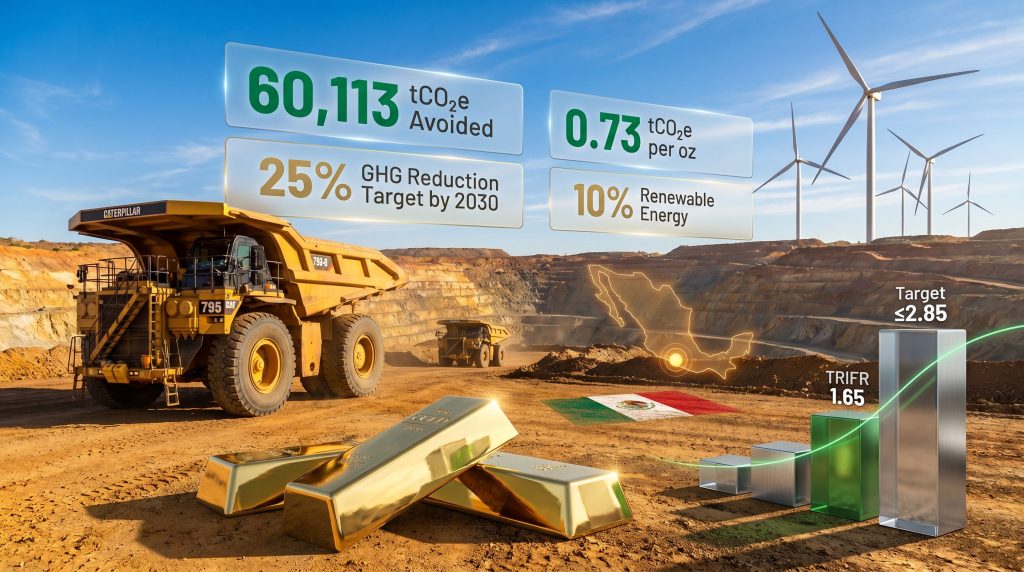
The headline figure from Equinox Gold's 2025 Sustainability Report is an estimated 60,113 tCO₂e avoided through a combination of operational efficiency programs, power purchase agreements, and international renewable energy certificates. To understand why this figure is significant, it must be read against the underlying gross emissions data.
| Metric | 2025 Value |
|---|---|
| Gross Scope 1 GHG Emissions | 612,006 tCO₂e |
| Scope 2 Emissions (Location-Based) | 92,857 tCO₂e |
| Scope 2 Emissions (Market-Based) | 46,450 tCO₂e |
| GHG Emissions Intensity | 0.73 tCO₂e per oz |
| Total Energy Consumption | 12 million GJ |
| Renewable Energy Share | 10% |
| Energy Intensity | 13.40 GJ per oz |
| Emissions Avoided | 60,113 tCO₂e |
The gap between the location-based and market-based Scope 2 figures is technically important. The location-based method applies average regional grid emission factors to purchased electricity. The market-based method adjusts for contractual instruments such as renewable energy certificates and power purchase agreements that effectively assign cleaner electricity to specific consumption points. The 46,407 tCO₂e difference between the two Scope 2 values represents the measurable impact of the company's renewable energy procurement strategy on its reported carbon footprint.
Total aggregate emissions increased year-on-year as a direct consequence of integrating Calibre Mining assets with their own energy configurations and transitional mine plan adjustments. This is a structurally predictable outcome of consolidation-phase mining, and analysts evaluating the 2025 data in isolation should treat it as a transitional baseline rather than a steady-state performance indicator.
Where Equinox Gold's Emissions Come From
Diesel and Mobile Equipment: The 70% Problem
Diesel-powered mobile equipment, particularly large-capacity haul trucks, accounts for approximately 70% of total corporate greenhouse gas emissions. This concentration reflects a fundamental characteristic of open-pit mining: the sheer mass of material moved from pit to processing facility or waste dump requires continuous, high-energy mechanical work that currently has no commercially scalable zero-emission alternative at production scale. Broader mining electrification trends suggest this may change in the coming decade, however the timeline remains uncertain for large-scale open-pit operations.
Grid-sourced electricity generation represents the second major emission category, and together these two sources account for substantially all of the company's Scope 1 and Scope 2 footprint. The practical implication is that any credible Equinox Gold emissions reduction strategy must disproportionately target diesel consumption in mobile fleet operations.
Why Los Filos Carries an Outsized Scope 2 Burden
The Los Filos Mine Complex in Guerrero, Mexico, contributed 59% of the total corporate market-based Scope 2 emissions footprint despite operating in a care and maintenance configuration during 2025. This counterintuitive result reflects a dynamic specific to heap leach gold operations.
In heap leach processing, ore is stacked on lined pads and irrigated with a cyanide-bearing solution that percolates through the ore over weeks or months, dissolving gold as it migrates to collection ponds for processing. Critically, the leaching process continues to generate recoverable gold even after active mining operations pause, and the infrastructure servicing those pads, including pumps, solution management systems, and processing circuits, continues drawing grid electricity throughout the residual leaching phase. The result is relatively high electricity consumption relative to immediate gold output, which concentrates Scope 2 emissions intensity at the site during operational suspensions.
The suspension at Los Filos is linked to ongoing community land access negotiations in the Guerrero region, a complex socio-political dynamic that has defined operations at the site for several years. The heap leach process generating 2.70 Mt of waste rock and zero conventional tailings during 2025 underscores the environmental profile of the technology: the elimination of tailings impoundments removes a significant contamination risk vector, though waste rock management remains a material environmental obligation.
Equinox Gold's Layered Decarbonisation Approach
Fleet Efficiency and Haul Truck Upgrades
The most immediately impactful Equinox Gold emissions reduction initiative involved the transition to higher-capacity Caterpillar 793-8 haul trucks at the Greenstone Mine, which delivered savings of 161,000 tCO₂e in 2024 alone. The mechanism is straightforward: larger payload capacity per truck cycle reduces the total number of cycles required to move equivalent volumes of material, thereby reducing cumulative engine hours, fuel burn, and emissions per tonne moved.
A parallel initiative at Los Filos optimised average load volumes by 10 tonnes per load, saving an estimated 167,800 litres of diesel and reducing emissions by 521 tCO₂e in 2023. While this figure appears modest relative to the fleet upgrade at Greenstone, load optimisation programs require minimal capital expenditure and can be implemented operationally through driver behaviour programs, dispatch system adjustments, and improved shovel-to-truck matching protocols. For additional context, the company's approach to reducing diesel combustion outlines the operational logic behind these fleet efficiency programmes in considerable detail.
Renewable Energy Procurement in Brazil
Wind power contracts at the Santa Luz and Fazenda mines in Brazil delivered first-year Equinox Gold emissions reductions of 3,566 tCO₂e and 2,630 tCO₂e respectively. Both Brazilian operations now source 100% of their electrical power from clean energy platforms, establishing them as the portfolio's benchmark sites for grid-based decarbonisation. The ongoing shift toward renewable energy in mining is demonstrating that clean power procurement can deliver both emissions and cost benefits simultaneously.
The broader portfolio uses international renewable energy certificates to offset grid-sourced electricity consumption where direct power purchase agreements are not yet in place. These certificates function as tradeable instruments representing the environmental attributes of one megawatt-hour of renewable electricity generation, allowing buyers to claim the carbon benefit of clean power even when physically connected to a mixed-source grid.
Diesel Substitution and Process Efficiency
Where regional supply chains permit, the company is progressively transitioning toward lower-emission diesel formulations. Blended biofuels and lower-sulphur diesel variants reduce both greenhouse gas and particulate emissions per litre consumed. Complementary process efficiency improvements across ore processing and infrastructure systems target reductions in electricity consumption intensity, compounding the impact of renewable energy procurement by reducing the volume of electricity required in the first place.
The dual-track logic of attacking the largest emission source (mobile equipment diesel) while simultaneously reducing the most contractually flexible emission source (purchased electricity) reflects a layered decarbonisation model increasingly standard among mid-tier gold producers targeting credible near-term progress against 2030 commitments.
Safety Metrics: A Mixed Signal for Investors
Equinox Gold's 2025 safety performance delivered a clear positive in the most critical category: zero workplace fatalities among both employees and contractors across the entire portfolio.
| Safety Metric | 2024 | 2025 | Corporate Target |
|---|---|---|---|
| Total Recordable Injury Frequency Rate | 2.21 | 1.65 | 2.85 or less |
| All Injury Frequency Rate | 9.92 | 11.48 | Not specified |
| Lost-Time Injury Frequency Rate | 0.49 | 0.70 | Not specified |
| Workplace Fatalities | 0 | 0 | 0 |
The TRIFR improvement from 2.21 to 1.65 is statistically meaningful and comfortably outperformed the corporate target of 2.85 or fewer per million hours worked. However, the simultaneous rise in both the All Injury Frequency Rate (from 9.92 to 11.48) and the Lost-Time Injury Frequency Rate (from 0.49 to 0.70) points to a divergence between serious recordable events and lower-severity incidents requiring time away from work.
Understanding whether this divergence reflects genuine safety culture changes, classification methodology shifts following asset integration, or site-specific trends within newly incorporated operations is important context for investors applying safety screens.
Total recorded exposure hours reached 10.65 million for employees and 22.1 million for contractors, with 100% of the workforce covered under formal occupational health and safety management systems. At Los Filos specifically, the completion of 100% human rights training for all security personnel, aligned with the Voluntary Principles on Security and Human Rights, reflects the elevated governance requirements of operating in Guerrero, a region with a complex security and community relations environment.
The next major ASX story will hit our subscribers first
Environmental Stewardship Beyond Carbon
Beyond the Equinox Gold emissions reduction headline, the company's 2025 environmental performance delivered a Significant Environmental Incident Frequency Rate of 0.00 per million hours worked, satisfying the corporate target of 1.2 or fewer significant incidents. This metric encompasses permit exceedances, material spills, and ecosystem disturbances classified as significant under the company's environmental management framework.
Water management is increasingly a differentiating ESG metric for mining companies operating in water-stressed regions. Key figures from 2025 include:
- Total water withdrawals: 19.91 million m³
- Total water discharges: 11.96 million m³
- Water permit compliance violations: zero
- Active land restoration through progressive reclamation: 40 hectares
- New land disturbance during the reporting period: 448 hectares
A zero-violation water compliance record across a multi-asset, multi-jurisdiction portfolio during a year of major corporate restructuring reflects well-developed environmental management system maturity. This is likely to carry weight with institutional investors applying water risk screens, particularly given Los Filos' location in central Mexico where water availability is a sensitive community concern. In addition, considerations around natural capital in mining are becoming increasingly central to how institutional investors assess the long-term licence to operate for producers like Equinox Gold.
Workforce, Community Investment, and Social Licence at Scale
At year-end, the total corporate workforce comprised 13,163 workers, split between 5,219 permanent or temporary employees and 7,944 contractors. Women represented 16% of total employees and held 30% of Board of Directors seats, with Los Filos standing out across the entire portfolio with a 41% female representation rate among locally hired personnel.
| Economic Value Category | Amount (USD) |
|---|---|
| Total Direct Economic Value Distributed | US$2.1 billion |
| Employee Salaries and Benefits | US$352 million |
| Corporate Income Taxes Paid | US$129 million |
| Royalties Paid | US$64 million |
| Community Investments | US$14 million |
| Mexico Community Investments | US$4.435 million |
Community relations performance at Los Filos centred on the management of 52 active local agreements through a dedicated Community Commitments Management System, with delivery performance maintained between 90% and 100% throughout the year. Across the broader portfolio, 259 formal community grievances were tracked and a 93% resolution rate achieved by year-end, a metric that directly reflects social licence health in jurisdictions where community opposition can halt or delay operations.
National procurement spending reached 93% of total procurement expenditures directed to in-country suppliers, with Los Filos channelling 18% of operational procurement to community-based suppliers. These figures matter for securing and maintaining operating permits in jurisdictions with local content expectations embedded in concession conditions or community agreements.
What the Calibre Integration Means for the 2030 Target
The 2025 reporting period is explicitly a transitional baseline. The Calibre Mining combination introduced assets with materially different energy intensities and mine plan configurations, creating upward pressure on aggregate emissions that is structurally distinct from operational deterioration. The pending acquisition of Orla Mining, expected to close in Q3 2026, will require another recalibration of the business-as-usual baseline before the 2030 target can be meaningfully tracked against a stable reference point.
Renewable energy currently accounts for 10% of total energy consumption across the portfolio. Given that the Brazilian operations are already at 100% clean power, and that the remaining portfolio still draws heavily from diesel and mixed-source grids, the pathway to the 2030 target will require either accelerated renewable procurement agreements in new jurisdictions, material fleet electrification advances, or continued expansion of load optimisation and operational efficiency programs at scale.
For investors, the critical variable is not the 2025 snapshot but the trajectory of emissions intensity (currently 0.73 tCO₂e per ounce) as the company scales production with the expanded asset base. Consequently, gold miners' market performance in the current environment suggests that producers demonstrating genuine decarbonisation progress alongside production growth are increasingly well positioned with ESG-focused capital allocators. A stable or declining intensity figure over the next two reporting cycles would be a more reliable indicator of genuine decarbonisation progress than any single annual avoided-emissions figure.
Disclaimer: This article contains forward-looking statements regarding emissions targets, acquisition timelines, and sustainability performance projections. These are based on currently available information and involve inherent uncertainties. Readers should not rely on these statements as guarantees of future outcomes. For further context on ESG performance standards in the gold mining sector, explore related reporting frameworks and industry analysis published by Mexico Business News at mexicobusiness.news/mining.
Want to Stay Ahead of the Next Major ASX Mineral Discovery?
Discovery Alert's proprietary Discovery IQ model delivers real-time alerts on significant ASX mineral discoveries, cutting through complex data across more than 30 commodities to surface actionable opportunities the moment they are announced — explore Discovery Alert's discoveries page to see the historic returns major discoveries have generated, then begin your 14-day free trial to position yourself ahead of the broader market.