June 25, 2026
The Scale Imperative: Why Size Is Becoming the Defining Factor in Gold Mining
The gold mining industry has long operated under a deceptively simple premise: find it, mine it, sell it. But the financial reality facing producers in 2026 is considerably more complex. As development costs escalate, permitting timelines lengthen, and institutional capital gravitates toward liquidity and scale, mid-tier producers are confronting a structural ceiling that organic growth alone cannot break through. The result is a wave of consolidation reshaping competitive hierarchies across North America, and the Equinox Gold and Orla Mining merger represents one of the most significant expressions of this trend yet seen.
When big ASX news breaks, our subscribers know first
Deal Architecture: How a $5.1 Billion All-Stock Transaction Is Structured
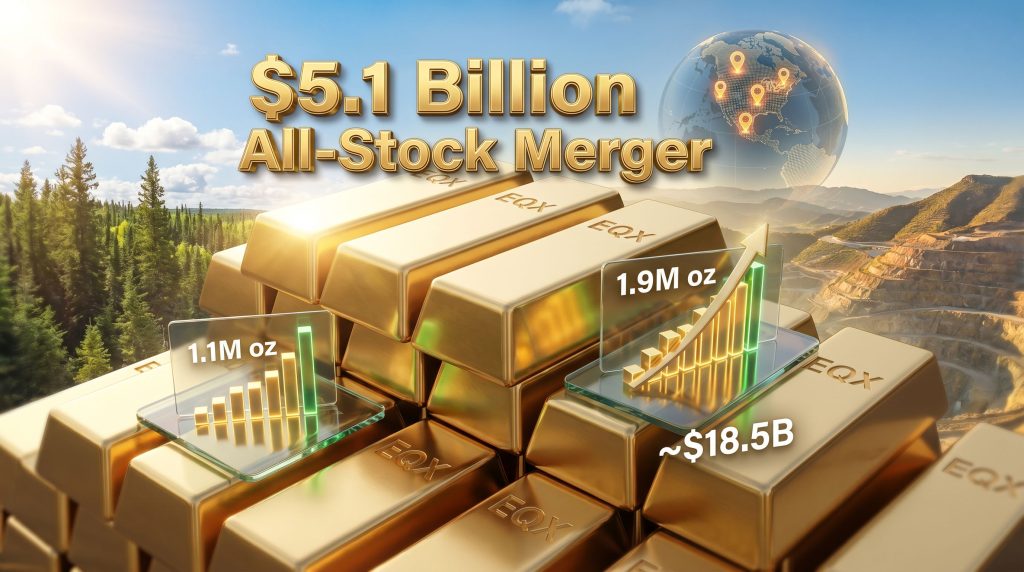
Understanding the mechanics of this transaction is essential before evaluating its strategic merit. Rather than deploying cash, Equinox Gold is acquiring all outstanding Orla Mining shares through a pure equity exchange, with a nominal cash component of just $0.0001 per share. This near-zero cash element is not commercially meaningful; its function is technical, ensuring the transaction satisfies certain legal definitions under Canadian corporate law for the arrangement structure.
The exchange ratio is straightforward: each Orla shareholder receives exactly one Equinox Gold common share per Orla share held. Furthermore, following completion, existing Equinox shareholders will hold approximately 67% of the combined entity, with former Orla shareholders retaining the remaining 33%.
Deal Structure at a Glance
| Parameter | Detail |
|---|---|
| Transaction Type | All-stock merger |
| Total Deal Value | ~$5.1 billion |
| Implied Market Capitalisation | ~$18.5 billion |
| Exchange Ratio | 1 Equinox share + $0.0001 cash per Orla share |
| Post-Merger Equinox Shareholder Ownership | ~67% |
| Post-Merger Orla Shareholder Ownership | ~33% |
| New Shares to Be Issued | Up to 421,770,377 Equinox common shares |
| Continued Ticker Symbol | EQX (TSX and NYSE American) |
| Expected Close | Q3 2026 (September) |
The decision to structure this entirely in stock carries a clear message from both boards: neither party needed to monetise their position. An all-stock transaction demands that shareholders on both sides accept long-term value creation as the primary outcome, rather than an immediate liquidity event. When boards unanimously endorse such a structure, it typically signals strong conviction that the combined entity is worth more than the sum of its parts.
The combined company will retain the Equinox Gold name and continue trading under the ticker EQX on both the Toronto Stock Exchange and NYSE American. For additional context on how gold M&A activity is reshaping the broader sector, the patterns emerging in 2025 and 2026 share several structural similarities.
Production Profile and Asset Base: What the Merged Entity Actually Looks Like
The operational footprint of the combined company is genuinely transformative in scale. Upon closing, the merged entity will immediately become Canada's second-largest gold producer, with six producing mines spread across Canada, the United States, Mexico, and Nicaragua.
Key Production Metric: The combined company is projected to produce 1.1 million ounces of gold in 2026, with a clearly defined organic growth pathway extending toward 1.9 million ounces annually, representing an incremental uplift of approximately 800,000 ounces sourced entirely from North American development and expansion assets.
The Canadian component alone is particularly notable. Three cornerstone Canadian operations — including Greenstone, Valentine, and Musselwhite — are collectively expected to contribute 685,000 ounces of gold production in 2026, anchoring the company's jurisdictional profile at the premium end of the peer group.
Combined Asset Portfolio Summary
| Mine / Asset | Country | Type | Significance |
|---|---|---|---|
| Greenstone | Canada | Operating | Core long-life Equinox anchor asset |
| Valentine | Canada | Operating | Major Canadian production contributor |
| Musselwhite | Canada | Operating (via Orla) | Key Orla operational contribution |
| U.S. Operations | United States | Operating | Jurisdictional diversification |
| Mexican Operations | Mexico | Operating | Growth and cash flow contributor |
| Nicaraguan Assets | Nicaragua | Operating | Long-term optionality |
Beyond the six operating mines, the merged company will also manage four active expansion projects across four countries, providing meaningful sequencing flexibility. This matters enormously for capital allocation: rather than being locked into a single development timeline, management can prioritise projects based on gold price environments, permitting progress, and capital availability.
Why North American Jurisdiction Commands a Valuation Premium
Institutional investors, particularly large pension funds and ETF managers, apply what practitioners often call a jurisdictional premium when valuing gold producers. Assets located in stable, rule-of-law jurisdictions attract lower discount rates and higher net asset value multiples compared to equivalent deposits in politically uncertain regions.
With the majority of production anchored in Canada and the United States, the combined entity sits at the upper end of the peer group on this metric. This positioning directly influences index inclusion eligibility and the quality of institutional shareholder register a company can attract. In addition, the relationship between gold price and mining equities means that jurisdictional strength amplifies the valuation benefits when gold prices remain elevated.
Financial Metrics: Free Cash Flow, Liquidity, and Self-Funded Development
The financial case for the Equinox Gold and Orla Mining merger extends well beyond production scale. The combined entity's cash generation capacity fundamentally changes what becomes possible without returning to equity markets for dilutive capital raises.
Financial Snapshot: Analyst consensus estimates project the combined entity will generate approximately $1.4 billion in free cash flow during 2026, supported by $1.4 billion in total available liquidity, providing the financial runway to self-fund an estimated $2 billion development pipeline without requiring external equity dilution.
This is a materially different position from either company standing alone. For context, mid-tier gold producers with sub-500,000-ounce production profiles typically face a difficult choice when funding major development projects: dilute existing shareholders through equity issuances, take on significant debt, or defer growth. The combined cash flow profile eliminates this dilemma, at least within the current gold price environment.
Key Financial Metrics: Pre-Merger vs. Post-Merger Comparison
| Metric | Equinox Gold (Standalone) | Combined Entity |
|---|---|---|
| Annual Gold Production | Sub-1M oz | ~1.1M oz (2026) |
| Growth Target | Limited organic runway | 1.9M oz pathway |
| Free Cash Flow (2026E) | Partial contribution | ~$1.4 billion |
| Total Liquidity | Partial | ~$1.4 billion |
| Mineral Reserves | Partial | ~23M oz Proven and Probable |
| Market Capitalisation | Lower | ~$18.5 billion |
The ~23 million ounces in Proven and Probable Mineral Reserves held by the combined entity is another dimension worth examining carefully. In mining financial analysis, reserve size functions similarly to a balance sheet asset; it represents the volume of economically extractable gold already defined and delineated through drilling. At current gold prices, a 23-million-ounce reserve base provides multi-decade production visibility and substantially reduces the geological risk premium that investors assign to smaller, less-defined producers.
Leadership Structure: Operational Continuity With Complementary Expertise
One of the underappreciated risks in any mining merger is leadership transition. Operational expertise in gold mining is not easily transplanted; mine-specific knowledge, workforce relationships, and community engagement frameworks take years to develop. The structure chosen here addresses this directly.
Darren Hall retains the CEO role, preserving continuity of strategic direction and operational culture within Equinox Gold's existing platform. Jason Simpson, who led Orla Mining's operational development, transitions into a President role, embedding Orla's operational discipline and project development track record at the senior management level. The dual board representation structure ensures that neither shareholder group loses governance influence in the post-merger entity.
This approach reflects a broader lesson from gold sector mergers that have underperformed expectations: the companies that extract the most value from consolidation are typically those that retain key operational talent rather than displacing it through a winner-takes-all integration model.
Shareholder Vote: Timeline, Requirements, and What Investors Should Know
The path to completion is clearly structured around a dual shareholder approval process scheduled for July 22, 2026.
- Equinox Gold Special Meeting: July 22, 2026 at 9:00 AM Vancouver time
- Vote Required (Equinox): Simple majority approval for the share issuance resolution
- Vote Required (Orla): Two-thirds supermajority approval from Orla shareholders
- Proxy Voting Deadline: July 20, 2026 at 9:00 AM Vancouver time
- Board Recommendation: Unanimous approval recommended by both boards
The two-thirds supermajority requirement on the Orla side is standard for Canadian plan-of-arrangement transactions of this type, but its implications are worth understanding. A supermajority threshold is substantially harder to achieve than a simple majority; it requires broad shareholder consensus and effectively neutralises the ability of a small opposing bloc to block the deal. The fact that both boards have unanimously endorsed the transaction provides a meaningful signal of aligned incentives.
Beyond shareholder votes, the transaction remains subject to court approval and customary regulatory clearances, with closing targeted for Q3 2026. As reported by Mining.com, the deal has attracted significant industry attention given its scale and all-stock structure.
The next major ASX story will hit our subscribers first
Competitive Repositioning: Where the Combined Entity Sits in the Peer Landscape
The strategic reframe here is important. Neither Equinox Gold nor Orla Mining, operating independently, possessed the scale required to compete for the same institutional capital pools as established senior producers. The merger compresses what would otherwise be a multi-year, capital-intensive growth trajectory into a single corporate event. Indeed, the broader mining industry consolidation occurring across North America provides important context for understanding why this transaction is structured the way it is.
North American Gold Producer Scale Comparison (Illustrative)
| Producer | Annual Production (Approx.) | Primary Jurisdiction |
|---|---|---|
| Agnico Eagle | ~3.4M oz | Canada / Mexico |
| Kinross Gold | ~2.1M oz | Multi-jurisdictional |
| Equinox Gold + Orla (Combined) | ~1.1M oz (path to 1.9M oz) | Canada / USA / Mexico |
| Pan American Silver (Gold Eq.) | ~1.0M oz | Americas |
Note: Figures are approximate and provided for illustrative comparative context only. Investors should verify current production figures from individual company disclosures.
Achieving Canada's second-largest gold producer status is not merely a marketing designation. It carries concrete implications for index inclusion eligibility, ETF weighting, and analyst coverage breadth. Larger index weights translate to more passive capital inflows when gold sector sentiment turns constructive, creating a structural tailwind that smaller producers simply cannot access regardless of their individual asset quality.
The Organic Growth Pathway: Unpacking the 800,000-Ounce Expansion Case
The growth narrative from 1.1 million ounces to 1.9 million ounces annually is not speculative; it is grounded in the development pipeline that both companies bring to the merger. However, investors should approach this pathway with nuanced expectations.
Several key considerations shape the growth outlook:
- Development sequencing risk: Four projects across four countries means execution complexity. Permitting timelines, contractor availability, and capital prioritisation decisions will influence which projects accelerate first.
- Near-mine exploration potential: Both Equinox and Orla have historically demonstrated strong track records of reserve extension through drilling near existing operations. The combined land package magnifies this optionality.
- Self-funded capital discipline: The projected $1.4 billion free cash flow base provides the internal funding capacity to advance the $2 billion pipeline without equity dilution, but this assumes gold prices remain constructive and operational performance meets forecasts.
- Reserve extension as a value multiplier: At 23 million ounces in Proven and Probable Reserves, there is already substantial defined inventory, but near-mine exploration success could extend mine lives and improve the long-term net asset value case significantly.
Disclaimer: Projections regarding future production levels, free cash flow, and development timelines are forward-looking and subject to material risks including gold price volatility, permitting delays, operational disruptions, and capital cost escalation. These figures should not be relied upon as guarantees of future performance.
Why Gold Sector Consolidation Is Accelerating in 2026
The Equinox Gold and Orla Mining merger does not exist in isolation. It reflects a broader structural shift in how the gold industry is organising itself in response to a convergence of forces:
- Sustained gold price strength has improved free cash flow generation across the sector, giving producers the financial confidence to pursue transformative transactions.
- Institutional capital concentration continues to favour larger, more liquid vehicles over smaller producers, creating a valuation gap that consolidation can close.
- Replacement cost economics mean that building a comparable asset portfolio from scratch through greenfield exploration would cost multiples more and take far longer than acquiring an existing producer at a negotiated premium.
- Jurisdictional risk repricing has intensified institutional preference for politically stable mining jurisdictions, making North American asset concentrations particularly attractive to capital allocators.
The strategic logic of combining complementary portfolios rather than pursuing independent greenfield development is becoming increasingly compelling at current gold prices. Consequently, history suggests that mergers executed during periods of strong commodity prices, when both parties have financial flexibility and neither is distressed, tend to produce better long-term outcomes than distressed consolidations driven by balance sheet necessity. For investors exploring undervalued mining stocks in this environment, the valuation re-rating potential from scale-driven consolidation is an important consideration.
Frequently Asked Questions: Equinox Gold and Orla Mining Merger
What is the Equinox Gold and Orla Mining merger?
A $5.1 billion all-stock transaction in which Equinox Gold will acquire all outstanding Orla Mining shares, creating a combined North American gold producer with an implied market capitalisation of approximately $18.5 billion.
What will Orla Mining shareholders receive?
Each Orla share will be exchanged for one Equinox Gold common share plus a nominal cash payment of $0.0001.
When will the merger be finalised?
Subject to shareholder, court, and regulatory approvals, the transaction is expected to close in Q3 2026, with shareholder votes scheduled for July 22, 2026.
How much gold will the combined company produce?
The merged entity is projected to produce approximately 1.1 million ounces in 2026, with a defined organic growth pathway to 1.9 million ounces annually.
What ticker symbol will the new company trade under?
The combined company will retain the Equinox Gold name and continue trading under the ticker EQX on both the TSX and NYSE American exchanges.
What are the combined company's mineral reserves?
The merged entity will hold approximately 23 million ounces in Proven and Probable Mineral Reserves.
Who will lead the combined company?
Darren Hall will serve as CEO, with Jason Simpson assuming the role of President.
Key Takeaways: What the Equinox Gold and Orla Mining Merger Signals for the Sector
- The transaction creates Canada's second-largest gold producer by annual output, with immediate implications for index inclusion and institutional capital flows
- An all-stock structure preserves liquidity while aligning long-term shareholder interests across both former shareholder bases
- Approximately 23 million ounces in Proven and Probable Mineral Reserves provides multi-decade production visibility and reduces geological risk premiums
- Projected 2026 free cash flow of $1.4 billion funds the $2 billion development pipeline without external dilution, a structural advantage few mid-tier producers can claim
- North American asset concentration positions the combined entity for a valuation re-rating relative to peers with more geopolitically complex portfolios
- The merger compresses years of organic growth into a single transformative corporate event, delivering scale, reserve depth, and cash flow generation simultaneously
Understanding the full range of gold mining stock types — from seniors to royalty companies — provides useful context for positioning around transactions of this scale. Meanwhile, the official announcement from Equinox Gold outlines the full strategic rationale for investors seeking primary source documentation.
Further coverage of gold sector transactions and Latin American mining developments is available through Brasil Mineral at brasilmineral.com.br, which provides ongoing regional context for investors tracking consolidation trends across the Americas.
Want to Capitalise on the Next Major Gold Discovery Before the Market Does?
The Equinox Gold and Orla Mining merger illustrates just how transformative significant mineral discoveries and strategic scale can be for investor returns — and Discovery Alert's proprietary Discovery IQ model delivers real-time ASX alerts the moment significant new discoveries are announced, ensuring subscribers can act ahead of the broader market. Explore historic discovery returns to understand the scale of opportunity, then begin a 14-day free trial to position yourself at the forefront of the next major find.