June 15, 2026
When Scale Becomes Survival: The Strategic Logic Behind Gold's Biggest North American Combination
Every decade or so, the gold mining industry reaches a moment where the competitive mathematics of the sector shift irreversibly. The last major inflection point came in the post-2012 era when collapsing margins forced a painful rationalisation across the industry. Today, the dynamics have reversed, but the pressure on mid-tier producers to act decisively has, if anything, intensified. Elevated gold prices have expanded equity valuations, institutional capital is flowing back into the sector, and producers sitting below the one-million-ounce threshold are finding themselves structurally disadvantaged in capital markets. The Equinox Gold and Orla Mining merger is not simply a deal between two companies. It is a calculated response to a window that may not remain open indefinitely.
When big ASX news breaks, our subscribers know first
Why North American Gold Consolidation Has Reached an Inflection Point
The conditions enabling this transaction have been years in the making. Three compounding pressures have been squeezing mid-tier producers simultaneously: rising all-in sustaining costs (AISC), a repricing of geopolitical risk in emerging market mining jurisdictions, and gold prices at historically elevated levels that have created an unusual window for accretive, equity-funded dealmaking.
Producers operating below one million ounces per year face a set of structural disadvantages that go beyond cost efficiency. They are frequently excluded from major gold equity indices, which means institutional fund managers with index-tracking mandates cannot hold their shares. Their trading liquidity tends to be thinner, creating wider bid-ask spreads that discourage large institutional positions. And their cost-per-ounce structures rarely benefit from the overhead leverage that larger platforms generate.
North America has become the preferred destination for this consolidation wave for reasons that extend well beyond geography. Canada, the United States, and Mexico collectively offer regulatory stability, established infrastructure, proximity to deep equity capital markets, and a legal framework that institutional investors in London, New York, and Toronto understand well. The contrast with West Africa, parts of Latin America, and certain Asia-Pacific jurisdictions, where political risk has been materially repriced upward, has made North American assets increasingly scarce and therefore increasingly valuable.
The Role of the Gold Price Environment in Making This Deal Possible
Strong gold price performance throughout 2025 and into 2026 has done something specific to the M&A calculus: it has inflated equity currencies for mid-tier producers to the point where all-share combinations become economically viable without requiring either party to pay a large cash premium. When equity valuations are depressed, all-share deals are difficult because neither party wants to sell cheaply. When valuations are elevated, both parties can exchange shares at prices that reflect genuine long-term asset value.
This dynamic explains why the Equinox Gold and Orla Mining merger was structured the way it was. An at-market, all-share combination signals that both boards believed their respective equity currencies were fairly valued and that the combined entity would be worth more than the sum of its parts. That kind of conviction is structurally rare in mining M&A, where acquisitions are typically accompanied by a control premium extracted from the acquirer.
Key Insight: All-share mergers at or near market value are sometimes described as mergers of equals. Their emergence signals that both parties see long-term strategic value exceeding any short-term premium negotiation. In an elevated gold price environment, this structure can be more accretive than a cash acquisition, because it avoids leverage and preserves the balance sheet for development capital.
What the Equinox Gold and Orla Mining Merger Actually Looks Like
Deal Structure and Ownership Split
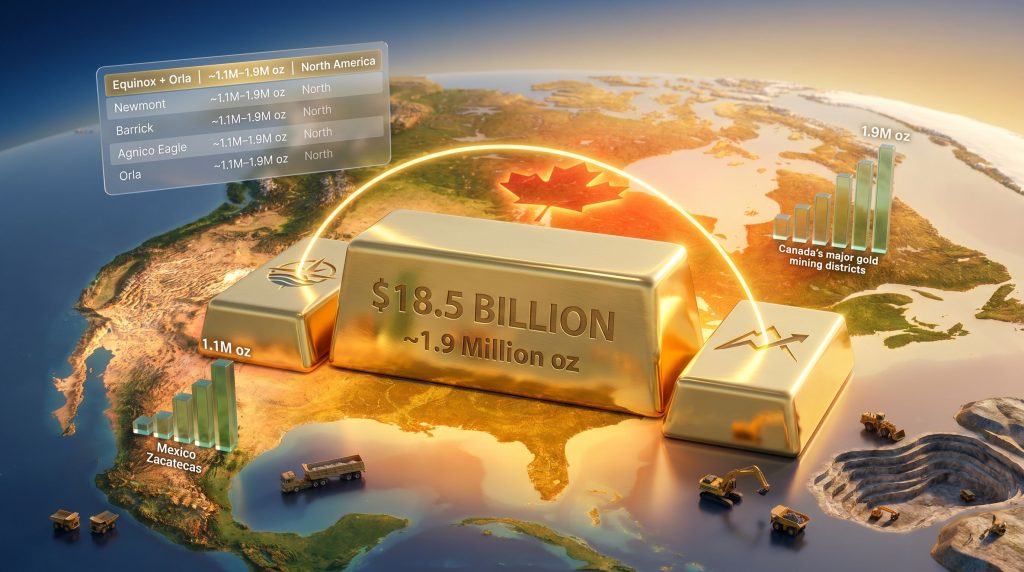
Under the definitive agreement announced in May 2026, Equinox Gold and Orla Mining will combine through an all-share transaction at market value, with no significant control premium paid to either shareholder base. The implied combined market capitalisation at announcement was approximately $18.5 billion, making the entity one of the largest North America-focused gold producers by market value.
Upon completion, Equinox shareholders will retain approximately 67% of the combined company, while Orla shareholders will receive approximately 33%. The transaction has been structured as a merger of equals, a designation that carries specific meaning: it signals mutual strategic conviction, continuity of management from both organisations, and a shared vision for the combined asset base rather than a hostile or opportunistic takeover dynamic.
Leadership Architecture
| Role | Executive | Previous Company |
|---|---|---|
| Chief Executive Officer | Greg Hall | Equinox Gold |
| President | Jason Simpson | Orla Mining |
The dual-leadership model is deliberately designed to retain institutional knowledge and operational expertise from both organisations. For a transaction of this complexity, spanning multiple jurisdictions and mine types, preserving technical and management continuity is arguably as important as the financial structure of the deal itself.
Geographic Footprint of the Combined Entity
Combined assets will span Canada, the United States, Mexico, and Nicaragua, creating a portfolio that is overwhelmingly concentrated in stable, well-understood mining jurisdictions. Upon completion, the merged entity is expected to rank as Canada's second-largest gold producer, sitting behind Agnico Eagle in terms of domestic production scale.
Production Profile: From Day One to Full Pipeline Realisation
The production story for the combined entity unfolds across two timeframes. At the point of combination, the merged company is expected to produce approximately 1.1 million ounces of gold per year, crossing the threshold that separates mid-tier producers from senior producers in the eyes of most institutional classification frameworks. Over time, through the execution of the combined development pipeline, that figure is projected to reach approximately 1.9 million ounces per year.
| Metric | Combined Entity (Initial) | Combined Entity (Pipeline Target) |
|---|---|---|
| Annual Gold Output | ~1.1 million oz | ~1.9 million oz |
| Implied Market Cap | ~$18.5 billion | Not yet determined |
| Primary Jurisdictions | North America | North America |
| Canadian Production Rank | ~2 (behind Agnico Eagle) | Potential top-tier |
The 1.5 to 2 million ounce range is widely regarded within the sector as the gateway to genuine senior producer status. Crossing this threshold unlocks inclusion in major gold equity indices, broadens the institutional investor base substantially, and compresses the cost of capital over time. Critically, the development pipeline underpinning this growth is composed of assets already within the portfolio, which reduces execution risk significantly compared to exploration-dependent growth strategies that require greenfield discoveries to materialise.
Key Assets: What Each Company Brings to the Table
Equinox Gold's Contribution
Equinox Gold contributes a portfolio of producing mines and development assets concentrated across the Americas, including operations in Canada, the United States, Mexico, and Brazil. The company has a demonstrated track record of operational ramp-ups, having grown from a single-asset developer into a multi-mine platform over the preceding decade. Brazilian assets within the portfolio may be subject to future rationalisation given the combined entity's stated focus on North American jurisdictions.
Orla Mining's Contribution: Camino Rojo as the Crown Jewel
Orla Mining's flagship asset is the Camino Rojo gold-silver operation in the Zacatecas state of Mexico, a low-cost, open-pit heap leach operation with strong ongoing cash flow generation characteristics. Heap leach mining, for readers less familiar with the methodology, is a cost-effective extraction process used for lower-grade ore deposits. Crushed ore is stacked on lined pads, and a cyanide or acid solution is percolated through the heap to dissolve and recover gold. The process carries lower capital intensity than conventional milling, which makes it particularly well-suited to assets where grade and tonnage economics favour volume over metallurgical complexity.
Orla's technical team brings deep expertise in this methodology, and the Camino Rojo asset has been an important cash flow generator for the combined portfolio from the outset.
The Panama Wildcard: Cerro Quema Arbitration
The merged company will inherit Orla Mining's international arbitration claim against the Republic of Panama related to the Cerro Quema gold project. Orla is seeking approximately $400 million in damages following permit denials linked to anti-mining political sentiment in Panama, a country that experienced significant social unrest over mining-related issues in recent years.
Risk Note: International arbitration claims against sovereign governments are characteristically multi-year processes with deeply uncertain outcomes. The $400 million figure should be treated as a contingent optionality item rather than a balance sheet asset. If arbitration is resolved favourably, it would represent a meaningful upside catalyst. If it is not, the primary cost to the combined entity is legal expense and management bandwidth, rather than capital.
The Broader Consolidation Context: This Deal Does Not Exist in Isolation
Parallel M&A Activity Confirming the Trend
The Equinox Gold and Orla Mining merger was announced against a backdrop of accelerating consolidation activity across the gold and precious metals sector. In the same week, Elemental Altus Royalties made a bid to acquire Vizsla Royalties for approximately $239 million, with Vizsla's share price rising approximately 17.5% on announcement. The extension of consolidation pressure into the royalty and streaming sub-sector underscores that the structural forces driving M&A are not confined to operating producers.
Meanwhile, Barrick Mining announced a $3 billion share repurchase program, double the size of its prior buyback, signalling a different but equally deliberate capital allocation posture: returning cash to shareholders rather than pursuing acquisitive growth. Barrick's first-quarter 2026 gold production came in at 719,000 ounces, ahead of its own guidance range of 640,000 to 680,000 ounces, with AISC of $1,708 per ounce. The contrast between Barrick's buyback strategy and the Equinox-Orla combination illustrates the range of rational strategic responses available to producers at different points on the size and asset quality spectrum.
Competitive Positioning Among Major North American Producers
According to Reuters reporting on the transaction, the combined entity is designed to compete directly at the senior producer tier. Furthermore, the competitive landscape amongst major North American producers makes this positioning all the more significant.
| Producer | Annual Production (approx.) | Jurisdictional Focus |
|---|---|---|
| Newmont | ~6 million oz | Global |
| Barrick Mining | ~4 to 5 million oz | Global |
| Agnico Eagle | ~3 to 3.5 million oz | North America and Europe |
| Kinross Gold | ~2 million oz | Americas and West Africa |
| Equinox + Orla (Combined) | ~1.1M oz initial / ~1.9M oz pipeline | North America |
Zhaojin and the Bifurcation of Global Gold Ownership
An important contextual development running alongside North American consolidation is the shifting ownership of West African gold assets. As Western miners continue their structural exit from the region, Zhaojin Mining, the Shandong-based Chinese producer, has indicated its intent to acquire additional mines in politically stable West African nations including Côte d'Ivoire, Ghana, and Guinea. This movement is gradually bifurcating the global gold mining landscape along geopolitical lines, with North American-focused entities on one side and Chinese state-linked operators increasingly dominant in West Africa on the other. This structural divide is likely to intensify over the medium term, further amplifying the scarcity value of well-capitalised, stable-jurisdiction producers like the combined Equinox-Orla entity.
The next major ASX story will hit our subscribers first
Macro Headwinds That Investors Cannot Ignore
Interest Rates and the Dollar: A Persistent Tension
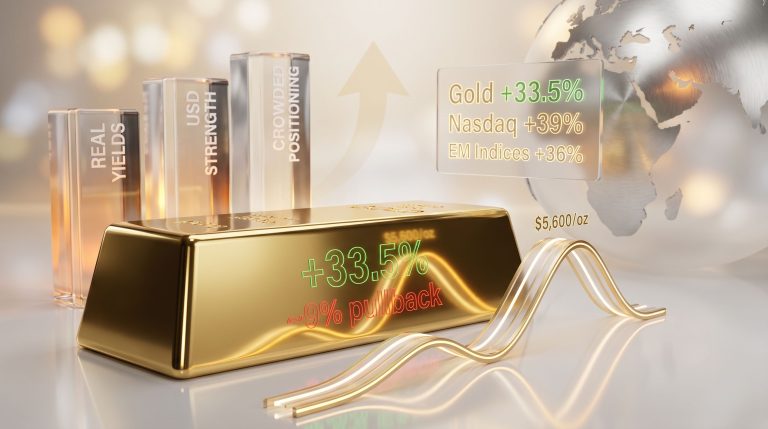
Gold mining equities do not operate in a macro vacuum, and the week of the merger announcement delivered a pointed reminder of this. Yields on the U.S. 2-year Treasury note rose 19.5 basis points, while 5-year through 20-year maturities all rose by more than 20 basis points, effectively tightening financial conditions without any Federal Reserve intervention. This pushed the U.S. dollar higher by approximately 1.43%. A stronger dollar and rising real yields are structurally negative for gold price performance, and by extension for the revenue projections underpinning the merger's financial rationale.
Investors should be aware that the production and pipeline targets cited at announcement are implicitly dependent on gold prices remaining at or near current levels. Any sustained dollar strengthening or upward shift in real yields could compress gold prices and alter the economic calculus of the development pipeline.
India's Demand Suppression: An Underappreciated Threat
India represents the world's second-largest jewellery market and has negligible domestic gold production, making it one of the most significant swing factors in global physical gold demand. Several converging developments are weighing on Indian gold demand simultaneously:
- Import tariffs on gold and silver have been raised to 15%, one of the highest rates in recent history, as part of austerity measures tied to energy cost pressures.
- Prime Minister Narendra Modi publicly encouraged Indian citizens to refrain from purchasing gold for a period of one year, citing the need to protect foreign exchange reserves, according to reporting by Barron's.
- Indian banks faced temporary disruptions to gold import operations at the start of the new Indian tax year in April due to administrative delays in the publication of eligible importer lists.
Individually, each of these factors is manageable. Collectively, however, they represent a meaningful compression of physical demand from one of the world's most important gold-consuming nations. If sustained, this could exert downward pressure on gold prices over the medium term, affecting the revenue assumptions embedded in the merger's financial projections.
What the Merger Means for Shareholders of Each Company
Equinox Gold Shareholders
Existing Equinox shareholders retain a 67% economic interest in a materially larger, more diversified platform. The primary value proposition includes the addition of Orla's low-cost Camino Rojo cash flow engine, exposure to a development pipeline targeting 1.9 million ounces per year, and improved institutional investor appeal through increased market capitalisation and trading liquidity. Index inclusion, should it follow from the scale threshold being crossed, would be a particularly meaningful re-rating catalyst.
Orla Mining Shareholders
Orla shareholders receive approximately 33% ownership of the combined entity with no cash premium embedded in the exchange. The value case rests on the belief that the combined entity's re-rating potential, driven by index inclusion, improved liquidity, and pipeline execution, will generate superior long-term returns compared to Orla continuing as a standalone mid-tier producer with a smaller institutional following.
Investor Consideration: The absence of a traditional acquisition premium is structurally unusual and warrants careful scrutiny. Shareholders of both companies should assess whether the strategic rationale, centred on scale, diversification, and long-term pipeline optionality, justifies the at-market exchange ratio, or whether the standalone path for either company might have delivered greater near-term value. The answer to that question will ultimately depend on execution quality during the integration phase and the trajectory of gold prices over the next several years.
Frequently Asked Questions: Equinox Gold and Orla Mining Merger
What is the combined market capitalisation of Equinox Gold and Orla Mining?
The implied combined market capitalisation at announcement was approximately $18.5 billion, positioning the merged entity among the largest North America-focused gold producers by market value.
Is this an all-cash or all-share deal?
The transaction is structured as an all-share combination at market value, with no significant cash premium paid to either party. Equinox shareholders will own approximately 67% and Orla shareholders approximately 33% of the combined company upon completion.
Who will lead the combined company?
Greg Hall, previously CEO of Equinox Gold, will serve as CEO of the merged entity. Jason Simpson, previously CEO of Orla Mining, will become President of the combined company.
What initial gold production is expected?
Initial annual production is targeted at approximately 1.1 million ounces. Through the execution of the combined development pipeline, output is projected to reach approximately 1.9 million ounces per year over time.
What is the Cerro Quema arbitration claim?
The merged company will inherit Orla Mining's international arbitration claim against Panama related to the Cerro Quema gold project, where approximately $400 million in damages is being sought following permit denials tied to anti-mining political sentiment. The outcome and timeline of this process remain uncertain.
Where will the combined company rank among Canadian gold producers?
The merged entity is expected to rank as Canada's second-largest gold producer, sitting behind Agnico Eagle.
The Bigger Picture: A Foundational Move in a Multi-Year Cycle
The Equinox Gold and Orla Mining merger is best understood not as a one-off transaction, but as one of the defining moves in a consolidation cycle that is still in relatively early stages. The structural forces driving it, including cost inflation, jurisdictional risk repricing, investor demand for liquidity, and the elevated gold price window, are not going away. If anything, they are intensifying.
The emergence of a credible second-tier of senior producers, sitting between the Agnico Eagles of the world and the fragmented mid-tier, represents a genuinely new competitive layer in the North American gold sector. Whether the combined entity validates this positioning will depend on how cleanly the two organisations integrate, how effectively the development pipeline is advanced, and whether the macro environment cooperates. None of these outcomes are guaranteed.
What is clear is that the window for at-market, equity-funded consolidation will not remain open indefinitely. As analysts at Mining.com have noted, the companies that move decisively during this cycle will define the sector's competitive landscape for the decade ahead. The Equinox-Orla combination has consequently placed an early, substantial bet on exactly that thesis.
This article contains forward-looking statements and projections based on publicly available information at the time of writing. Gold production targets, market capitalisation figures, and development pipeline estimates are subject to material change based on gold price movements, regulatory developments, integration execution, and other factors outside the companies' control. Nothing in this article constitutes financial or investment advice. Readers should conduct their own due diligence before making investment decisions.
Want to Spot the Next Major Gold Discovery Before the Market Moves?
Discovery Alert's proprietary Discovery IQ model delivers real-time alerts on significant ASX mineral discoveries, instantly turning complex mineral data into actionable insights for both short-term traders and long-term investors — explore the historic returns that major discoveries have generated and begin your 14-day free trial at Discovery Alert to position yourself ahead of the market.