July 31, 2026
Consolidation at Scale: How North America's Gold Sector Is Reshaping Itself
The gold mining industry has always moved in cycles, but the current wave of consolidation sweeping North America is different in character from previous rounds. This time, the driving logic is not desperation or distressed asset pricing. It is ambition, scale, and the institutional reality that only producers above a certain size attract the capital flows capable of funding long-life mine development. Understanding the Equinox Gold and Orla Mining merger requires stepping back from the transaction itself and recognising the structural forces that made it not just logical, but arguably inevitable.
The senior gold producer tier is not simply a marketing label. It represents a functional threshold above which companies gain meaningful access to index inclusion, institutional mandate eligibility, and the kind of analyst coverage that drives sustained re-rating. For mid-tier producers operating below one million ounces annually, the gap between their actual asset quality and their market valuation is frequently a function of scale alone, not geological merit. This dynamic is increasingly shaping gold M&A activity across the sector.
When big ASX news breaks, our subscribers know first
What the Transaction Actually Involves
The Equinox Gold and Orla Mining merger was structured as an all-share arrangement, with each Orla Mining shareholder receiving one Equinox Gold share plus a nominal US$0.0001 cash consideration per share. This structure is worth examining carefully because it reflects deliberate financial engineering rather than convenience.
By keeping the exchange ratio at a clean one-to-one and minimising cash outflows, both parties preserved their combined balance sheet capacity for what comes next: a substantial development pipeline requiring sustained capital deployment across six operating mines spread across three countries. Broader mining industry consolidation trends suggest this kind of balance sheet discipline is becoming standard practice in large-scale mergers.
Unpacking the Two Market Capitalisation Figures
A point of frequent confusion in media coverage of this deal involves the difference between two figures that have both been reported accurately:
| Metric | Value |
|---|---|
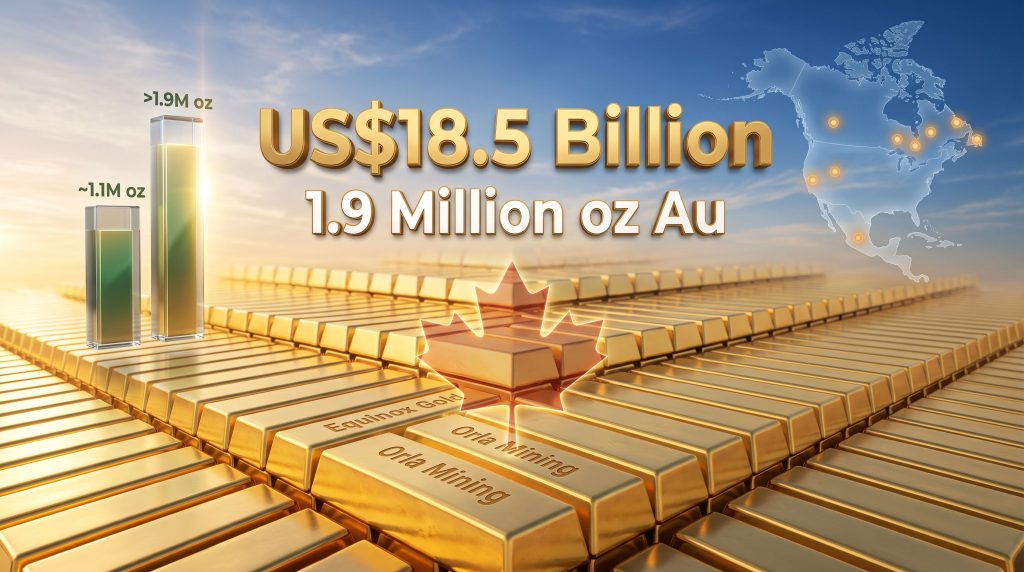
| Implied Combined Market Capitalisation | US$18.5 billion |
| Reported Transaction Value (deal basis) | US$5.1 billion |
| Exchange Ratio | 1.00 Equinox share + US$0.0001 cash per Orla share |
| Equinox Shareholder Ownership Post-Close | ~67% (fully diluted) |
| Orla Shareholder Ownership Post-Close | ~33% (fully diluted) |
The US$5.1 billion figure represents the transaction value calculated at the time of deal announcement, reflecting Orla Mining's market capitalisation at that moment. The US$18.5 billion figure represents the implied combined market capitalisation of the merged entity, encompassing the full equity value of both companies at prevailing share prices. Both numbers are correct within their respective frames of reference, and conflating them misrepresents the economic reality of what was constructed.
Shareholder Conviction: Near-Unanimous Approval
On July 22, 2026, Orla Mining shareholders voted in favour of the arrangement with 99.91% of votes cast in support, a level of shareholder conviction that is exceptionally rare in Canadian gold sector M&A. Equinox shareholders approved the transaction on the same date, and the merger was formally completed on July 31, 2026 following court and regulatory clearances. Orla shareholders overwhelmingly approved the business combination, reinforcing the broad confidence in the deal's strategic merit.
A 99.91% approval rate is not simply a procedural formality. In the context of mining M&A, where shareholder activism, competing bids, and valuation disputes routinely fragment votes, this result signals an unusually unified view among Orla shareholders that the deal terms and strategic direction were compelling on their own merits.
The Six-Mine Production Platform: Geography and Grade
The combined company operates across six North American mines, each contributing differently to the overall production and risk profile:
- Greenstone Mine (Ontario, Canada) – flagship long-life asset forming part of the Canadian production core
- Valentine Mine (Newfoundland and Labrador, Canada) – significant contributor with Phase 2 expansion potential
- Musselwhite Mine (Ontario, Canada) – formerly an Orla Mining asset, now integrated into the combined portfolio
- Castle Mountain (United States) – US-based operation within the growth pipeline
- South Railroad (United States) – development-stage project targeting future US production growth
- Los Filos and Camino Rojo Underground (Mexico) – Latin American exposure providing geographic diversification
Canada as the Production Backbone
The strategic weighting toward Canada is not incidental. With more than 60% of combined production sourced from three long-life Canadian operations, the merged entity has deliberately prioritised jurisdictional stability as a core valuation driver. Canada's established regulatory frameworks, strong rule of law, and deep capital markets familiarity make it a preferred domicile for institutional gold investment.
Equinox Gold's Canadian operations alone are projected to contribute approximately 685,000 ounces in 2026, drawn from the Greenstone, Valentine, and Musselwhite mines. This figure represents a meaningful production base in isolation, let alone as one component of a broader six-mine system.
Production Trajectory: Near-Term Reality vs. Long-Term Potential
| Production Milestone | Projected Output |
|---|---|
| Near-Term Annual Production (combined) | ~1.1 million oz Au/year |
| Long-Term Production Potential (full development) | >1.9 million oz Au/year |
| Canadian Contribution Estimate (2026) | ~685,000 oz Au |
The pathway from 1.1 million ounces to the long-term target exceeding 1.9 million ounces is contingent on the successful advancement of several growth catalysts, including the Valentine Phase 2 expansion, the South Railroad project in Nevada, and the Camino Rojo underground development in Mexico. Each of these projects carries its own permitting, capital, and execution timeline, meaning the 1.9 million ounce figure is a development horizon rather than a near-term production commitment.
Strategic Logic: Why Scale Changes the Investment Equation
The Institutional Capital Threshold
One of the least-discussed but most consequential aspects of gold producer consolidation is the role of index mechanics and institutional mandate criteria. Many large asset managers operate under mandates that exclude companies below specific market capitalisation thresholds. By crossing into senior producer territory with a combined implied market capitalisation of US$18.5 billion, the merged entity becomes eligible for consideration by a materially larger pool of institutional capital.
This is not speculation. It is a structural feature of how capital markets allocate resources to the mining sector, and it partially explains why the same assets can trade at higher multiples inside a larger company than they would as standalone mid-tier producers. Furthermore, the gold price impact on equities at the senior producer level is amplified precisely because these companies attract more liquid, diversified shareholder bases.
Jurisdictional Premium: What Investors Pay for Stability
The deliberate concentration of production in Canada reflects a broader market dynamic that experienced mining investors price into their models: jurisdictional risk premium. Operations in stable, mining-friendly jurisdictions with transparent permitting processes, established royalty frameworks, and low political risk trade at better valuation multiples than equivalent assets in higher-risk geographies.
The combined company's Canadian-heavy production weighting is not merely an operational reality. It functions as a valuation mechanism, effectively embedding a jurisdictional quality premium into the combined enterprise value that the market has historically rewarded in comparable senior producer structures.
Pre- and Post-Merger Competitive Positioning
| Category | Pre-Merger (Equinox Gold) | Post-Merger (Combined Entity) |
|---|---|---|
| Annual Production | Sub-1 million oz | ~1.1 million oz |
| Market Capitalisation | Mid-tier | ~US$18.5 billion (senior tier) |
| Operating Mines | Limited North American base | 6 North American mines |
| Development Pipeline | Moderate | Multi-country expansion pipeline |
| Institutional Eligibility | Constrained by scale | Expanded mandate access |
Leadership Architecture: Transition by Design
The leadership structure emerging from the Equinox Gold and Orla Mining merger is not simply a matter of personnel change. It represents a deliberate generational shift that aligns governance with the company's next operational phase.
The Outgoing Leadership Layer
- Ross Beaty founded Equinox Gold in 2017 and built it from a blank-cheque concept into a meaningful North American gold producer over eight years. His transition to Special Advisor to the Board preserves access to his network and strategic judgment without creating governance ambiguity during the integration period.
- Darren Hall served as CEO through the construction and commissioning phase of several key assets. His retirement on October 31, 2026 follows a structured three-month handover designed to preserve institutional knowledge.
The Incoming Leadership Layer
- Chuck Jeannes assumes the Chairman role, bringing with him a track record in senior gold sector leadership that spans multiple market cycles. His appointment signals a governance posture oriented toward operational discipline and shareholder returns rather than greenfield exploration.
- Jason Simpson, previously associated with Orla Mining, steps into the CEO role following the transition period. His background with Orla is particularly relevant given that the integration of Musselwhite and other Orla assets into the combined operating framework will define much of the company's near-term execution risk.
The three-month overlap between outgoing and incoming CEOs is a structured governance mechanism that is more deliberate than it might appear. In mining, where operational continuity at the asset level depends heavily on relationship management with contractors, regulators, and local communities, the knowledge transfer that occurs during a CEO transition period can have material consequences for project timelines and cost outcomes.
Key Risks Facing the Combined Entity
Multi-Jurisdictional Complexity
Operating across Canada, the United States, and Mexico introduces three distinct regulatory environments that must be managed simultaneously. Canadian provincial mining regulations vary significantly between Ontario and Newfoundland. US federal and state-level permitting requirements, particularly in Nevada, carry their own timelines. Mexico's mining policy landscape has been subject to ongoing revision, introducing a layer of uncertainty for assets like Los Filos and Camino Rojo.
Capital Allocation Sequencing
With six producing or development-stage assets competing for capital, the management team faces genuine trade-offs in prioritisation. The growth from 1.1 million to 1.9 million ounces requires advancing multiple projects simultaneously or sequentially, each with significant capital requirements. Decisions about which projects receive funding first will have long-term consequences for production growth timing and return profiles.
Integration Execution Risk
Merging two corporate cultures, two operational management teams, and two sets of contractor relationships under a single framework is operationally complex. The mining sector has a documented history of post-merger integration challenges, including cost overruns, management departures, and operational disruptions at the asset level. The structured leadership transition partially mitigates this risk, but it does not eliminate it.
The next major ASX story will hit our subscribers first
What This Means for North American Gold M&A
The completion of the Equinox Gold and Orla Mining merger adds meaningful weight to the consolidation trend reshaping the North American gold sector. As mid-tier producers face increasing pressure to either grow through acquisition or accept valuation discounts relative to senior peers, deal activity is likely to remain elevated through the remainder of 2026 and into the following year. The broader gold market outlook suggests that conditions supporting this consolidation wave are unlikely to ease in the near term.
For investors, the implications extend beyond this specific transaction. The premium that markets attach to jurisdictional quality, production scale, and institutional eligibility is becoming increasingly visible in how gold producers are valued relative to their underlying asset quality. Companies that can achieve senior producer status through consolidation are likely to attract sustained re-rating interest, provided that integration execution meets expectations. However, those considering exposure to smaller operators should carefully weigh the junior mining risks and rewards before positioning accordingly.
Disclaimer: This article contains forward-looking statements and projections regarding production targets, development timelines, and market capitalisation figures. These projections are subject to material risks and uncertainties including commodity price fluctuations, permitting delays, capital availability, and operational execution. Readers should not interpret any information in this article as financial or investment advice. Past performance and announced targets are not guarantees of future outcomes.
Frequently Asked Questions: Equinox Gold and Orla Mining Merger
When Did the Equinox Gold and Orla Mining Merger Complete?
The merger was finalised on July 31, 2026, following court and regulatory approvals obtained after both shareholder bases approved the arrangement on July 22, 2026. According to the official merger announcement, the combined entity is specifically designed to grow and endure across multiple market cycles.
What Is the Combined Company Called After the Merger?
The merged entity retains the Equinox Gold name and continues trading under its existing market identity.
How Many Ounces of Gold Will the Combined Company Produce?
The combined company is projected to produce approximately 1.1 million ounces of gold per year in the near term, with a long-term development pathway targeting more than 1.9 million ounces annually as pipeline projects advance toward full production.
What Share Exchange Ratio Did Orla Mining Shareholders Receive?
Each Orla Mining shareholder received one Equinox Gold share plus a nominal US$0.0001 cash payment per Orla share held, structured to minimise tax friction while preserving balance sheet efficiency.
Who Is the New CEO of Equinox Gold Following the Merger?
Jason Simpson, who previously held a senior role at Orla Mining, is assuming the CEO position following a structured transition period. Outgoing CEO Darren Hall is retiring on October 31, 2026.
What Percentage of Production Comes From Canadian Mines?
More than 60% of the combined company's gold production is sourced from three long-life Canadian operations: Greenstone in Ontario, Valentine in Newfoundland and Labrador, and Musselwhite in Ontario, with a combined estimated output of approximately 685,000 ounces in 2026.
Want to Identify the Next Major Gold Discovery Before the Market Does?
While senior producer mergers like Equinox Gold and Orla Mining reshape the upper tiers of the gold sector, the most asymmetric returns in gold investing have historically come from being early — and Discovery Alert's proprietary Discovery IQ model delivers real-time ASX mineral discovery alerts straight to subscribers, turning complex geological announcements into actionable opportunities the moment they hit the exchange. Explore historic discovery returns on Discovery Alert's dedicated discoveries page and begin a 14-day free trial to position ahead of the broader market.