July 21, 2026
The Economics of Ore: Why African Nations Are Demanding More From Their Minerals
For much of the twentieth century, the global mining industry operated on a straightforward premise: resource-rich developing nations dug up raw materials, shipped them abroad, and watched the majority of economic value get captured by downstream processors in industrialised economies. That model is now being aggressively dismantled across Sub-Saharan Africa, and nowhere is this shift more visible than in Gabon's evolving relationship with its most important asset: manganese.
The Eramet Gabon manganese ore processing MOU, signed in July 2026, is more than a bilateral industrial agreement. It represents a formal commitment to reshape an entire commodity value chain from within the country that produces the raw material, and it carries implications that extend far beyond Gabon's borders.
When big ASX news breaks, our subscribers know first
Gabon's Manganese Endowment: Understanding the Foundation
Before examining the agreement itself, it is worth understanding exactly what Gabon brings to this negotiation. The country is home to the Moanda deposit in the southeast, widely regarded as one of the largest and highest-grade manganese ore bodies on the planet. Manganese ore grades are typically measured by their percentage of manganese content, and high-grade ore is generally considered anything above 44% Mn. The Moanda deposit consistently yields ore in that high-grade bracket, which is a geological advantage that substantially reduces the energy and processing costs required to upgrade ore into finished alloys.
Globally, Gabon ranks among the top manganese ore producers, consistently accounting for a meaningful share of world seaborne supply. South Africa and Australia are the other major producing nations, but Gabon's ore quality and its strategic position as the sole major producer in Central Africa gives it a distinct profile within the global manganese supply hierarchy.
Manganese itself occupies a unique position in the critical minerals conversation. It is indispensable to steel manufacturing, where it is consumed in large volumes as ferromanganese and silicomanganese alloys to improve tensile strength and remove impurities during the steelmaking process. Simultaneously, it is gaining traction in battery chemistry, with lithium-manganese-oxide and certain NMC formulations used in electric vehicle batteries requiring high-purity manganese inputs. This connects directly to the broader battery storage expansion driving demand across multiple critical mineral categories, creating a second demand vector that did not meaningfully exist a decade ago.
What the Eramet Gabon MOU Actually Commits To
The agreement was signed in Paris by Eramet, its Gabonese subsidiary Comilog, and representatives of the Gabonese government, with both French and Gabonese heads of state present. The diplomatic setting is notable because it signals the degree to which this arrangement carries bilateral strategic weight beyond a standard commercial negotiation.
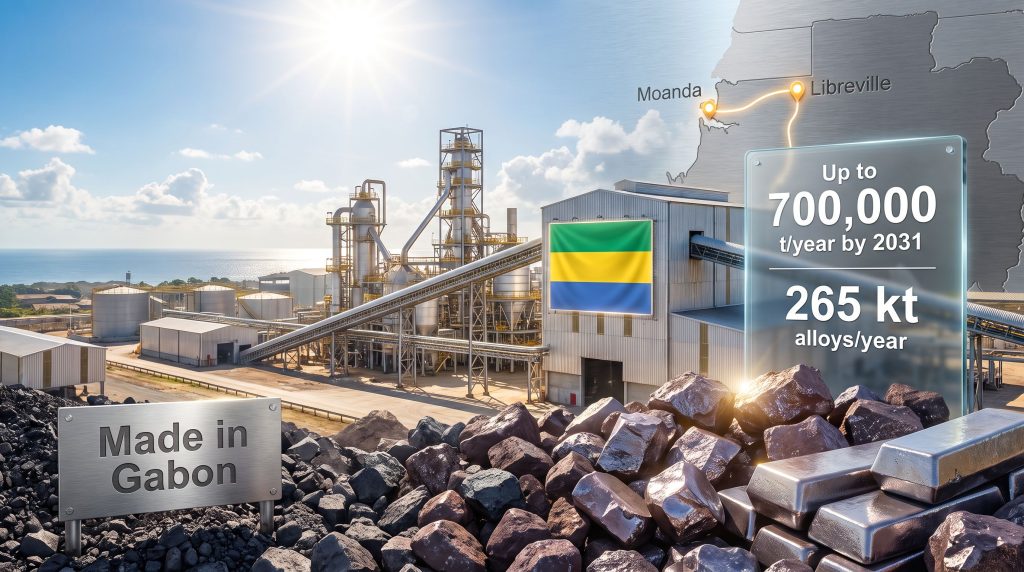
The core target of the Eramet Gabon manganese ore processing MOU is the processing of up to 700,000 tonnes of manganese ore per year within Gabon by the end of 2031. Three distinct industrial scenarios are under evaluation to reach that figure:
| Scenario | Facility Type | Projected Capacity | Target Timeline |
|---|---|---|---|
| Scenario 1 | Manganese oxide plant (Libreville) | Near-term pilot phase | |
| Scenario 2 | Upgrade of Moanda Metallurgical Complex (CMM) | Profitability-focused restructure | Mid-term |
| Scenario 3 | New coastal manganese alloy plant | 265 kt alloys/year (~530 kt ore input) | Operational by 2031 |
Each scenario addresses a different tier of the manganese processing ladder. The oxide plant targets electrolytic manganese dioxide and chemical manganese dioxide grades relevant to battery and chemical applications. The CMM upgrade reflects the practical reality that existing infrastructure requires modernisation before it can operate competitively. The coastal alloy plant is the most transformative proposal: a 265,000-tonne-per-year ferromanganese and silicomanganese alloy facility, sited near the coast to reduce export logistics costs and access industrial energy infrastructure.
The coastal siting decision deserves particular attention. Inland processing in Gabon faces a genuine constraint: the Transgabonais railway that connects Moanda to the coast at Owendo is the primary bulk transport corridor, and any significant expansion of processing volumes requires either upgrading that rail link or building processing capacity closer to port infrastructure. A coastal facility sidesteps part of that constraint.
The 2029 Export Ban: A Structural Deadline That Cannot Be Ignored
The MOU does not exist in a policy vacuum. Gabon has announced a prohibition on unrefined manganese ore exports, set to take effect in 2029. This regulatory deadline transforms what might otherwise be a voluntary commitment into an operational imperative for Eramet and Comilog.
The precedent for this type of resource nationalism is well established. Indonesia's ban on unprocessed nickel ore exports, introduced progressively between 2014 and 2020, forced a rapid build-out of domestic nickel smelting capacity and fundamentally altered global nickel supply chains. Gabon appears to be pursuing a structurally similar strategy, using regulatory pressure to accelerate the domestic value chain that purely market-based incentives had failed to deliver. Furthermore, critical minerals demand in 2025 and beyond is only reinforcing the logic behind such resource policies as energy transition accelerates globally.
The Gabonese government holds a 29% equity stake in Comilog, giving it a direct financial interest in the operational and financial outcomes of any processing expansion. This ownership structure is not incidental: it gives the state both a governance lever and a commercial incentive to ensure that processing commitments translate into operational reality rather than remaining on paper.
There are also reports of the Gabonese state pursuing a broader ownership position in Eramet's parent structure, a development that would further deepen sovereign influence over strategic processing decisions. If that stake materialises, the governance dynamic shifts considerably, with the state potentially holding influence at both the subsidiary and parent-company levels simultaneously.
Three Processing Pathways, One Strategic Direction
The Manganese Oxide Route
Scenario 1, the Libreville oxide plant, targets relatively modest throughput but serves a strategically important purpose. Electrolytic manganese dioxide (EMD) and chemical manganese dioxide (CMD) are battery-grade products that command significant price premiums over raw ore. At approximately 20,000 tonnes of ore input per year, the facility's direct contribution to the 700 kt target is limited, but it establishes Gabon's credentials in the battery materials supply chain and creates a foundation for future capacity expansion in higher-purity manganese processing.
Revitalising the Moanda Metallurgical Complex
The existing Moanda Metallurgical Complex has historically struggled with profitability, a reflection of both energy costs and the economics of processing at a facility that has not been substantially upgraded in decades. Scenario 2 focuses on restructuring this facility around a commercial viability framework rather than simply maintaining legacy capacity. The significance of this scenario lies not in its headline numbers but in what a successfully restructured CMM would signal about Gabon's ability to operate a competitive processing industry on an ongoing basis.
The Coastal Alloy Plant: The Transformative Scenario
The 265 kt/year coastal alloy plant is the most consequential element of the entire framework. To contextualise that scale: global ferromanganese and silicomanganese production is currently heavily concentrated in China and South Africa. A new 265 kt/year operation in Gabon would represent a meaningful addition to non-Chinese alloy supply, which is a dimension of particular strategic relevance to European steelmakers seeking to diversify away from single-geography dependencies. Indeed, this mirrors the goals of steel decarbonisation collaboration initiatives emerging globally as the industry responds to emissions pressures.
The capital expenditure requirements for a greenfield facility of this scale are substantial. Industry benchmarks for manganese alloy smelter construction suggest costs in the range of several hundred million dollars depending on energy infrastructure, environmental compliance requirements, and local content mandates. The financing structure for this facility has not been publicly detailed as part of the MOU, which remains one of the key execution uncertainties.
Economic Dimensions: Jobs, Seeds, and Biochar
The MOU extends beyond pure industrial output into economic development and environmental sustainability commitments.
The Made in Gabon Seed Fund
Embedded within the agreement is the launch of a seed fund operating under the Made in Gabon banner, targeting the creation of 3,000 industrial sector jobs. In the context of Gabon's economy, where the extractive sector has historically generated significant export revenues without creating proportional domestic employment, this employment target carries political and social weight beyond its headline figure.
The multiplier dynamics of industrial job creation in resource-adjacent sectors are well documented. Each direct industrial job in a processing facility typically supports two to four indirect jobs in logistics, maintenance, services, and supply chain functions. Consequently, if the 3,000 direct job target is achieved, the total employment impact across the broader economy could be materially higher.
Biochar: The Sustainability Layer
The commitment to developing a local biochar production sector is a detail that deserves more analytical attention than it typically receives in news coverage of the MOU. Biochar is a carbon-rich material produced from organic matter through pyrolysis, and in the context of manganese smelting, it has a specific technical relevance: it can substitute for metallurgical coke as a reductant in the smelting process, reducing both fossil fuel consumption and net carbon emissions.
Gabon is one of Africa's most heavily forested nations, with forest cover representing a globally significant carbon sink. The country has actively pursued carbon credit revenues in international markets, and a domestic biochar sector would align with that positioning by demonstrating active management of biomass resources for industrial decarbonisation purposes. For Eramet, which as a publicly listed European company faces increasing ESG disclosure obligations, the biochar commitment provides a tangible element of its environmental credibility in Gabon.
| Economic Variable | Conservative Estimate | Optimistic Estimate |
|---|---|---|
| Direct industrial jobs created | 1,500 to 2,000 | 3,000+ |
| Annual ore processed by 2031 | 400 to 500 kt | Up to 700 kt |
| Value-added uplift per tonne (ore vs. alloy) | 2x to 3x | 4x to 5x |
| Manganese alloy export revenue potential | Moderate uplift | Significant GDP contribution |
Estimates are illustrative projections based on published capacity targets and industry benchmarks. Actual outcomes are subject to project execution, capital availability, and prevailing market conditions.
The next major ASX story will hit our subscribers first
Manganese's Dual Role in Steel and Batteries
A less commonly appreciated dimension of the Eramet Gabon manganese ore processing MOU is the way it positions Gabon at the intersection of two distinct demand cycles for manganese.
| Application | Manganese Form Required | Relevance to MOU |
|---|---|---|
| Steel manufacturing | Ferromanganese / Silicomanganese alloys | Directly targeted by Scenario 3 coastal alloy plant |
| Electric vehicle batteries (LMO/NMC) | High-purity manganese sulphate | Potential future extension via Scenario 1 oxide plant |
| Chemical and industrial uses | EMD / CMD grades | Addressed by Libreville oxide facility |
The battery chemistry dimension is speculative in terms of the MOU's immediate scope, but it represents a logical extension pathway. High-purity manganese sulphate, the form required for battery cathode production, involves additional refining steps beyond what a standard oxide plant produces. However, establishing an oxide plant creates the technical foundation and operational expertise from which higher-purity processing could be developed, particularly as demand from battery manufacturers intensifies over the coming decade.
Execution Risk: The Gap Between Commitment and Delivery
Historical analysis of African mining MOUs reveals a pattern worth acknowledging candidly: formal agreements between host governments and mining majors frequently fail to translate into operational outcomes on the timelines originally committed to. Infrastructure constraints, financing gaps, political transitions, and commodity price cycles all act as friction forces between intention and execution.
For this MOU, the key risk vectors include:
- Energy infrastructure: Manganese smelting is an energy-intensive process. Gabon's domestic power generation capacity and grid reliability will be critical determinants of whether a coastal alloy plant can operate competitively against established producers.
- Capital requirements: The financing of a 265 kt/year greenfield smelter requires substantial upfront capital that may require co-investment from development finance institutions or offtake-backed commercial lending.
- Political continuity: Gabon experienced a political transition in 2023, and while the current administration has affirmed the country's commitment to industrial development, any further political uncertainty could affect investor confidence in long-dated infrastructure commitments.
- Commodity price sensitivity: Manganese alloy margins are cyclical. A sustained period of weak alloy prices between now and 2031 could alter the economics of the coastal plant sufficiently to delay or downscale the facility.
Five years from MOU signing to a fully operational 265 kt/year alloy plant represents an ambitious but not unrealistic timeline, provided that engineering studies, permitting, financing, and construction proceed in parallel rather than sequentially. The appointment of a dedicated director of value chain transformation within the Eramet-Comilog organisational structure suggests that the company is treating execution as a genuine priority rather than a long-term aspiration.
Africa's Critical Minerals Industrialisation: Where Gabon Fits
The Eramet Gabon manganese ore processing MOU should be understood within the broader continental shift toward processing-led industrialisation that is reshaping African resource policy. The Democratic Republic of Congo has pursued domestic cobalt and copper processing requirements. Zimbabwe has enacted legislation to restrict raw lithium exports and incentivise in-country conversion. Tanzania, Namibia, and Zambia have each introduced varying forms of beneficiation requirements across their respective mineral portfolios.
In addition, the African Continental Free Trade Area provides a structural incentive layer for this shift: as intra-African trade barriers reduce, domestically processed minerals gain preferential access to a consumer base of over 1.4 billion people, creating economic logic for processing investment that extends beyond export revenues alone.
For global manganese supply chains, the more immediate implication is the potential emergence of Gabon as a meaningful source of processed manganese alloys outside the China-South Africa duopoly that currently defines the market. This shift is comparable in strategic logic to developments seen elsewhere, such as the Butcherbird manganese expansion in Australia and the development of a strategic manganese deposit in Europe, both of which reflect the same global imperative to diversify manganese supply chains. European steelmakers in particular have expressed sustained interest in diversifying their alloy procurement geography, and a Gabonese coastal smelter with direct Atlantic shipping access would be geographically well positioned to serve that demand. For further context on Gabon's historical position in the manganese sector, Comilog's role in the region illustrates how deeply embedded the mining operation is within the national economy.
Key Takeaways for Investors and Industry Observers
- The Eramet Gabon manganese ore processing MOU formalises a 700,000-tonne-per-year processing ambition underpinned by Gabon's 2029 raw ore export ban, creating both regulatory urgency and commercial incentive.
- Three processing scenarios are under evaluation simultaneously, with the transformative element being a 265 kt/year coastal alloy plant targeting 2031 commissioning.
- The agreement includes employment creation through the Made in Gabon seed fund targeting 3,000 industrial jobs and a biochar commitment that adds environmental credibility to the overall framework.
- Execution risk is material: capital requirements, energy availability, and political continuity are the three most significant variables determining whether the 2031 targets are achieved.
- Strategically, the agreement positions Gabon as a potential new source of non-Chinese manganese alloy supply at a time when global supply chain diversification is a priority for steel and battery manufacturers in Europe and beyond.
This article contains forward-looking projections and scenario-based analysis. Readers should exercise independent judgement when assessing the likelihood of stated targets being achieved. Nothing in this article constitutes financial or investment advice.
Want to Stay Ahead of the Next Major Mineral Discovery on the ASX?
Discovery Alert's proprietary Discovery IQ model delivers real-time alerts on significant ASX mineral discoveries across manganese and 30+ other commodities, instantly transforming complex data into actionable investment insights — explore historic discoveries and their returns to understand the potential scale of opportunity, then begin your 14-day free trial at Discovery Alert to position yourself ahead of the broader market.